English Cocker Spaniel vs French Spaniel: Which Suits Your Home?
Quick answer
Cocker or French Spaniel, what's the real difference?
Mainly size and exercise need. The French Spaniel is significantly bigger and wants more daily activity; the Cocker is smaller, fits apartments better, and is the gentler choice for a first-time owner. Cost and family-friendliness are close either way.
English Cocker Spaniel or French Spaniel? On paper they differ most on apartment suitability, and on the scales French Spaniel is the heavier at 45–60 lbs. Here is how the two compare on everything that shapes an ordinary week.
This is for someone already down to English Cocker Spaniel and French Spaniel and deciding between them. For this pair the decision usually turns on apartment suitability, so those are covered first and in most detail. Anyone choosing from a flat has a clear answer here: English Cocker Spaniel rates 4/5 against 2/5. The focus throughout is on daily consequences rather than breed background.
Quick verdict
Between English Cocker Spaniel and French Spaniel, apartment suitability is what separates them, and English Cocker Spaniel is the lower-effort dog of the two to keep.
Choose english cocker spaniel if...
Choose English Cocker Spaniel if you are in a flat or a smaller home, this is your first dog and your walking routine is modest.
Choose french spaniel if...
Choose French Spaniel if you do not want a standing grooming appointment and you want a dog that can keep up with an active routine.
Head-to-head comparison
Feature
english cocker spaniel
french spaniel
Winner
Size class
medium
medium
Equal
Weight
26–34 lbs
45–60 lbs
Equal
Height
15–17 in
21–24 in
Equal
Lifespan
12–14 years
10–12 years
english cocker spaniel
Exercise need
High (4/5)
Very high (5/5)
english cocker spaniel
Grooming need
High (4/5)
Moderate (3/5)
french spaniel
Shedding
Moderate (3/5)
Moderate (3/5)
Equal
Energy level
High (4/5)
High (4/5)
Equal
Barking
Moderate (3/5)
Low (2/5)
french spaniel
Apartment suitability
High (4/5)
Low (2/5)
english cocker spaniel
Good for first-time owners
High (4/5)
Moderate (3/5)
english cocker spaniel
Tolerates being alone
Low (2/5)
Low (2/5)
Equal
Trainability
High (4/5)
High (4/5)
Equal
Good with kids
Very high (5/5)
High (4/5)
english cocker spaniel
Good with other dogs
High (4/5)
High (4/5)
Equal
Friendly to strangers
High (4/5)
High (4/5)
Equal
Cost level
Moderate (3/5)
Moderate (3/5)
Equal
Coat
Medium, silky and feathered
Medium, flat and feathered
Equal
Origin
Various
Various
Equal
Typical monthly cost
$100–$200
$100–$200
Equal
Typical first-year cost
$1,400–$2,900
$1,400–$2,900
Equal
Deep dive
Size and build
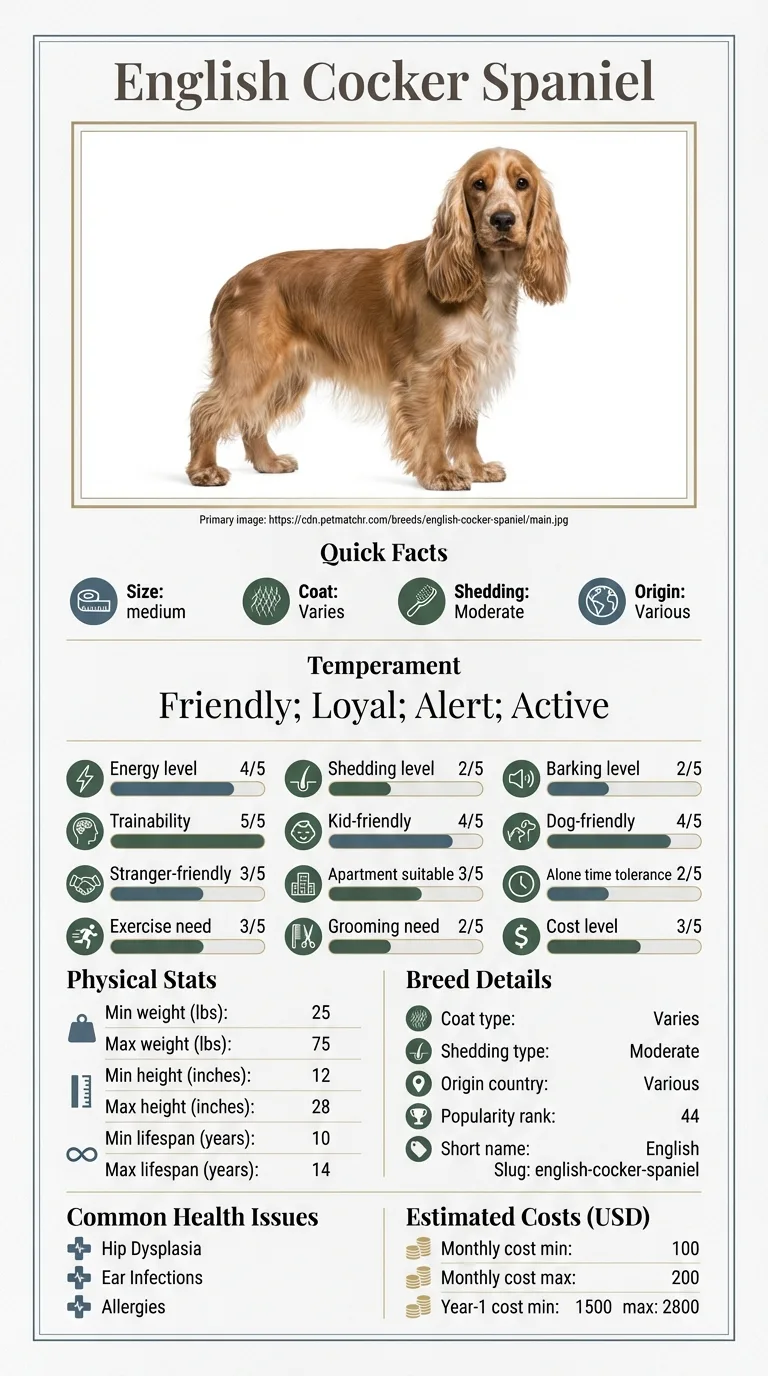
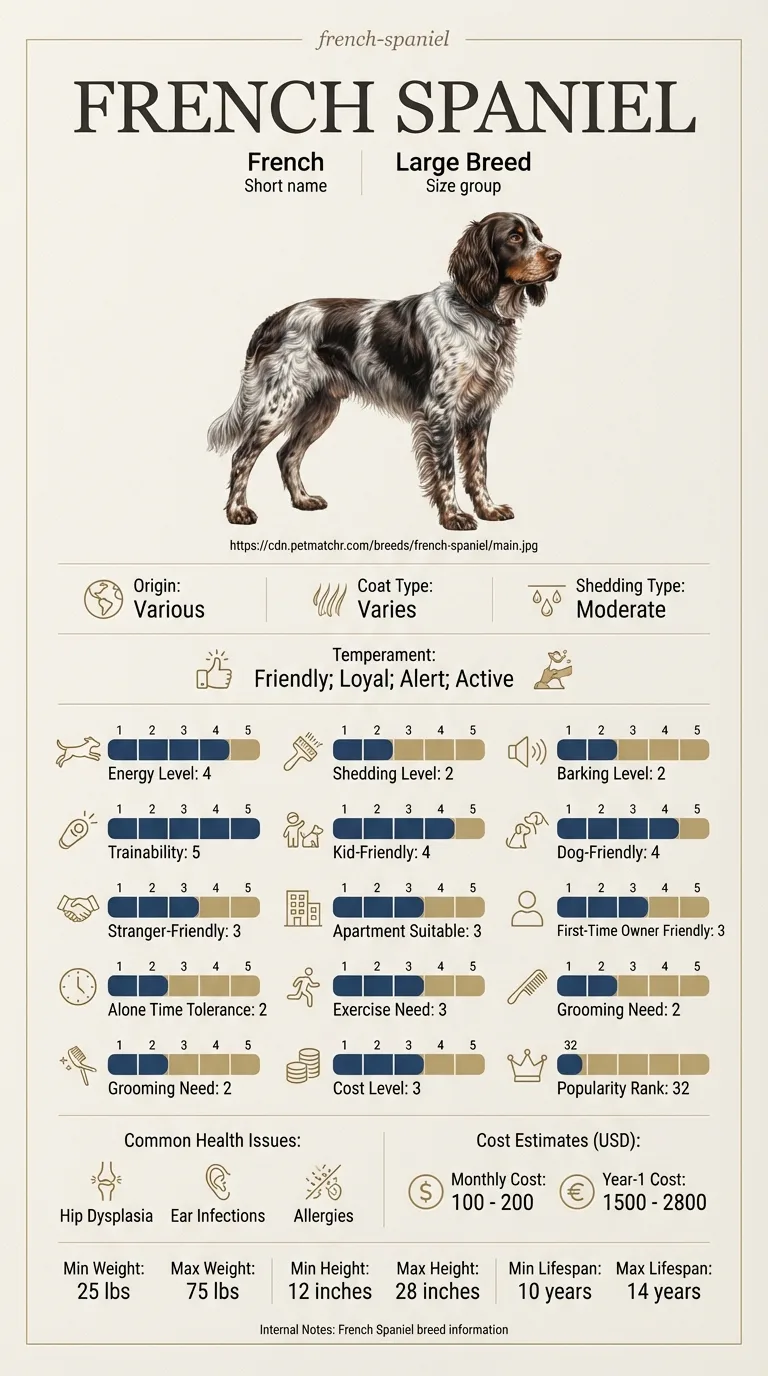
Despite sharing a medium size class, these two aren't the same size at all. The Cocker is the smaller of the pair at 26-34 lbs and 15-17 inches; the French Spaniel is considerably bigger at 45-60 lbs and 21-24 inches, closer to a pointer's frame than a spaniel's. Don't let the shared category fool you into expecting similar dogs.
Energy and exercise
The French Spaniel wants more from you, rated 5/5 on exercise need against the Cocker's 4/5, and its temperament profile of energetic outdoors, calm indoors suggests it channels that drive into structured activity rather than restless pacing. Both are gun-dog stock, so neither is a low-key pet.
Grooming and shedding
The Cocker actually needs more grooming here, rated 4/5 against the French Spaniel's 3/5, despite the French Spaniel's larger, flat-and-feathered coat. Shedding ties at moderate (3/5) for both, so the difference comes down to brushing frequency rather than hair volume.
Apartment living, noise and time alone
The Cocker is the far better small-space dog, rated 4/5 for apartment suitability against the French Spaniel's 2/5, and it barks more too (3/5 versus 2/5), proof that noise and space-friendliness don't always move together. If square footage is limited, the numbers favor the Cocker clearly.
Training and owner experience
Trainability ties at 4/5 for both breeds, but the Cocker is the gentler choice for someone newer to dogs, rated 4/5 for first-time owners against the French Spaniel's 3/5. Neither dog should struggle to learn commands; the difference is more about day-to-day patience required.
Kids, other dogs and visitors
The Cocker rates slightly higher with kids (5/5 versus 4/5), while good-with-other-dogs and friendliness-to-strangers both tie at 4/5. This is a comparison where the family-fit numbers stay close across the board, with the Cocker holding a small, consistent edge.
Health and lifespan
The Cocker lives longer on average, 12-14 years against the French Spaniel's 10-12, and shares hip dysplasia and ear infections with it. The French Spaniel's list also includes epilepsy, eye conditions, and acral mutilation syndrome, a rare inherited condition causing self-mutilation of the paws due to reduced pain sensitivity, worth asking a breeder about directly if you're considering this breed.
Cost to keep
Cost is a dead heat: both rate 3/5, both run $100-200 monthly, and both land in the same $1,400-2,900 first-year range. Whatever tips this decision, it won't be the budget line.
English Cocker Spaniel vs French Spaniel at a glance
English Cocker Spaniel weighs 26–34 lbs and lives 12–14 years; French Spaniel weighs 45–60 lbs and lives 10–12 years. The two diverge most on apartment suitability. They are level on tolerates being alone, cost level and good with other dogs, so those cannot decide it. The table below marks a winner only where one breed is genuinely easier for a typical owner; size and origin are facts rather than merits and stay level. Ratings come from one source applied to both breeds, so they are meaningful against each other rather than as absolute scores.
English Cocker Spaniel vs French Spaniel: Which Suits Your Home? - English Cocker Spaniel vs French Spaniel at a glance
Frequently asked questions
Is the French Spaniel really the same size as the Cocker?
No, despite sharing a medium size class. The Cocker is 26-34 lbs and 15-17 inches; the French Spaniel is 45-60 lbs and 21-24 inches, noticeably larger.
Which needs more exercise?
The French Spaniel, rated 5/5 versus the Cocker's 4/5. It's described as energetic outdoors but calm indoors, so the drive is real but manageable once it's had its exercise.
Which fits an apartment better?
The Cocker, clearly, 4/5 for apartment suitability against the French Spaniel's 2/5.
What is acral mutilation syndrome, and should I worry about it?
It's a rare inherited condition, listed for the French Spaniel, that causes self-mutilation of the paws because of reduced pain sensitivity. It's uncommon but serious enough to ask a breeder about directly before buying.
Which is the better first dog?
The Cocker, rated 4/5 for first-time owners versus the French Spaniel's 3/5, though both share the same 4/5 trainability score.
How much does each cost to keep?
The same, both rate 3/5 on cost, both run $100-200 a month, and both fall in the $1,400-2,900 first-year range.
Which lives longer?
The Cocker, at 12-14 years versus the French Spaniel's 10-12.
Cocker or French Spaniel, what's the real difference?
Mainly size and exercise need. The French Spaniel is significantly bigger and wants more daily activity; the Cocker is smaller, fits apartments better, and is the gentler choice for a first-time owner. Cost and family-friendliness are close either way.
Costs
How much does each cost monthly?
Identical ranges, $100-200 for both breeds.
Living
Which needs more exercise?
The French Spaniel, at 5/5 versus the Cocker's 4/5.
Health
Which lives longer?
The Cocker, typically 12-14 years against the French Spaniel's 10-12.
French Spaniel breed guide – The same for French Spaniel, so the comparison can be checked against the detail.
English Cocker Spaniel vs Cocker Spaniel – Cocker Spaniel is the closest breed to English Cocker Spaniel on the measured axes, so it is the natural next comparison.
French Spaniel vs Welsh Springer Spaniel – Welsh Springer Spaniel sits closest to French Spaniel, which makes it the alternative worth ruling out.
Health information here is general and is not veterinary advice. If your dog shows pain, sudden behaviour change, or worsening symptoms, consult a licensed veterinarian.
Some links on this site are affiliate links. We may earn a commission at no extra cost to you, and we only suggest products we believe are helpful for dog owners.
We research and check what we publish, but we do not warrant that any figure, date, price, or statement is accurate, complete, or current, and we accept no liability for any loss, cost, injury, or other harm arising from the use of this site. Use it as one reference among several. You remain responsible for your own decisions and for your dog's care - confirm anything that matters with a licensed veterinarian or another qualified professional before you act on it. Full disclaimer.