Cocker Spaniel vs Collie (Rough Collie): Which Suits Your Home?
Quick answer
Which is the better overall choice?
Both are strong family dogs on this data -- the deciding factor is really space and budget. The collie needs more room and costs more to keep; the cocker fits smaller homes and tighter budgets just as well temperamentally.
Cocker Spaniel or Collie (Rough Collie)? On paper they differ most on apartment suitability, and on the scales Collie (Rough Collie) is the heavier at 50–75 lbs. Here is how the two compare on everything that shapes an ordinary week.
This is for someone already down to Cocker Spaniel and Collie (Rough Collie) and deciding between them. For this pair the decision usually turns on apartment suitability, so those are covered first and in most detail. Anyone choosing from a flat has a clear answer here: Cocker Spaniel rates 4/5 against 2/5. The focus throughout is on daily consequences rather than breed background.
Quick verdict
Between Cocker Spaniel and Collie (Rough Collie), apartment suitability is what separates them; neither is the lower-effort dog overall.
Choose cocker spaniel if...
Choose Cocker Spaniel if you are in a flat or a smaller home, shedding is a problem in your house and a smaller dog suits your car, your home or your back.
Choose collie if...
Choose Collie (Rough Collie) if you do not want a standing grooming appointment, the dog will be alone during the working day and you want a dog that picks up training quickly.
Head-to-head comparison
Feature
cocker spaniel
collie
Winner
Size class
small
large
Equal
Weight
20–30 lbs
50–75 lbs
Equal
Height
13–16 in
22–26 in
Equal
Lifespan
10–14 years
11–14 years
collie
Exercise need
Moderate (3/5)
Moderate (3/5)
Equal
Grooming need
Very high (5/5)
High (4/5)
collie
Shedding
Moderate (3/5)
High (4/5)
cocker spaniel
Energy level
Moderate (3/5)
Moderate (3/5)
Equal
Barking
Moderate (3/5)
Moderate (3/5)
Equal
Apartment suitability
High (4/5)
Low (2/5)
cocker spaniel
Good for first-time owners
High (4/5)
High (4/5)
Equal
Tolerates being alone
Low (2/5)
Moderate (3/5)
collie
Trainability
High (4/5)
Very high (5/5)
collie
Good with kids
Very high (5/5)
Very high (5/5)
Equal
Good with other dogs
High (4/5)
High (4/5)
Equal
Friendly to strangers
High (4/5)
High (4/5)
Equal
Cost level
Moderate (3/5)
Moderate (3/5)
Equal
Coat
Silky and feathered
Long double coat
Equal
Origin
Various
Scotland
Equal
Typical monthly cost
$80–$150
$100–$200
Equal
Typical first-year cost
$1,100–$2,300
$1,500–$2,800
Equal
Deep dive
Size and build
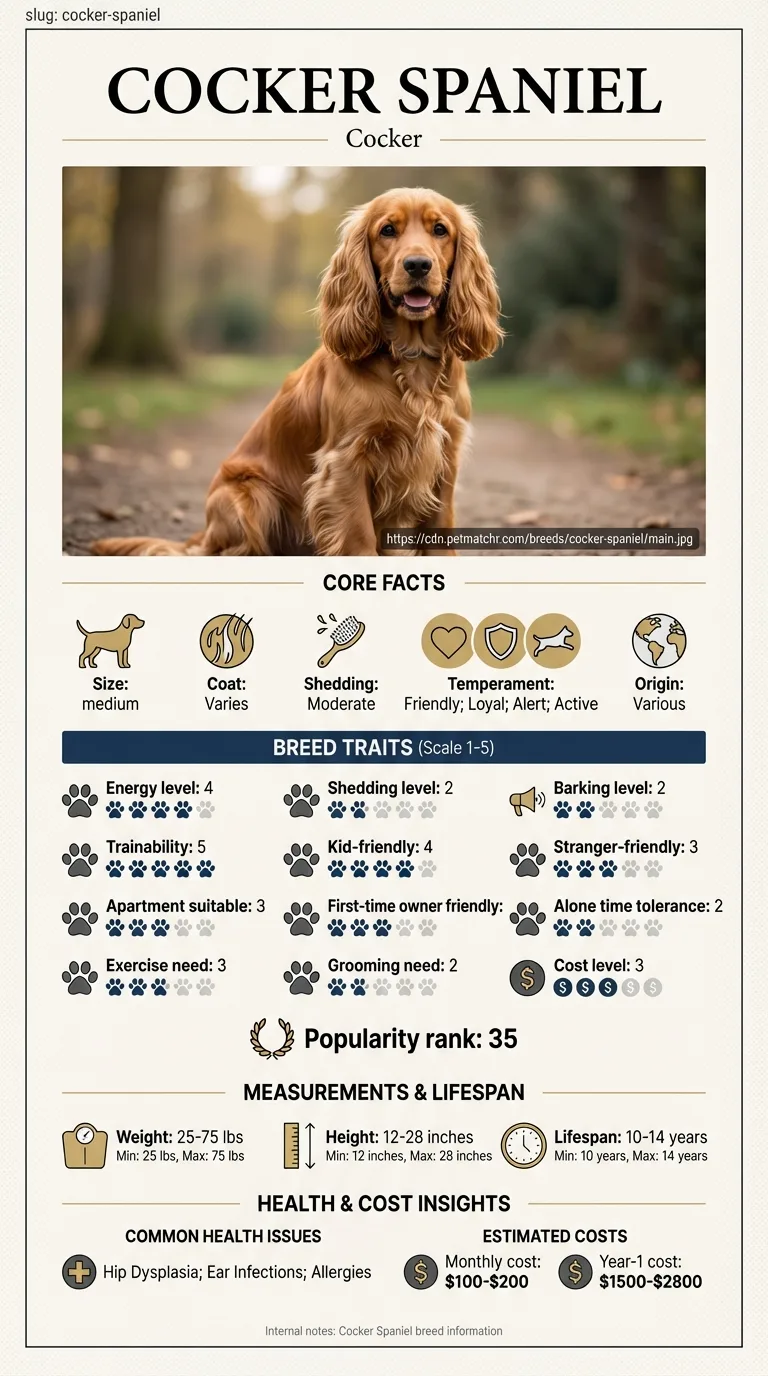
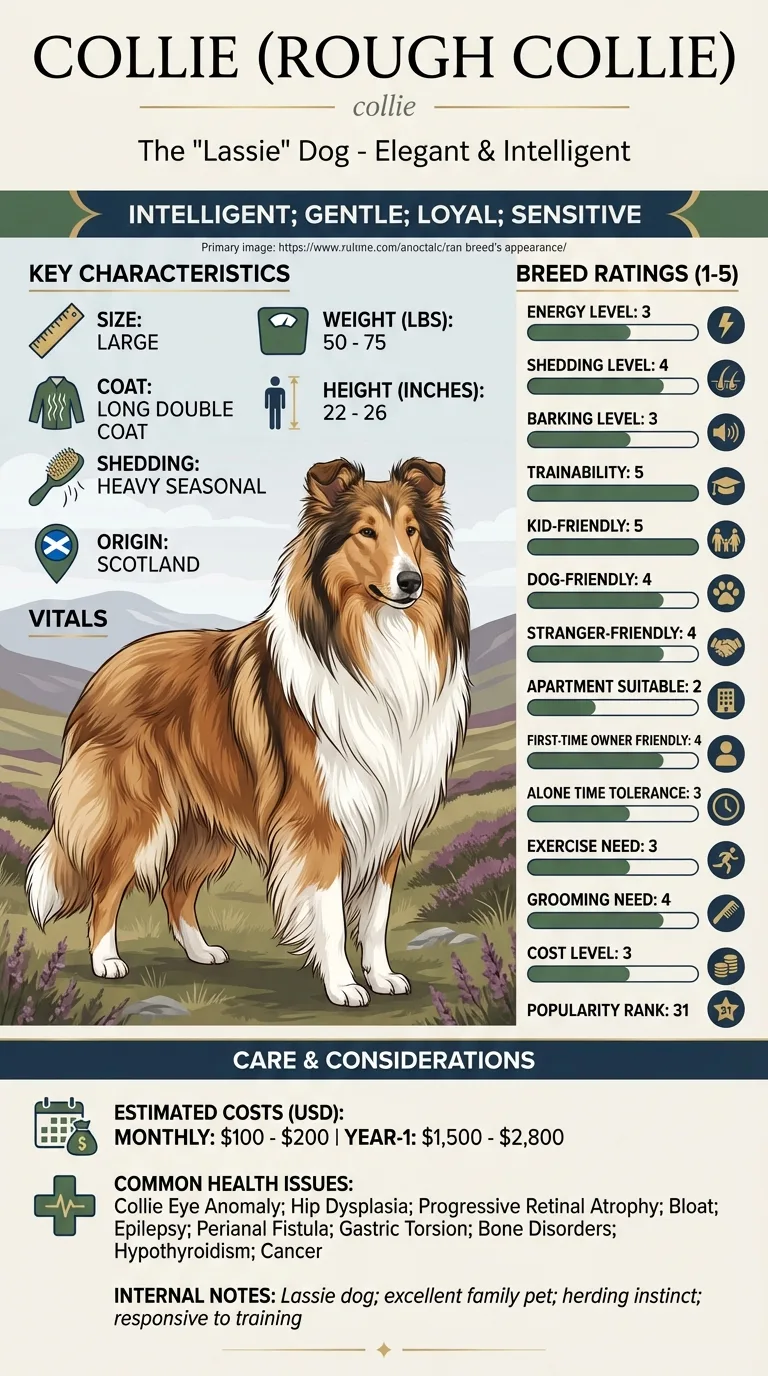
This is the clearest size mismatch in the pairing: cocker spaniel weighs 20-30 lbs and stands 13-16 in; collie weighs 50-75 lbs and stands 22-26 in. Size class makes it official -- small against large. Everything else about these two breeds reads surprisingly similar; this is the one row where they're not in the same conversation. Crate size, car space and even the size of the vet's exam table all follow from that one gap.
Energy and exercise
A clean tie: both rate moderate (3/5) on exercise need and moderate (3/5) on general energy level. Despite the size difference, neither breed demands the multi-hour daily commitment some working breeds do -- a couple of solid walks and some play cover both. That makes the exercise question a non-factor here; whichever breed you choose on other grounds, your daily routine won't need to change much.
Grooming and shedding
Cocker needs slightly more hands-on grooming, very high (5/5) against the collie's high (4/5), but sheds less, moderate (3/5) against the collie's high (4/5). That's a real trade: the cocker's silky, feathered coat mats if you skip brushing, while the collie's long double coat sheds more freely but is more forgiving between sessions. Both benefit from a slicker brush kept by the door rather than an occasional deep-clean session.
Apartment living, noise and time alone
Cocker rates high (4/5) for apartment living; collie rates low (2/5). Barking ties at moderate (3/5) for both, so the gap comes down to size and the collie's stronger pull toward space to move -- a large, historically working breed that doesn't compress into a studio apartment as comfortably as the smaller cocker does. Give a collie a proper yard and that low apartment score stops mattering much at all.
Training and owner experience
Both are strong picks for a first-time owner -- high (4/5) for both breeds on that score -- with the collie edging ahead on trainability, very high (5/5) against the cocker's already-solid high (4/5). Collies were bred to take direction from a handler at a distance; that instinct to respond makes obedience work come easier. The cocker isn't far behind, though, and either breed rewards a first-time owner who puts in the basic effort.
Kids, other dogs and visitors
About as tied as this comparison gets: both rate very high (5/5) with kids, high (4/5) with other dogs, and high (4/5) with strangers. The temperament data agrees too -- both lists include "gentle." If sociability is your deciding factor, this section won't move the needle; look at size and alone-tolerance instead, since those are where this pairing actually pulls apart.
Health and lifespan
Collie's lifespan (11-14 years) runs a touch longer and tighter than the cocker's 10-14 range. Both breeds share hip dysplasia and progressive retinal atrophy risk. Past that they diverge -- the collie's list is considerably longer, adding bloat, epilepsy, gastric torsion and cancer, while the cocker's shorter list adds ear infections and autoimmune hemolytic anemia. Routine ear checks are worth building into a cocker's grooming visits given how often that issue shows up.
Cost to keep
Cocker is the cheaper breed to keep in dollar terms -- monthly $80-150 against the collie's $100-200, first-year $1,100-2,300 against $1,500-2,800 -- even though both rate the same moderate (3/5) on the overall cost scale. The collie's larger size means more food and generally higher vet-visit costs even at a comparable care level, a difference that shows up steadily rather than all at once.
Cocker Spaniel vs Collie (Rough Collie) at a glance
Cocker Spaniel weighs 20–30 lbs and lives 10–14 years; Collie (Rough Collie) weighs 50–75 lbs and lives 11–14 years. The two diverge most on apartment suitability. They are level on barking, cost level and good with other dogs, so those cannot decide it. The table below marks a winner only where one breed is genuinely easier for a typical owner; size and origin are facts rather than merits and stay level. Ratings come from one source applied to both breeds, so they are meaningful against each other rather than as absolute scores.
Cocker Spaniel vs Collie (Rough Collie): Which Suits Your Home? - Cocker Spaniel vs Collie (Rough Collie) at a glance
Frequently asked questions
How different in size are the cocker spaniel and the collie?
Substantially -- cocker weighs 20-30 lbs and stands 13-16 in, collie weighs 50-75 lbs and stands 22-26 in. The collie can be more than twice the cocker's weight.
Which sheds more?
The collie, rated high (4/5) against the cocker's moderate (3/5) -- despite the cocker actually needing more hands-on grooming overall (very high, 5/5, versus the collie's high, 4/5).
Are both good for first-time owners?
Yes -- both rate high (4/5) for first-time owners, with the collie's trainability edging even higher (very high, 5/5, against the cocker's high, 4/5).
Which fits an apartment better?
The cocker spaniel, at high (4/5) apartment suitability against the collie's low (2/5). The collie's size is the main factor; barking rates the same moderate (3/5) for both.
How do monthly costs compare?
The cocker runs cheaper, $80-150 against the collie's $100-200, and the gap holds through the first year ($1,100-2,300 versus $1,500-2,800).
Do they share health risks?
Yes -- hip dysplasia and progressive retinal atrophy appear on both lists. The collie's overall list runs longer, adding bloat, epilepsy and cancer risk that don't appear on the cocker's sheet.
Which is better with kids and other pets?
Both, about equally -- very high (5/5) with kids and high (4/5) with other dogs and strangers, for each breed. This is one of the most socially matched pairings in the comparison set.
Both are strong family dogs on this data -- the deciding factor is really space and budget. The collie needs more room and costs more to keep; the cocker fits smaller homes and tighter budgets just as well temperamentally.
Costs
How do monthly costs compare?
Cocker runs $80-150, collie $100-200 -- a moderate gap tied mostly to size and food cost.
Living
How much exercise does each need?
Both are moderate (3/5) -- a tie. Neither breed needs marathon daily activity.
Health
Which lives longer?
Close either way -- the collie's range (11-14 years) is a touch tighter and higher-floored than the cocker's 10-14.
Related DogBreedCompass guides
Cocker Spaniel breed guide – Readers comparing the two usually want the full profile of Cocker Spaniel before deciding.
Cocker Spaniel vs English Cocker Spaniel – English Cocker Spaniel is the closest breed to Cocker Spaniel on the measured axes, so it is the natural next comparison.
Collie (Rough Collie) vs Golden Retriever – Golden Retriever sits closest to Collie (Rough Collie), which makes it the alternative worth ruling out.
What Cocker Spaniel costs to keep – Anyone weighing these two is usually also pricing them, and the cost pages carry city-level figures.
Collie (Rough Collie) health problems – The health pages set out what each breed is actually screened for.
Health information here is general and is not veterinary advice. If your dog shows pain, sudden behaviour change, or worsening symptoms, consult a licensed veterinarian.
Some links on this site are affiliate links. We may earn a commission at no extra cost to you, and we only suggest products we believe are helpful for dog owners.
We research and check what we publish, but we do not warrant that any figure, date, price, or statement is accurate, complete, or current, and we accept no liability for any loss, cost, injury, or other harm arising from the use of this site. Use it as one reference among several. You remain responsible for your own decisions and for your dog's care - confirm anything that matters with a licensed veterinarian or another qualified professional before you act on it. Full disclaimer.