Living
Which fits an apartment better?
Neither, really; both tie at 2/5 apartment suitability, though the Labradoodle barks less (2/5 versus 3/5).

Quick answer
Which fits an apartment better?
Neither, really; both tie at 2/5 apartment suitability, though the Labradoodle barks less (2/5 versus 3/5).
Collie (Rough Collie) or Labradoodle? On paper they differ most on exercise need, and on the scales Collie (Rough Collie) is the heavier at 50–75 lbs. Here is how the two compare on everything that shapes an ordinary week.
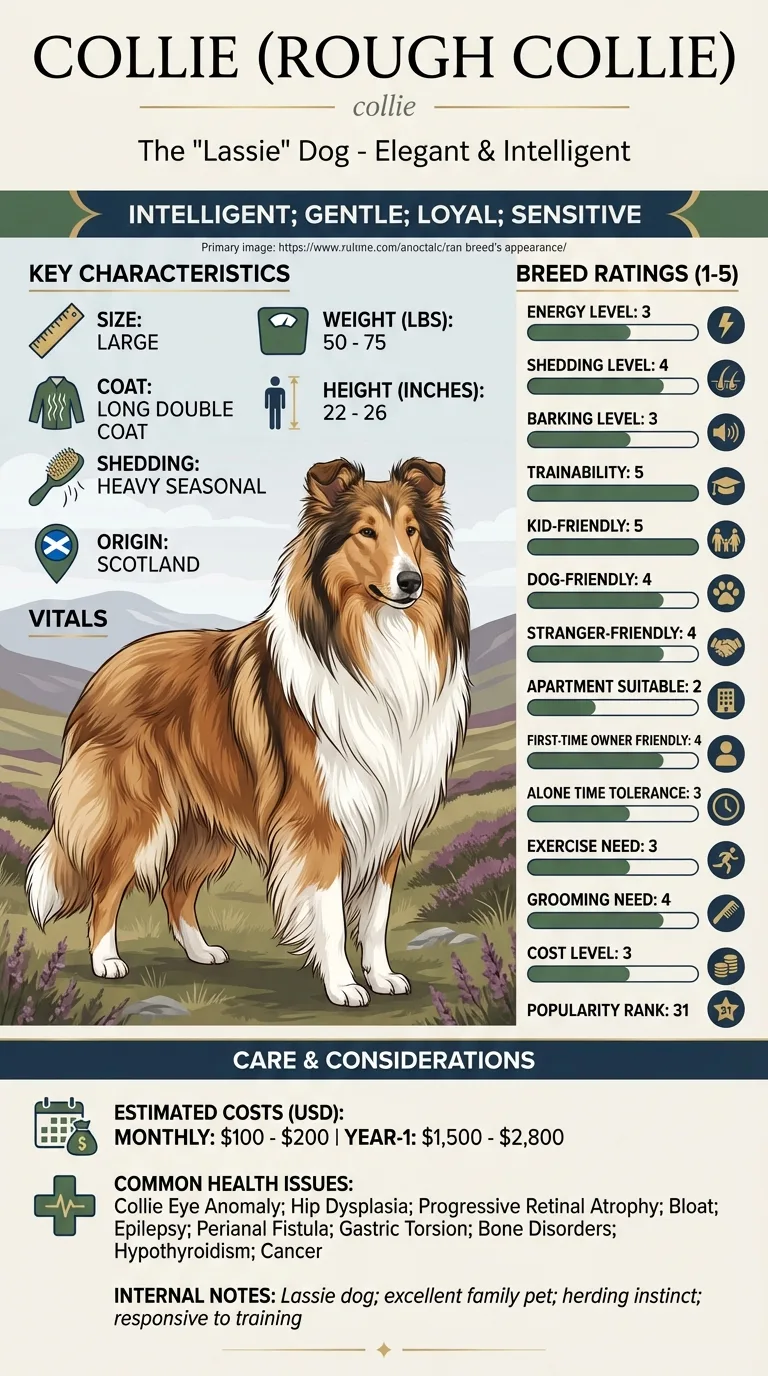
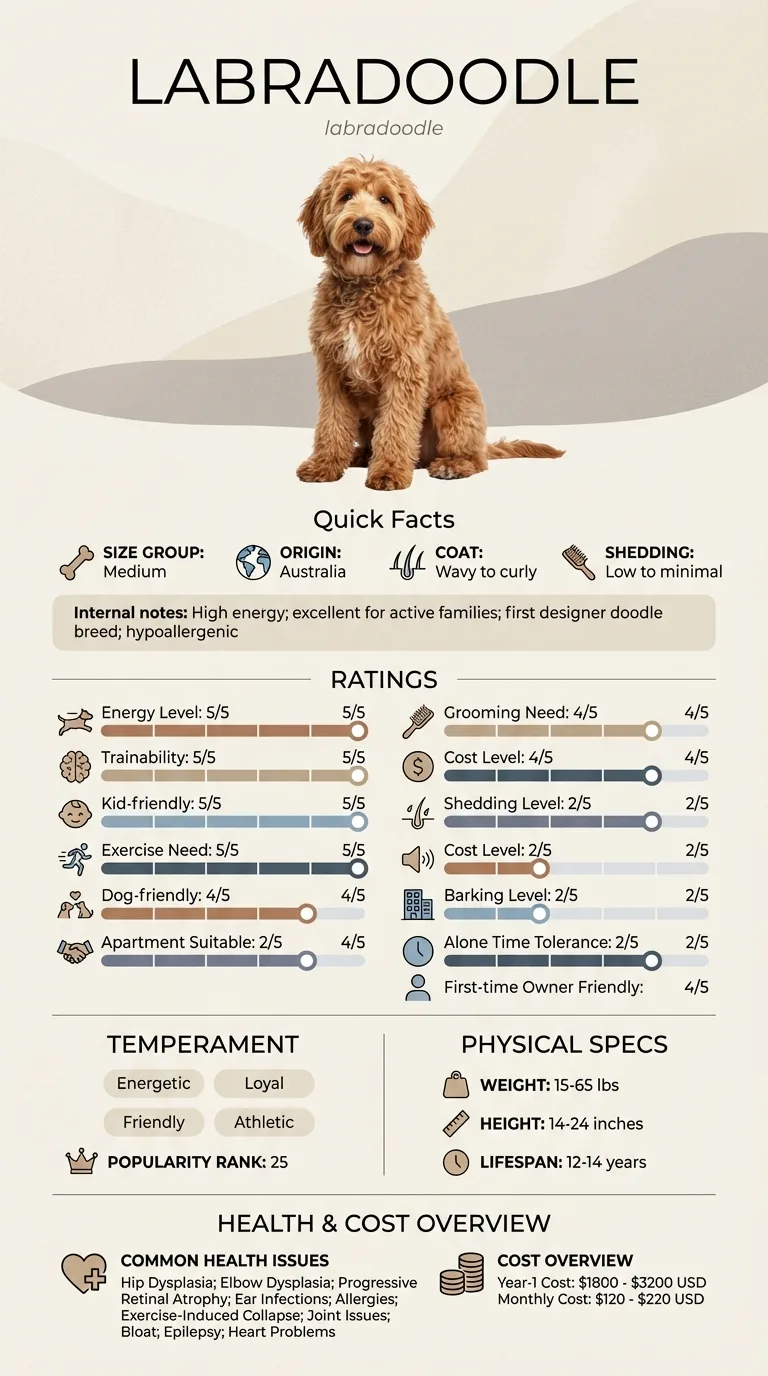
This is for someone already down to Collie (Rough Collie) and Labradoodle and deciding between them. For this pair the decision usually turns on exercise need and energy level, so those are covered first and in most detail. Both rate 2/5 for flats, so housing does not settle this one. Breed history is left out; what follows is what you will actually live with.
Between Collie (Rough Collie) and Labradoodle, exercise need is what separates them, and Collie (Rough Collie) is the lower-effort dog of the two to keep.
Choose Collie (Rough Collie) if your walking routine is modest and the dog will be alone during the working day.
Choose Labradoodle if shedding is a problem in your house, a smaller dog suits your car, your home or your back and you want a dog that can keep up with an active routine.
| Feature | collie | labradoodle | Winner |
|---|---|---|---|
| Size class | large | medium | Equal |
| Weight | 50–75 lbs | 15–65 lbs | Equal |
| Height | 22–26 in | 14–24 in | Equal |
| Lifespan | 11–14 years | 12–14 years | labradoodle |
| Exercise need | Moderate (3/5) | Very high (5/5) | collie |
| Grooming need | High (4/5) | High (4/5) | Equal |
| Shedding | High (4/5) | Low (2/5) | labradoodle |
| Energy level | Moderate (3/5) | Very high (5/5) | Equal |
| Barking | Moderate (3/5) | Low (2/5) | labradoodle |
| Apartment suitability | Low (2/5) | Low (2/5) | Equal |
| Good for first-time owners | High (4/5) | High (4/5) | Equal |
| Tolerates being alone | Moderate (3/5) | Low (2/5) | collie |
| Trainability | Very high (5/5) | Very high (5/5) | Equal |
| Good with kids | Very high (5/5) | Very high (5/5) | Equal |
| Good with other dogs | High (4/5) | High (4/5) | Equal |
| Friendly to strangers | High (4/5) | High (4/5) | Equal |
| Cost level | Moderate (3/5) | High (4/5) | collie |
| Coat | Long double coat | Wavy to curly | Equal |
| Origin | Scotland | Australia | Equal |
| Typical monthly cost | $100–$200 | $120–$220 | Equal |
| Typical first-year cost | $1,500–$2,800 | $1,800–$3,200 | Equal |
Weight-wise these two can end up close: a Collie sits at 50-75 lbs, a Labradoodle anywhere from 15-65 lbs depending on whether you get a mini or standard. Height follows the same pattern, with the Collie's 22-26 inches overlapping the taller end of the Labradoodle's 14-24 inch range. Ask about the specific parents before assuming size; Labradoodle alone doesn't pin down much.
The Labradoodle wants considerably more from you: 5/5 exercise need, the top tier, against the Collie's moderate 3/5. That's Labrador retrieving drive layered onto Poodle athleticism, and it doesn't compromise down just because the coat looks fluffy. If your daily routine tops out at a couple of leash walks, the Collie is the easier match; the Labradoodle wants running, fetch, or a job most days.
Both rate 4/5 on grooming need, so nobody here is low-maintenance on coat care. The payoff differs though: the Labradoodle sheds lightly (2/5) thanks to its Poodle-influenced coat, while the Collie sheds heavily (4/5). Expect regular brushing for both and periodic professional grooming for the Labradoodle specifically, since its wavy-to-curly coat mats if neglected.
Both breeds tie at 2/5 for apartment suitability; neither is a natural small-space dog, though for different reasons. The Labradoodle's issue is mostly its high exercise need (5/5) outstripping what an apartment routine typically provides; the Collie's is more about its size and herding instincts wanting room to work. Barking favors the Labradoodle at 2/5 against the Collie's 3/5, which helps a little with close neighbors.
Trainability is tied at the top for both, 5/5, and both suit first-time owners equally at 4/5. The practical difference shows up in temperament under pressure: a Collie is sensitive and can shut down with harsh handling, while a Labradoodle tends to be more food-driven and resilient. Either responds well to consistent, positive methods; neither should be your excuse to skip training basics.
This category is close to a wash: both score 5/5 with kids, 4/5 with other dogs, and 4/5 with strangers. If you're choosing based on how the dog will behave around family, extended family, or the neighborhood dog park, this comparison genuinely doesn't help you decide; look at exercise needs and cost instead.
The Labradoodle edges out a slightly longer lifespan, 12 to 14 years against the Collie's 11 to 14, though the ranges overlap almost entirely. Both share hip dysplasia, progressive retinal atrophy, and bloat risk. The Labradoodle's list adds exercise-induced collapse, a condition tied to its Labrador ancestry, while the Collie's leans toward Collie Eye Anomaly and epilepsy.
The Labradoodle costs more to keep: rated 4/5 versus the Collie's 3/5, with a monthly range of $120-$220 against $100-$200 and a first-year total that can reach $3,200 versus the Collie's $2,800 ceiling. Grooming upkeep and typically higher purchase prices for doodles account for most of that gap; budget an extra few hundred dollars a year if you go that route.
Collie (Rough Collie) weighs 50–75 lbs and lives 11–14 years; Labradoodle weighs 15–65 lbs and lives 12–14 years. The two diverge most on exercise need, energy level and shedding. They are level on apartment suitability, good with other dogs and good for first-time owners, so those cannot decide it. The comparison marks an easier option only where one exists. Facts like weight and country of origin are not scored. Both dogs are rated from the same dataset, which is what makes the numbers comparable with each other even though any individual dog sits somewhere inside its breed's range.

The Labradoodle, clearly; rated 5/5 on exercise need against the Collie's 3/5. This is a genuinely high-energy dog that wants daily structured activity, not just a walk.
Yes, noticeably: 2/5 versus the Collie's 4/5, though the Labradoodle's coat still needs regular grooming (4/5 grooming need) to avoid matting.
Both score equally well at 4/5, and both hit a perfect 5/5 on trainability, so this isn't a strong differentiator; the deciding factor should be exercise capacity, not trainability.
About $20 more per month ($120-$220 versus $100-$200) and up to $400 more in the first year, driven mainly by grooming costs.
Yes; both rate a perfect 5/5 with kids, and both score 4/5 with other dogs and strangers, so household sociability isn't the differentiator here.
Yes; hip dysplasia, progressive retinal atrophy, and bloat all appear on both lists, making joint and eye screening worthwhile for either breed.
Roughly the same: 11 to 14 years for the Collie, 12 to 14 for the Labradoodle. The ranges overlap enough that this shouldn't be a deciding factor.
Neither, really; both tie at 2/5 apartment suitability, though the Labradoodle barks less (2/5 versus 3/5).
The Labradoodle: $120-$220 monthly versus the Collie's $100-$200, and up to $3,200 in year one versus $2,800.
The Labradoodle by a full point: 5/5 exercise need against the Collie's 3/5, the widest gap in this comparison.
About the same: 11-14 years for the Collie versus 12-14 for the Labradoodle, close enough that it shouldn't drive the decision.
Secure checkout on Stripe. We never see your card.
7-day money-back guarantee. Instant access.


Health information here is general and is not veterinary advice. If your dog shows pain, sudden behaviour change, or worsening symptoms, consult a licensed veterinarian.
Some links on this site are affiliate links. We may earn a commission at no extra cost to you, and we only suggest products we believe are helpful for dog owners.
We research and check what we publish, but we do not warrant that any figure, date, price, or statement is accurate, complete, or current, and we accept no liability for any loss, cost, injury, or other harm arising from the use of this site. Use it as one reference among several. You remain responsible for your own decisions and for your dog's care - confirm anything that matters with a licensed veterinarian or another qualified professional before you act on it. Full disclaimer.
Match your lifestyle to the right dog.
Take quizNot sure which breed is right for you? Take our 2-minute quiz to find out.
Take the quiz