Living
Can a Great Dane live in an apartment?
Technically, but the data rates it 1/5 for apartment suitability, the lowest score in this comparison, so a house with room is strongly preferred.

Quick answer
Can a Great Dane live in an apartment?
Technically, but the data rates it 1/5 for apartment suitability, the lowest score in this comparison, so a house with room is strongly preferred.
Collie (Rough Collie) or Great Dane? On paper they differ most on grooming need, and on the scales Great Dane is the heavier at 110–175 lbs. Here is how the two compare on everything that shapes an ordinary week.
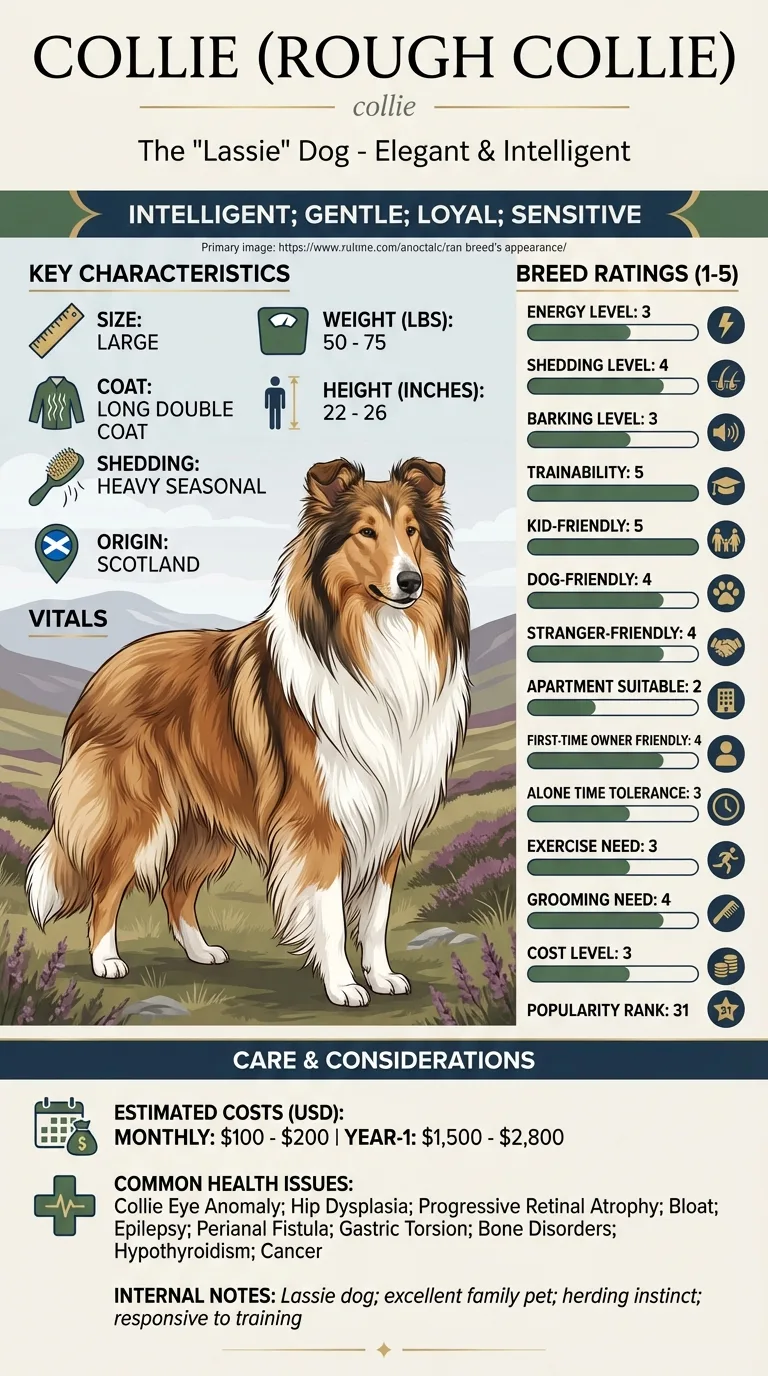
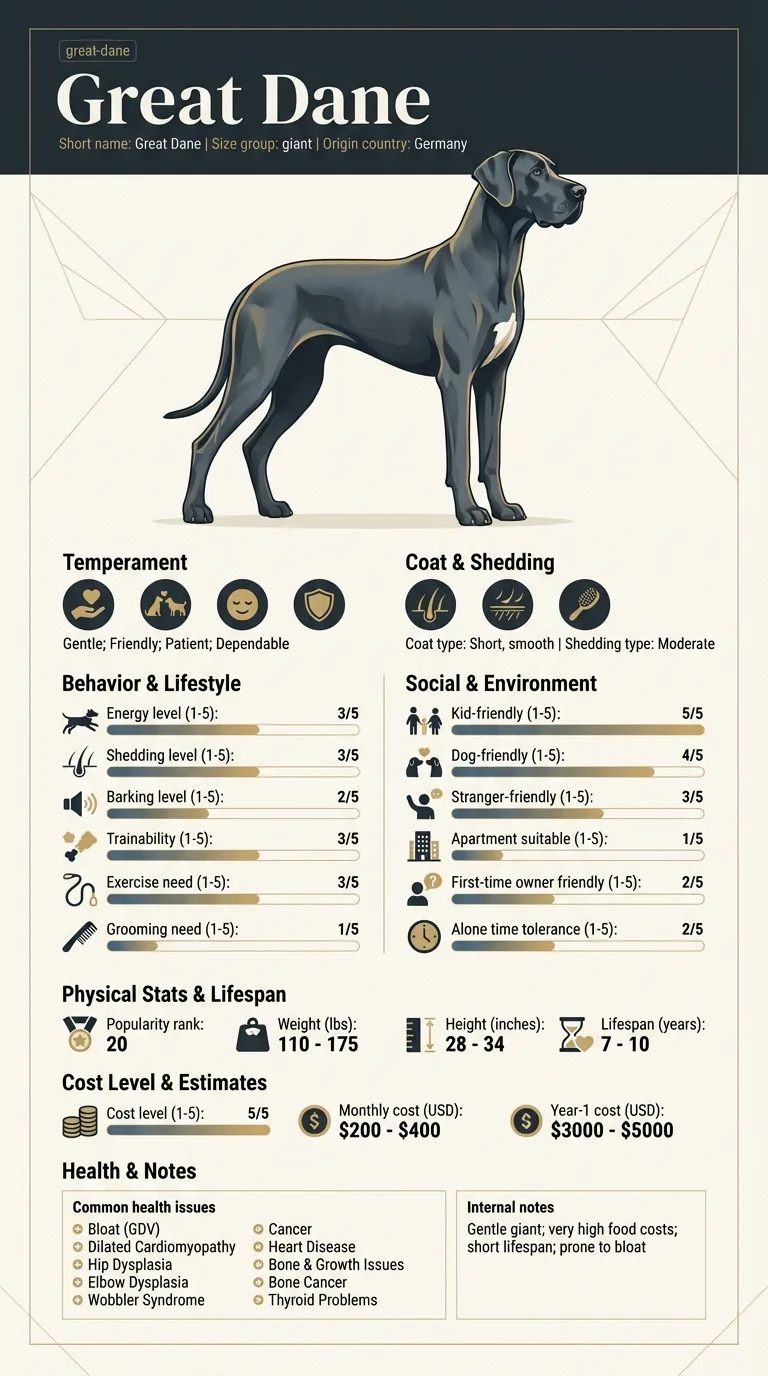
This is for someone already down to Collie (Rough Collie) and Great Dane and deciding between them. For this pair the decision usually turns on grooming need and good for first-time owners, so those are covered first and in most detail. Anyone choosing from a flat has a clear answer here: Collie (Rough Collie) rates 2/5 against 1/5. There is no origin story here — only what changes about your week.
Between Collie (Rough Collie) and Great Dane, grooming need is what separates them, and Collie (Rough Collie) is the lower-effort dog of the two to keep.
Choose Collie (Rough Collie) if this is your first dog, the dog will be alone during the working day and you want a dog that picks up training quickly.
Choose Great Dane if you do not want a standing grooming appointment, shedding is a problem in your house and you want a dog that is more watchful with visitors.
| Feature | collie | great dane | Winner |
|---|---|---|---|
| Size class | large | giant | Equal |
| Weight | 50–75 lbs | 110–175 lbs | Equal |
| Height | 22–26 in | 28–34 in | Equal |
| Lifespan | 11–14 years | 7–10 years | collie |
| Exercise need | Moderate (3/5) | Moderate (3/5) | Equal |
| Grooming need | High (4/5) | Very low (1/5) | great dane |
| Shedding | High (4/5) | Moderate (3/5) | great dane |
| Energy level | Moderate (3/5) | Moderate (3/5) | Equal |
| Barking | Moderate (3/5) | Low (2/5) | great dane |
| Apartment suitability | Low (2/5) | Very low (1/5) | collie |
| Good for first-time owners | High (4/5) | Low (2/5) | collie |
| Tolerates being alone | Moderate (3/5) | Low (2/5) | collie |
| Trainability | Very high (5/5) | Moderate (3/5) | collie |
| Good with kids | Very high (5/5) | Very high (5/5) | Equal |
| Good with other dogs | High (4/5) | High (4/5) | Equal |
| Friendly to strangers | High (4/5) | Moderate (3/5) | collie |
| Cost level | Moderate (3/5) | Very high (5/5) | collie |
| Coat | Long double coat | Short, smooth | Equal |
| Origin | Scotland | Germany | Equal |
| Typical monthly cost | $100–$200 | $200–$400 | Equal |
| Typical first-year cost | $1,500–$2,800 | $3,000–$5,000 | Equal |
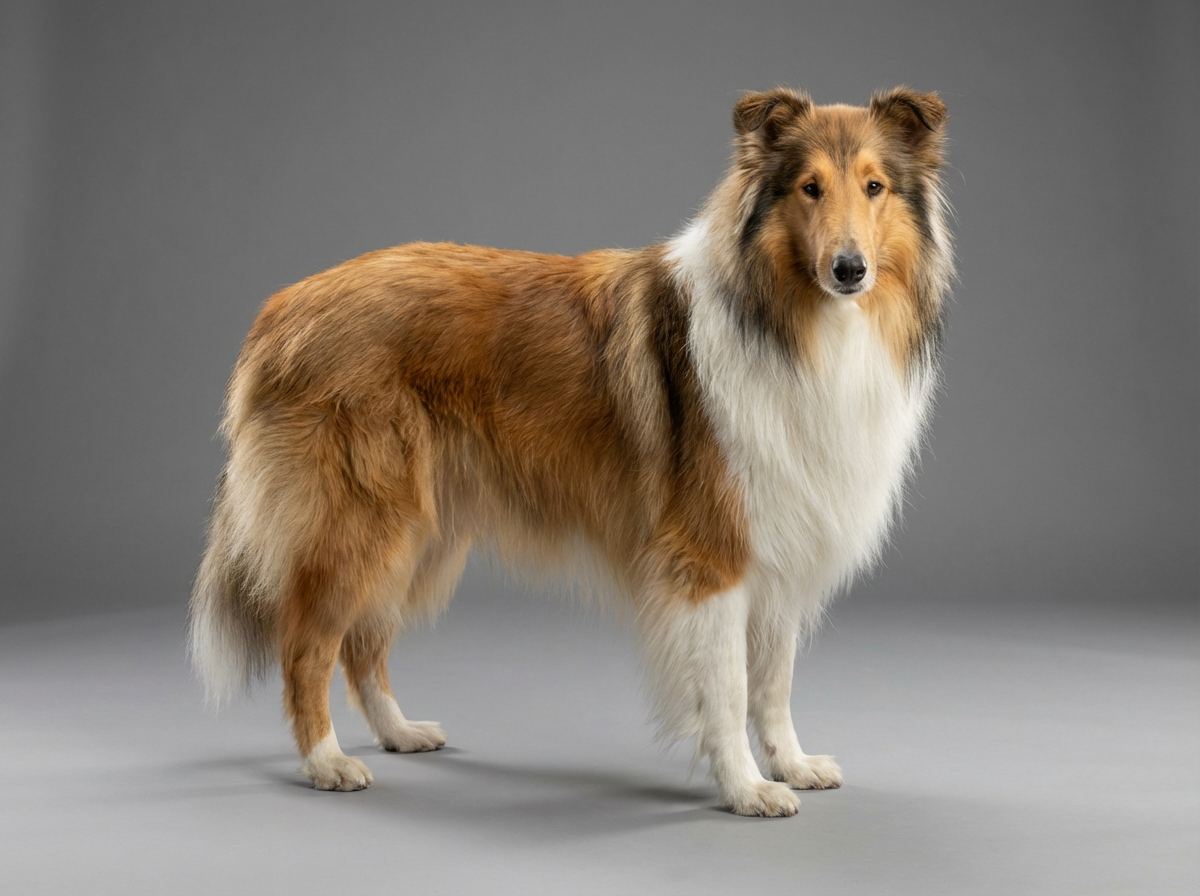
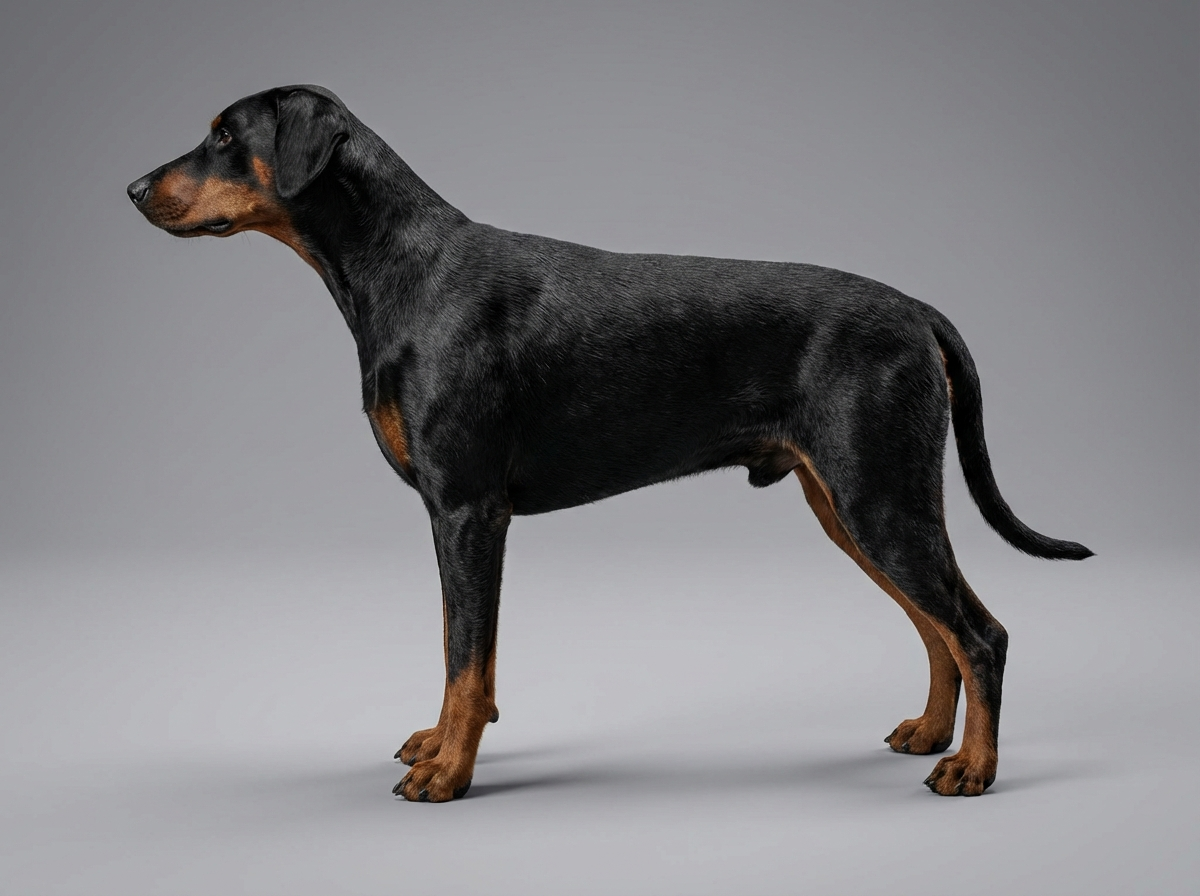
There's no real competition here: the Collie is a large breed at 50-75 lbs and 22-26 inches, while the Great Dane is genuinely giant at 110-175 lbs and up to 34 inches at the shoulder. A grown Dane can weigh more than two Collies combined. That size difference isn't just visual; it drives nearly everything else in this comparison, from the furniture you'll need to the size of the vet bill.
Surprisingly, both breeds rate the same moderate 3/5 on exercise need and energy level. Great Danes look like they should need marathon exercise, but their size works against sustained activity, especially as puppies whose joints are still developing. A Collie's herding instincts keep it more consistently active in short bursts. Practically, both are satisfied with regular walks and yard time rather than high-intensity daily workouts; just budget more space for the Dane to simply exist in.
Grooming flips the script on coat length: the Collie's long double coat rates 4/5 for grooming need with heavy shedding (4/5), while the Great Dane's short coat needs almost no upkeep (1/5 grooming) and sheds moderately (3/5). If brushing isn't your thing, the Dane's coat is far less demanding; you'll spend that saved time on drool cleanup instead, which the data doesn't capture but any Dane owner will tell you about.
Neither breed suits a small space, but the Dane is worse: 1/5 apartment suitability against the Collie's 2/5, and it barks less too (2/5 versus 3/5). A Great Dane's size makes cramped quarters genuinely impractical regardless of temperament; it needs room to turn around, not just tolerance for four walls. If you're apartment-bound, this comparison should end with the Collie by default.
This is a real gap: the Collie rates 5/5 on trainability and 4/5 as a first-time-owner breed, while the Great Dane comes in at 3/5 and 2/5 respectively. A Dane's size means poor training has real consequences; an untrained 150 lb dog is a different problem than an untrained 60 lb one. First-time owners should take the 2/5 rating seriously. This isn't a breed to learn on.
Both score a perfect 5/5 with kids and 4/5 with other dogs, so families and multi-dog households don't need to choose based on this alone. Strangers are where they diverge slightly: the Collie rates 4/5 friendly to strangers, the Dane 3/5, likely reflecting the Dane's more reserved, watchful nature. Supervise young kids around the Dane anyway; gentle temperament aside, a dog that size can knock a toddler over just by turning around.
The lifespan gap is the headline number here: 11-14 years for the Collie versus just 7-10 for the Great Dane, a difference of roughly a third. Both breeds share bloat and hip dysplasia risk, but the Dane's list adds Wobbler Syndrome and dilated cardiomyopathy, serious, giant-breed-specific conditions. If longevity matters to you more than anything else in this comparison, the numbers are unambiguous.
The Dane is expensive to keep: rated 5/5 (Very high) on cost versus the Collie's 3/5, with a monthly range of $200-$400 against $100-$200 and a first-year cost that can run $3,000-$5,000 versus $1,500-$2,800. Food alone for a 150 lb dog adds up fast, and giant-breed vet visits, medications, and even boarding tend to be priced by weight. Budget accordingly before you fall for the puppy.
Collie (Rough Collie) weighs 50–75 lbs and lives 11–14 years; Great Dane weighs 110–175 lbs and lives 7–10 years. The two diverge most on grooming need, good for first-time owners and trainability and 1 other rated axes. They are level on good with other dogs, energy level and exercise need, so those cannot decide it. Where the table declares a winner it means less work for the owner, nothing more; descriptive rows are left as ties on purpose. The value here is in the differences between the two columns; treat any single score as approximate.

Considerably; a Dane runs 110-175 lbs against a Collie's 50-75 lbs, roughly double to triple the weight, with several extra inches of height. It's a genuinely different scale of dog to live with.
The Collie, by a clear margin: 11 to 14 years versus the Great Dane's 7 to 10. That's one of the largest lifespan gaps you'll see in any breed comparison, a direct consequence of the Dane's giant size.
The data says no; it rates just 2/5 for first-time owners against the Collie's 4/5, largely due to its size, training needs (3/5 trainability), and cost. A Collie is the more forgiving choice to learn on.
The Great Dane, by far; its short coat needs almost no grooming (1/5) despite moderate shedding (3/5), while the Collie's long double coat demands regular brushing (4/5 grooming, 4/5 shedding).
Expect $100-$200 for a Collie and $200-$400 for a Great Dane, with first-year totals of roughly $1,500-$2,800 versus $3,000-$5,000; the Dane's food and medical costs scale with its size.
Bloat and hip dysplasia appear on both lists, so both benefit from slow feeding and joint-friendly exercise as puppies. The Dane's list also includes Wobbler Syndrome and heart disease, conditions tied specifically to its giant frame.
Neither really is, but the Collie is the lesser problem: 2/5 apartment suitability against the Dane's 1/5. A Great Dane needs physical space a small unit simply can't provide.
Technically, but the data rates it 1/5 for apartment suitability, the lowest score in this comparison, so a house with room is strongly preferred.
The Great Dane by a wide margin: $200-$400 a month and up to $5,000 in year one, against the Collie's $100-$200 and $2,800 ceiling.
Giant breeds age faster as a rule; the data puts the Dane at 7-10 years against the Collie's 11-14, a gap tied to size rather than any single condition.
No; it rates a gentle, high 5/5 with kids and 4/5 with other dogs, though its sheer size means supervision around small children matters regardless of temperament.
Secure checkout on Stripe. We never see your card.
7-day money-back guarantee. Instant access.
Health information here is general and is not veterinary advice. If your dog shows pain, sudden behaviour change, or worsening symptoms, consult a licensed veterinarian.
Some links on this site are affiliate links. We may earn a commission at no extra cost to you, and we only suggest products we believe are helpful for dog owners.
We research and check what we publish, but we do not warrant that any figure, date, price, or statement is accurate, complete, or current, and we accept no liability for any loss, cost, injury, or other harm arising from the use of this site. Use it as one reference among several. You remain responsible for your own decisions and for your dog's care - confirm anything that matters with a licensed veterinarian or another qualified professional before you act on it. Full disclaimer.
Match your lifestyle to the right dog.
Take quizNot sure which breed is right for you? Take our 2-minute quiz to find out.
Take the quiz