Living
Which is quieter for neighbors nearby?
The Collie, clearly: 3/5 on barking against the Jack Russell Terrier's maximum 5/5 rating.

Quick answer
Which is quieter for neighbors nearby?
The Collie, clearly: 3/5 on barking against the Jack Russell Terrier's maximum 5/5 rating.
Collie (Rough Collie) or Jack Russell Terrier? On paper they differ most on exercise need, and on the scales Collie (Rough Collie) is the heavier at 50–75 lbs. Here is how the two compare on everything that shapes an ordinary week.
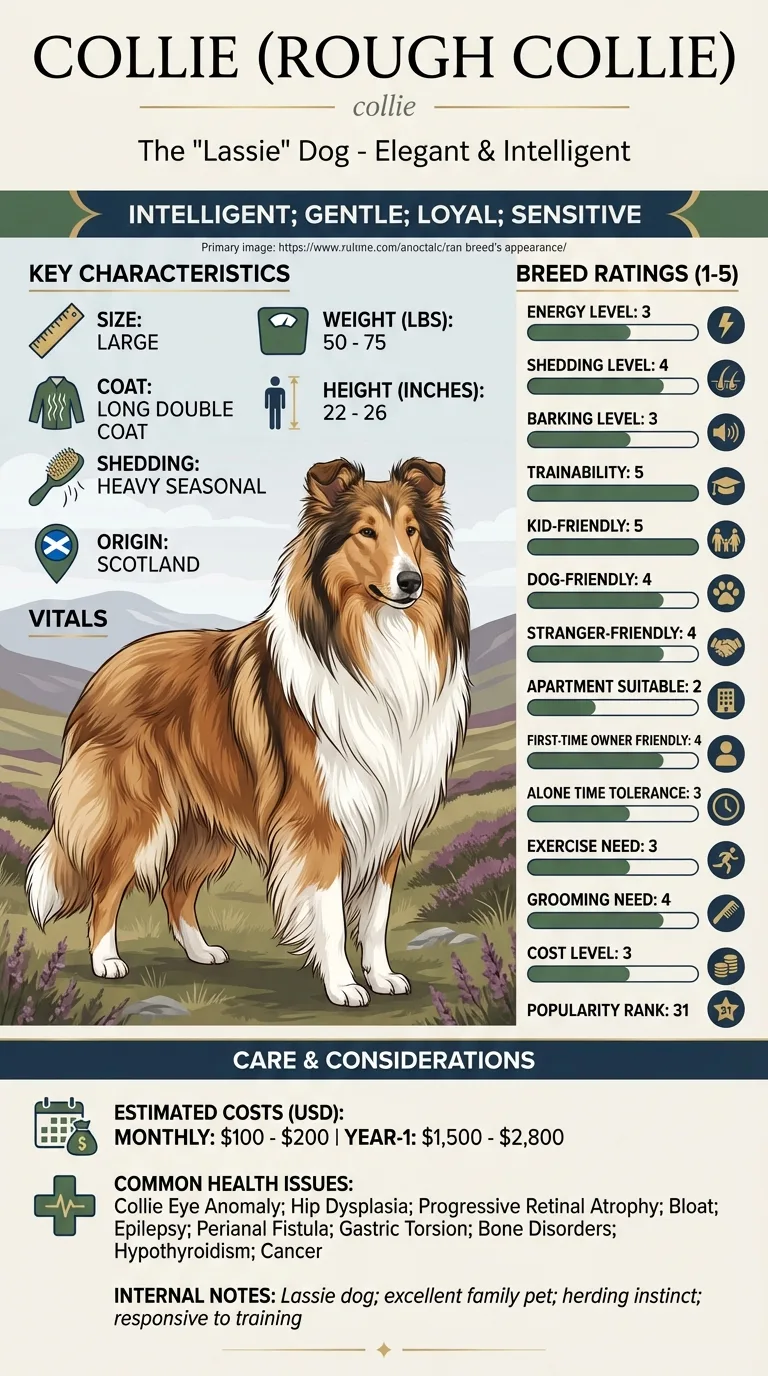
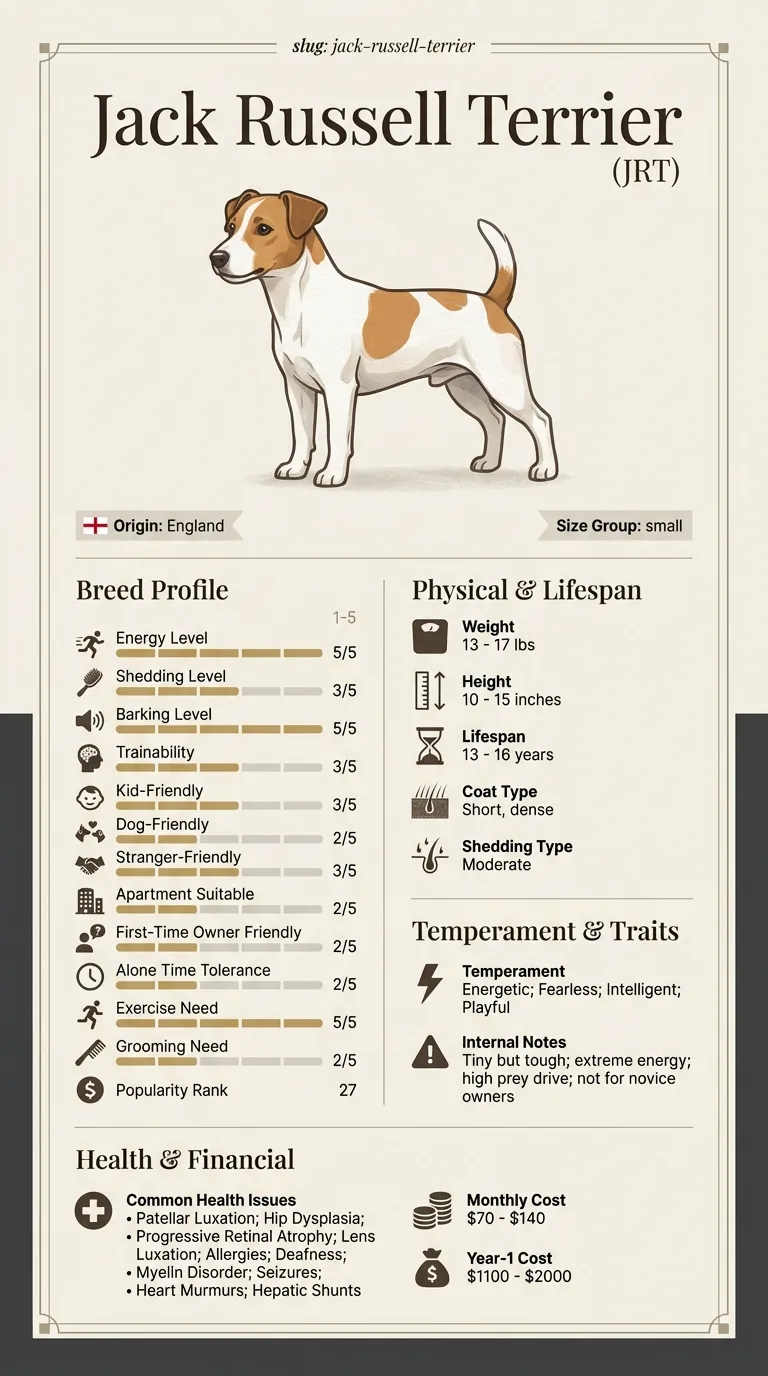
This is for someone already down to Collie (Rough Collie) and Jack Russell Terrier and deciding between them. For this pair the decision usually turns on exercise need and grooming need, so those are covered first and in most detail. Both rate 2/5 for flats, so housing does not settle this one. The focus throughout is on daily consequences rather than breed background.
Between Collie (Rough Collie) and Jack Russell Terrier, exercise need is what separates them, and Collie (Rough Collie) is the lower-effort dog of the two to keep.
Choose Collie (Rough Collie) if this is your first dog, your walking routine is modest and the dog will be alone during the working day.
Choose Jack Russell Terrier if you do not want a standing grooming appointment, shedding is a problem in your house and a smaller dog suits your car, your home or your back.
| Feature | collie | jack russell terrier | Winner |
|---|---|---|---|
| Size class | large | small | Equal |
| Weight | 50–75 lbs | 13–17 lbs | Equal |
| Height | 22–26 in | 10–15 in | Equal |
| Lifespan | 11–14 years | 13–16 years | jack russell terrier |
| Exercise need | Moderate (3/5) | Very high (5/5) | collie |
| Grooming need | High (4/5) | Low (2/5) | jack russell terrier |
| Shedding | High (4/5) | Moderate (3/5) | jack russell terrier |
| Energy level | Moderate (3/5) | Very high (5/5) | Equal |
| Barking | Moderate (3/5) | Very high (5/5) | collie |
| Apartment suitability | Low (2/5) | Low (2/5) | Equal |
| Good for first-time owners | High (4/5) | Low (2/5) | collie |
| Tolerates being alone | Moderate (3/5) | Low (2/5) | collie |
| Trainability | Very high (5/5) | Moderate (3/5) | collie |
| Good with kids | Very high (5/5) | Moderate (3/5) | collie |
| Good with other dogs | High (4/5) | Low (2/5) | collie |
| Friendly to strangers | High (4/5) | Moderate (3/5) | collie |
| Cost level | Moderate (3/5) | Low (2/5) | jack russell terrier |
| Coat | Long double coat | Short, dense | Equal |
| Origin | Scotland | England | Equal |
| Typical monthly cost | $100–$200 | $70–$140 | Equal |
| Typical first-year cost | $1,500–$2,800 | $1,100–$2,000 | Equal |
Fifty pounds separates these two, easily. The Collie runs 50-75 lbs and stands up to 26 inches; the Jack Russell Terrier tops out around 17 lbs and 15 inches. Both are technically large versus small by class, but the terrier's compact frame is deceptive: it's a lot of dog packed into a small body, which matters more in the next section than it does here.
Don't let the size fool you: the Jack Russell rates a 5/5 on exercise need, the highest tier, against the Collie's moderate 3/5. Energy level is rated the same tier for both, but in practice a JRT's intensity is relentless; it was bred to work all day chasing vermin, and that drive doesn't switch off because the dog is small. This is not a low-maintenance terrier by any measure in the data.
The terrier wins clearly on upkeep: 2/5 grooming need against the Collie's 4/5, thanks to its short, dense coat. Shedding still happens (3/5 for the JRT, 4/5 for the Collie) but without the long-coat brushing routine a Collie demands. If grooming time is your limiting factor, the Jack Russell asks a lot less of you here, even though it makes up for it elsewhere.
Both breeds score the same low 2/5 on apartment suitability, but for opposite reasons: the Collie is too large and active for cramped space, while the Jack Russell is small enough physically but rated a 5/5 on barking, the maximum in this dataset. A vocal terrier in a thin-walled building is its own kind of problem. Neither breed is a natural fit for close-quarters living, just via different mechanisms.
This is where the gap is starkest: the Collie rates 5/5 on trainability and 4/5 for first-time owners, while the Jack Russell comes in at 3/5 and 2/5. Terriers were bred to think independently and solve problems without waiting for instruction, which makes them harder to direct than a Collie's more cooperative herding temperament. A first-time owner drawn to the JRT's size should know the size isn't the hard part.
The Collie is the stronger family and multi-dog pick across the board: 5/5 with kids versus the JRT's 3/5, and 4/5 with other dogs versus the terrier's 2/5. Jack Russells have real prey drive and can be scrappy with other dogs; that's not a knock on the breed, just a fact worth planning around if you already have pets. Strangers follow the same pattern: 4/5 for the Collie, 3/5 for the terrier.
The Jack Russell actually outlives the Collie on paper, 13 to 16 years against 11 to 14, which tracks with its small size. Both breeds carry hip dysplasia and progressive retinal atrophy risk. The terrier's list adds lens luxation and seizure risk, while the Collie's includes bloat and epilepsy; different specific conditions, but neither breed's health list is short.
The Jack Russell is the budget option here: $70-$140 a month and $1,100-$2,000 in year one, against the Collie's $100-$200 and $1,500-$2,800. That's a meaningful gap over a dog's lifetime, driven mostly by food volume and the terrier's low grooming needs. If upfront and ongoing cost is the deciding factor, the numbers favor the smaller dog clearly.
Collie (Rough Collie) weighs 50–75 lbs and lives 11–14 years; Jack Russell Terrier weighs 13–17 lbs and lives 13–16 years. The two diverge most on exercise need, grooming need and energy level and 5 other rated axes. Almost every rated axis separates them at least slightly. The table below marks a winner only where one breed is genuinely easier for a typical owner; size and origin are facts rather than merits and stay level. Ratings come from one source applied to both breeds, so they are meaningful against each other rather than as absolute scores.

Not according to the data; it rates just 2/5 for first-time owners, well below the Collie's 4/5, largely due to its independent streak and lower trainability score (3/5 versus 5/5).
The Jack Russell, by a lot; it rates the maximum 5/5 on barking against the Collie's moderate 3/5. That's worth taking seriously if you have close neighbors.
The Jack Russell, rated 5/5 on exercise need versus the Collie's 3/5. This is a genuinely high-energy terrier despite its small size, not a low-key lapdog.
The Jack Russell: $70-$140 monthly against the Collie's $100-$200, and $1,100-$2,000 versus $1,500-$2,800 in the first year.
The Collie more so: 4/5 versus the Jack Russell's 2/5. Terriers can be scrappy with other dogs due to prey drive, which matters if you're building a multi-pet household.
The Jack Russell, typically: 13 to 16 years against the Collie's 11 to 14, in line with the general size-to-lifespan pattern.
Hip dysplasia and progressive retinal atrophy appear on both lists. Beyond that they diverge; the terrier carries lens luxation and seizure risk, the Collie carries bloat and epilepsy risk.
The Collie, clearly: 3/5 on barking against the Jack Russell Terrier's maximum 5/5 rating.
The Jack Russell Terrier: about $30-$60 less per month and roughly $400-$800 less in year one.
The Collie, rated 5/5 on trainability against the terrier's 3/5; the JRT's independent streak makes it a tougher training project.
The Jack Russell Terrier by a wide margin: 5/5 exercise need versus the Collie's 3/5, despite its much smaller size.
Secure checkout on Stripe. We never see your card.
7-day money-back guarantee. Instant access.
Health information here is general and is not veterinary advice. If your dog shows pain, sudden behaviour change, or worsening symptoms, consult a licensed veterinarian.
Some links on this site are affiliate links. We may earn a commission at no extra cost to you, and we only suggest products we believe are helpful for dog owners.
We research and check what we publish, but we do not warrant that any figure, date, price, or statement is accurate, complete, or current, and we accept no liability for any loss, cost, injury, or other harm arising from the use of this site. Use it as one reference among several. You remain responsible for your own decisions and for your dog's care - confirm anything that matters with a licensed veterinarian or another qualified professional before you act on it. Full disclaimer.
Match your lifestyle to the right dog.
Take quizNot sure which breed is right for you? Take our 2-minute quiz to find out.
Take the quiz