Living
Which is better for a small apartment?
The Maltese, clearly: 5/5 apartment suitability versus the Collie's 2/5.

Quick answer
Which is better for a small apartment?
The Maltese, clearly: 5/5 apartment suitability versus the Collie's 2/5.
Collie (Rough Collie) or Maltese? On paper they differ most on apartment suitability, and on the scales Collie (Rough Collie) is the heavier at 50–75 lbs. Here is how the two compare on everything that shapes an ordinary week.
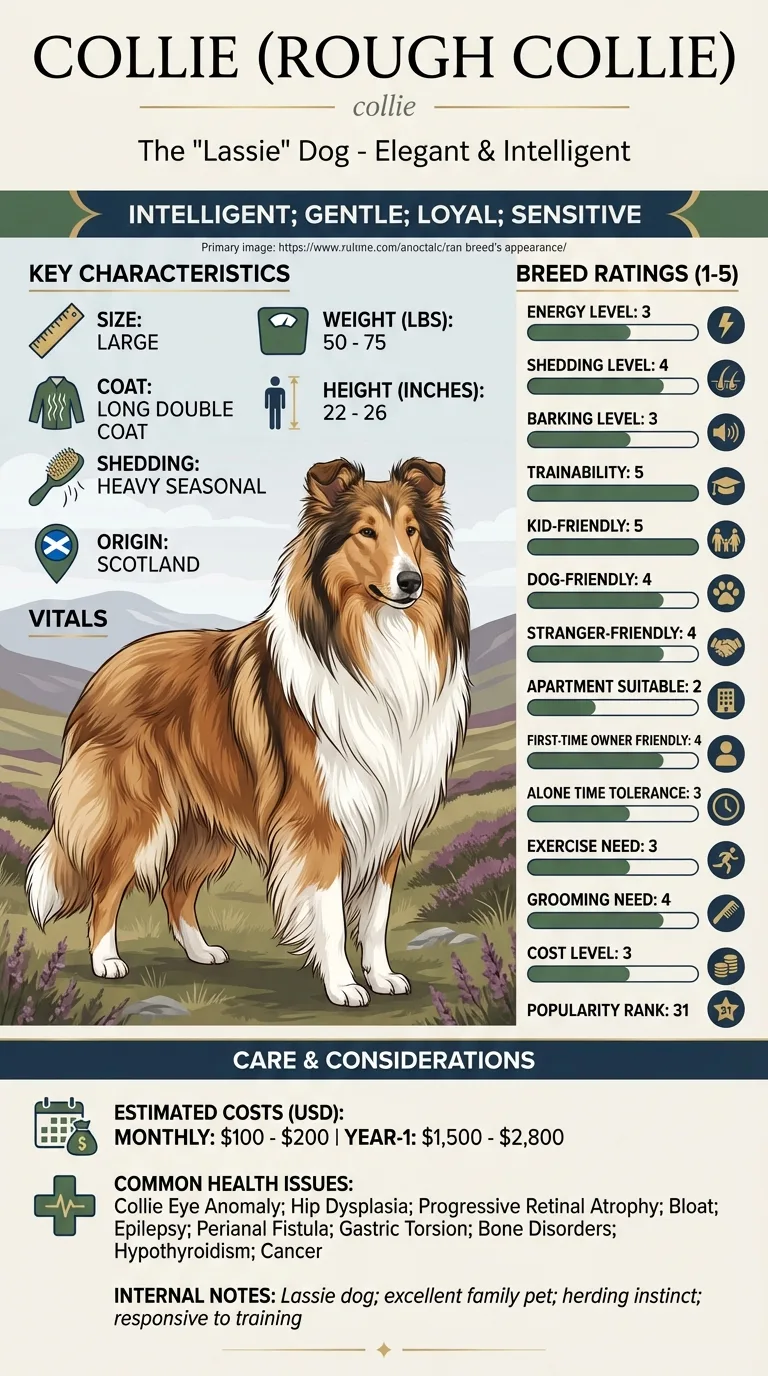
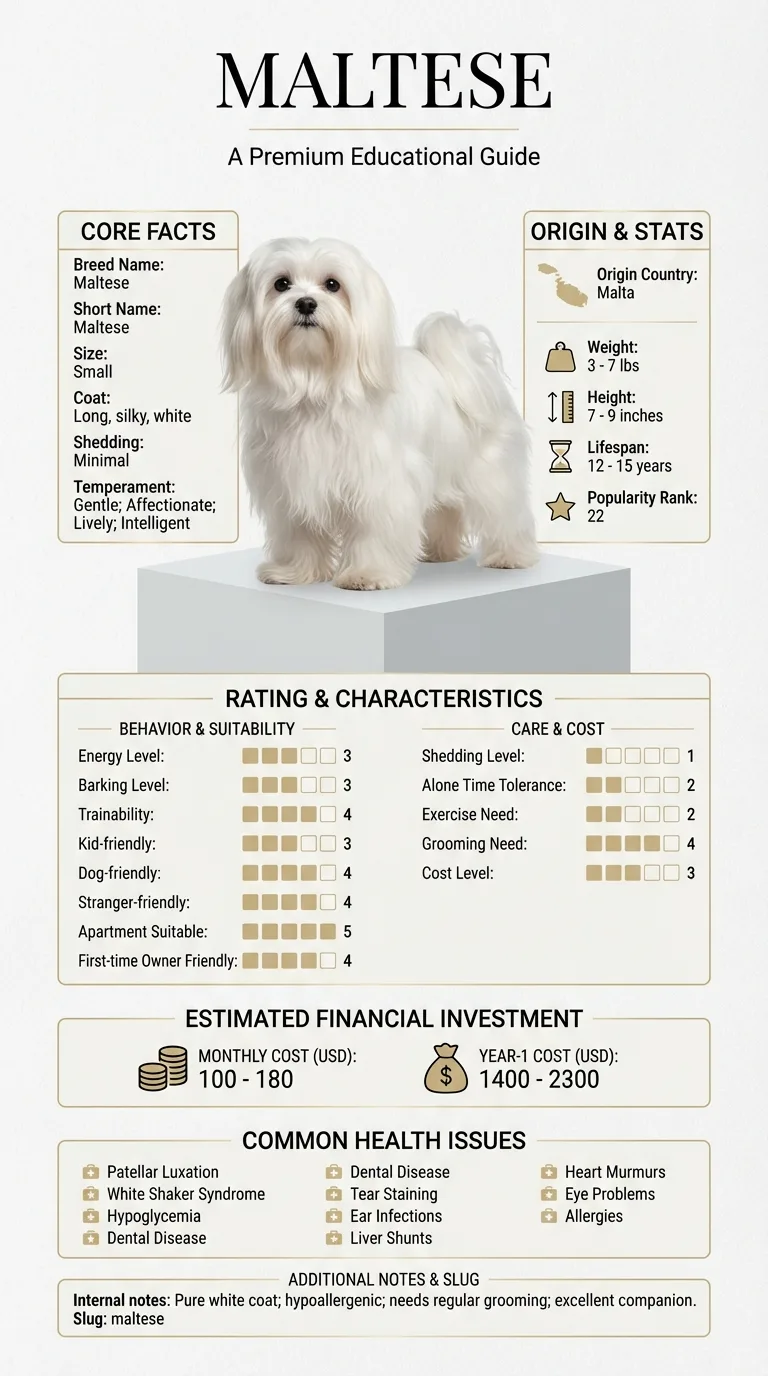
This is for someone already down to Collie (Rough Collie) and Maltese and deciding between them. For this pair the decision usually turns on apartment suitability and shedding, so those are covered first and in most detail. Anyone choosing from a flat has a clear answer here: Maltese rates 5/5 against 2/5. It is written for the decision rather than the breed history.
Between Collie (Rough Collie) and Maltese, apartment suitability is what separates them, and Maltese is the lower-effort dog of the two to keep.
Choose Collie (Rough Collie) if the dog will be alone during the working day, there are young children at home and you want a dog that picks up training quickly.
Choose Maltese if you are in a flat or a smaller home, shedding is a problem in your house and your walking routine is modest.
| Feature | collie | maltese | Winner |
|---|---|---|---|
| Size class | large | small | Equal |
| Weight | 50–75 lbs | 3–7 lbs | Equal |
| Height | 22–26 in | 7–9 in | Equal |
| Lifespan | 11–14 years | 12–15 years | maltese |
| Exercise need | Moderate (3/5) | Low (2/5) | maltese |
| Grooming need | High (4/5) | High (4/5) | Equal |
| Shedding | High (4/5) | Very low (1/5) | maltese |
| Energy level | Moderate (3/5) | Moderate (3/5) | Equal |
| Barking | Moderate (3/5) | Moderate (3/5) | Equal |
| Apartment suitability | Low (2/5) | Very high (5/5) | maltese |
| Good for first-time owners | High (4/5) | High (4/5) | Equal |
| Tolerates being alone | Moderate (3/5) | Low (2/5) | collie |
| Trainability | Very high (5/5) | High (4/5) | collie |
| Good with kids | Very high (5/5) | Moderate (3/5) | collie |
| Good with other dogs | High (4/5) | High (4/5) | Equal |
| Friendly to strangers | High (4/5) | High (4/5) | Equal |
| Cost level | Moderate (3/5) | Moderate (3/5) | Equal |
| Coat | Long double coat | Long, silky, white | Equal |
| Origin | Scotland | Malta | Equal |
| Typical monthly cost | $100–$200 | $100–$180 | Equal |
| Typical first-year cost | $1,500–$2,800 | $1,400–$2,300 | Equal |
The scale here is dramatic: a Collie weighs 50-75 lbs, a Maltese just 3-7 lbs; you could carry two or three Maltese in the space one Collie occupies. Height tells the same story, 22-26 inches against 7-9. This isn't a comparison of similar dogs with different coats; it's genuinely two different categories of pet, and that should drive most of your other decisions here.
The Maltese needs less physical output, 2/5 exercise need against the Collie's 3/5, but both land at a moderate 3/5 on general energy level, meaning the Maltese is still playful and alert indoors even without long walks. A short daily walk plus some indoor play usually covers a Maltese's needs; a Collie wants more consistent outdoor time to work off its herding energy.
Grooming is tied at 4/5 for both, which surprises people who assume a tiny dog means less coat work; the Maltese's long, silky, white coat actually demands meticulous brushing to avoid matting and staining. Shedding is where they split: the Maltese barely sheds (1/5) against the Collie's heavy 4/5. So less fur on your floors with the Maltese, but not less time at the brush.
The Maltese was practically built for this scenario: 5/5 apartment suitability against the Collie's 2/5. Barking ties at 3/5 for both, so it's really the Maltese's small size and low exercise need doing the work here, not any behavioral advantage. If your home is a studio or a small apartment, this category alone makes the case for the Maltese.
The Collie trains slightly more easily, 5/5 versus the Maltese's 4/5, but both suit first-time owners equally at 4/5. Small dogs like the Maltese sometimes get under-trained because owners underestimate how much a tiny dog's behavior still needs shaping; don't let the size fool you into skipping the basics just because the consequences of an untrained 5 lb dog feel smaller than an untrained 60 lb one.
Here's a real gap worth flagging: the Collie rates a perfect 5/5 with kids, while the Maltese comes in at just 3/5. A 3-7 lb dog is genuinely fragile around rough or unsupervised play, which is likely what's driving that score rather than any temperament issue. Both are equally friendly to strangers (4/5) and good with other dogs (4/5), so this kid-specific gap is the one to weigh carefully.
The Maltese lives a bit longer, 12 to 15 years against the Collie's 11 to 14, typical for its smaller size. Their health lists don't overlap much: the Collie's risks include bloat, epilepsy, and Collie Eye Anomaly, while the Maltese's include patellar luxation, hypoglycemia, and White Shaker Syndrome, conditions more associated with toy breeds. Ask a breeder about patella and liver screening specifically for a Maltese.
Costs come out almost identical: both rated a moderate 3/5, with monthly ranges of $100-$200 for the Collie and $100-$180 for the Maltese, and first-year totals of $1,500-$2,800 versus $1,400-$2,300. Whatever you save on a smaller dog's food bill, you're likely spending back on Maltese-specific grooming and dental care, so don't expect a dramatic difference either way.
Collie (Rough Collie) weighs 50–75 lbs and lives 11–14 years; Maltese weighs 3–7 lbs and lives 12–15 years. The two diverge most on apartment suitability, shedding and good with kids. They are level on barking, cost level and good with other dogs, so those cannot decide it. In the table, a "winner" means easier for an ordinary household — not better. Size, coat and origin are recorded without a verdict. Because both breeds are scored the same way, the gaps are reliable even where the absolute numbers are rough.

It's rated 3/5, noticeably lower than the Collie's 5/5, largely due to its small, fragile size rather than temperament. Supervise interactions with younger children regardless of breed choice.
The Maltese, decisively: 5/5 apartment suitability against the Collie's 2/5, driven by its tiny size and lower exercise needs.
Very little; it rates 1/5 on shedding, among the lowest in this dataset, though its long silky coat still needs regular brushing (4/5 grooming need) to prevent matting.
They're close: $100-$200 for the Collie versus $100-$180 for the Maltese. Neither breed has a clear cost advantage here.
The Maltese, typically: 12 to 15 years against the Collie's 11 to 14, consistent with its smaller size.
Not really; the lists barely overlap. The Collie's risks lean toward bloat and eye conditions, while the Maltese's lean toward patellar luxation and hypoglycemia, more typical toy-breed concerns.
Both rate 4/5 for first-time owners, so either is a reasonable starting point, though the Maltese's fragility around kids and the Collie's larger size and grooming needs are worth weighing against your household.
The Maltese, clearly: 5/5 apartment suitability versus the Collie's 2/5.
Slightly: $100-$180 monthly versus the Collie's $100-$200, though the gap is small enough not to be decisive.
Rated 3/5, noticeably below the Collie's 5/5; its small size makes it more fragile around boisterous or young children.
The Maltese, typically 12-15 years against the Collie's 11-14 years, a modest edge tied to its smaller size.
Secure checkout on Stripe. We never see your card.
7-day money-back guarantee. Instant access.
Health information here is general and is not veterinary advice. If your dog shows pain, sudden behaviour change, or worsening symptoms, consult a licensed veterinarian.
Some links on this site are affiliate links. We may earn a commission at no extra cost to you, and we only suggest products we believe are helpful for dog owners.
We research and check what we publish, but we do not warrant that any figure, date, price, or statement is accurate, complete, or current, and we accept no liability for any loss, cost, injury, or other harm arising from the use of this site. Use it as one reference among several. You remain responsible for your own decisions and for your dog's care - confirm anything that matters with a licensed veterinarian or another qualified professional before you act on it. Full disclaimer.
Match your lifestyle to the right dog.
Take quizNot sure which breed is right for you? Take our 2-minute quiz to find out.
Take the quiz