About $90 to $180 a month and $1,260 to $2,610 in year one, below the national average. The Detroit-specific note is diagnostic rather than financial: order the full thyroid panel, not the single screening value, when a middle-aged dog starts slowing down.
A Welsh Springer Spaniel in Detroit costs roughly $90 to $180 a month, with year one between $1,260 and $2,610 — comfortably under the national average, which is where most of southeast Michigan sits. The local detail worth knowing is not a price at all. It concerns a blood sample, and where in the country that sample ends up being read.
Why costs vary
Among the five conditions documented in Welsh Springer Spaniels, hypothyroidism is the cheapest to treat and the easiest to get wrong on the way in. A misread screening result costs nothing on the invoice and a great deal in lost years.
Cost summary
These figures apply Detroit's below-average service pricing to a 35-to-55-pound sporting dog, with a seasonal rather than year-round prevention schedule built in.
Estimate · source: estimation · confidence: medium · updated 2026-09-06 · not a quote
First year
$1260 - $2610
Ongoing monthly
$90 - $180
First-year expenses
Item
Cost range
One-time setup: first exam, spay or neuter, cold-weather gear
Includes a towel routine and paw care for a coat that comes home wet from November onward.
$370 - $620
Monthly expenses
Item
Cost range
Food for a 35-to-55-pound active dog
Priced at southeast Michigan's below-average grocery and pet-supply rates.
$42 - $72
How these numbers are estimated
Each range starts from a national baseline for this breed's size class and is then adjusted for local cost of living and veterinary pricing. The baselines, and the source each one came from, are listed on our sources page (dataset 2026.09). Two inputs, the purchase price and the emergency reserve, have no published national figure we could verify, so we leave them to you rather than invent them.
These are planning estimates, not quotes. Your own numbers will move with the individual dog, your vet and your insurer. Build a budget with your own figures.
Is pet insurance worth it?
Detroit's low service pricing makes routine care affordable outright, which shifts the insurance question onto the expensive tail of this breed's documented list rather than onto everyday visits.
When insurance makes sense
Worth quoting early if you want protection against the orthopaedic and neurological ends of the list. Thyroid disease itself is cheap to manage and rarely the reason a policy pays for itself.
When you might skip it
In a below-average market, an owner with a genuine reserve can reasonably self-fund routine and moderate care and carry the risk themselves.
Ways to save without cutting essentials
Detroit is already inexpensive to run a dog in, so the savings here come from testing well rather than from shopping harder.
Ask for a recorded weight at every visit so a slow gain shows up as a trend, not a guess.
Treat a low total T4 as a question rather than an answer, and request the fuller panel before starting medication.
Set prevention to Michigan's roughly seven-month season instead of defaulting to year-round.
Use Belle Isle and the metropark network for free mileage rather than paying for structured exercise.
Dry the ear feathering after winter walks; wet snow reaches the ear canal even when the dog never swims.
Detroit Cost Factors: The Panel Matters More Than the Price
Michigan State University runs an endocrinology reference laboratory in East Lansing that is one of the places veterinary practices across North America send canine thyroid samples to be read. For a Detroit owner that laboratory is about ninety miles away rather than half a continent, which quietly shortens turnaround on a test that often gets repeated.
The distinction that matters is what gets ordered. A single total T4 is the cheap screen, and it is genuinely useful for ruling the condition out — a comfortably normal total T4 usually ends the conversation. What it is poor at is confirming the condition, because total T4 falls for reasons that have nothing to do with the thyroid gland: another illness, certain medications, even a hard week. A dog can be labelled hypothyroid on a low total T4 alone and started on lifelong medication it never needed.
The fuller picture comes from a panel — free T4 measured by equilibrium dialysis alongside canine TSH, with thyroglobulin autoantibodies added when the question is whether an autoimmune process is under way. It costs more than the screen and it is the version worth paying for when a middle-aged Welsh Springer's numbers come back ambiguous. In a market as reasonably priced as Detroit's, the difference between the two is small enough that it should not be the deciding factor.
A Seven-Month Window, Below-Average Pricing, and Where the Miles Come From
The recurring numbers here are friendly. Southeast Michigan prices food, grooming, boarding and routine veterinary visits below the national average, and real winters keep flea and tick prevention to roughly seven months rather than the full twelve a Gulf Coast owner pays for. That combination is why the monthly figure lands where it does.
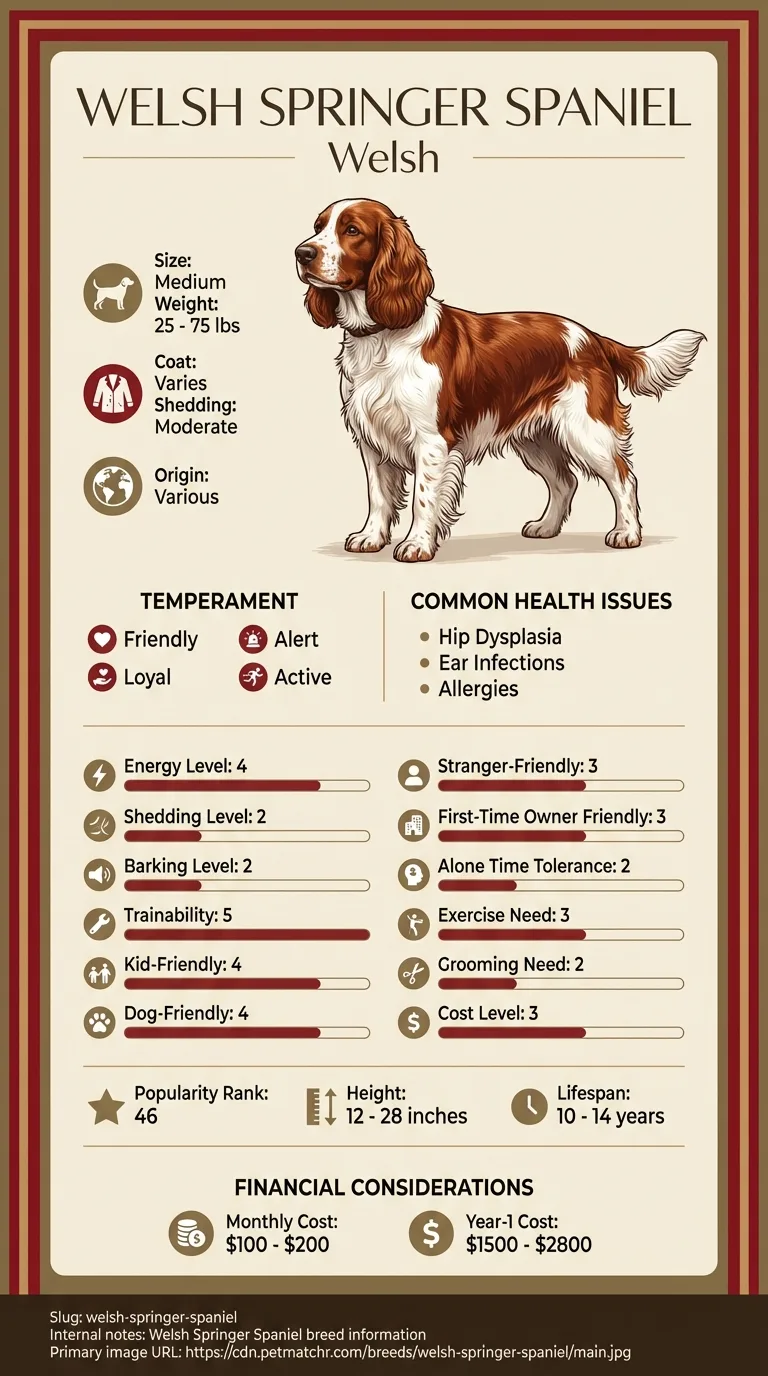
Exercise is not a constraint either. Belle Isle sits in the Detroit River with several miles of shoreline path, the Dequindre Cut connects the riverfront to the Eastern Market district, and the metropark system ringing the city adds thousands of acres within a short drive. A dog rated 4 out of 5 on both energy and exercise need has plenty to work with.
One caution belongs with a cold-weather city and a slow endocrine disease: winter is a plausible excuse for everything. A dog that wants shorter walks in February, gains a few pounds by March, and grows a coat that looks thick but feels coarse is doing something entirely normal, right up until it is not. The cheap defence is a recorded weight at every visit, so that the trend is on paper rather than in memory.
Welsh Springer Spaniel Cost in Detroit - A Seven-Month Window, Below-Average Pricing, and Where the Miles Come From
The Number That Was Never Rechecked
A seven-year-old Welsh Springer in the northern suburbs came in during a bout of gastrointestinal upset, and the routine bloodwork run that week showed a low total T4. He was started on thyroid medication on the strength of it.
He felt better within a fortnight, which everyone took as confirmation, though the stomach trouble had also resolved by then. Two years later a new veterinarian ran a full panel — free T4 by dialysis alongside canine TSH — and the numbers did not support the diagnosis at all. The original low reading had almost certainly been the illness pulling the value down, not the gland.
Key takeaway: In a well-served market like Detroit's, the fuller thyroid panel is a small enough expense that a single ambiguous screening value should never be the whole basis for a lifelong prescription.
Frequently asked questions
How much does a Welsh Springer Spaniel cost per month in Detroit?
Roughly $90 to $180, comfortably below the national average, reflecting southeast Michigan's general cost of living.
What does the first year cost?
Around $1,260 to $2,610, which covers the initial exam, vaccinations, spay or neuter if needed, and starting gear on top of the monthly running costs.
Why does the type of thyroid test matter?
A single total T4 is a good rule-out but a poor confirmation, because it drops for reasons unrelated to the thyroid. A panel including free T4 by equilibrium dialysis and canine TSH gives a far more reliable answer.
Is thyroid testing expensive here?
No. It is one of the cheaper diagnostic decisions you will make, and Michigan practices sit close to a major endocrinology reference laboratory in East Lansing, which helps turnaround.
How long is the parasite prevention season in Detroit?
About seven months. Michigan winters genuinely interrupt flea and tick activity, so a year-round schedule is more coverage than most local dogs need.
What emergency fund makes sense in Detroit?
Around $630 covers a significant unplanned visit at local pricing, which is a sensible floor for a breed with a documented list this long.
About $90 to $180 a month and $1,260 to $2,610 in year one, below the national average. The Detroit-specific note is diagnostic rather than financial: order the full thyroid panel, not the single screening value, when a middle-aged dog starts slowing down.
This guide is not medical advice. If your dog shows pain, sudden behavior change, or worsening symptoms, consult a licensed veterinarian.
Some links may be affiliate links. We may earn a commission at no extra cost to you. We only suggest products we believe are helpful for dog owners.
We research and check what we publish, but we do not warrant that any figure, date, price, or statement is accurate, complete, or current, and we accept no liability for any loss, cost, injury, or other harm arising from the use of this site. Use it as one reference among several. You remain responsible for your own decisions and for your dog's care - confirm anything that matters with a licensed veterinarian or another qualified professional before you act on it. Full disclaimer.