Living
Border Collie or Welsh Springer Spaniel?
These two are close on almost every measure; lean toward the Springer if you're a first-time owner or want a shorter health-risk list, toward the Collie if you want maximum trainability.

Quick answer
Border Collie or Welsh Springer Spaniel?
These two are close on almost every measure; lean toward the Springer if you're a first-time owner or want a shorter health-risk list, toward the Collie if you want maximum trainability.
Border Collie or Welsh Springer Spaniel? On paper they differ most on good for first-time owners, and on the scales Welsh Springer Spaniel is the heavier at 35–55 lbs. Here is how the two compare on everything that shapes an ordinary week.
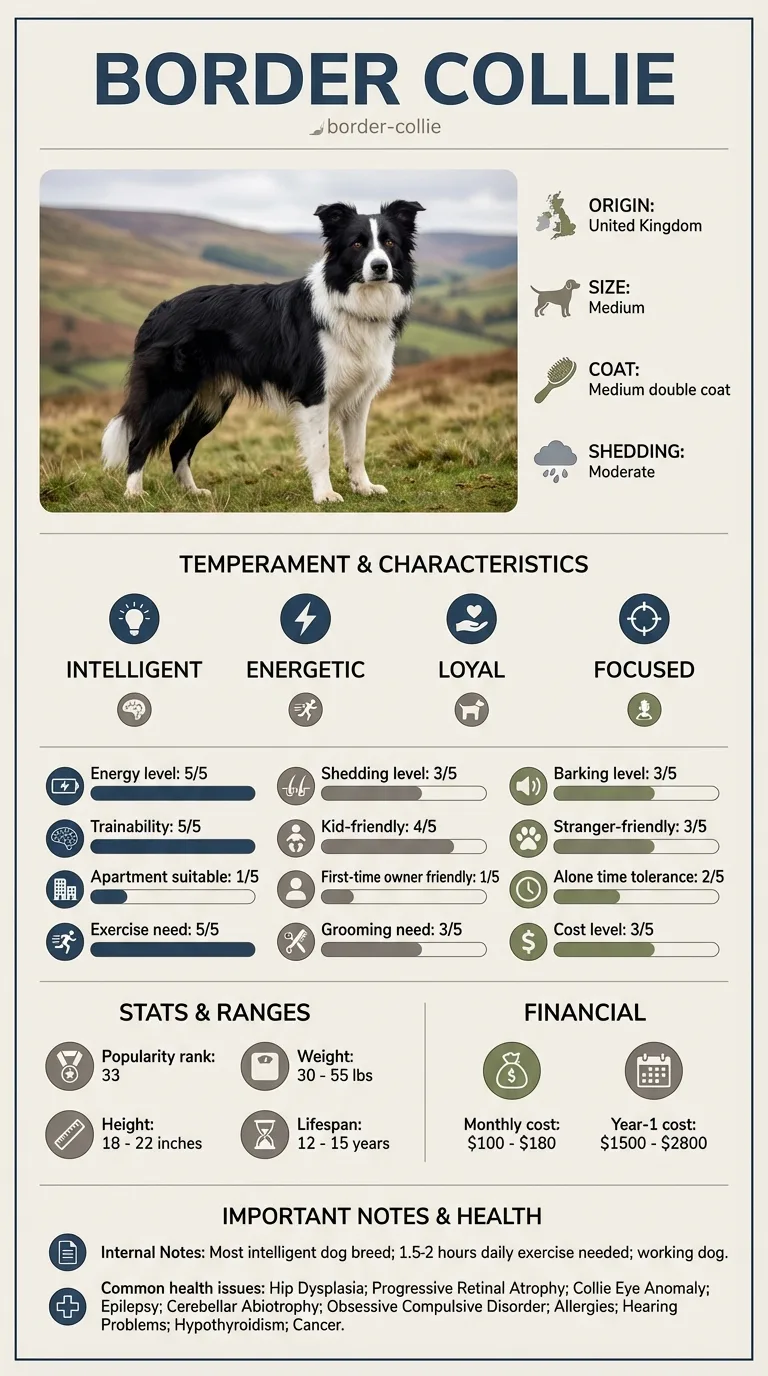
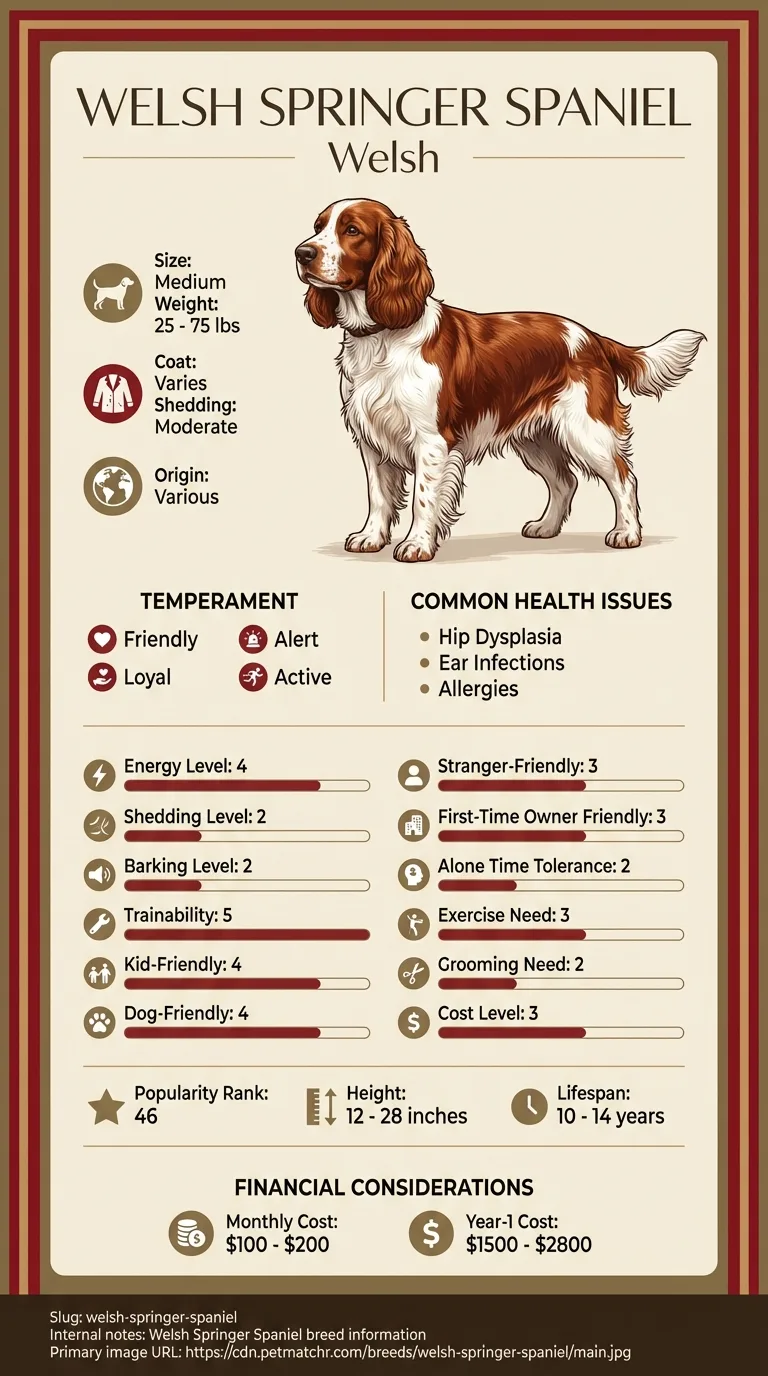
This is for someone already down to Border Collie and Welsh Springer Spaniel and deciding between them. For this pair the decision usually turns on good for first-time owners, so those are covered first and in most detail. Anyone choosing from a flat has a clear answer here: Welsh Springer Spaniel rates 2/5 against 1/5. The focus throughout is on daily consequences rather than breed background.
Between Border Collie and Welsh Springer Spaniel, good for first-time owners is what separates them, and Welsh Springer Spaniel is the lower-effort dog of the two to keep.
Choose Border Collie if you want a dog that picks up training quickly, a smaller dog suits your car, your home or your back and you want a dog that can keep up with an active routine.
Choose Welsh Springer Spaniel if this is your first dog and your walking routine is modest.
| Feature | border collie | welsh springer spaniel | Winner |
|---|---|---|---|
| Size class | medium | medium | Equal |
| Weight | 30–55 lbs | 35–55 lbs | Equal |
| Height | 18–22 in | 17–19 in | Equal |
| Lifespan | 12–15 years | 12–15 years | Equal |
| Exercise need | Very high (5/5) | High (4/5) | welsh springer spaniel |
| Grooming need | Moderate (3/5) | Moderate (3/5) | Equal |
| Shedding | Moderate (3/5) | Moderate (3/5) | Equal |
| Energy level | Very high (5/5) | High (4/5) | Equal |
| Barking | Moderate (3/5) | Moderate (3/5) | Equal |
| Apartment suitability | Very low (1/5) | Low (2/5) | welsh springer spaniel |
| Good for first-time owners | Very low (1/5) | Moderate (3/5) | welsh springer spaniel |
| Tolerates being alone | Low (2/5) | Low (2/5) | Equal |
| Trainability | Very high (5/5) | High (4/5) | border collie |
| Good with kids | High (4/5) | High (4/5) | Equal |
| Good with other dogs | High (4/5) | High (4/5) | Equal |
| Friendly to strangers | Moderate (3/5) | Moderate (3/5) | Equal |
| Cost level | Moderate (3/5) | Moderate (3/5) | Equal |
| Coat | Medium double coat | Medium, straight and water-resistant | Equal |
| Origin | United Kingdom | Various | Equal |
| Typical monthly cost | $100–$180 | $100–$200 | Equal |
| Typical first-year cost | $1,500–$2,800 | $1,400–$2,900 | Equal |
Both breeds land in the medium class with genuinely overlapping ranges: 30-55 lbs and 18-22 inches for the Collie, 35-55 lbs and 17-19 inches for the Welsh Springer Spaniel. If you lined up an average dog from each breed side by side, you'd be hard-pressed to guess which was which by size alone.
The Collie edges ahead at 5/5 exercise need against the Welsh Springer's still-substantial 4/5. Both are working-line dogs at heart -- herding for one, flushing game for the other -- and both want more than a lap around the block. The gap here is real but smaller than in most Collie comparisons.
Grooming and shedding are identical on paper -- both rate a moderate 3/5 for each. The coats themselves differ in texture (the Collie's medium double coat versus the Springer's water-resistant, slightly wavy one), but the maintenance burden works out about the same: regular brushing, no professional grooming required.
Apartment living is a stretch for both, though the Welsh Springer is marginally more workable at 2/5 versus the Collie's 1/5. Barking rates identically at moderate 3/5 for both. Neither breed is a realistic small-space dog -- this pairing is really about which one is less unrealistic.
The Collie's trainability tops out at 5/5, the Welsh Springer close behind at 4/5 -- both respond well to structured work. First-time-owner suitability separates them more clearly: 3/5 for the Springer against just 1/5 for the Collie, making the Springer the more realistic choice for someone newer to dog ownership.
This is an unusually even matchup: kids (4/5), other dogs (4/5), strangers (3/5), and tolerating alone time (2/5) all score identically for both breeds. If household sociability is your main filter, this comparison doesn't help you choose -- you'll need to look at exercise need or first-time suitability instead.
Lifespan matches exactly at 12-15 years for both. Health is where the Welsh Springer pulls ahead on paper -- its list runs just five conditions against the Collie's ten, and three of those five (hip dysplasia, epilepsy, hypothyroidism) are shared anyway. The Collie's extra risks are largely eye- and neurological-related, tied to its herding-dog lineage.
Costs run close: $100-180 monthly for the Collie against $100-200 for the Springer, with first-year totals essentially matching at $1,500-2,800 and $1,400-2,900. Both rate moderate (3/5) overall. There's no meaningful budget argument for choosing one over the other here.
Border Collie weighs 30–55 lbs and lives 12–15 years; Welsh Springer Spaniel weighs 35–55 lbs and lives 12–15 years. The two diverge most on good for first-time owners. They are level on tolerates being alone, barking and cost level, so those cannot decide it. The table below marks a winner only where one breed is genuinely easier for a typical owner; size and origin are facts rather than merits and stay level. Ratings come from one source applied to both breeds, so they are meaningful against each other rather than as absolute scores.

Very similar -- both fall in the medium class, with the Collie at 30-55 lbs/18-22 inches and the Welsh Springer Spaniel at 35-55 lbs/17-19 inches. Size isn't a useful way to choose between them.
Neither -- both rate an identical moderate 3/5 for shedding and grooming effort. Expect similar weekly brushing routines regardless of which you pick.
The Welsh Springer Spaniel, rated 3/5 for first-time-owner suitability against the Collie's very low 1/5, even though the Collie trains slightly better overall (5/5 versus 4/5).
Not really, though the Springer is somewhat more workable at 2/5 versus the Collie's 1/5. Both were bred for outdoor work and do better with yard access.
Minimal -- $100-180 monthly for the Collie against $100-200 for the Springer, with nearly identical first-year totals around $1,400-2,900. Budget isn't a deciding factor here.
Yes, three of the Springer's five listed conditions -- hip dysplasia, epilepsy, and hypothyroidism -- also appear on the Collie's longer ten-condition list. The Springer's overall health profile is simpler.
The Collie, slightly -- 5/5 against the Springer's 4/5. Both are working-bred dogs that need real daily exercise, just with the Collie needing a touch more.
These two are close on almost every measure; lean toward the Springer if you're a first-time owner or want a shorter health-risk list, toward the Collie if you want maximum trainability.
Nearly identical: $100-180 for the Collie versus $100-200 for the Springer.
Both are high-energy working breeds -- 5/5 for the Collie, 4/5 for the Springer -- needing more than a casual daily walk.
Neither -- both typically live 12-15 years, an exact match.
Secure checkout on Stripe. We never see your card.
7-day money-back guarantee. Instant access.


Health information here is general and is not veterinary advice. If your dog shows pain, sudden behaviour change, or worsening symptoms, consult a licensed veterinarian.
Some links on this site are affiliate links. We may earn a commission at no extra cost to you, and we only suggest products we believe are helpful for dog owners.
We research and check what we publish, but we do not warrant that any figure, date, price, or statement is accurate, complete, or current, and we accept no liability for any loss, cost, injury, or other harm arising from the use of this site. Use it as one reference among several. You remain responsible for your own decisions and for your dog's care - confirm anything that matters with a licensed veterinarian or another qualified professional before you act on it. Full disclaimer.
Match your lifestyle to the right dog.
Take quizNot sure which breed is right for you? Take our 2-minute quiz to find out.
Take the quiz