Health
Should every Weimaraner get a preventive gastropexy?
It's not mandatory, but most vets recommend it given the breed's elevated lifetime risk, especially when combined with another planned surgery.

Quick answer
Should every Weimaraner get a preventive gastropexy?
It's not mandatory, but most vets recommend it given the breed's elevated lifetime risk, especially when combined with another planned surgery.
Bloat isn't something a Weimaraner outgrows or ages out of; the same deep chest that makes a puppy look elegant is still there at age twelve. That means the planning decisions, gastropexy, insurance, feeding routine, are ones you'll live with for the dog's whole life.
This affects owners weighing a preventive gastropexy decision, owners who've already been through one bloat episode and are managing recurrence risk, and anyone budgeting for the possibility of a major emergency surgery over their dog's lifetime.
This guide is not medical advice. If your dog shows pain, sudden behavior change, or worsening symptoms, consult a licensed veterinarian.
Some links may be affiliate links. We may earn a commission at no extra cost to you. We only suggest products we believe are helpful for dog owners.
We research and check what we publish, but we do not warrant that any figure, date, price, or statement is accurate, complete, or current, and we accept no liability for any loss, cost, injury, or other harm arising from the use of this site. Use it as one reference among several. You remain responsible for your own decisions and for your dog's care - confirm anything that matters with a licensed veterinarian or another qualified professional before you act on it. Full disclaimer.
Because deep chest conformation doesn't change as a Weimaraner ages, bloat risk is a lifelong consideration rather than a puppyhood or senior-specific concern. Long-term planning centers on whether to pursue a preventive gastropexy, how to budget for the possibility of an emergency, and how to keep every caretaker informed of the warning signs.
Lifetime bloat risk for deep-chested breeds like the Weimaraner is high enough that many veterinary practices bring up preventive gastropexy proactively, rather than waiting for owners to ask, which reflects how seriously the profession treats this as an ongoing, not one-time, risk.
The Weimaraner's deep chest conformation is permanent and doesn't change with age, training, or diet, meaning the anatomical risk factor behind bloat is present for the dog's entire life, not just during a vulnerable phase.
Consistency of feeding routine, caretaker awareness, and whether a preventive gastropexy has been performed all shape how that lifelong anatomical risk translates into an actual event or not over the years.
Bring up gastropexy timing at any routine visit, not just when scheduling a spay or neuter. If your dog has already had one bloat episode without a gastropexy performed, talk to your vet promptly about scheduling one, since recurrence risk without it is significant.
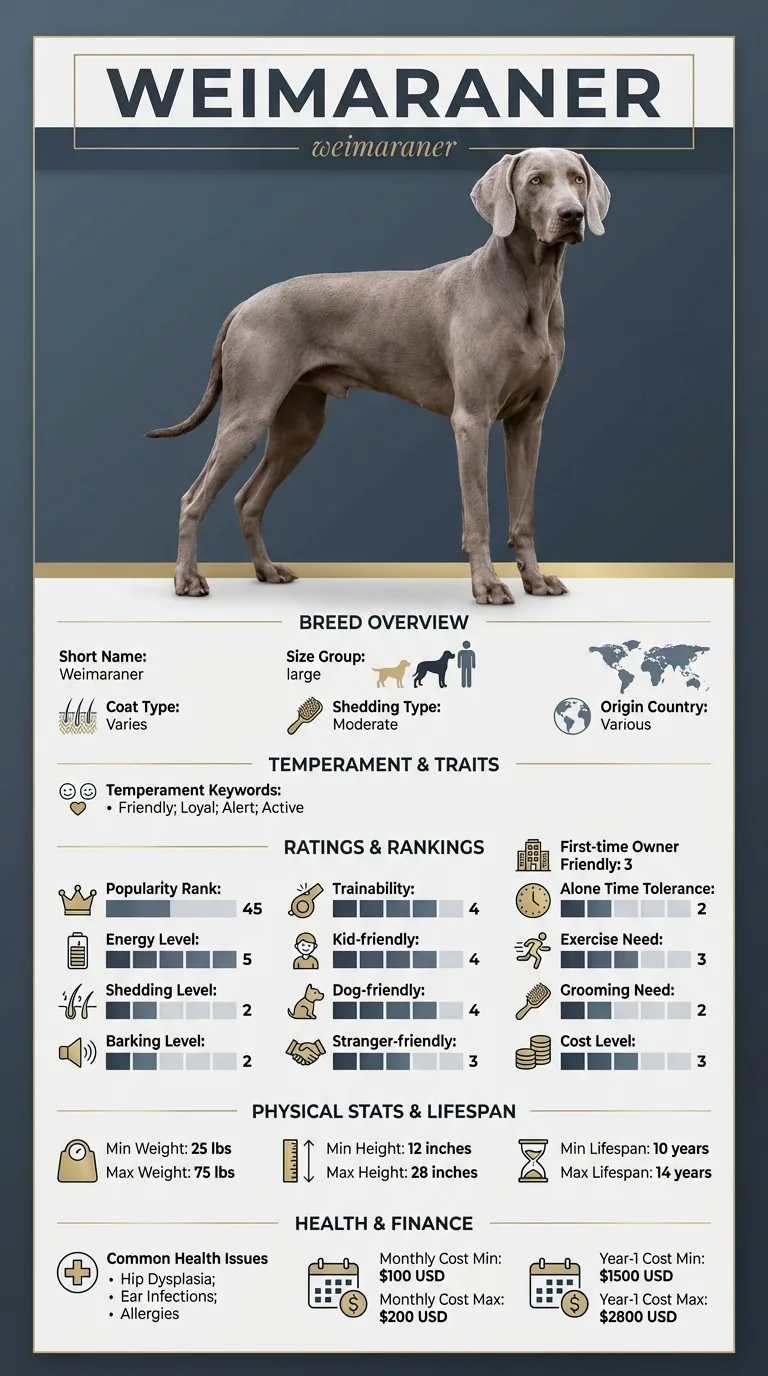
See all Weimaraner health problems, which breeds are prone to gastric dilatation volvulus gdvbloat, or the full Weimaraner breed guide for temperament, exercise needs and ownership costs.
This is a lifelong consideration rather than something resolved at any single point; the anatomical risk factor is present from puppyhood through the senior years.
Success is having a clear plan in place, whether that's a gastropexy, disciplined feeding routines, adequate insurance or savings, or some combination, so that this breed's known risk never turns into an unmanaged crisis.
A prophylactic gastropexy tacks the stomach to the abdominal wall before a dog ever bloats, and it is the single most effective step available for reducing GDV risk in a high-risk breed. The decision usually comes down to timing and cost rather than whether it's worthwhile: many vets recommend doing it laparoscopically at the same time as a spay or neuter, which keeps the added cost and anesthesia time relatively modest compared to a standalone procedure later.
A gastropexy dramatically lowers the chance of a fatal rotation, but it's worth being clear about what it does not do: a dog can still develop gastric dilatation, the stomach filling with gas, even after a gastropexy. What the surgery prevents is the far more dangerous rotation. Some owners choose to skip it and rely entirely on feeding management instead; that's a valid choice too, but it means carrying a higher lifetime risk that a single feeding mistake or unlucky moment could still result in an emergency.
If your Weimaraner has already had one bloat episode treated without a gastropexy at the time, recurrence risk without one is substantial, and most vets strongly recommend addressing this during recovery or as soon as reasonably possible afterward.
These are the decisions that matter most over a Weimaraner's full lifetime, not just in the first year.

If you think your Weimaraner has gastric dilatation-volvulus (gdv/bloat), the plan is three steps: write down what you have seen and when it started, book a veterinary appointment rather than waiting for the next flare, and take video of the behaviour or symptom before you go — the thing you are worried about rarely happens in the consulting room. Screening in the parents covers bloat (gdv), hip dysplasia, hypertrophic osteodystrophy.
What the vet visit should produce is a diagnosis and a written plan, not just reassurance: what is being ruled out, what the monitoring interval is, and which signs mean you come back sooner. Ask what the treatment costs across a year rather than per visit, because that is the number that decides whether you are managing this condition or reacting to it.
Between appointments, keep a short log — dates, what you saw, what changed. It is the single most useful thing an owner brings to a follow-up, and for gastric dilatation-volvulus (gdv/bloat) it is often what separates a clear pattern from a guess.
When Wren adopted her second Weimaraner, Birch, she already knew from her first dog's bloat episode years earlier just how fast and expensive an emergency could get. This time, she scheduled a gastropexy alongside Birch's spay at six months old, enrolled in pet insurance before any symptoms had ever occurred, and set a strict two-meals-a-day routine that her dog walker followed exactly. Birch is now nine years old and has never had a bloat episode. Wren credits the difference not to luck, but to treating the risk as a permanent fact of owning this breed rather than a one-time scare to get past.
Key takeaway: Wren's first experience with bloat taught her that this risk doesn't fade with a dog's age or good behavior. Planning for it as a lifelong fact, rather than a single crisis to survive, is what changed the outcome the second time around.
Most vets consider it worthwhile given the breed's elevated lifetime bloat risk, particularly when combined with an already-planned spay or neuter to reduce the added cost and anesthesia exposure.
It prevents the dangerous rotation (volvulus), which is the life-threatening part, but a dog can still develop gastric distension afterward. It dramatically lowers risk without eliminating it entirely.
It's substantial, which is why most vets strongly recommend a gastropexy either during the initial emergency surgery or as soon as possible afterward if it wasn't done at the time.
Many owners find it worthwhile given how costly and unpredictable GDV emergencies are, though coverage details and pre-existing condition rules vary by provider, so it's worth researching before you need it, not after.
Feeding management, smaller meals, and activity timing meaningfully reduce risk factors, but they don't remove the underlying anatomical risk the way a gastropexy does. Many owners combine both approaches.
Explain the breed's elevated risk plainly, share the key warning signs, and confirm they know to seek emergency care immediately rather than waiting to see if symptoms pass.
No, dogs recover normally and go on to live active, unrestricted lives after the initial recovery period. The surgery doesn't limit exercise, diet, or activity long-term.
It's not mandatory, but most vets recommend it given the breed's elevated lifetime risk, especially when combined with another planned surgery.
No, it prevents the dangerous rotation but a dog can still develop stomach distension. It significantly reduces, but doesn't remove, risk.
Many owners consider it worthwhile specifically because of bloat risk, given how costly and unpredictable emergency surgery can be.
Explain the key warning signs plainly and make sure they know to seek emergency care immediately rather than waiting.
A standalone procedure generally costs more than adding it to an already-scheduled spay, neuter, or other abdominal surgery, since anesthesia and facility costs are shared.
A one-page prep sheet for this condition: the signs, the questions to ask, what to get priced. Unlocks here.
You get: Vet visit prep sheet
No spam. One-click unsubscribe. See our privacy policy.
Preview page 1 before you decide.