Health
Why do Weimaraners bloat more than shallow-chested breeds?
Their deep, narrow chest gives the stomach more physical room to rotate, which is the mechanical cause of GDV.

Quick answer
Why do Weimaraners bloat more than shallow-chested breeds?
Their deep, narrow chest gives the stomach more physical room to rotate, which is the mechanical cause of GDV.
Bloat is listed among the documented health issues for Weimaraners for a reason that comes down to simple geometry: this breed's deep chest gives the stomach more room to rotate than a barrel-chested dog's does.
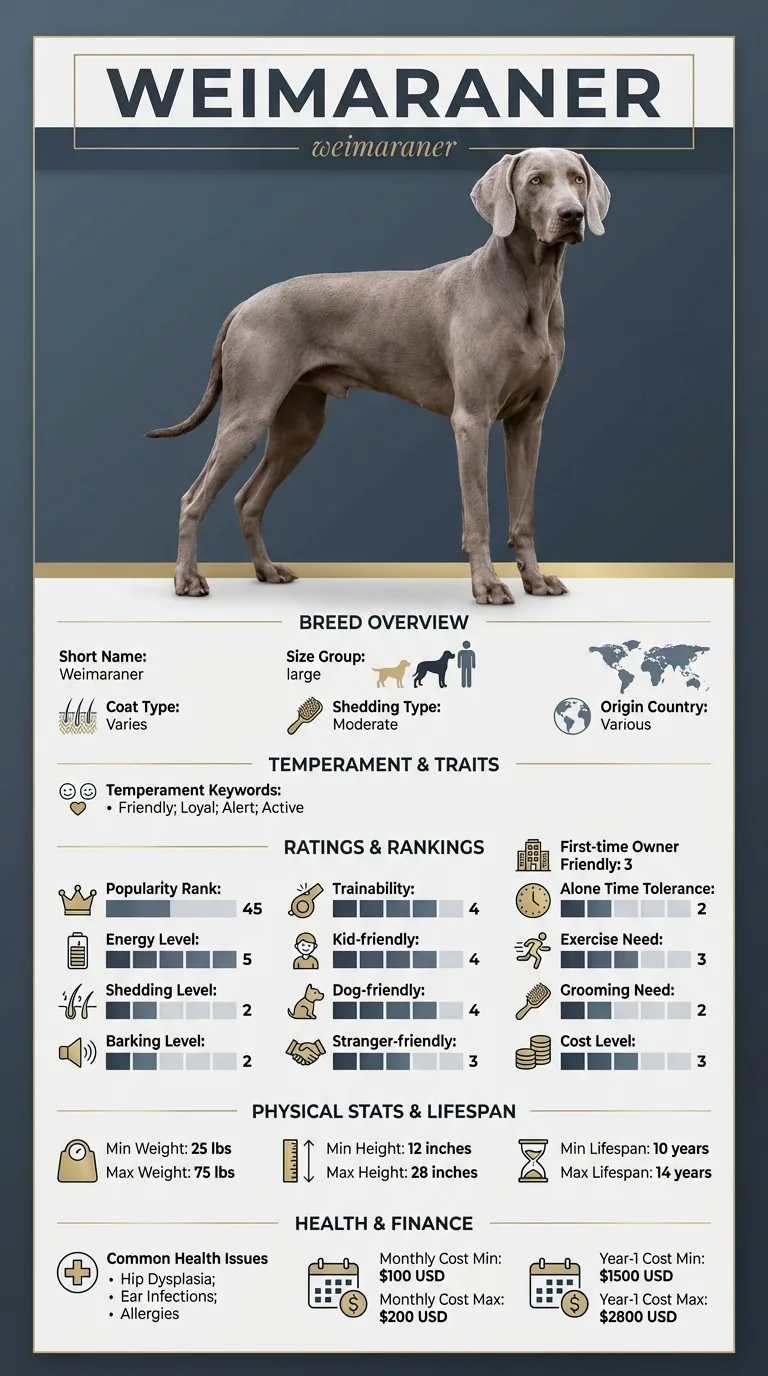
This affects every Weimaraner owner, since deep chest conformation is a breed-wide trait, not something that affects only certain lines or certain dogs.
This guide is not medical advice. If your dog shows pain, sudden behavior change, or worsening symptoms, consult a licensed veterinarian.
Some links may be affiliate links. We may earn a commission at no extra cost to you. We only suggest products we believe are helpful for dog owners.
We research and check what we publish, but we do not warrant that any figure, date, price, or statement is accurate, complete, or current, and we accept no liability for any loss, cost, injury, or other harm arising from the use of this site. Use it as one reference among several. You remain responsible for your own decisions and for your dog's care - confirm anything that matters with a licensed veterinarian or another qualified professional before you act on it. Full disclaimer.
Gastric dilatation-volvulus happens when a dog's stomach fills with gas and then rotates on its own axis, trapping gas and cutting off blood supply. A deep, narrow chest, a defining trait of the Weimaraner's build, gives the stomach the physical room needed to complete that rotation, making this one of the breed's most serious documented health risks.
Deep-chested breeds, Weimaraners included, are consistently among the highest-risk breeds for GDV in veterinary studies, with lifetime risk considerably higher than in shallow-chested breeds. This is one of the reasons preventive gastropexy is discussed so often for this breed specifically.
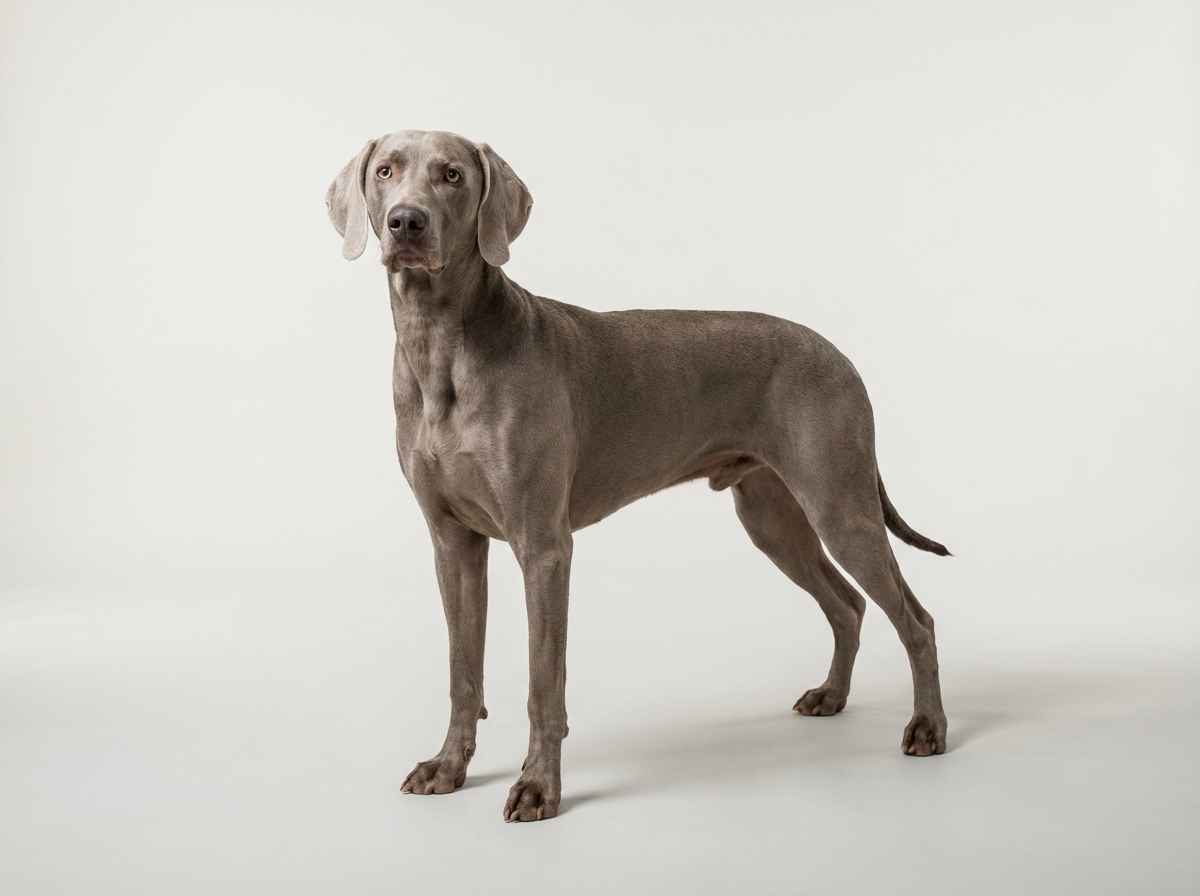
The Weimaraner's deep, narrow chest is a defining, breed-standard trait, and it is also the direct anatomical reason this breed carries elevated bloat risk. A deep chest gives the stomach more vertical space to shift within the abdomen than a shallow-chested dog's anatomy allows, creating the physical conditions needed for the stomach to rotate.
Large, fast meals, exercise too close to eating, and rapid eating that causes air-gulping all increase how quickly and how much the stomach fills, raising the odds that it shifts enough to rotate. Stressful or high-excitement environments around mealtime can compound this.
This condition has no safe home management; treat it as a same-hour emergency. A distended, hard abdomen, unproductive retching without bringing anything up, restlessness or pacing, drooling, or a rapid decline in the hour or two after a meal all warrant an immediate trip to the vet or emergency clinic. Do not wait to see if it passes.
See all Weimaraner health problems, which breeds are prone to bloat gastric dilatation volvulusgdv, or the full Weimaraner breed guide for temperament, exercise needs and ownership costs.
GDV is a surgical emergency measured in hours, not days; a dog showing symptoms needs to be at a vet within that same window. Recovery from emergency GDV surgery typically takes one to two weeks, with activity restrictions during that time.
Success is prevention working as intended: consistent feeding practices, and for many owners, a prophylactic gastropexy, mean this breed's elevated anatomical risk never turns into an actual emergency.
A dog's stomach is held in place by ligaments, but those ligaments can only do so much. In a deep, narrow chest like a Weimaraner's, there's more vertical space for the stomach to move within the abdominal cavity. When the stomach fills with gas or food and then shifts, usually during a period of activity soon after eating, it has enough room to rotate on its own axis. That rotation, the volvulus part of GDV, closes off the stomach's entry and exit points, trapping gas inside and cutting off blood supply to the stomach wall and, in severe cases, the spleen.
This is why bloat is fundamentally different from ordinary indigestion or a distended stomach that isn't twisted: dilatation alone is uncomfortable but survivable, while volvulus cuts off blood flow and becomes fatal within hours without surgery. A shallow-chested breed's stomach has far less room to complete that rotation, which is part of why deep-chested breeds like Weimaraners, Great Danes, and Standard Poodles appear so consistently at the top of bloat-risk lists.
This mechanical explanation also clarifies why prevention focuses on reducing the conditions that let the stomach fill and shift quickly, rather than on any medication or supplement. There is no safe home treatment for bloat once it starts; the anatomy that causes it also means only surgery can correct it.
Some long-standing bloat advice turns out not to hold up; here's what's actually supported by veterinary research for a deep-chested breed.

If you think your Weimaraner has bloat (gastric dilatation-volvulus/gdv), the plan is three steps: write down what you have seen and when it started, book a veterinary appointment rather than waiting for the next flare, and take video of the behaviour or symptom before you go — the thing you are worried about rarely happens in the consulting room. Screening in the parents covers bloat (gdv), hip dysplasia, hypertrophic osteodystrophy.
What the vet visit should produce is a diagnosis and a written plan, not just reassurance: what is being ruled out, what the monitoring interval is, and which signs mean you come back sooner. Ask what the treatment costs across a year rather than per visit, because that is the number that decides whether you are managing this condition or reacting to it.
Between appointments, keep a short log — dates, what you saw, what changed. It is the single most useful thing an owner brings to a follow-up, and for bloat (gastric dilatation-volvulus/gdv) it is often what separates a clear pattern from a guess.
When Ben adopted his Weimaraner puppy, Scout, his vet brought up gastropexy at the very first puppy visit, explaining the breed's deep chest put her at real risk over her lifetime. Ben was initially skeptical about scheduling surgery for a healthy puppy, until his vet walked him through the mechanics of how the rotation happens and showed him the research on breed-specific risk. Ben scheduled a gastropexy alongside Scout's spay at six months old. He also switched her to two smaller daily meals and stopped using her raised bowl after learning about the Purdue study. Scout is now seven, active, and has never had a bloat episode.
Key takeaway: Understanding the actual mechanics behind bloat, rather than treating it as vague bad luck, is what convinced Ben that a preventive surgery on a healthy puppy made sense for this specific breed.
Their deep, narrow chest gives the stomach more room to shift and rotate than a shallow-chested dog's anatomy allows, which is the mechanical basis for gastric dilatation-volvulus.
Not exactly. Bloat, or gastric dilatation, is the stomach filling with gas and distending. GDV includes the volvulus, meaning the stomach has also rotated, cutting off blood flow. GDV is the life-threatening version and the one that needs emergency surgery.
No. A widely cited Purdue University study actually found raised bowls associated with a higher risk of bloat in large, deep-chested breeds, the opposite of what many owners assume.
It's a surgical procedure that tacks the stomach to the abdominal wall to prevent it from rotating, done proactively before a dog ever bloats. Many vets recommend it for high-risk breeds, often timed with a spay or neuter.
No. There is no safe home treatment for gastric dilatation-volvulus. It requires emergency veterinary care and, in true GDV cases, surgery, since the underlying anatomy problem cannot be corrected any other way.
It varies by clinic and region, generally running into several hundred to over a thousand dollars as a standalone procedure, though the cost is often lower when combined with a planned spay or neuter.
Smaller, more frequent meals reduce how much the stomach fills at once, which is one of several practical steps that lower risk, though no feeding change eliminates risk entirely in a deep-chested breed.
Deep chest conformation, which underlies the risk, is a breed-standard trait rather than something that varies dog to dog. A family history of bloat in close relatives is also considered a risk factor worth mentioning to your vet.
Their deep, narrow chest gives the stomach more physical room to rotate, which is the mechanical cause of GDV.
No, research has actually linked raised bowls to higher bloat risk in large breeds, not lower.
A prophylactic gastropexy, a surgery that anchors the stomach in place, is the most effective preventive measure for a high-risk breed.
Typically several hundred to over a thousand dollars, often less when combined with a spay or neuter already being planned.
No, there is no home treatment. GDV is a surgical emergency and needs immediate veterinary care.
A one-page prep sheet for this condition: the signs, the questions to ask, what to get priced. Unlocks here.
You get: Vet visit prep sheet
No spam. One-click unsubscribe. See our privacy policy.
Preview page 1 before you decide.