Living
Which is bigger?
The Rottweiler Mix, at up to 135 lbs versus the Sheltie's 25 lbs max.

Quick answer
Which is bigger?
The Rottweiler Mix, at up to 135 lbs versus the Sheltie's 25 lbs max.
Rottweiler Mix or Shetland Sheepdog? On paper they differ most on barking, and on the scales Rottweiler Mix is the heavier at 80–135 lbs. Here is how the two compare on everything that shapes an ordinary week.
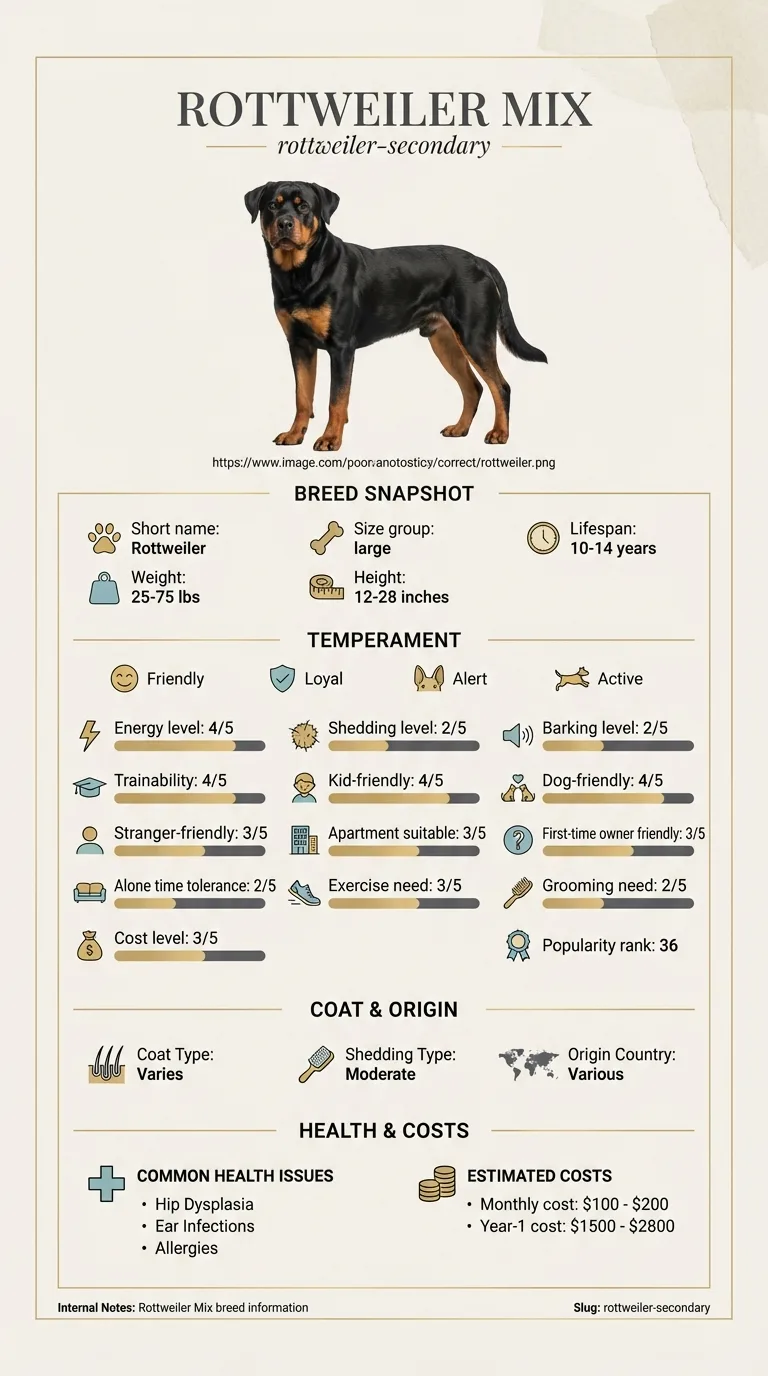
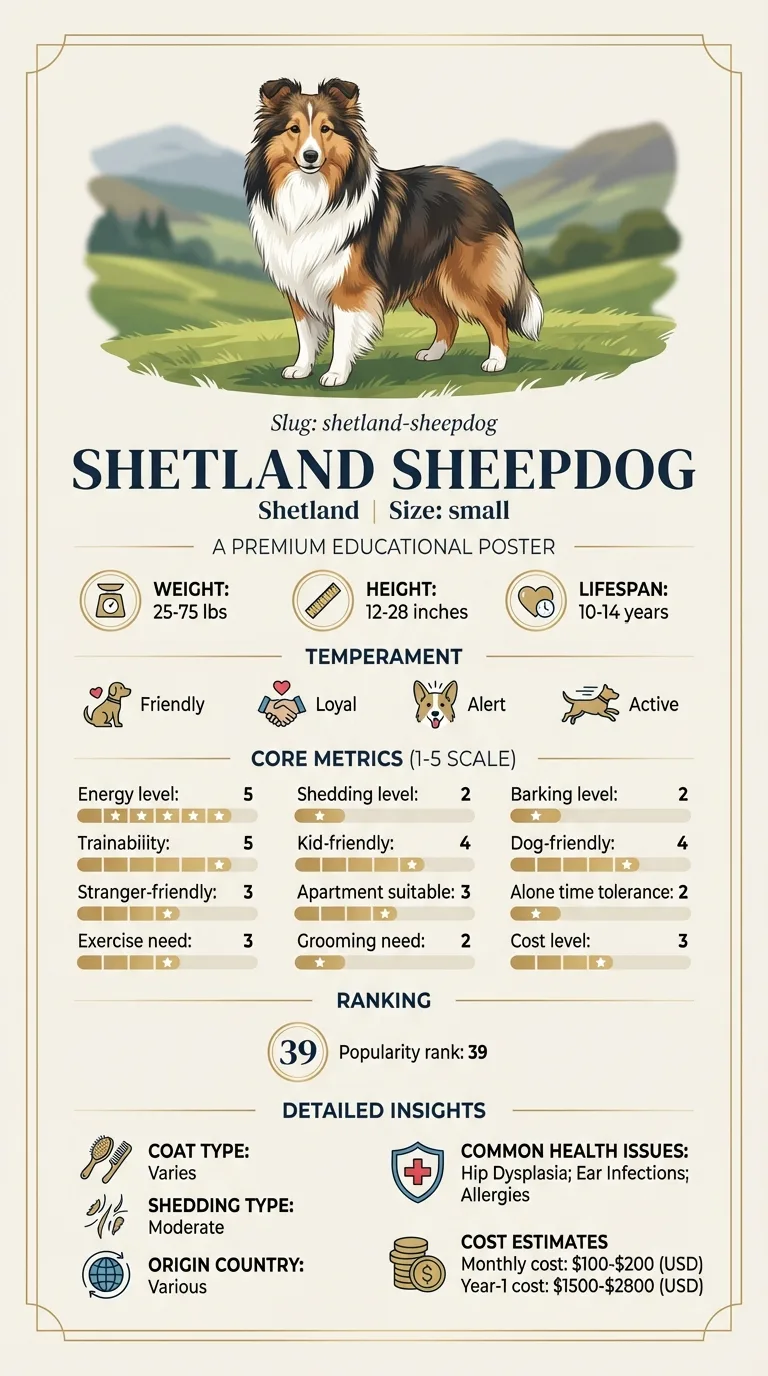
This is for someone already down to Rottweiler Mix and Shetland Sheepdog and deciding between them. For this pair the decision usually turns on barking and grooming need, so those are covered first and in most detail. Anyone choosing from a flat has a clear answer here: Shetland Sheepdog rates 3/5 against 2/5. Breed history is left out; what follows is what you will actually live with.
Between Rottweiler Mix and Shetland Sheepdog, barking is what separates them; neither is the lower-effort dog overall.
Choose Rottweiler Mix if you do not want a standing grooming appointment, shedding is a problem in your house and the dog will be alone during the working day.
Choose Shetland Sheepdog if you are in a flat or a smaller home, this is your first dog and there are young children at home.
| Feature | rottweiler secondary | shetland sheepdog | Winner |
|---|---|---|---|
| Size class | large | small | Equal |
| Weight | 80–135 lbs | 15–25 lbs | Equal |
| Height | 22–27 in | 13–16 in | Equal |
| Lifespan | 9–10 years | 12–14 years | shetland sheepdog |
| Exercise need | High (4/5) | High (4/5) | Equal |
| Grooming need | Low (2/5) | High (4/5) | rottweiler secondary |
| Shedding | Moderate (3/5) | High (4/5) | rottweiler secondary |
| Energy level | Moderate (3/5) | High (4/5) | Equal |
| Barking | Low (2/5) | Very high (5/5) | rottweiler secondary |
| Apartment suitability | Low (2/5) | Moderate (3/5) | shetland sheepdog |
| Good for first-time owners | Low (2/5) | High (4/5) | shetland sheepdog |
| Tolerates being alone | Moderate (3/5) | Low (2/5) | rottweiler secondary |
| Trainability | High (4/5) | Very high (5/5) | shetland sheepdog |
| Good with kids | Moderate (3/5) | High (4/5) | shetland sheepdog |
| Good with other dogs | Low (2/5) | High (4/5) | shetland sheepdog |
| Friendly to strangers | Low (2/5) | Low (2/5) | Equal |
| Cost level | High (4/5) | Moderate (3/5) | shetland sheepdog |
| Coat | Short, dense double coat | Long, dense double coat | Equal |
| Origin | Various | Various | Equal |
| Typical monthly cost | $110–$240 | $80–$150 | Equal |
| Typical first-year cost | $1,700–$3,200 | $1,100–$2,300 | Equal |
Picture the two side by side: an 80-to-135-lb Rottweiler Mix standing 22-27 inches next to a 15-to-25-lb Shetland Sheepdog barely reaching 13-16 inches -- roughly a sixth of the Rottweiler Mix's mass. This isn't a subtle size gap, it's a different weight class entirely, closer to comparing a linebacker to a lean distance runner. That difference cascades into everything from leash-pulling risk (a Sheltie is far easier to physically control) to how much space each needs to turn around indoors. Anyone torn between these two is essentially choosing between substantial physical presence and a compact, herding-dog build.
Both breeds tie at High (4/5) exercise need, which surprises owners who assume a 20-lb dog needs less activity than an 80-plus-lb one -- the Shetland Sheepdog's herding heritage means it wants to run, chase, and work just as much as the Rottweiler Mix, just across a smaller stride. Energy level nudges higher for the Sheltie (High 4/5 vs Moderate 3/5 for the Rottweiler Mix), often showing up as quicker reflexes and more reactive movement to motion. A yard game of fetch tires the Rottweiler Mix through sheer effort; the same game tires the Sheltie through repetition and mental engagement.
Grooming and shedding both favor the Rottweiler Mix here: Low (2/5) grooming versus the Sheltie's High (4/5), and Moderate (3/5) shedding versus the Sheltie's High (4/5). The Shetland Sheepdog's long, dense double coat sheds seasonally in significant volume and mats easily around the ears and britches without regular brushing -- often three or more sessions a week during coat blow. The Rottweiler Mix's short, dense double coat is comparatively low-maintenance, needing just a weekly brush. Households sensitive to loose hair on furniture should expect noticeably more coat management with the Sheltie despite its smaller overall size.
Noise is the deciding factor for apartment living here, and it isn't close: the Shetland Sheepdog rates Very High (5/5) for barking against the Rottweiler Mix's Low (2/5), a direct result of its Vocal, herding-bred temperament that alerts to nearly every stimulus. Apartment suitability still edges toward the Sheltie, Moderate (3/5) versus Low (2/5) for the Rottweiler Mix, mostly on size alone. But tolerating being alone favors the Rottweiler Mix, Moderate (3/5) against the Sheltie's Low (2/5) -- a Sensitive, Devoted dog that can develop anxious barking when left solo for long stretches, which compounds the noise problem in shared walls.
Trainability tilts toward the Shetland Sheepdog, Very High (5/5) against the Rottweiler Mix's already-solid High (4/5), and its Bright temperament makes it one of the more responsive breeds to positive reinforcement. The good-for-first-time-owners gap is wider still: Low (2/5) for the Rottweiler Mix versus High (4/5) for the Sheltie. That said, a Sensitive temperament means the Sheltie doesn't respond well to harsh corrections and can shut down or become fearful -- a different kind of handling skill than the firm, confident leadership a Confident, Watchful Rottweiler Mix requires. Easier doesn't mean identical in approach.
The Shetland Sheepdog outperforms the Rottweiler Mix with kids (High 4/5 vs Moderate 3/5) and other dogs (High 4/5 vs Low 2/5), while both tie at Low (2/5) with strangers -- the Sheltie's watchfulness toward unfamiliar people mirrors the Rottweiler Mix's reserve, just expressed as barking rather than physical wariness. Its Devoted, Bright nature makes it an attentive family shadow, often bonding tightly with children who play predictably and gently. The Rottweiler Mix's Loyal, Steady disposition still works well in a calm household, but multi-dog homes or busy kid-heavy households will generally find the Sheltie's temperament easier to integrate.
The Shetland Sheepdog's 12-14 year lifespan beats the Rottweiler Mix's 9-10 by a meaningful margin. Its health list -- Collie Eye Anomaly, MDR1 Drug Sensitivity, Dermatomyositis, Hypothyroidism, Patellar Luxation -- centers on inherited eye conditions and a drug-sensitivity gene that vets need to know about before prescribing certain medications like ivermectin. The Rottweiler Mix's list, by contrast, leans toward orthopedic and cardiac strain: Hip Dysplasia, Elbow Dysplasia, Osteosarcoma, Subaortic Stenosis, and Cruciate Ligament Tears, conditions more typical of a large, heavy-muscled breed carrying significant body weight through years of active exercise. Both lists warrant genetic screening before adopting from a breeder.
Cost level favors the Sheltie clearly, Moderate (3/5) against the Rottweiler Mix's High (4/5), and the dollar ranges confirm it: $80-$150 monthly and $1,100-$2,300 first-year for the Sheltie versus $110-$240 monthly and $1,700-$3,200 for the Rottweiler Mix. Smaller body mass means less food, smaller medication doses, and often lower baseline vet fees. The one line item that can narrow the gap is grooming -- the Sheltie's High (4/5) grooming need may mean regular professional sessions that a Low (2/5)-grooming Rottweiler Mix skips, so budget-conscious owners should factor coat care into the total, not just the headline monthly figure.
Rottweiler Mix weighs 80–135 lbs and lives 9–10 years; Shetland Sheepdog weighs 15–25 lbs and lives 12–14 years. The two diverge most on barking, grooming need and good for first-time owners and 1 other rated axes. They are level on exercise need and friendly to strangers, so those cannot decide it. The comparison marks an easier option only where one exists. Facts like weight and country of origin are not scored. Both dogs are rated from the same dataset, which is what makes the numbers comparable with each other even though any individual dog sits somewhere inside its breed's range.

No -- both tie at High (4/5) exercise need, since the Sheltie's herding instincts demand real activity despite its compact 15-25 lb frame.
The Shetland Sheepdog by far, rated Very High (5/5) versus Low (2/5) for the Rottweiler Mix -- a trait that can be an issue in close-quarters housing.
Yes, it rates High (4/5) with kids compared to the Rottweiler Mix's Moderate (3/5), and its Devoted temperament tends to make it an attentive family companion.
The Shetland Sheepdog, rated High (4/5) shedding against the Rottweiler Mix's Moderate (3/5), largely due to its long double coat's seasonal blowouts.
Generally yes on food and baseline vet costs, with a first-year estimate of $1,100-$2,300 versus $1,700-$3,200, though grooming bills can close some of that gap.
Yes, it's on their health watch-list, meaning certain medications like ivermectin need to be avoided or carefully dosed -- worth flagging to any vet treating a Sheltie.
The Rottweiler Mix, rated Moderate (3/5) for tolerating being alone versus Low (2/5) for the Sheltie, which can develop anxious barking when left solo too long.
The Rottweiler Mix, at up to 135 lbs versus the Sheltie's 25 lbs max.
The Shetland Sheepdog, rated Very High (5/5) versus Low (2/5).
The Shetland Sheepdog, rated High (4/5) versus Low (2/5) for the Rottweiler Mix.
The Shetland Sheepdog, typically 12-14 years versus 9-10 for the Rottweiler Mix.
Secure checkout on Stripe. We never see your card.
7-day money-back guarantee. Instant access.
Health information here is general and is not veterinary advice. If your dog shows pain, sudden behaviour change, or worsening symptoms, consult a licensed veterinarian.
Some links on this site are affiliate links. We may earn a commission at no extra cost to you, and we only suggest products we believe are helpful for dog owners.
We research and check what we publish, but we do not warrant that any figure, date, price, or statement is accurate, complete, or current, and we accept no liability for any loss, cost, injury, or other harm arising from the use of this site. Use it as one reference among several. You remain responsible for your own decisions and for your dog's care - confirm anything that matters with a licensed veterinarian or another qualified professional before you act on it. Full disclaimer.
Match your lifestyle to the right dog.
Take quizNot sure which breed is right for you? Take our 2-minute quiz to find out.
Take the quiz