Health
What does the Sheltie skip look like?
A brief hop with one hind leg held up mid-run, lasting a stride or two, after which the dog carries on normally.

Quick answer
What does the Sheltie skip look like?
A brief hop with one hind leg held up mid-run, lasting a stride or two, after which the dog carries on normally.
Most owners meet it as a habit rather than a diagnosis: the dog runs, skips for two strides with a back leg tucked up, and carries on as if nothing happened.
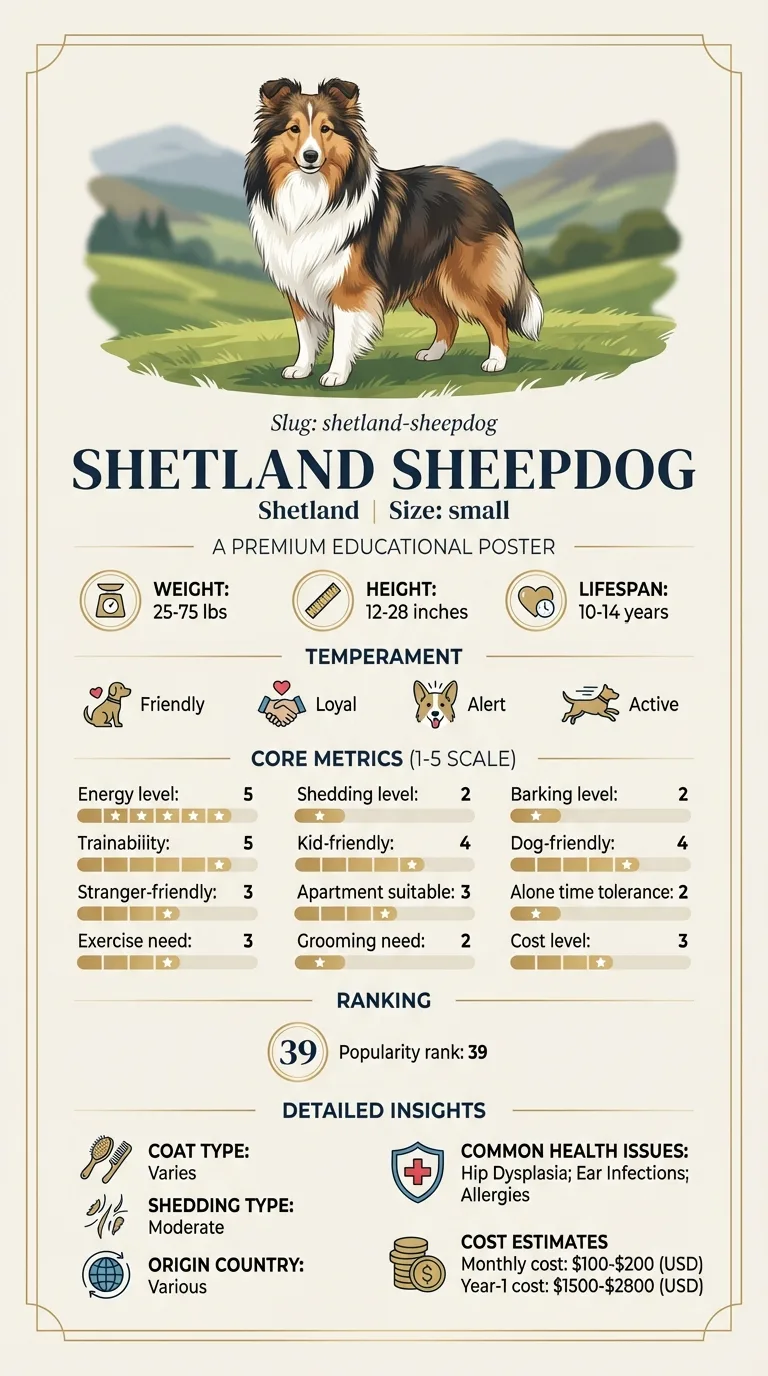
Owners who have seen the skip and been told it is nothing to worry about, and owners trying to work out which parts of the house and which activities are actually making it worse.
This guide is not medical advice. If your dog shows pain, sudden behavior change, or worsening symptoms, consult a licensed veterinarian.
Some links may be affiliate links. We may earn a commission at no extra cost to you. We only suggest products we believe are helpful for dog owners.
A luxating patella is a kneecap that slips out of the groove it should run in and then returns. In Shetland Sheepdogs it is the breed's characteristic orthopaedic condition and it usually presents as an intermittent skipping hop mid-run rather than as obvious lameness. Day to day it changes very little at first, which is precisely the problem, because each dislocation contributes to cartilage wear and eventual arthritis in a dog that may live fourteen years.
Common. Patellar luxation is documented as a Shetland Sheepdog health issue and is among the most frequently diagnosed orthopaedic conditions in small dogs overall. Many affected Shelties are mildly affected, live entirely normal lives on conservative management, and never need surgery.
This is a conformational problem written into the skeleton. The groove at the end of the femur may be too shallow, or the attachment point of the ligament on the shin bone may sit slightly off-centre, so the whole extensor mechanism pulls at an angle rather than straight. Those features are inherited, which is why patellar luxation sits on the Shetland Sheepdog's documented health list and why breeders have stifles graded. It is present in the anatomy from the start; what changes with age is how much the repeated dislocation has damaged the joint.
The environment does not create the geometry but it dictates how often the kneecap actually comes out. Hard slippery floors are the main culprit in most households, because a foot that slides sideways applies exactly the lateral force that levers a patella out of a shallow groove. Repeated jumping down from height and sharp repetitive turning add to it. Body condition multiplies every one of those forces, and poor hind limb muscle removes the active support that would otherwise hold the kneecap on track.
Same day: a hind leg that is being held up continuously rather than for a stride or two, a dog that will not bear weight at all, obvious pain, or a sudden dramatic worsening after a fall or a hard turn. A kneecap that has luxated and not returned needs attention, and a sudden severe lameness in a dog with an unstable stifle can also mean a torn cruciate ligament. Within a few weeks: a rising frequency of skipping, new stiffness after rest, reluctance to jump onto things the dog used to manage, or thigh muscle that feels smaller on one side. Ask for both stifles to be examined and graded, and have the MDR1 result recorded before any sedation is scheduled.
See all Shetland Sheepdog health problems, which breeds are prone to luxating patellas, or the full Shetland Sheepdog breed guide for temperament, exercise needs and ownership costs.
Household changes reduce skipping frequency within days, because they act directly on the mechanics. Muscle building takes eight to twelve weeks to show. Weight loss on a small dog should be deliberate and slow, over months. Beyond that, think in years: many Shelties remain at a low grade throughout life with good management, while others progress gradually and reach a point, often in middle age, where a surgical opinion becomes appropriate.
Success is a skip count that is stable or falling year on year, a dog with even thigh muscle on both sides, and a Sheltie that still does everything it wants to do. It is not a kneecap that stays in place on examination, because conservative management does not change the anatomy. If your dog is nine and skipping about as often as it did at four, the management worked.
When the patella slips out of its groove, the muscles that straighten the leg can no longer pull in a straight line, so the leg locks. The dog cannot extend it, holds it up, takes a couple of hopping strides, and then the kneecap slides back and normal service resumes. The whole event takes about a second.
It is not usually acutely painful, which is why owners so often describe a dog that skips and then immediately runs full tilt again. That absence of drama is exactly what makes it easy to dismiss.
What matters is what the skipping does over years. Every dislocation drags cartilage across a bony ridge, wearing the groove shallower and the cartilage thinner. The joint becomes progressively less stable, the ligaments stretch, and arthritis develops. A young Sheltie that skips occasionally may become a nine-year-old with a stiff, sore, arthritic stifle.
So the frequency of the skip is the number to watch. Once a month during hard play is a different animal from a dozen times a walk, and a dog whose skipping has become more frequent over a year has told you the joint is deteriorating.
Conservative management of a luxating patella is mostly about reducing how often the kneecap comes out, and that is a matter of surfaces, heights and muscle.

Rosalind's Sheltie, Kit, skipped occasionally from about eighteen months. Her vet graded both stifles as mildly affected and said to keep an eye on it, which she found unsatisfyingly vague until he suggested she simply count. She started putting a tick on the kitchen calendar every time she saw it. The first month averaged three or four a week, almost all on the tiled kitchen floor or coming off the sofa. She put two runners down, added a step to the sofa, and stopped throwing the ball in the yard, replacing it with scentwork in the evening. The count dropped to under one a week within a fortnight and stayed there. Kit is now ten. He has been rechecked annually, his grade has not changed, and he has never needed surgery. Rosalind still ticks the calendar, though she now does it monthly, and she says the counting was worth more than any advice she was given because it told her which changes actually did something.
Key takeaway: The frequency of the skip is the disease progressing in real time. Count it, change the surfaces and the heights that cause it, and you convert an inherited anatomy problem into something that stays where it is for a decade.
The kneecap has slipped out of its groove and locked the leg, then slid back into place. The hop is the dog carrying the locked leg for a stride or two. Because it resolves in a second and is not sharply painful, most dogs simply carry on, which is why owners underestimate it for years.
It is one of the breed's five documented health conditions, alongside Collie Eye Anomaly, MDR1 drug sensitivity, dermatomyositis and hypothyroidism. It is the breed's characteristic joint problem, and among small dogs generally it is one of the most frequently diagnosed orthopaedic conditions.
Often, though not always and not quickly. Repeated dislocation wears the groove shallower and stretches the supporting soft tissue, so instability tends to increase and arthritis follows. Some dogs stay at a low grade for life. Tracking how often the skip happens is the practical way to know which kind you have.
No. Muscle is what stabilises the joint, and a dog that stops exercising loses it. What is worth changing is the character of the exercise: steady daily walks and controlled play on grass rather than repetitive sharp turning after a ball on a hard surface.
No supplement corrects the underlying geometry, and any claim otherwise is worth treating sceptically. Joint supplements may play a supporting role in arthritis management, which is a conversation for your vet. Bracing is not an established treatment for patellar luxation in dogs.
When the frequency of skipping is clearly rising, when the dog starts holding the leg up for more than a stride or two, when it begins avoiding activities it used to enjoy, or when a vet finds arthritic change. Those are the points at which a surgical opinion is worth getting rather than deferring.
It should. Patellar luxation has a hereditary component, and responsible Sheltie breeders have stifles examined and graded. If you are buying a puppy, ask about it alongside the eye certification and MDR1 status that should already be on your list.
A brief hop with one hind leg held up mid-run, lasting a stride or two, after which the dog carries on normally.
Usually not sharply, which is why it gets ignored. The pain comes later, from the arthritis that repeated dislocation causes.
Rugs or runners on slippery floors, plus keeping the dog lean. Both reduce how often the kneecap comes out, and neither costs much.
Yes. A rough weekly tally turns a vague impression into a trend, and a rising trend is the signal that management is losing ground.
Many low-grade dogs compete happily, but it should be a decision made with the vet who examined the stifles, and jump heights are worth discussing.
A one-page prep sheet for this condition: the signs, the questions to ask, what to get priced. Unlocks here.
You get: Vet visit prep sheet
No spam. One-click unsubscribe. See our privacy policy.
Preview page 1 before you decide.