Health
Why do dogs rupture cruciate ligaments so easily?
Because the ligament usually degenerates over months first. The rupture is the end of a slow process, not a fresh injury.

Quick answer
Why do dogs rupture cruciate ligaments so easily?
Because the ligament usually degenerates over months first. The rupture is the end of a slow process, not a fresh injury.
Owners describe a cruciate injury as an accident. In most dogs it is nothing of the kind. The ligament has been degenerating for months and the moment of failure is simply when it finally gives way.
Owners whose Sheltie has suddenly gone lame on a hind leg after nothing dramatic. People who have been given several surgical options with very different prices. Anyone whose dog has been limping intermittently for months and has just got much worse.
This guide is not medical advice. If your dog shows pain, sudden behavior change, or worsening symptoms, consult a licensed veterinarian.
Some links may be affiliate links. We may earn a commission at no extra cost to you. We only suggest products we believe are helpful for dog owners.
We research and check what we publish, but we do not warrant that any figure, date, price, or statement is accurate, complete, or current, and we accept no liability for any loss, cost, injury, or other harm arising from the use of this site. Use it as one reference among several. You remain responsible for your own decisions and for your dog's care - confirm anything that matters with a licensed veterinarian or another qualified professional before you act on it. Full disclaimer.
Cruciate ligament disease is the progressive weakening and eventual failure of the main stabilising ligament inside the knee. Once it goes, the shin bone slides forward under the thigh bone with every step, the joint becomes unstable, the cartilage pad between the bones is often damaged as well, and arthritis follows reliably. It is one of the most common orthopaedic problems in dogs of all sizes, and in small breeds it is frequently layered on top of an existing kneecap problem.
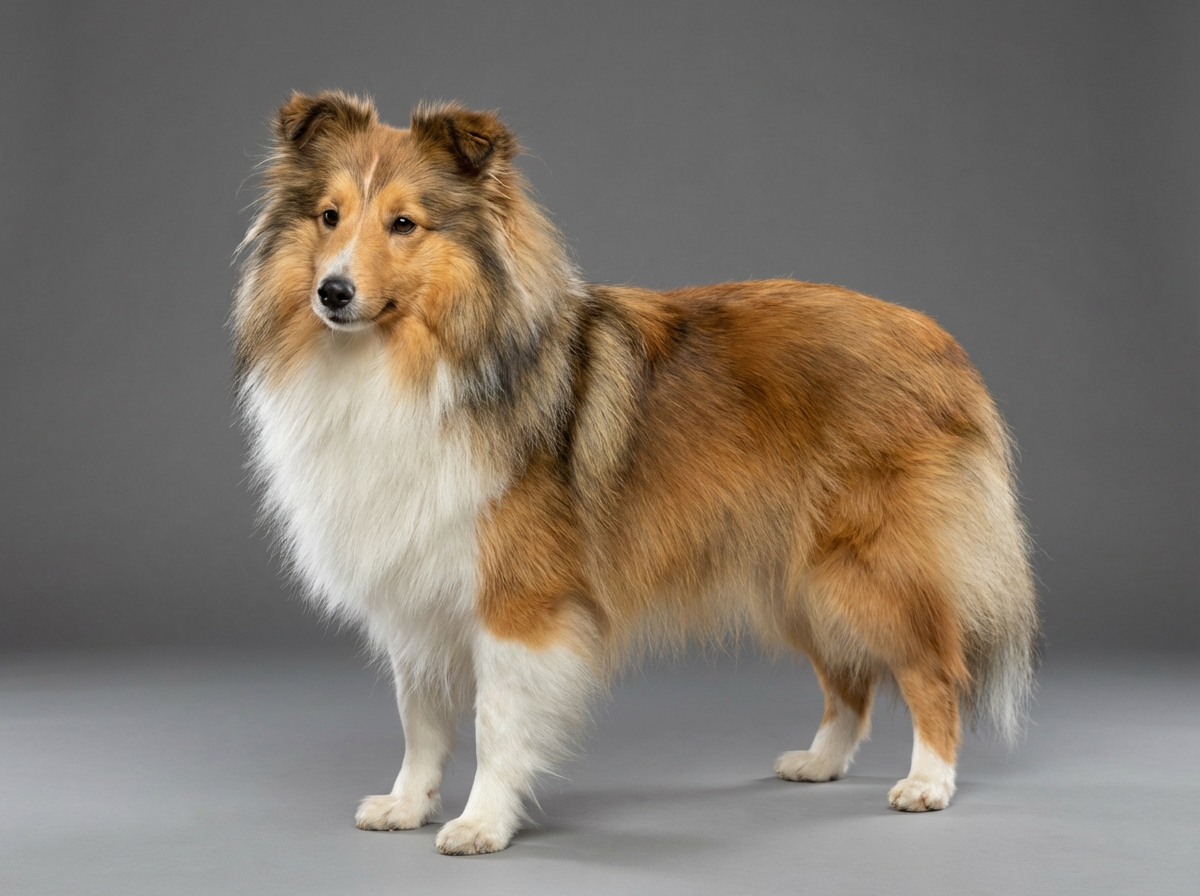
Cruciate rupture itself is not listed among the Shetland Sheepdog's documented conditions, but patellar luxation is, and the two are mechanically linked. Cruciate disease is one of the most frequent reasons any dog is referred for orthopaedic surgery. For a Sheltie the realistic framing is that a well-formed knee kept lean and muscled carries modest risk, while an untreated luxating patella on an overweight dog carries considerably more.
Patellar luxation is the key documented breed factor. When the kneecap does not sit in its groove, the joint tracks abnormally and the cruciate is subjected to twisting forces it is not built to resist, year after year. That fatigues the ligament long before any moment of injury. Body size cuts both ways: at 15 to 25 pounds a Sheltie loads the joint far less than a large breed would, which is why conservative management is a more realistic option here, but small dogs with luxating patellas still accumulate the damage. Hypothyroidism, also documented in the breed, contributes indirectly by promoting weight gain and reducing activity.
Traction and impact drive the mechanical side. Smooth flooring lets the hind legs slide apart, which is precisely the movement a compromised knee cannot absorb, and repeated jumping down from furniture and car boots delivers force through a partially damaged joint. Exercise pattern matters too: a dog who does very little all week and then chases a ball flat out for an hour on Sunday is loading a cold, under-conditioned knee in the worst possible way. Weight gain hidden beneath a dense double coat is the quiet multiplier behind all of it.
Seek a same-day appointment for a dog who suddenly cannot bear weight on a hind leg, whose knee is hot and swollen, or who is crying with a leg held up. Book within a few days for intermittent hind limb lameness that recurs after exercise, for a dog who has started sitting with a leg kicked out, or for stiffness on rising that has appeared over recent weeks, because a partial tear caught at that stage gives more options than a complete rupture does. Ask specifically for the kneecap to be graded at the same examination, since patellar luxation is documented in this breed and changes both the diagnosis and the surgical plan.
See all Shetland Sheepdog health problems, which breeds are prone to cruciate ligament injuries, or the full Shetland Sheepdog breed guide for temperament, exercise needs and ownership costs.
Surgical recovery runs eight to twelve weeks of strictly controlled activity, with normal function typically by four to six months. Conservative management in a small dog takes longer, often three to six months, with a less complete result. Arthritis in the affected joint is permanent regardless of which route is chosen.
A dog who bears weight evenly, has rebuilt the thigh muscle on the operated side, and walks comfortably every day. It is not a knee restored to its original state, and some stiffness after hard exercise usually remains. Protecting the second knee is part of the definition of success.
Patellar luxation is one of the five conditions documented for the Shetland Sheepdog, and it is not a separate issue from cruciate disease. It is a contributor. A kneecap that slides out of its groove pulls the whole extensor mechanism of the leg off its intended line, and the joint no longer tracks the way it was designed to. The cruciate ligament inside that joint is loaded unevenly, twisting slightly on movements where it should simply resist.
Over years, that abnormal loading fatigues the ligament fibres. They fray, they lose tensile strength, and the joint becomes progressively less stable, which in turn puts more strain on the fibres that remain. It is a slow feedback loop, and it is the reason a dog with an untreated luxating patella carries an elevated cruciate risk rather than simply an occasional skip.
That has a practical consequence. If your Sheltie ruptures a cruciate, the surgical conversation should include the kneecap, because stabilising the ligament while leaving the patella tracking badly means the repair is working against the same forces that caused the original problem. Many surgeons address both in one procedure.
There is a second thing on the ligament's side of the ledger: weight. The load through the knee is a direct multiple of body mass. A Shetland Sheepdog should weigh 15 to 25 pounds, and a heavily coated dog can be four pounds over her ideal without anybody seeing it. That is roughly a twenty percent increase in force through a ligament that is already fraying, applied several thousand times a day.
Partial tears and complete ruptures present differently. Recognising the partial phase is what allows intervention before the joint is destabilised entirely.

Lachlan's owner Marta first noticed he had started sitting oddly, with his right hind leg swung out to the side instead of folded under him. He was not limping and she thought it was a habit. Roughly a year later he came in from the garden holding the same leg off the ground entirely. The examination found a ruptured cranial cruciate ligament and a grade two luxating patella on the same side, which had almost certainly been driving the ligament damage the whole time. The surgeon addressed both in one procedure, and Lachlan spent eleven weeks on controlled lead walks with fortnightly physiotherapy. He returned to full function. Marta now watches how her second Sheltie sits, on the grounds that the sideways leg was a symptom for a year before anything else was.
Key takeaway: Watch the sit. A hind leg swung out to the side is the knee telling you it cannot flex comfortably, months before the rupture.
Not always, and size genuinely matters. Some dogs under about 30 pounds do reasonably well with conservative management, meaning strict rest, weight control, pain relief and physiotherapy. Surgery usually gives faster and more complete return to function, and the decision should be made with your vet on the individual joint.
Broadly, procedures that place an artificial restraint outside the joint, and procedures that reshape the top of the shin bone so the ligament is no longer needed. Both are used in small dogs. Ask your vet which they recommend for your dog's size, activity level and kneecap status, and why.
A substantial proportion of dogs rupture the second cruciate within a couple of years, because the same degenerative process affects both. This is the strongest argument for treating weight and muscle condition as ongoing management rather than as recovery from one event.
Expect eight to twelve weeks of tightly controlled activity after surgery, starting with very short lead walks and building gradually. Physiotherapy through that period makes a real difference to how much thigh muscle comes back.
Rest without a diagnosis risks missing a partial tear that is progressing. Get the knee examined, because a partially torn ligament, a luxating patella and a meniscal injury need different plans, and they can feel similar to an owner.
Yes. Cruciate surgery requires general anesthesia and the Shetland Sheepdog carries a documented MDR1 drug sensitivity. Test the genotype before an elective procedure so the anesthetic team is working from a known position.
Because the ligament usually degenerates over months first. The rupture is the end of a slow process, not a fresh injury.
A kneecap that tracks badly loads the cruciate unevenly for years, fatiguing the fibres until they fail.
Sitting with one hind leg kicked out sideways instead of tucked underneath. It appears well before obvious lameness.
Commonly one to three thousand dollars per knee including imaging and aftercare, far beyond a Sheltie's usual monthly budget.
Indirectly. Teaching a dog to use a ramp rather than leap down, and building even hind limb muscle, both reduce load on the joint.
A one-page prep sheet for this condition: the signs, the questions to ask, what to get priced. Unlocks here.
You get: Vet visit prep sheet
No spam. One-click unsubscribe. See our privacy policy.
Preview page 1 before you decide.