Behavior
Which needs more exercise?
The Siberian Husky, rated Very High (5/5) versus the Sheltie's High (4/5).

Quick answer
Which needs more exercise?
The Siberian Husky, rated Very High (5/5) versus the Sheltie's High (4/5).
Shetland Sheepdog or Siberian Husky? On paper they differ most on good for first-time owners, and on the scales Siberian Husky is the heavier at 45–60 lbs. Here is how the two compare on everything that shapes an ordinary week.
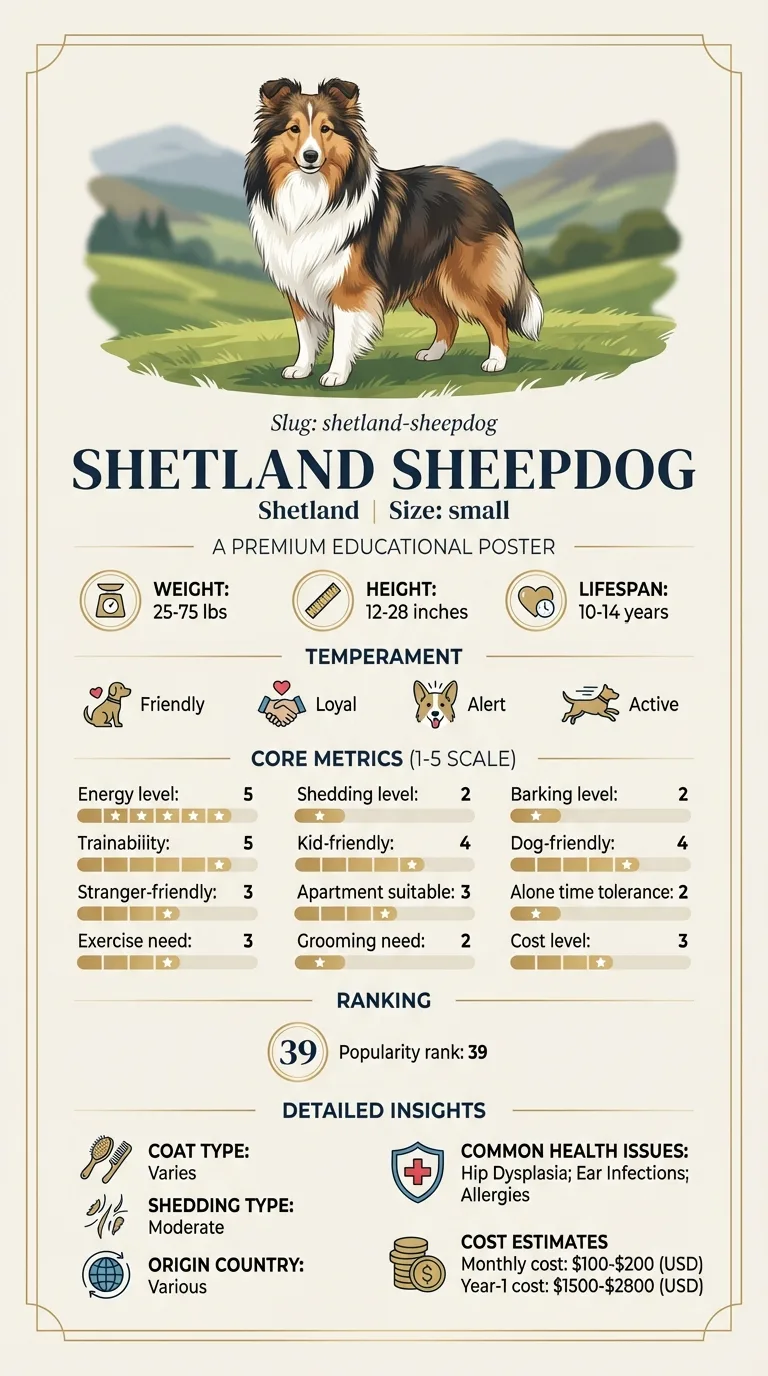
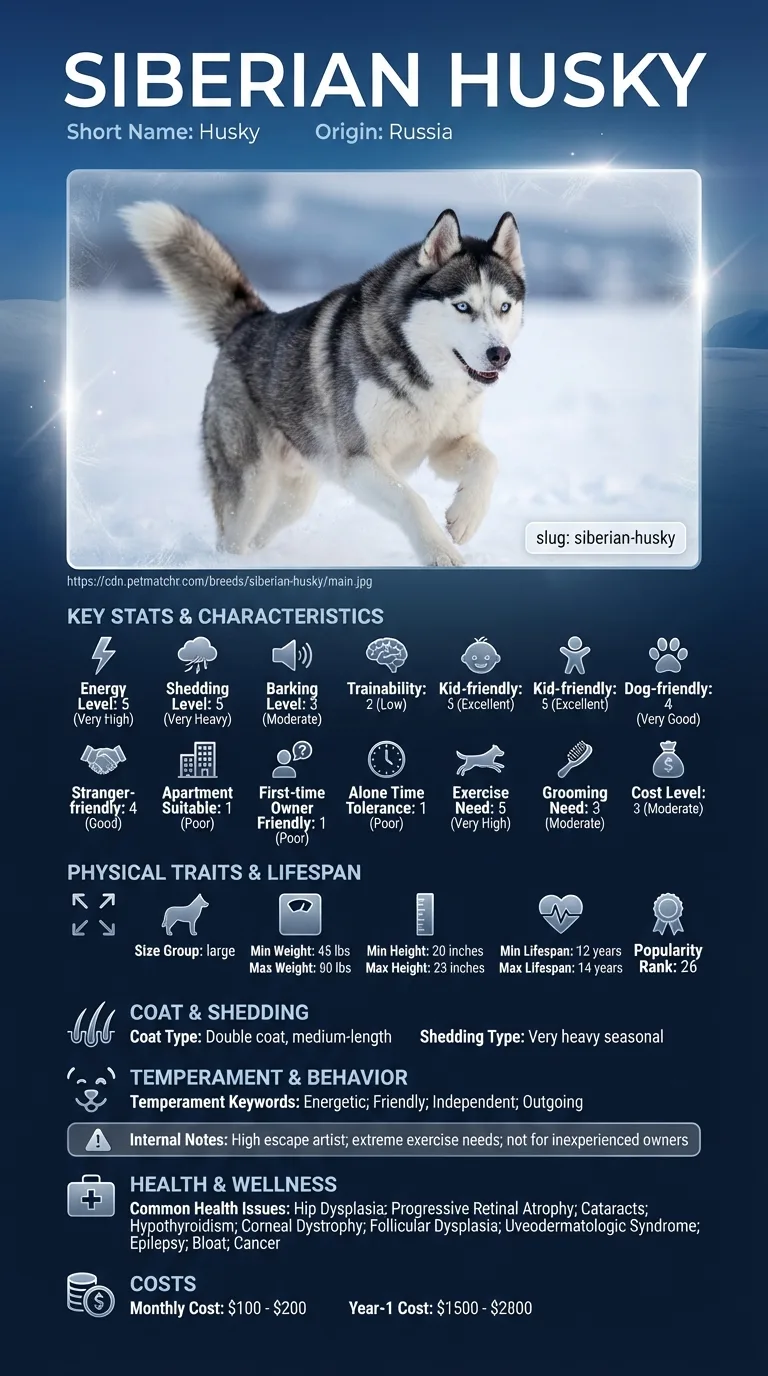
This is for someone already down to Shetland Sheepdog and Siberian Husky and deciding between them. For this pair the decision usually turns on good for first-time owners and trainability, so those are covered first and in most detail. Anyone choosing from a flat has a clear answer here: Shetland Sheepdog rates 3/5 against 1/5. It is written for the decision rather than the breed history.
Between Shetland Sheepdog and Siberian Husky, good for first-time owners is what separates them, and Shetland Sheepdog is the lower-effort dog of the two to keep.
Choose Shetland Sheepdog if you are in a flat or a smaller home, this is your first dog and shedding is a problem in your house.
Choose Siberian Husky if you do not want a standing grooming appointment, there are young children at home and you want a dog that can keep up with an active routine.
| Feature | shetland sheepdog | siberian husky | Winner |
|---|---|---|---|
| Size class | small | large | Equal |
| Weight | 15–25 lbs | 45–60 lbs | Equal |
| Height | 13–16 in | 20–23 in | Equal |
| Lifespan | 12–14 years | 12–14 years | Equal |
| Exercise need | High (4/5) | Very high (5/5) | shetland sheepdog |
| Grooming need | High (4/5) | Moderate (3/5) | siberian husky |
| Shedding | High (4/5) | Very high (5/5) | shetland sheepdog |
| Energy level | High (4/5) | Very high (5/5) | Equal |
| Barking | Very high (5/5) | Moderate (3/5) | siberian husky |
| Apartment suitability | Moderate (3/5) | Very low (1/5) | shetland sheepdog |
| Good for first-time owners | High (4/5) | Very low (1/5) | shetland sheepdog |
| Tolerates being alone | Low (2/5) | Very low (1/5) | shetland sheepdog |
| Trainability | Very high (5/5) | Low (2/5) | shetland sheepdog |
| Good with kids | High (4/5) | Very high (5/5) | siberian husky |
| Good with other dogs | High (4/5) | High (4/5) | Equal |
| Friendly to strangers | Low (2/5) | High (4/5) | siberian husky |
| Cost level | Moderate (3/5) | Moderate (3/5) | Equal |
| Coat | Long, dense double coat | Double coat, medium-length | Equal |
| Origin | Various | Russia | Equal |
| Typical monthly cost | $80–$150 | $100–$200 | Equal |
| Typical first-year cost | $1,100–$2,300 | $1,500–$2,800 | Equal |
The size gap between these two is substantial: the Shetland Sheepdog weighs 15–25 lbs and stands 13–16 inches, while the Siberian Husky weighs 45–60 lbs and stands 20–23 inches — the Husky can outweigh the Sheltie by triple at the extremes. The Sheltie's compact, herding-dog frame under a long double coat contrasts with the Husky's rangy, endurance-built sled-dog structure, designed to cover miles of snow efficiently. Anyone comparing these two on looks alone should remember they're really comparing a small breed to a large one, which has real consequences for space, food costs and handling strength.
The Husky rates Very High (5/5) for exercise need against the Sheltie's already-substantial High (4/5), and its Energetic temperament trait and sled-dog stamina back that up — this is a breed built to run for hours. The Sheltie's herding-driven High exercise need is real but more satisfiable with structured walks, fetch, or agility-style games in a yard. Both breeds need daily engagement well beyond a quick bathroom break, but the Husky's ceiling is higher, and owners without access to serious running or hiking time should think carefully before choosing it over the smaller Sheltie.
Shedding runs heavy for both, but the Husky edges higher at Very High (5/5) against the Sheltie's already-substantial High (4/5) — both breeds blow their dense double coats seasonally in noticeable clumps. Grooming effort flips the other way, though: the Sheltie rates High (4/5) versus the Husky's Moderate (3/5), since the Sheltie's longer coat needs more frequent brushing to avoid matting even though the Husky's coat sheds more total volume. Neither breed suits an owner hoping to avoid vacuuming, but the Sheltie demands more hands-on brushing time overall.
The Sheltie rates Moderate (3/5) for apartment suitability, modest but still well ahead of the Husky's Very Low (1/5) — among the lowest scores on this entire site. The Husky's Moderate (3/5) alone-tolerance actually beats the Sheltie's Low (2/5), though, an interesting reversal given the Husky's larger size and higher exercise needs; Huskies are simply more emotionally independent day to day. On barking, the Sheltie is louder, Very High (5/5) against the Husky's Moderate (3/5), though Huskies are known for howling rather than barking, which can carry just as far in shared housing.
The Sheltie is dramatically more trainable, Very High (5/5) versus the Husky's Low (2/5), and the gap repeats for first-time-owner suitability, High (4/5) for the Sheltie against Very Low (1/5) for the Husky — one of the widest spreads in this comparison. The Husky's Independent temperament, inherited from generations of making trail decisions without constant human input, makes it notoriously difficult to recall off-leash or drill through standard obedience work. The Sheltie's Bright, Devoted nature makes it one of the more naturally cooperative herding breeds, a serious consideration for anyone without prior training experience.
Both breeds score well with kids, though the Husky edges ahead at Very High (5/5) against the Sheltie's still-strong High (4/5). Compatibility with other dogs is a tie, both rating High (4/5), but the Husky is considerably friendlier to strangers, High (4/5) versus the Sheltie's Low (2/5) — consistent with the Husky's Friendly, Outgoing temperament against the Sheltie's more reserved, watchful nature. Families that host frequently or want a dog that greets guests warmly may lean Husky, while those wanting a more naturally protective, alert presence at home may prefer the Sheltie.
Lifespan is a tie here, both breeds averaging 12–14 years. The Sheltie's shorter list includes MDR1 Drug Sensitivity and Dermatomyositis, conditions tied to its herding-breed genetics, alongside Hypothyroidism and Patellar Luxation. The Husky's longer list shares Progressive Retinal Atrophy, Cataracts and Hypothyroidism with several other breeds on this site, but also carries Corneal Dystrophy, Follicular Dysplasia, Uveodermatologic Syndrome and Bloat risk specific to the breed. Husky owners should discuss eye screening early given the number of vision-related conditions listed, while Sheltie owners should flag MDR1 status before any new medication.
Both breeds rate Moderate (3/5) for overall cost, though the Sheltie runs slightly cheaper: $80–$150 monthly and $1,100–$2,300 in the first year, versus the Husky's $100–$200 monthly and $1,500–$2,800 first-year cost. The gap likely reflects the Husky's larger size driving up food volume, plus potential fencing and containment costs given its Very Low apartment suitability and escape-prone reputation. The Sheltie's costs concentrate more in grooming time than raw dollars. Either way, both fall into a moderate, manageable cost bracket relative to the pricier toy and brachycephalic breeds elsewhere on this site.
Shetland Sheepdog weighs 15–25 lbs and lives 12–14 years; Siberian Husky weighs 45–60 lbs and lives 12–14 years. The two diverge most on good for first-time owners, trainability and apartment suitability and 2 other rated axes. They are level on cost level and good with other dogs, so those cannot decide it. In the table, a "winner" means easier for an ordinary household — not better. Size, coat and origin are recorded without a verdict. Because both breeds are scored the same way, the gaps are reliable even where the absolute numbers are rough.

Considerably — the Husky weighs 45–60 lbs and stands 20–23 inches, versus the Sheltie's 15–25 lbs and 13–16 inches.
The Shetland Sheepdog by far, rated High (4/5) for first-time-owner suitability versus the Husky's Very Low (1/5).
Neither is truly quiet — the Sheltie rates Very High (5/5) for barking, while the Husky rates Moderate (3/5) but is known for howling instead.
Neither scores well, but the Sheltie's Moderate (3/5) apartment rating is far better than the Husky's Very Low (1/5).
The Sheltie, rated Very High (5/5) for trainability versus the Husky's Low (2/5).
The Siberian Husky, rated High (4/5) versus the Sheltie's Low (2/5).
Yes — both average 12–14 years.
The Siberian Husky, rated Very High (5/5) versus the Sheltie's High (4/5).
The Siberian Husky, rated Very High (5/5) versus the Sheltie's High (4/5).
The Siberian Husky, rated Very High (5/5) versus the Sheltie's High (4/5).
The Shetland Sheepdog, typically $80–$150 versus the Husky's $100–$200.
Secure checkout on Stripe. We never see your card.
7-day money-back guarantee. Instant access.
Health information here is general and is not veterinary advice. If your dog shows pain, sudden behaviour change, or worsening symptoms, consult a licensed veterinarian.
Some links on this site are affiliate links. We may earn a commission at no extra cost to you, and we only suggest products we believe are helpful for dog owners.
We research and check what we publish, but we do not warrant that any figure, date, price, or statement is accurate, complete, or current, and we accept no liability for any loss, cost, injury, or other harm arising from the use of this site. Use it as one reference among several. You remain responsible for your own decisions and for your dog's care - confirm anything that matters with a licensed veterinarian or another qualified professional before you act on it. Full disclaimer.
Match your lifestyle to the right dog.
Take quizNot sure which breed is right for you? Take our 2-minute quiz to find out.
Take the quiz