Health
What makes DM different from arthritis?
It is painless and it causes knuckling of the hind feet. Arthritis is painful and causes stiffness without misplaced paws.

Quick answer
What makes DM different from arthritis?
It is painless and it causes knuckling of the hind feet. Arthritis is painful and causes stiffness without misplaced paws.
The defining feature of degenerative myelopathy is not weakness. It is that the dog is not in pain. An older dog whose back legs are failing without any sign of discomfort is the picture that raises this diagnosis.
Owners whose older dog is wearing her hind nails flat and has begun to sway. People trying to work out whether their Sheltie is stiff or genuinely losing coordination. Anyone facing a diagnosis of exclusion and wondering what can honestly be done.
This guide is not medical advice. If your dog shows pain, sudden behavior change, or worsening symptoms, consult a licensed veterinarian.
Some links may be affiliate links. We may earn a commission at no extra cost to you. We only suggest products we believe are helpful for dog owners.
We research and check what we publish, but we do not warrant that any figure, date, price, or statement is accurate, complete, or current, and we accept no liability for any loss, cost, injury, or other harm arising from the use of this site. Use it as one reference among several. You remain responsible for your own decisions and for your dog's care - confirm anything that matters with a licensed veterinarian or another qualified professional before you act on it. Full disclaimer.
Degenerative myelopathy is a slow, painless breakdown of the white matter of the spinal cord, beginning in the thoracic region and spreading. Nerve signals to the hind limbs weaken and become unreliable, so the dog loses awareness of where her back feet are before she loses the strength to move them. It is diagnosed by excluding everything else, since a definitive diagnosis is only possible on examination of the spinal cord after death. Management is entirely supportive.
Not documented for the Shetland Sheepdog and uncommon overall relative to arthritis and disc disease, which are the far more frequent causes of an older dog's hind end failing. The SOD1 variant appears across many breeds, so it is not impossible here, but a Sheltie owner whose dog is slowing down behind should expect the investigation to point at joints or discs in the great majority of cases.
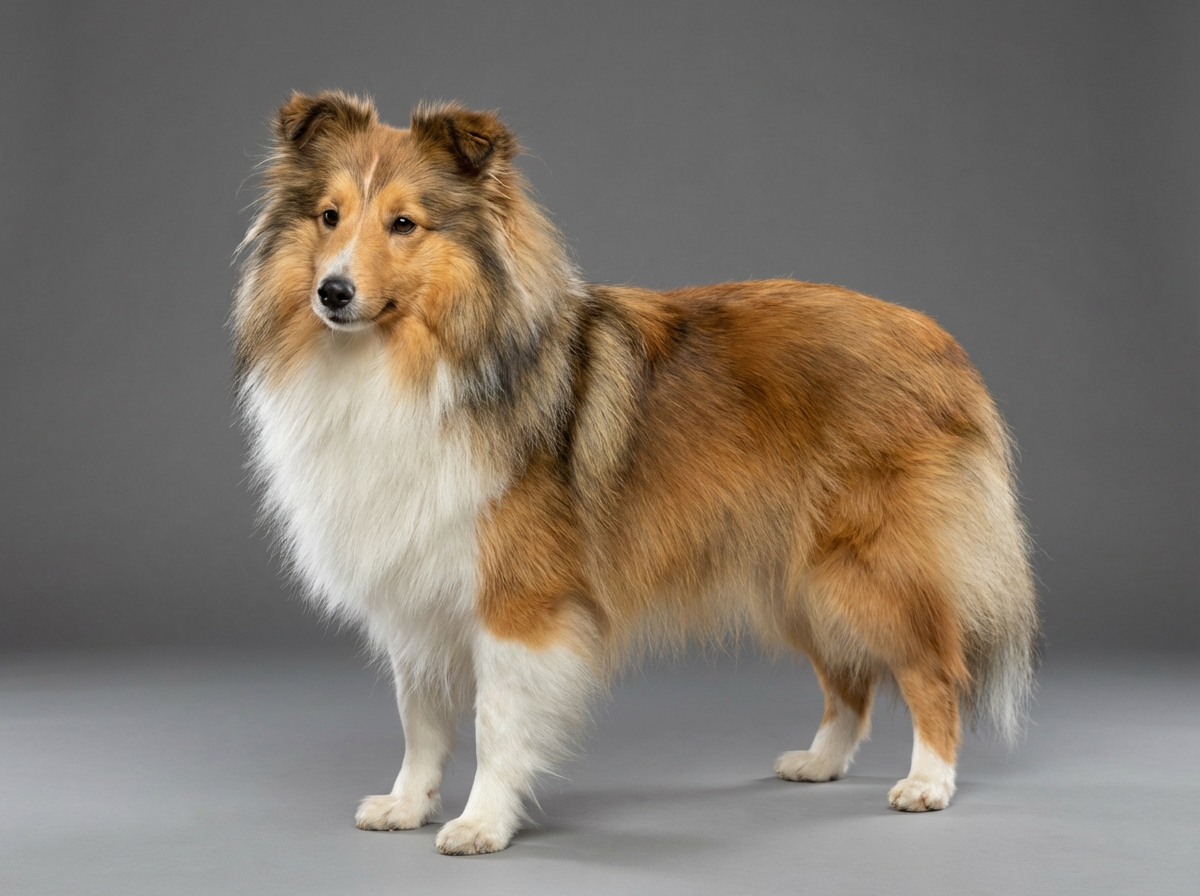
The Shetland Sheepdog has no documented predisposition to degenerative myelopathy. What the breed contributes is longevity: a 12 to 14 year lifespan means plenty of dogs reach the ages at which neurological decline becomes possible. Patellar luxation, which is documented in the breed, matters here as a confounder rather than a cause, since a dog with chronic knee problems has an abnormal hind gait already and the change to a neurological gait can be missed against that background. The dense double coat similarly conceals the muscle wastage that accompanies progressive weakness.
Nothing in the environment causes this disease. Environment does, however, determine how disabling it is at any given stage. Smooth flooring turns mild incoordination into repeated falls. Stairs and steps become hazards early. Long-pile carpet catches a knuckling paw. Cold and damp stiffen the compensating front limbs. A dog living in a house with good traction, ramps in place of steps and protective boots for the hind feet stays functional considerably longer than the same dog on laminate floors.
Book an appointment for any progressive change in hind limb coordination, particularly knuckling, swaying or scuffing, rather than assuming age. Ask specifically for a neurological examination and for a trial of pain relief, since a dog who improves markedly on medication almost certainly has a painful joint or disc problem rather than DM. Go urgently for a sudden rather than gradual loss of hind limb function, for a dog who cannot stand, for loss of bladder control or an inability to urinate, or for signs of pain, all of which suggest an acute spinal problem where prompt treatment matters. Discuss whether advanced imaging is worthwhile before accepting a diagnosis of exclusion.
See all Shetland Sheepdog health problems, which breeds are prone to degenerative myelopathy dm, or the full Shetland Sheepdog breed guide for temperament, exercise needs and ownership costs.
From first noticeable signs to loss of independent hind limb walking usually takes six to eighteen months, with the whole course running one to three years. Physiotherapy does not change the underlying course but consistently extends the period of useful mobility.
Success is not stopping the disease, because that is not available. It is a dog who keeps walking, keeps exploring and stays comfortable and clean for as long as possible, with equipment introduced ahead of need rather than in response to a crisis, and with honest conversations about quality of life happening early rather than late.
The three conditions that produce a wobbly hind end in older dogs are arthritis, chronic disc compression and degenerative myelopathy. Separating them is what the whole diagnostic process is about.
The DNA test looks for a variant in the SOD1 gene, and results are reported as clear, carrier or at risk. The last of those is worded carefully for a reason. A dog with two copies of the variant is at elevated risk of developing degenerative myelopathy, but many such dogs live full lives and never show a sign of it. The test identifies susceptibility, not destiny, and a positive result in a healthy dog is not a diagnosis.
That cuts both ways, and it is worth being clear about the limitation. A dog testing at risk who develops hind limb weakness still needs proper investigation, because arthritis and disc disease are far more common and both are treatable. Assuming DM because of a DNA result and skipping the workup is how treatable problems get missed. Conversely, a clear result makes DM very unlikely and pushes the search elsewhere, which is genuinely useful.
Degenerative myelopathy is not among the five conditions documented on the Shetland Sheepdog's health profile, which lists Collie Eye Anomaly, MDR1 drug sensitivity, dermatomyositis, hypothyroidism and patellar luxation. The SOD1 variant has been identified across a wide range of breeds including herding breeds, so it is not absent from the wider gene pool, but this is not a breed where DM is an expectation. If your dog develops hind limb signs, the far more probable explanations are the joints and the discs.
Because DM is diagnosed by ruling other things out, expect the process to involve advanced imaging under anesthesia. That makes the breed's documented MDR1 drug sensitivity relevant to the planning, and it is one more reason to have that genotype recorded well before an older dog needs a neurological workup.

Struan was eleven when his owner Eilidh noticed he was scuffing his right hind foot. The vet started him on pain relief for suspected arthritis, which was entirely reasonable given his age. Four weeks later there was no change at all, and Eilidh reported that he had never flinched when the leg was handled. That absence of response redirected the investigation. A neurological examination found reduced awareness of foot position on both hind limbs, worse on the right, with no pain anywhere. Imaging ruled out disc compression. Struan was managed as a presumed degenerative myelopathy case with fortnightly hydrotherapy, boots, runners across the whole ground floor and a rear support harness. He walked for another fourteen months, latterly with a cart Eilidh had introduced while he could still manage without it.
Key takeaway: A dog who does not improve on pain relief is telling you the problem is not pain. That non-response is a diagnostic result, not a failed treatment.
The disease process itself is not. That absence of pain is one of its most useful diagnostic features. Secondary problems can hurt, such as sores from dragging or strain in the front limbs taking extra load, and those should be treated.
There is no treatment that stops or reverses the underlying degeneration. What genuinely helps is physiotherapy to maintain muscle, harnesses and carts to preserve mobility, non-slip flooring, and careful attention to skin and bladder care as the disease progresses.
Typically over one to three years from the first subtle signs. It usually starts in the hind limbs, advances to a dog unable to stand behind, and eventually affects the front limbs and, in late stages, breathing. Most owners make end-of-life decisions before that point.
It is more useful for breeders than for pet owners, since a positive result in a well dog changes nothing about management and can cause a lot of anxiety. A clear result can be reassuring. Discuss the value with your vet rather than testing reflexively.
The strongest home clue is the combination of knuckling and an absence of pain. Arthritis is painful and produces stiffness rather than misplaced feet. A neurological examination is what confirms it, and a trial of pain relief that produces no improvement is informative.
For many dogs, considerably. A well-fitted wheeled cart restores the ability to exercise and explore, which matters enormously for a working breed. It works best when introduced while the dog still has some hind limb function rather than after she has stopped walking.
It is painless and it causes knuckling of the hind feet. Arthritis is painful and causes stiffness without misplaced paws.
Yes, for a variant in the SOD1 gene. It identifies risk rather than diagnosing the disease, and many at-risk dogs never develop it.
No. It is not among the five conditions recorded for the breed, and hind limb decline here is far more likely to be joints or discs.
Non-slip flooring, a support harness, regular physiotherapy and boots to protect knuckling feet from abrasion.
Carts, harnesses and ongoing physiotherapy add several hundred dollars a year on top of the breed's usual monthly running costs.
A one-page prep sheet for this condition: the signs, the questions to ask, what to get priced. Unlocks here.
You get: Vet visit prep sheet
No spam. One-click unsubscribe. See our privacy policy.
Preview page 1 before you decide.