Health
What is the main autoimmune condition in Shetland Sheepdogs?
Dermatomyositis, a documented breed condition affecting small blood vessels in skin and sometimes muscle.

Quick answer
What is the main autoimmune condition in Shetland Sheepdogs?
Dermatomyositis, a documented breed condition affecting small blood vessels in skin and sometimes muscle.
Most crusty faces on young dogs are infections. In a Sheltie puppy, one particular pattern of sores over the bridge of the nose and the tips of the ears is worth taking to a vet before you reach for a cream.
New puppy owners finding scabs on a nose and being told it is probably just play damage. Breeders trying to work out whether a litter is affected. Owners of an adult Sheltie with permanent bald patches who want to know whether anything more is coming.
This guide is not medical advice. If your dog shows pain, sudden behavior change, or worsening symptoms, consult a licensed veterinarian.
Some links may be affiliate links. We may earn a commission at no extra cost to you. We only suggest products we believe are helpful for dog owners.
We research and check what we publish, but we do not warrant that any figure, date, price, or statement is accurate, complete, or current, and we accept no liability for any loss, cost, injury, or other harm arising from the use of this site. Use it as one reference among several. You remain responsible for your own decisions and for your dog's care - confirm anything that matters with a licensed veterinarian or another qualified professional before you act on it. Full disclaimer.
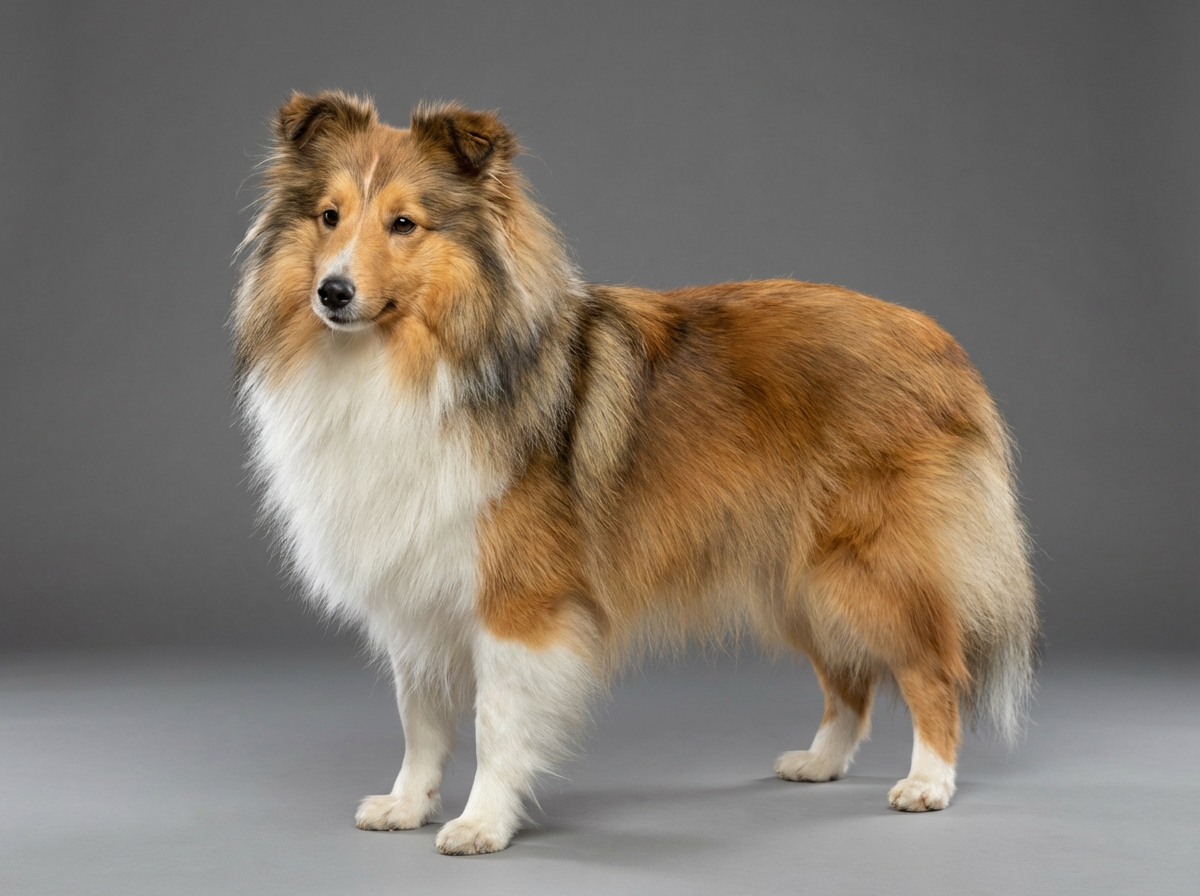
In autoimmune disease the immune system stops distinguishing the body from a threat and attacks its own tissue. In the Shetland Sheepdog the documented example is dermatomyositis, where the target is the small blood vessels supplying skin and sometimes muscle. Starved of blood, the skin over the face, ear tips and bony points ulcerates and scars, and affected hair follicles do not recover. Severity ranges from a few permanent bald patches to a dog with serious difficulty eating.
Dermatomyositis is uncommon in dogs generally but is specifically documented for the Shetland Sheepdog, meaning it appears here at a rate that owners and breeders need to know about. Most Sheltie owners will never see a case. Those who do usually see it in a puppy, and usually in a mild form. Hypothyroidism, also documented in the breed and immune-mediated in many dogs, is far more frequently encountered.
This is a genetic condition established in the Shetland Sheepdog's lineage and shared with the closely related Rough Collie. The inheritance is not a simple single-gene switch, which is why severity varies so widely between affected littermates and why no straightforward DNA test resolves it. The breed's other documented conditions are relevant context: hypothyroidism is frequently immune-mediated in dogs, so a Sheltie with one immune problem is worth monitoring for the other. The long double coat plays no causal role but does delay owners noticing lesions on the limbs and tail tip.
The disease is inherited, but flares are influenced by what happens to the skin. Ultraviolet light damages vessels that are already compromised, so sunny weather often coincides with worsening. Physical trauma at the pressure points matters: a dog who rubs her face on carpet or wears a harness that chafes over a bony point can convert a stable patch into an open lesion. Periods of physiological stress, including surgery and illness, are commonly reported around flares.
Get any symmetrical crusting on a puppy's face or ear tips examined rather than treated at home, because the diagnosis depends on catching the pattern early. Seek same-day help for coughing during or after meals, for regurgitation of undigested food, for laboured breathing, or for a fever with lethargy, since aspiration pneumonia develops fast and is the most dangerous complication of this disease. Also book promptly if lesions become wet, painful or foul smelling, which means secondary infection, or if your dog is suddenly reluctant to chew hard food. Do not start any steroid or immune-modulating product without veterinary direction.
See all Shetland Sheepdog health problems, which breeds are prone to autoimmune diseases, or the full Shetland Sheepdog breed guide for temperament, exercise needs and ownership costs.
Lesions in puppies often wax and wane through the first year and then stabilise, sometimes improving noticeably after eighteen months. Medication effects are judged over six to twelve weeks. Established bald and scarred areas are permanent.
Success is a dog whose lesions stay stable rather than spreading, who eats and swallows normally, and who has never had a pneumonia episode. Cosmetically she may always have a bare nose bridge and thin ear tips, and that is an acceptable outcome, not a failure.
Autoimmune skin disease is diagnosed largely on where the lesions sit. Dermatomyositis has a distinctive map, and it is a map of pressure points and thin skin rather than of anything the dog has touched.
The name has two halves for a reason. Dermato refers to skin and myositis to muscle inflammation, and in more severely affected dogs the same vascular damage occurs in muscle tissue. The muscles most often involved are the ones that chew and the ones that move the face, so the signs are functional rather than visible at first: difficulty picking up food, dropping it, slow eating, or a change in the shape of the head as the muscles above the skull waste.
Swallowing is the part that turns this from a cosmetic problem into a serious one. If the muscles of the throat and oesophagus are affected, food and water can end up in the airway instead of the stomach. That leads to aspiration pneumonia, which is a genuine emergency and the main way this disease kills dogs. Coughing after meals, nasal discharge after drinking, or regurgitating undigested food shortly after eating are all signs to act on the same day.
Most Shelties with dermatomyositis, it is worth saying, sit at the mild end. They have some permanent hair loss over the nose and ear tips, they scar a little, and they live entirely normal lives across a 12 to 14 year lifespan. The severity varies enormously between individuals, including within a single litter, which is why a diagnosis is a reason to monitor rather than a reason to despair.
One treatment note specific to this breed. Immune-modulating medication is often part of long-term control, and the Shetland Sheepdog carries a documented MDR1 drug sensitivity. Get the genotype tested before a lifelong medication plan is drawn up, so your vet is choosing from a known position.

If you think your Shetland has autoimmune diseases, the plan is three steps: write down what you have seen and when it started, book a veterinary appointment rather than waiting for the next flare, and take video of the behaviour or symptom before you go — the thing you are worried about rarely happens in the consulting room. Screening in the parents covers collie eye anomaly, mdr1 drug sensitivity, dermatomyositis.
What the vet visit should produce is a diagnosis and a written plan, not just reassurance: what is being ruled out, what the monitoring interval is, and which signs mean you come back sooner. Ask what the treatment costs across a year rather than per visit, because that is the number that decides whether you are managing this condition or reacting to it.
Between appointments, keep a short log — dates, what you saw, what changed. It is the single most useful thing an owner brings to a follow-up, and for autoimmune diseases it is often what separates a clear pattern from a guess.
Wisp was fourteen weeks old when her owner Deirdre noticed matching scabs on the bridge of her nose and the tip of each ear. Online she found plenty of people saying puppies knock themselves about. The symmetry was what bothered her, so she booked an appointment. A biopsy confirmed dermatomyositis. Wisp turned out to be mildly affected: no muscle involvement, no eating difficulty, and an MDR1 test that came back carrying one faulty copy, which shaped the medication plan. Deirdre photographs the lesions on the first of each month, keeps Wisp out of the sun between eleven and three, and reports mealtime coughing to the vet immediately as a standing rule. At four Wisp has a permanently bare nose bridge and is otherwise an entirely ordinary, extremely vocal Sheltie.
Key takeaway: Symmetry is the clue. Injuries land on one side. Immune disease tends to mirror itself, and that is worth a biopsy.
By a skin biopsy, usually taken under sedation, combined with the pattern and the age of onset. Bloodwork and swabs are used to rule out infection and other causes first. Breed alone is suggestive but not sufficient.
No. It is an inherited immune-mediated disease, not an infection. Other dogs in the household are at no risk from contact, though littermates may of course carry the same predisposition.
Sometimes partly, sometimes not. Where follicles have been destroyed the bald patch is permanent, and the skin there often stays slightly thin and shiny. Preventing new lesions matters more than recovering the old ones.
Ultraviolet exposure is a recognised aggravator, and the bald areas are exactly the places with no coat left to protect them. Limiting midday sun and asking your vet about a dog-safe barrier product for the nose is reasonable.
No. This is inherited, and breeding from affected dogs or their close relatives is how the condition persists in the breed. A responsible breeder will discuss family history openly rather than treating it as an embarrassment.
Allergy is itchy, usually starts between one and three years, and concentrates on feet, ears, armpits and belly. Dermatomyositis is often barely itchy, typically starts before six months, and concentrates on the face, ear tips and bony points.
The early signs are set out in the sections above, and they are the reason to book a veterinary appointment rather than wait. Autoimmune Diseases in Shetlands is diagnosed by a vet, not from a symptom list, and the sooner it is on record the more options remain open.
The early signs are set out in the sections above, and they are the reason to book a veterinary appointment rather than wait. Autoimmune Diseases in Shetland Sheepdogs is diagnosed by a vet, not from a symptom list, and the sooner it is on record the more options remain open.
Dermatomyositis, a documented breed condition affecting small blood vessels in skin and sometimes muscle.
Usually before six months old, which is much earlier than allergic skin disease and is one of the strongest diagnostic clues.
Coughing after eating or drinking, or regurgitating food. That suggests swallowing muscles are involved and risks pneumonia.
Mild cases usually do not. Severe cases with muscle and swallowing involvement carry real risk and need close veterinary management.
Biopsy, specialist referral and long-term medication run considerably above the breed's typical eighty to a hundred and fifty dollar monthly cost.
A one-page prep sheet for this condition: the signs, the questions to ask, what to get priced. Unlocks here.
You get: Vet visit prep sheet
No spam. One-click unsubscribe. See our privacy policy.
Preview page 1 before you decide.