Health
What does von Willebrand's disease affect?
A protein essential for the initial stage of blood clot formation, impairing the body's response to significant vascular injury.

Quick answer
What does von Willebrand's disease affect?
A protein essential for the initial stage of blood clot formation, impairing the body's response to significant vascular injury.
A dog can live for years with von Willebrand's disease and show absolutely no sign of it — right up until a routine spay surgery turns into an unexpectedly difficult bleeding event that nobody saw coming.
Owners who've just learned about this condition, often after an unexpected bleeding complication during a routine procedure, or breeders trying to understand how genetic screening actually prevents this surprise.
This guide is not medical advice. If your dog shows pain, sudden behavior change, or worsening symptoms, consult a licensed veterinarian.
Some links may be affiliate links. We may earn a commission at no extra cost to you. We only suggest products we believe are helpful for dog owners.
We research and check what we publish, but we do not warrant that any figure, date, price, or statement is accurate, complete, or current, and we accept no liability for any loss, cost, injury, or other harm arising from the use of this site. Use it as one reference among several. You remain responsible for your own decisions and for your dog's care - confirm anything that matters with a licensed veterinarian or another qualified professional before you act on it. Full disclaimer.
Von Willebrand's disease is an inherited disorder affecting a protein critical to the initial stage of blood clotting, and it typically stays invisible through ordinary daily life, revealing itself only during significant vascular trauma like surgery. Pre-surgical screening is the primary tool for turning this hidden risk into a manageable, planned-for one.
Von Willebrand's disease is a recognized inherited bleeding disorder documented across several breeds, and while overall prevalence varies, it's well enough established that a specific screening blood test and genetic testing both exist for it.
Von Willebrand's disease is caused by an inherited genetic mutation affecting the production or function of von Willebrand factor, and its documented presence in certain breeding lines makes genetic testing a relevant consideration for responsible breeding decisions.
There's no environmental trigger for the underlying protein deficiency itself. What varies is whether an individual dog ever encounters vascular trauma significant enough — surgery, major injury — to actually reveal the deficiency during their lifetime.
Discuss pre-surgical screening with your vet before any planned procedure, and seek immediate veterinary care for any bleeding that seems excessive, prolonged, or doesn't stop with normal first-aid measures after an injury.
Start here: Pug Most Common Genetic Disorders: What to Screen For
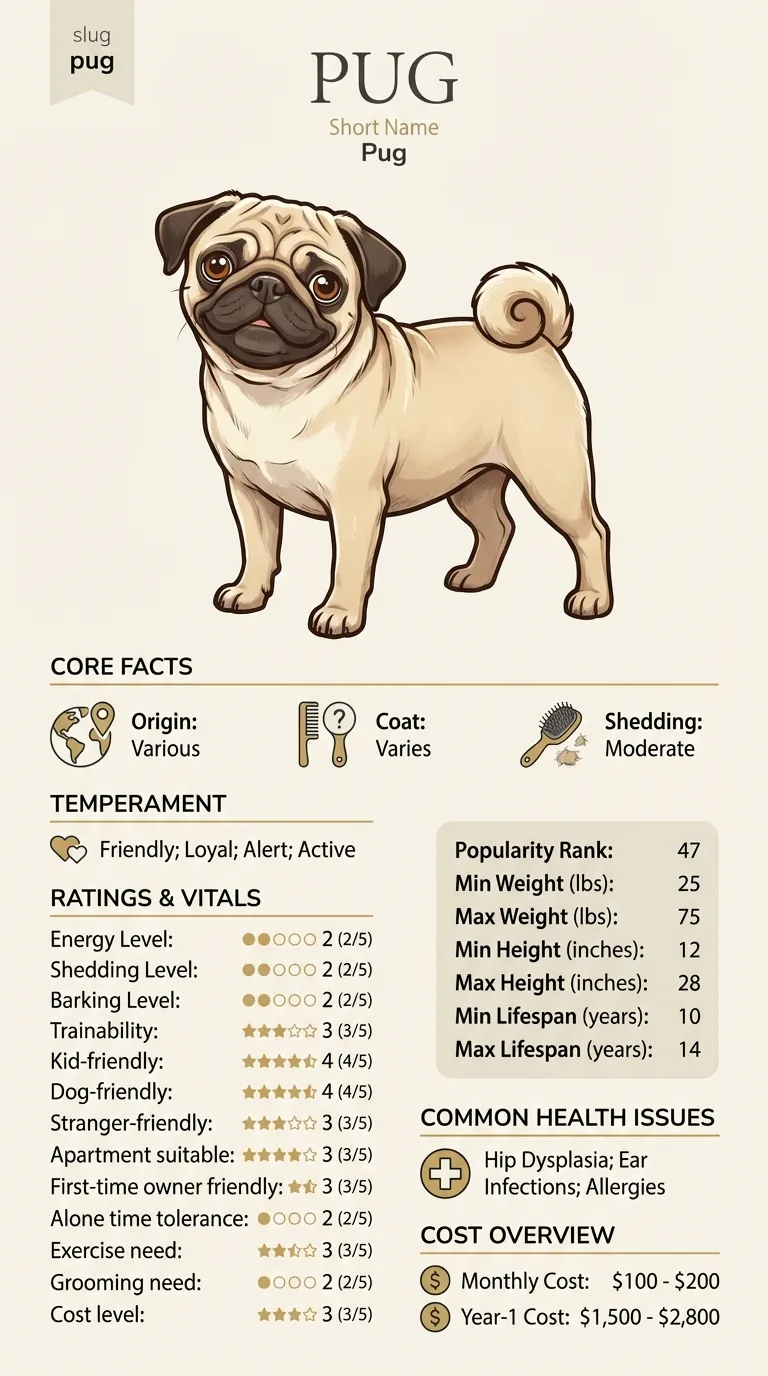
See all PUG health problems, which breeds are prone to von willebrands disease, or the full PUG breed guide for temperament, exercise needs and ownership costs.
Screening bloodwork typically returns results within days, allowing plenty of time to plan precautions before a scheduled surgery. The underlying condition itself is lifelong and doesn't resolve, but doesn't require ongoing daily management the way some chronic conditions do.
Success is a diagnosis known well before any significant surgical or traumatic bleeding challenge, allowing appropriate precautions to make necessary procedures safe — not a cure for the underlying clotting deficiency, which isn't currently achievable.
Von Willebrand factor is a protein that helps platelets stick together and adhere to damaged blood vessel walls, an early and critical step in forming a stable clot. In von Willebrand's disease, this protein is deficient or doesn't function normally, which means the initial clotting response to any blood vessel injury is impaired. Day-to-day life rarely puts enough stress on this specific clotting step to reveal a problem — minor bumps and scrapes generally heal fine, since the body has some redundancy in its clotting mechanisms. It's specifically larger vascular trauma — surgery, a significant injury, or even something like a dental cleaning that nicks gum tissue — that exposes the underlying deficiency, sometimes dramatically.
This is exactly why so many cases are discovered unexpectedly during a routine spay or neuter, rather than through any symptom an owner would have noticed beforehand. A dog can appear completely normal, energetic, and healthy right up until that first significant surgical or traumatic bleeding challenge, at which point excessive, hard-to-control bleeding reveals a condition that had been present, invisibly, the dog's entire life.
The entire value of testing for this condition comes from knowing about it before a bleeding event happens, rather than discovering it during one.

If you think your Pug has von willebrand's disease, the plan is three steps: write down what you have seen and when it started, book a veterinary appointment rather than waiting for the next flare, and take video of the behaviour or symptom before you go — the thing you are worried about rarely happens in the consulting room. Screening in the parents covers brachycephalic airway syndrome (boas), pug dog encephalitis, corneal ulcers.
What the vet visit should produce is a diagnosis and a written plan, not just reassurance: what is being ruled out, what the monitoring interval is, and which signs mean you come back sooner. Ask what the treatment costs across a year rather than per visit, because that is the number that decides whether you are managing this condition or reacting to it.
Between appointments, keep a short log — dates, what you saw, what changed. It is the single most useful thing an owner brings to a follow-up, and for von willebrand's disease it is often what separates a clear pattern from a guess.
During what was expected to be a routine spay, Marcy's Pug, Luna, bled far more than typical, alarming the surgical team enough to pause and investigate rather than continue as planned. Follow-up testing confirmed von Willebrand's disease — a diagnosis nobody had suspected, since Luna had never shown any prior sign of a bleeding problem. The surgery was completed successfully with additional precautions once the cause was identified, and Luna recovered without further complications. Marcy's vet noted that pre-surgical screening, had it been done, would likely have caught this in advance and avoided the unexpected complication entirely. Marcy now recommends this specific screening test to every fellow Pug owner she knows who's planning any surgery, having seen firsthand how invisible this condition can be until exactly the wrong moment.
Key takeaway: This bleeding disorder can hide completely through years of normal daily life — the only way to know about it before it matters is to test for it in advance, not to wait and see.
It's an inherited disorder affecting von Willebrand factor, a protein essential for the initial stage of blood clotting. Affected dogs have impaired clotting response specifically to significant blood vessel injury, such as surgery or major trauma.
Minor everyday bumps and scrapes rarely stress the clotting system enough to reveal the deficiency, since the body has some redundancy in its clotting mechanisms. It typically takes more significant trauma, like surgery, to expose the underlying problem.
Many cases are found unexpectedly during a routine surgery, like a spay or neuter, when bleeding is more severe or harder to control than expected — a discovery that could often have been anticipated with pre-surgical screening.
Yes — a specific blood test measuring von Willebrand factor levels can identify the deficiency in advance, allowing a vet to take appropriate precautions during any planned surgical procedure.
There's no cure for the underlying protein deficiency, but with advance knowledge of the diagnosis, precautions like having compatible blood products available and adjusting the surgical approach can help manage bleeding risk safely during necessary procedures.
Yes, it's an inherited condition, and genetic testing for specific known mutations is available, which is useful both for confirming an individual dog's status and informing responsible breeding decisions.
Given how invisibly this condition can hide until a major bleeding event, pre-surgical screening is a reasonable precaution for breeds with documented risk, ideally performed well before any planned procedure like a spay or neuter.
A protein essential for the initial stage of blood clot formation, impairing the body's response to significant vascular injury.
Often unexpectedly during a surgery like a spay or neuter, when bleeding is unusually severe or hard to control.
A specific blood test for von Willebrand factor levels typically adds a modest amount to standard pre-surgical bloodwork.
No, but knowing about it in advance allows precautions that make necessary surgeries safer to perform.
Yes, genetic testing is available and recommended to avoid passing the condition to offspring.
A one-page prep sheet for this condition: the signs, the questions to ask, what to get priced. Unlocks here.
You get: Vet visit prep sheet
No spam. One-click unsubscribe. See our privacy policy.
Preview page 1 before you decide.