Living
Which is smaller?
The Pug, at 14-18 lbs versus the Rottweiler's 80-135 lbs.

Quick answer
Which is smaller?
The Pug, at 14-18 lbs versus the Rottweiler's 80-135 lbs.
Pug or Rottweiler? On paper they differ most on apartment suitability, and on the scales Rottweiler is the heavier at 80–135 lbs. Here is how the two compare on everything that shapes an ordinary week.
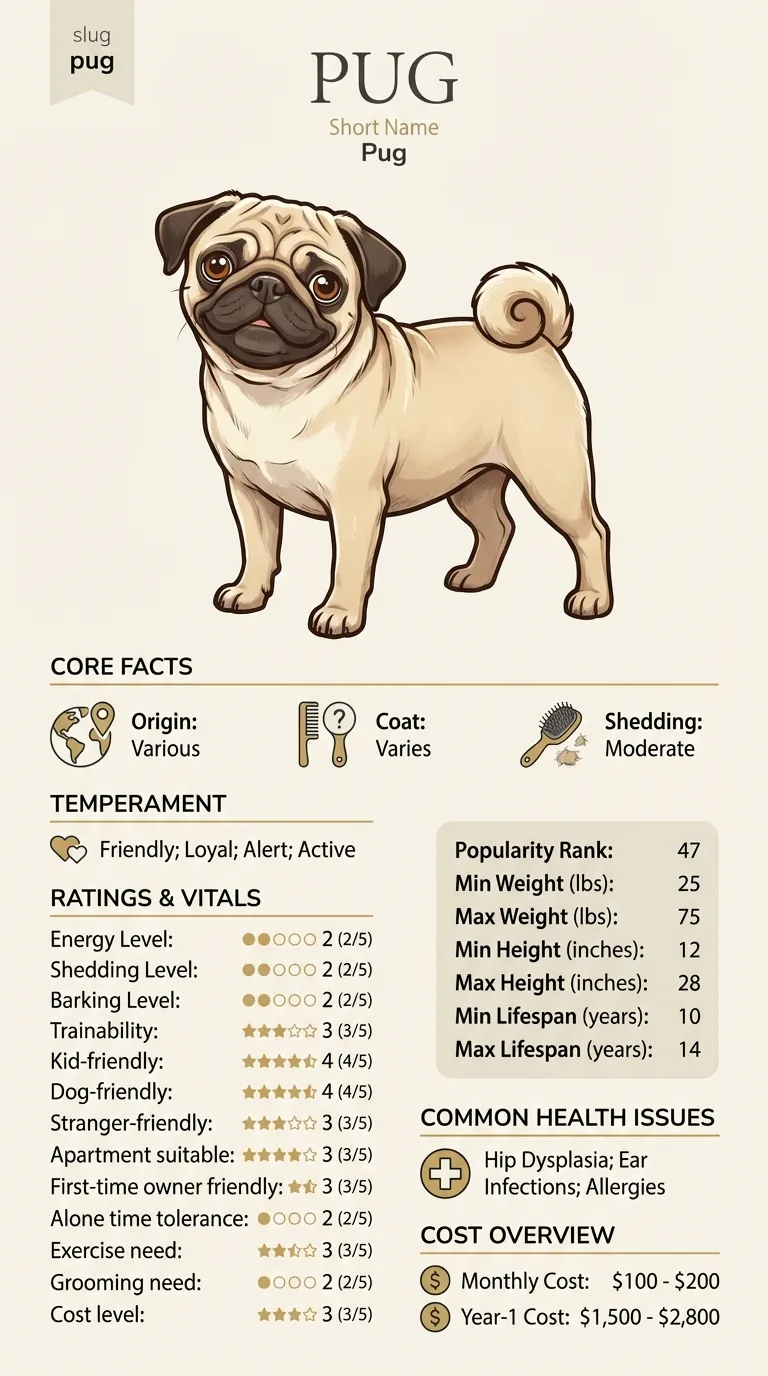
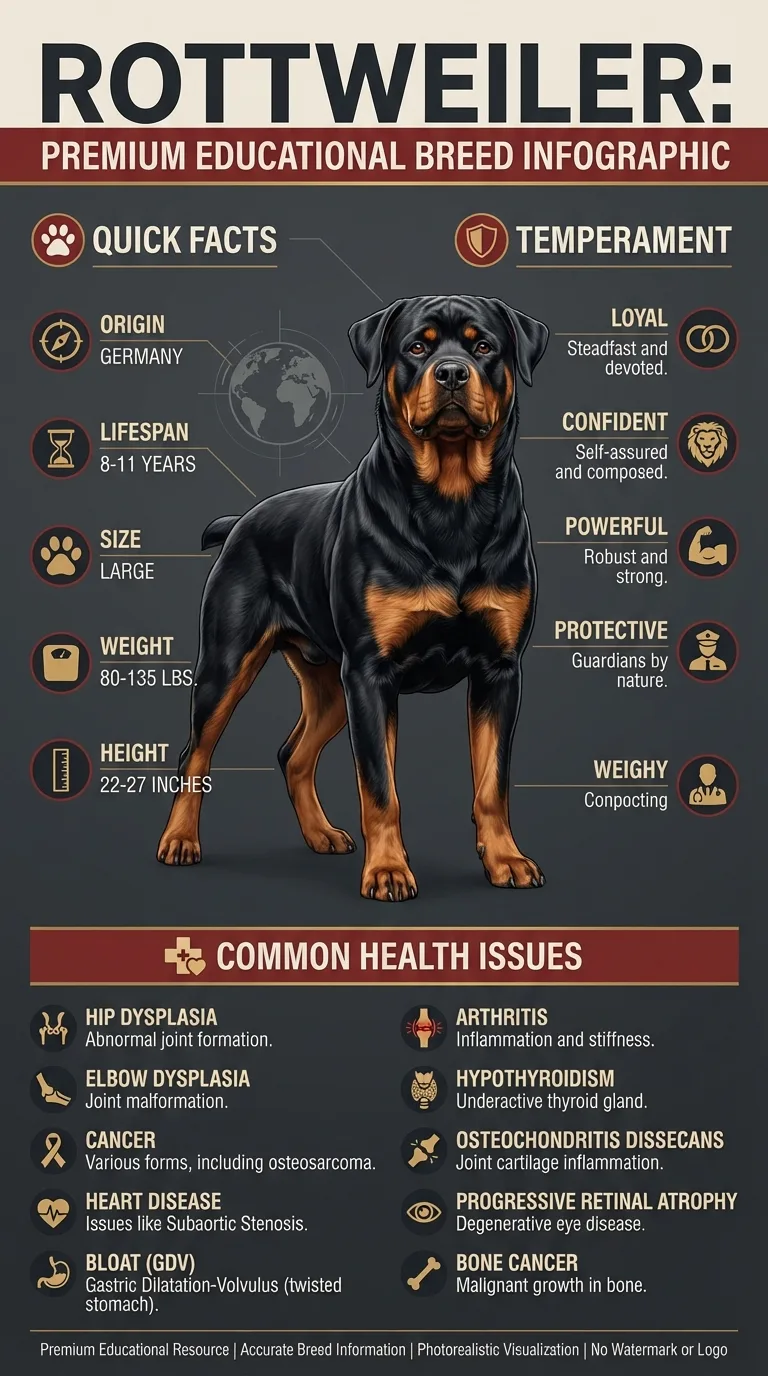
This is for someone already down to Pug and Rottweiler and deciding between them. For this pair the decision usually turns on apartment suitability and good for first-time owners, so those are covered first and in most detail. Anyone choosing from a flat has a clear answer here: Pug rates 5/5 against 2/5. Breed history is left out; what follows is what you will actually live with.
Between Pug and Rottweiler, apartment suitability is what separates them, and Pug is the lower-effort dog of the two to keep.
Choose Pug if you are in a flat or a smaller home, this is your first dog and your walking routine is modest.
Choose Rottweiler if you want a dog that picks up training quickly, you want a dog that can keep up with an active routine and you want a dog that is more watchful with visitors.
| Feature | pug | rottweiler | Winner |
|---|---|---|---|
| Size class | small | large | Equal |
| Weight | 14–18 lbs | 80–135 lbs | Equal |
| Height | 10–13 in | 22–27 in | Equal |
| Lifespan | 13–15 years | 8–11 years | pug |
| Exercise need | Low (2/5) | High (4/5) | pug |
| Grooming need | Low (2/5) | Low (2/5) | Equal |
| Shedding | High (4/5) | High (4/5) | Equal |
| Energy level | Low (2/5) | High (4/5) | Equal |
| Barking | Low (2/5) | Moderate (3/5) | pug |
| Apartment suitability | Very high (5/5) | Low (2/5) | pug |
| Good for first-time owners | Very high (5/5) | Low (2/5) | pug |
| Tolerates being alone | Low (2/5) | Low (2/5) | Equal |
| Trainability | Moderate (3/5) | High (4/5) | rottweiler |
| Good with kids | Very high (5/5) | High (4/5) | pug |
| Good with other dogs | High (4/5) | Moderate (3/5) | pug |
| Friendly to strangers | Very high (5/5) | Low (2/5) | pug |
| Cost level | Moderate (3/5) | High (4/5) | pug |
| Coat | Short, smooth double coat | Double coat, short | Equal |
| Origin | Various | Germany | Equal |
| Typical monthly cost | $80–$150 | $125–$250 | Equal |
| Typical first-year cost | $1,100–$2,300 | $2,000–$3,500 | Equal |
A Pug at 14 to 18 pounds and 10 to 13 inches tall is dwarfed by a Rottweiler's 80 to 135 pounds and 22 to 27 inch frame — a weight difference of roughly six to nine times. The Pug's short, smooth double coat covers a compact, muscular body built for companionship rather than work, while the Rottweiler's short double coat sits over a powerfully built frame historically used for driving cattle and pulling carts. Anyone picturing these two side by side should expect the Rottweiler to genuinely tower over the Pug — this is one of the largest size gaps in any comparison on this site.
Exercise need favors the Rottweiler at high (4/5) against the Pug's low (2/5), and energy level follows the same pattern — high (4/5) for the Rottweiler versus low (2/5) for the Pug. The Pug's brachycephalic (flat-faced) build limits how much exertion it can safely handle, especially in heat, which keeps its exercise needs modest by design rather than choice. The Rottweiler, bred for sustained working tasks, genuinely needs regular vigorous activity to stay physically and mentally balanced; under-exercising a dog this large and this driven tends to surface as unwanted chewing or restlessness rather than quiet boredom.
Grooming need ties at low (2/5) for both breeds, and shedding ties too, both rated high (4/5) — a reminder that short coats don't automatically mean low-maintenance floors. The Pug's smooth double coat and the Rottweiler's short double coat both shed steadily year-round rather than in dramatic seasonal blowouts, so regular brushing and a good vacuum matter more than professional grooming appointments for either breed. Neither dog will cost much in grooming bills, but neither is a good match for someone who wants zero pet hair on dark clothing.
Apartment suitability heavily favors the Pug at very high (5/5) against the Rottweiler's low (2/5), a gap driven largely by size and exercise needs rather than temperament. Barking rates low (2/5) for the Pug and moderate (3/5) for the Rottweiler, so the smaller dog is the quieter of the two through shared walls. Both breeds tie at low (2/5) for tolerating being alone, meaning neither is well suited to an owner gone most of the day — though a bored, understimulated Rottweiler left alone too often is a more serious management challenge given its size and strength.
Trainability favors the Rottweiler at high (4/5) against the Pug's moderate (3/5), and the temperament data explains the gap: the Rottweiler is described as loyal, confident, powerful, and protective, traits that respond well to structured, purposeful training, while the Pug's charming, mischievous, affectionate, even-tempered nature can make it more food-motivated but also more easily distracted. First-time-owner suitability actually favors the Pug strongly — very high (5/5) versus the Rottweiler's low (2/5) — since a novice handling a dog this size and this protective by instinct benefits enormously from prior training experience.
The Pug outscores the Rottweiler on every household-fit measure here: very high (5/5) versus high (4/5) with kids, high (4/5) versus moderate (3/5) with other dogs, and very high (5/5) versus low (2/5) with strangers. The Rottweiler's protective, watchful instincts make it naturally more reserved around unfamiliar people, which is exactly the behavior many owners want from a guardian breed but requires careful socialization and management around visitors and children's friends. The Pug's near-universal friendliness makes it the more forgiving choice for a household that hosts often or has a busy, unpredictable social calendar.
Lifespan favors the Pug at 13 to 15 years against the Rottweiler's shorter 8 to 11 — a meaningful gap tied to the size difference between the breeds. The Pug's five listed conditions are heavily shaped by its flat-faced build: Brachycephalic Airway Syndrome (BOAS), Pug Dog Encephalitis, corneal ulcers, hemivertebrae, and obesity, several of which require lifelong management around breathing and weight. The Rottweiler's ten-condition list leans toward large-breed structural and cancer risk: hip and elbow dysplasia, cancer, heart disease, bloat (GDV), arthritis, hypothyroidism, osteochondritis dissecans, Progressive Retinal Atrophy, and bone cancer — a genuinely heavier overall health burden despite the shorter Pug list.
Cost level rates moderate (3/5) for the Pug and high (4/5) for the Rottweiler, and the dollar figures track: $80 to $150 monthly for the Pug versus $125 to $250 for the Rottweiler, with first-year totals of $1,100 to $2,300 against a considerably steeper $2,000 to $3,500. The Rottweiler's premium comes from feeding an 80-to-135-pound body, larger-breed veterinary pricing, and sturdier gear built to handle its strength. The Pug's costs lean more toward ongoing management of its brachycephalic-related health issues rather than sheer volume, but its overall bill stays notably lower across both the monthly and first-year figures.
Pug weighs 14–18 lbs and lives 13–15 years; Rottweiler weighs 80–135 lbs and lives 8–11 years. The two diverge most on apartment suitability, good for first-time owners and exercise need and 2 other rated axes. They are level on tolerates being alone, grooming need and shedding, so those cannot decide it. The comparison marks an easier option only where one exists. Facts like weight and country of origin are not scored. Both dogs are rated from the same dataset, which is what makes the numbers comparable with each other even though any individual dog sits somewhere inside its breed's range.

The Pug, rated very high (5/5) versus the Rottweiler's low (2/5), reflecting the Rottweiler's naturally watchful, protective instincts.
Not typically recommended — it rates low (2/5) for first-time owners due to its size, strength, and protective temperament, versus the Pug's very high (5/5).
The Pug, at 13-15 years, compared with 8-11 years for the Rottweiler — a gap largely explained by their size difference.
Brachycephalic Airway Syndrome (BOAS), Pug Dog Encephalitis, corneal ulcers, hemivertebrae, and obesity — several tied directly to the breed's flat-faced structure.
The Rottweiler, rated high (4/5) versus the Pug's low (2/5).
Roughly $900 to $1,200 more — $2,000-$3,500 for the Rottweiler compared with $1,100-$2,300 for the Pug.
Yes, they rate high (4/5) with kids, just slightly behind the Pug's very high (5/5), though their size calls for supervision with small children.
The Pug, at 14-18 lbs versus the Rottweiler's 80-135 lbs.
The Pug, rated very high (5/5) versus the Rottweiler's low (2/5).
The Rottweiler, rated high (4/5) versus the Pug's moderate (3/5).
The Pug, at 13-15 years versus 8-11 years for the Rottweiler.
See every pug comparison.
Secure checkout on Stripe. We never see your card.
7-day money-back guarantee. Instant access.


Health information here is general and is not veterinary advice. If your dog shows pain, sudden behaviour change, or worsening symptoms, consult a licensed veterinarian.
Some links on this site are affiliate links. We may earn a commission at no extra cost to you, and we only suggest products we believe are helpful for dog owners.
We research and check what we publish, but we do not warrant that any figure, date, price, or statement is accurate, complete, or current, and we accept no liability for any loss, cost, injury, or other harm arising from the use of this site. Use it as one reference among several. You remain responsible for your own decisions and for your dog's care - confirm anything that matters with a licensed veterinarian or another qualified professional before you act on it. Full disclaimer.
Match your lifestyle to the right dog.
Take quizNot sure which breed is right for you? Take our 2-minute quiz to find out.
Take the quiz