Living
What's the overall pick?
This is one of the closer matchups: pick the pug for a slightly longer lifespan and easier grooming, the basset for a bit more space between meals given similar obesity risk either way.

Quick answer
What's the overall pick?
This is one of the closer matchups: pick the pug for a slightly longer lifespan and easier grooming, the basset for a bit more space between meals given similar obesity risk either way.
Basset Hound or Pug? On paper they differ most on grooming need, and on the scales Basset Hound is the heavier at 40–65 lbs. Here is how the two compare on everything that shapes an ordinary week.
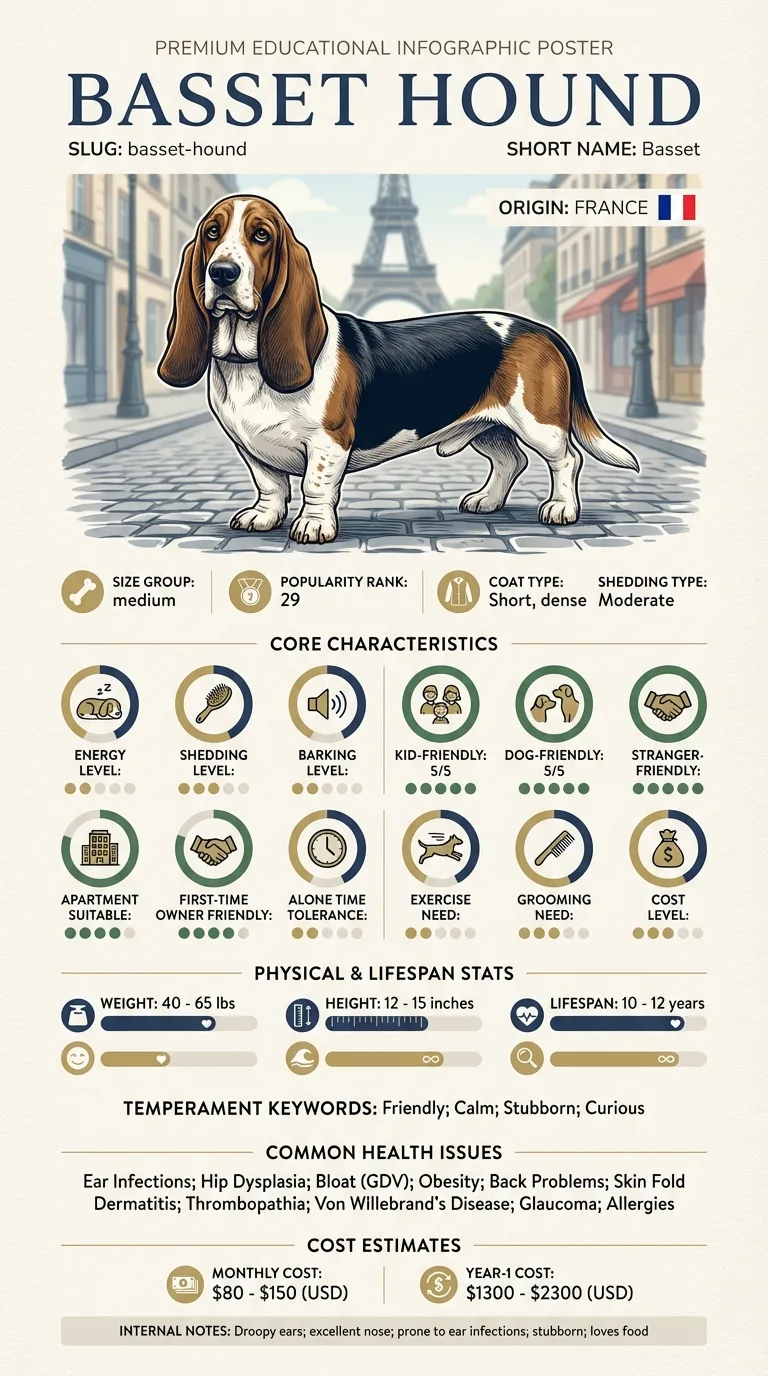
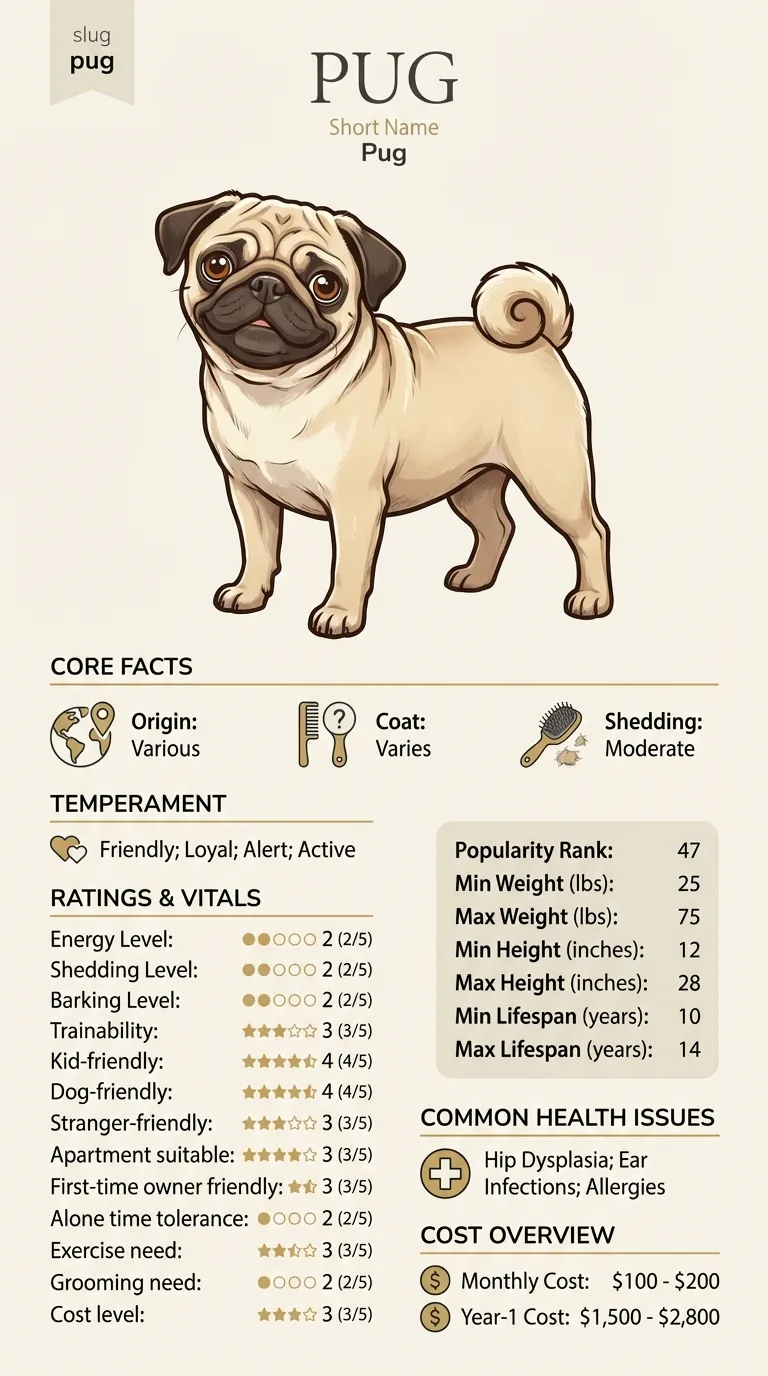
This is for someone already down to Basset Hound and Pug and deciding between them. Because the two are so evenly matched, the page works through every axis rather than leading with one. Anyone choosing from a flat has a clear answer here: Pug rates 5/5 against 4/5. Breed history is left out; what follows is what you will actually live with.
Between Basset Hound and Pug, size is the honest dividing line, and Pug is the lower-effort dog of the two to keep.
Choose Basset Hound if shedding is a problem in your house and you already have another dog.
Choose Pug if you are in a flat or a smaller home, this is your first dog and you do not want a standing grooming appointment.
| Feature | basset hound | pug | Winner |
|---|---|---|---|
| Size class | medium | small | Equal |
| Weight | 40–65 lbs | 14–18 lbs | Equal |
| Height | 12–15 in | 10–13 in | Equal |
| Lifespan | 10–12 years | 13–15 years | pug |
| Exercise need | Low (2/5) | Low (2/5) | Equal |
| Grooming need | Moderate (3/5) | Low (2/5) | pug |
| Shedding | Moderate (3/5) | High (4/5) | basset hound |
| Energy level | Low (2/5) | Low (2/5) | Equal |
| Barking | Low (2/5) | Low (2/5) | Equal |
| Apartment suitability | High (4/5) | Very high (5/5) | pug |
| Good for first-time owners | High (4/5) | Very high (5/5) | pug |
| Tolerates being alone | Low (2/5) | Low (2/5) | Equal |
| Trainability | Low (2/5) | Moderate (3/5) | pug |
| Good with kids | Very high (5/5) | Very high (5/5) | Equal |
| Good with other dogs | Very high (5/5) | High (4/5) | basset hound |
| Friendly to strangers | Very high (5/5) | Very high (5/5) | Equal |
| Cost level | Moderate (3/5) | Moderate (3/5) | Equal |
| Coat | Short, dense | Short, smooth double coat | Equal |
| Origin | France | Various | Equal |
| Typical monthly cost | $80–$150 | $80–$150 | Equal |
| Typical first-year cost | $1,300–$2,300 | $1,100–$2,300 | Equal |
Both are small-to-medium dogs but built differently. The pug weighs 14-18 lbs and stands 10-13 inches -- compact and square. The basset weighs 40-65 lbs on a 12-15 inch frame -- similar height, three to four times the weight, all of it packed into a long body on short legs. Pick either one up and you'll notice the difference immediately.
This is a genuine tie: both breeds rate low (2/5) for exercise need and low (2/5) for energy level. Neither dog is going to drag you out for a run. A short walk and some couch time suits both equally, making this one of the closer matchups on the whole list.
Grooming favors the pug, rating low (2/5) against the basset's moderate (3/5) -- no ears to clean out the way a basset's droopy ones need. Shedding flips the other way: the pug rates high (4/5), the basset moderate (3/5), so despite the easier grooming routine, expect more hair around the house with the pug.
Both do well in apartments, with the pug rating very high (5/5) against the basset's high (4/5). Barking is low (2/5) for both -- a rare area of full agreement. Neither dog handles being left alone well, both landing at low (2/5), so this isn't the pairing to choose if you're out of the house all day.
The pug rates moderate (3/5) for trainability against the basset's low (2/5), a modest edge. Both rate well for first-time owners -- the pug very high (5/5), the basset high (4/5) -- making this one of the more beginner-friendly matchups regardless of which one you pick.
Kids and strangers are a dead heat: both breeds rate very high (5/5) on each. Other dogs tilt slightly to the basset, very high (5/5) against the pug's high (4/5). Whichever you choose, you're getting a dog built for a social household.
The pug's 13-15 year lifespan runs ahead of the basset's 10-12. Obesity is the one shared item between their health lists -- both breeds pack on weight easily and need portion control. Beyond that they diverge sharply: the pug's risks center on its flat face and short spine (BOAS, hemivertebrae), while the basset's stem from its long back and ears.
Cost level ties at moderate (3/5) for both breeds, and the numbers back it up almost exactly: $80-150 a month for either dog, with first-year costs of $1,300-2,300 for the basset and $1,100-2,300 for the pug. This is about as close as two breeds get on cost.
Basset Hound weighs 40–65 lbs and lives 10–12 years; Pug weighs 14–18 lbs and lives 13–15 years. No rated axis separates them by more than a single point, which makes this one of the closer pairings on the site. They are level on tolerates being alone, barking and cost level, so those cannot decide it. The comparison marks an easier option only where one exists. Facts like weight and country of origin are not scored. Both dogs are rated from the same dataset, which is what makes the numbers comparable with each other even though any individual dog sits somewhere inside its breed's range.

Neither -- they tie at low (2/5) for both exercise need and energy level. This is one of the rare matchups where activity level isn't a deciding factor.
The pug, rating high (4/5) against the basset's moderate (3/5), despite the pug's much shorter coat and easier grooming overall.
Yes, both score well -- the pug very high (5/5), the basset high (4/5). Either is a reasonable choice if this is your first dog.
Almost identically -- both rate moderate (3/5) for cost level, with monthly costs around $80-150 for either breed and first-year costs within $200 of each other.
Only obesity appears on both lists. Otherwise their risks don't overlap -- the pug's are tied to its flat face and short spine, the basset's to its long back and heavy ears.
The pug, typically 13-15 years against the basset's 10-12 -- a solid few years' edge.
Neither has an advantage -- both rate low (2/5) for barking, making this one of the quieter matchups on the site if noise is a concern.
This is one of the closer matchups: pick the pug for a slightly longer lifespan and easier grooming, the basset for a bit more space between meals given similar obesity risk either way.
Both run about $80-150 a month -- cost isn't a differentiator here.
Both rate low (2/5) -- neither breed needs much beyond a short daily walk.
Pugs average 13-15 years; bassets average 10-12.
See every pug comparison.
Secure checkout on Stripe. We never see your card.
7-day money-back guarantee. Instant access.
Health information here is general and is not veterinary advice. If your dog shows pain, sudden behaviour change, or worsening symptoms, consult a licensed veterinarian.
Some links on this site are affiliate links. We may earn a commission at no extra cost to you, and we only suggest products we believe are helpful for dog owners.
We research and check what we publish, but we do not warrant that any figure, date, price, or statement is accurate, complete, or current, and we accept no liability for any loss, cost, injury, or other harm arising from the use of this site. Use it as one reference among several. You remain responsible for your own decisions and for your dog's care - confirm anything that matters with a licensed veterinarian or another qualified professional before you act on it. Full disclaimer.
Match your lifestyle to the right dog.
Take quizNot sure which breed is right for you? Take our 2-minute quiz to find out.
Take the quiz