Health
Why does this breed have so many documented health conditions?
Population genetics research links it to a historically small founding population and reduced genetic diversity.

Quick answer
Why does this breed have so many documented health conditions?
Population genetics research links it to a historically small founding population and reduced genetic diversity.
The long list of conditions covered elsewhere on this site isn't a coincidence; it traces back to how few dogs this entire breed descended from.
This is useful big-picture context for any owner trying to understand why this breed seems to have an unusually long list of documented health conditions compared to some other breeds, and for anyone considering breeding decisions or researching genetic testing options.
This guide is not medical advice. If your dog shows pain, sudden behavior change, or worsening symptoms, consult a licensed veterinarian.
Some links may be affiliate links. We may earn a commission at no extra cost to you. We only suggest products we believe are helpful for dog owners.
Population genetics research has identified this breed as descending from a historically small founder population, resulting in reduced genetic diversity and a higher concentration of inherited disease-associated variants across the breed as a whole. This is a population-level pattern that helps explain this breed's unusually long list of documented health conditions, rather than any single disease.
This pattern applies to the breed as a whole rather than varying by individual dog in the way a specific disease does. What varies between individual dogs is which specific inherited conditions, if any, they end up expressing.
This is fundamentally a population genetics phenomenon tied to this breed's specific breeding history and historically small founder population, distinct from any single trait or disease mechanism discussed elsewhere.
Environment doesn't drive this underlying population-level genetic pattern, though ongoing breeding practices, prioritizing diversity and health testing versus appearance alone, are the main lever available to gradually influence it over future generations.
This isn't itself a reason for a specific vet visit, but it's worth discussing with your vet as context for building a comprehensive wellness and screening plan appropriate for this breed's overall documented health profile.
Start here: Pug Most Common Genetic Disorders: What to Screen For
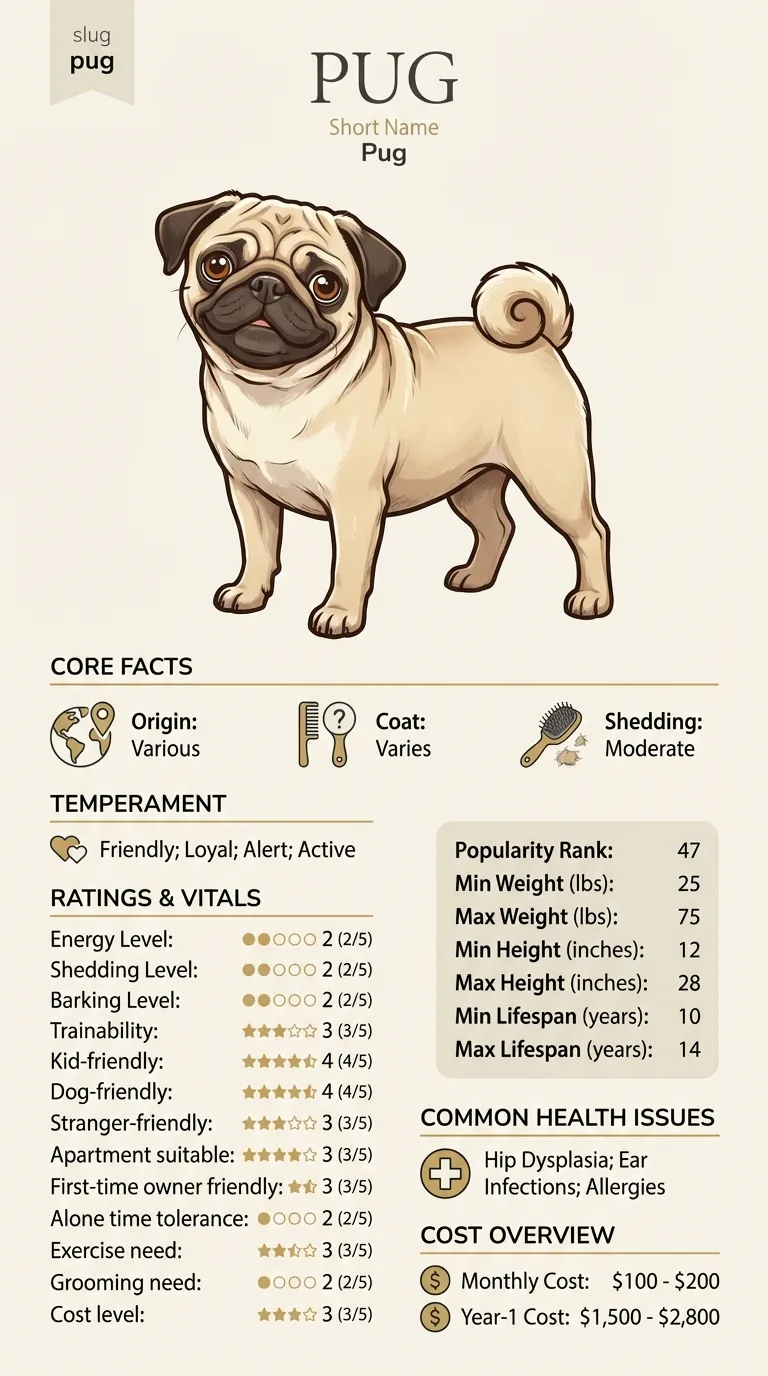
See all PUG health problems, which breeds are prone to genetic load, or the full PUG breed guide for temperament, exercise needs and ownership costs.
This is a population-level pattern rather than something with an individual dog treatment timeline. Broader change happens at the scale of breeding generations, not within an individual dog's lifetime.
Success here means understanding this context well enough to set realistic expectations and build a comprehensive, proactive wellness plan for your individual dog, rather than being caught off guard by any single condition in isolation.
Population genetics research has identified this breed as having passed through a significant historical population bottleneck, meaning the entire modern breed descends from a relatively small number of founding dogs. When a population starts small, any harmful genetic variants present in those founders get passed forward at a higher frequency than they would in a breed descending from a larger, more genetically diverse starting group, since there are fewer alternative gene copies to dilute them. Over generations, this can mean a higher overall concentration of disease-associated genetic variants circulating in the population, a different mechanism from any one condition being uniquely severe on its own.
This population-level pattern doesn't mean every individual Pug will develop multiple serious conditions; it means the breed as a whole carries a higher baseline load of inherited disease risk than some more genetically diverse breeds, which is reflected in the range of conditions documented across the population. For an individual owner, this translates into practical takeaways: genetic testing panels can screen for some, though not all, known inherited conditions before or shortly after adoption, and responsible breeding practices that prioritize genetic diversity, rather than breeding for appearance traits alone, are part of ongoing efforts within the breed community to manage this issue over time.

After her Pug puppy was diagnosed with a mild, unrelated congenital finding at a routine puppy exam, first-time owner Fatima found herself anxiously researching every possible Pug health condition online, feeling overwhelmed by how long the list seemed. A conversation with her vet about this breed's population genetics history helped her understand the pattern behind the long list, rather than assuming her puppy was uniquely unlucky. With that context, Fatima built a proactive wellness plan, appropriate genetic testing, regular screenings, weight management, rather than anxiously waiting for the next condition to appear.
Key takeaway: Understanding the population-level genetic story behind this breed's long condition list helps owners build a proactive, realistic wellness plan rather than feeling blindsided by each individual diagnosis as a separate surprise.
It means the modern breed descends from a relatively small number of historical founding dogs, which concentrates whatever harmful genetic variants those founders carried at a higher frequency throughout the population than in a more genetically diverse breed.
No, this is a population-level pattern, not a guarantee for any individual dog. It means the breed as a whole carries a higher baseline genetic disease load, but individual dogs vary significantly in which, if any, conditions they actually develop.
Yes, genetic panels can screen for some known inherited conditions, though not all possible issues, giving useful information for individual health planning and for breeders making pairing decisions.
Several other purebred dog breeds are documented as having gone through similar historical population bottlenecks, meaning reduced genetic diversity and elevated inherited disease concentration is not unique to this breed, though the degree varies.
Some responsible breeding programs prioritize genetic diversity and health testing in pairing decisions, working to manage disease-variant concentration over time, rather than breeding solely for appearance traits.
It's useful context for understanding this breed's overall health profile and setting realistic expectations, though it's one factor among many; many Pugs live full, healthy lives with attentive ongoing veterinary care.
Population genetics research links it to a historically small founding population and reduced genetic diversity.
No, this is a population-level pattern; individual dogs vary widely in which conditions, if any, they develop.
Yes, genetic panels can screen for some known inherited conditions, though not every possible issue.
No, several other purebred breeds share similar historical population bottlenecks and reduced diversity.
Some prioritize genetic diversity and health testing in breeding decisions as part of ongoing efforts.
A one-page prep sheet for this condition: the signs, the questions to ask, what to get priced. Unlocks here.
You get: Vet visit prep sheet
No spam. One-click unsubscribe. See our privacy policy.
Preview page 1 before you decide.