Behavior
Louder barker?
Neither — both Pug and Saint Bernard rate Low (2/5) for barking.

Quick answer
Louder barker?
Neither — both Pug and Saint Bernard rate Low (2/5) for barking.
Pug or Saint Bernard? On paper they differ most on apartment suitability, and on the scales Saint Bernard is the heavier at 120–180 lbs. Here is how the two compare on everything that shapes an ordinary week.
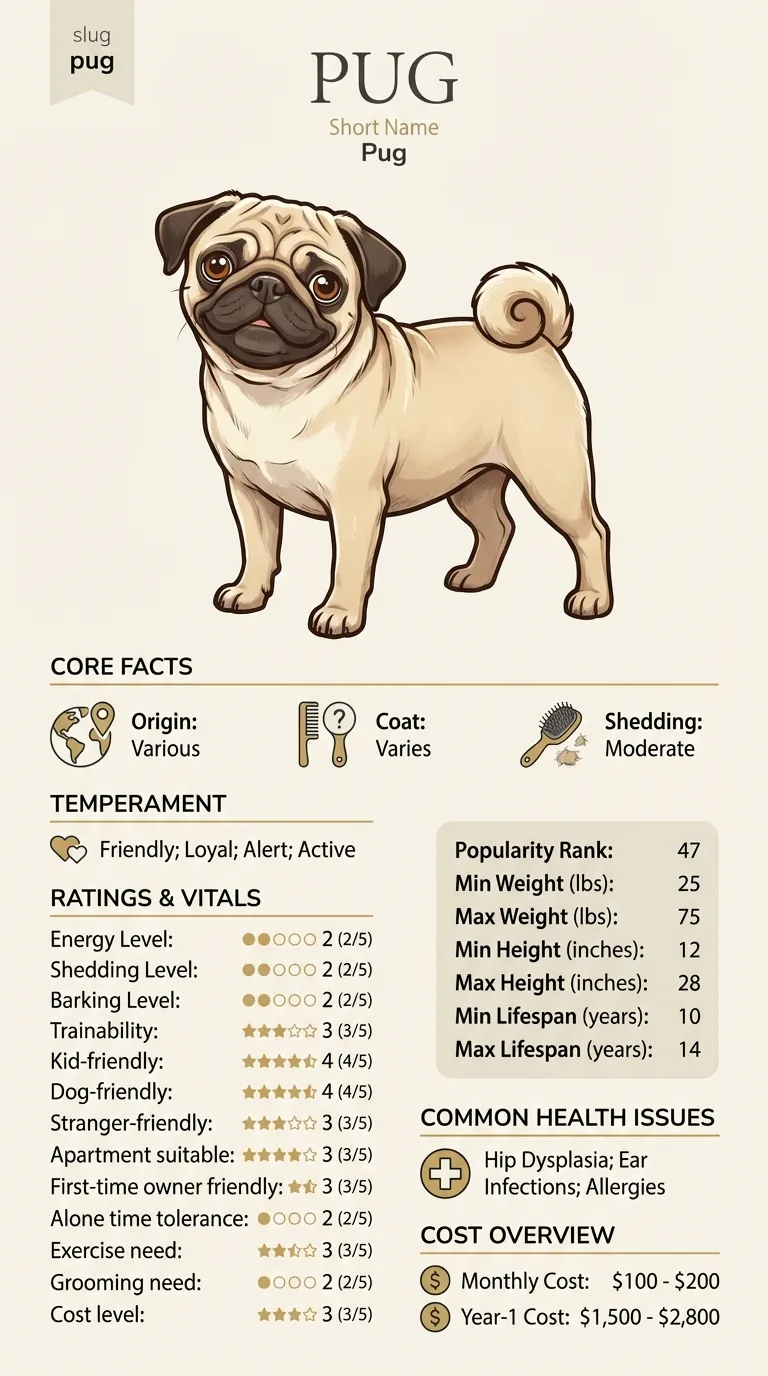
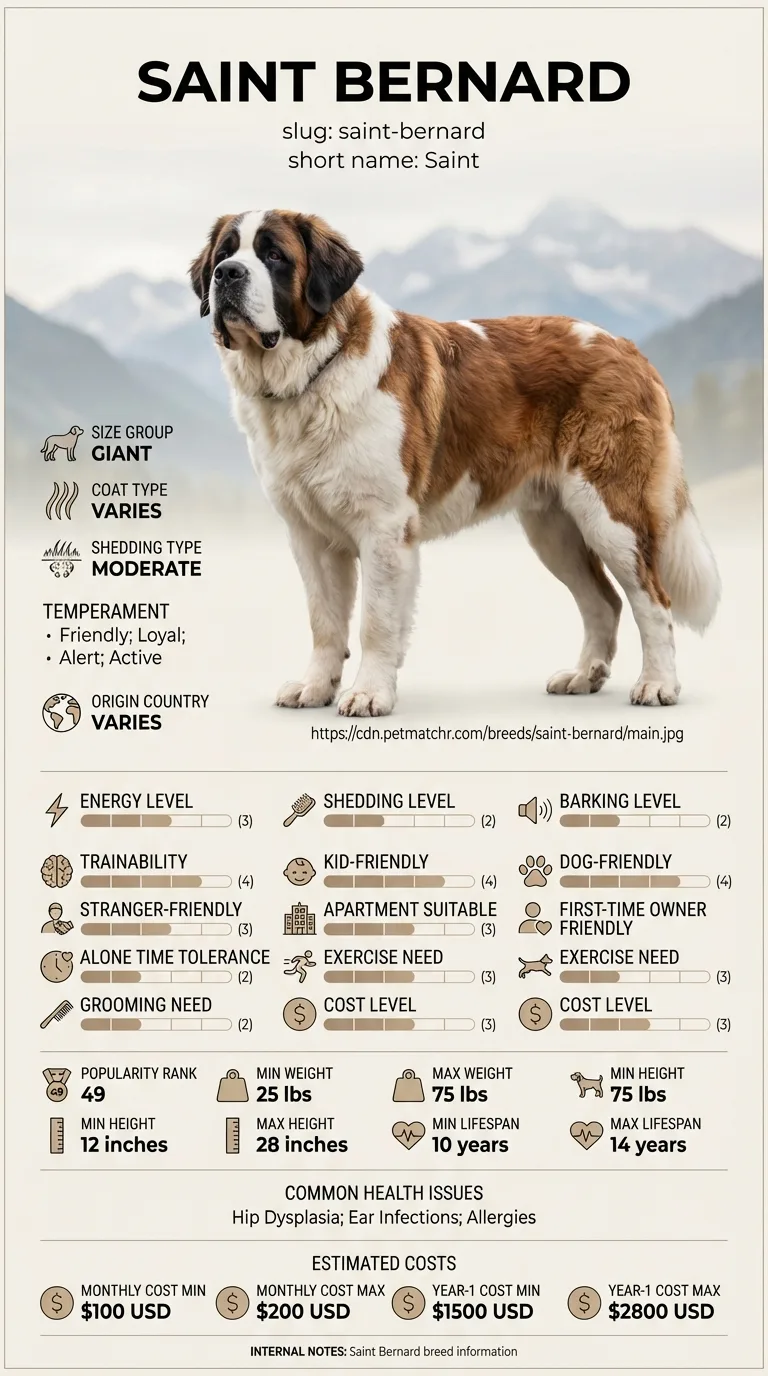
This is for someone already down to Pug and Saint Bernard and deciding between them. For this pair the decision usually turns on apartment suitability and good for first-time owners, so those are covered first and in most detail. Anyone choosing from a flat has a clear answer here: Pug rates 5/5 against 1/5. The focus throughout is on daily consequences rather than breed background.
Between Pug and Saint Bernard, apartment suitability is what separates them, and Pug is the lower-effort dog of the two to keep.
Choose Pug if you are in a flat or a smaller home, this is your first dog and you do not want a standing grooming appointment.
Choose Saint Bernard if the dog will be alone during the working day and you want a dog that is more watchful with visitors.
| Feature | pug | saint bernard | Winner |
|---|---|---|---|
| Size class | small | giant | Equal |
| Weight | 14–18 lbs | 120–180 lbs | Equal |
| Height | 10–13 in | 26–30 in | Equal |
| Lifespan | 13–15 years | 8–10 years | pug |
| Exercise need | Low (2/5) | Low (2/5) | Equal |
| Grooming need | Low (2/5) | Moderate (3/5) | pug |
| Shedding | High (4/5) | High (4/5) | Equal |
| Energy level | Low (2/5) | Low (2/5) | Equal |
| Barking | Low (2/5) | Low (2/5) | Equal |
| Apartment suitability | Very high (5/5) | Very low (1/5) | pug |
| Good for first-time owners | Very high (5/5) | Moderate (3/5) | pug |
| Tolerates being alone | Low (2/5) | Moderate (3/5) | saint bernard |
| Trainability | Moderate (3/5) | Moderate (3/5) | Equal |
| Good with kids | Very high (5/5) | Very high (5/5) | Equal |
| Good with other dogs | High (4/5) | High (4/5) | Equal |
| Friendly to strangers | Very high (5/5) | High (4/5) | pug |
| Cost level | Moderate (3/5) | Very high (5/5) | pug |
| Coat | Short, smooth double coat | Short or long double coat | Equal |
| Origin | Various | Various | Equal |
| Typical monthly cost | $80–$150 | $150–$310 | Equal |
| Typical first-year cost | $1,100–$2,300 | $2,200–$4,200 | Equal |
The gap here is about as extreme as this site ever covers: a Pug tops out around 18 pounds and 13 inches at the shoulder, while a Saint Bernard can reach 180 pounds and stand 30 inches tall — roughly ten times heavier at the top end. That difference cascades into everything else, from the size of crate and car needed to how much a slipped leash actually costs you in control. The Pug's compact, square body suits laps and small furniture; the Saint Bernard's massive, loose-skinned frame needs floor space, wide doorways, and furniture that can handle a dog leaning its full weight against it.
Despite the size gap, exercise need is rated Low (2/5) for both breeds, which surprises many first-time researchers. Neither dog was bred to run all day — the Saint Bernard's working history was cold-weather rescue and hauling, not marathon herding, so it's content with a couple of short walks. The Pug's flat face makes sustained exertion genuinely risky, particularly in heat, so its low-energy rating is as much a health limit as a temperament trait. Owners of either breed should still watch weight closely, since low exercise combined with a hearty appetite is a fast route to obesity in both.
Grooming need favors the Pug, rated Low (2/5) against the Saint Bernard's Moderate (3/5), but shedding is a wash — both breeds land at High (4/5). The Pug's short, smooth double coat needs little more than a weekly brush and regular cleaning of its facial wrinkles to prevent skin infections. The Saint Bernard, whether short- or long-coated, sheds seasonally in heavier volumes simply because there's more dog to shed, and its coat needs more frequent brushing to keep loose undercoat from matting. Neither breed is a fit for anyone who wants a hair-free home.
Apartment suitability is one of the starkest contrasts on this page: Very high (5/5) for the Pug against Very low (1/5) for the Saint Bernard, whose sheer bulk makes small hallways, elevators, and compact kitchens genuinely impractical. Barking, by contrast, is rated Low (2/5) for both, so neither breed is likely to annoy neighbors through thin walls with constant noise. A Saint Bernard in a city apartment isn't impossible, but it demands a much larger floor plan and patient neighbors used to a giant dog squeezing past them in the hallway — something a Pug owner never has to think about.
Both breeds share a Moderate (3/5) trainability score, so neither is a pushover to teach nor a natural obedience star. Where they diverge is suitability for first-time owners: Very high (5/5) for the Pug versus Moderate (3/5) for the Saint Bernard. That gap has less to do with intelligence and more with physical management — a stubborn 150-pound dog that decides not to move is a real handling challenge for a novice, while a Pug's mischievous streak rarely translates into anything a new owner can't redirect. Early leash and recall training matters more with the Saint Bernard simply because the consequences of skipping it are bigger.
With kids, both breeds score Very high (5/5), and the Saint Bernard's reputation as a patient, gentle giant around children is well earned — its temperament list even includes 'Gentle' and 'Patient' directly. Sociability with other dogs is tied at High (4/5) too. The only household category where they separate is strangers: Very high (5/5) for the Pug's naturally outgoing charm versus High (4/5) for the Saint Bernard, whose watchfulness makes it a touch more measured with new faces at the door, even if it warms up quickly. Supervision around toddlers still matters with the Saint Bernard purely due to its size.
Lifespan is a genuine deciding factor for many buyers: 13–15 years for the Pug against just 8–10 for the Saint Bernard, a gap of roughly five years that reflects the health realities giant breeds face. The Saint Bernard's list — Hip Dysplasia, Elbow Dysplasia, Dilated Cardiomyopathy, Entropion, and life-threatening Bloat (GDV) — is largely a function of its enormous frame and deep chest. The Pug's own list is no lighter, just different: Brachycephalic Airway Syndrome, Pug Dog Encephalitis, Corneal Ulcers, Hemivertebrae, and Obesity all stem from its flat face and compact spine. Both breeds need a vet who specializes in their particular body plan.
Cost level is rated Moderate (3/5) for the Pug and Very high (5/5) for the Saint Bernard, and the monthly numbers back that up clearly: $80–$150 versus $150–$310, with first-year costs of $1,100–$2,300 against $2,200–$4,200. Food alone explains a large share of that gap — a giant breed simply eats several times what a 16-pound Pug does — and larger doses of flea, tick, and heartworm medication, bigger beds, and oversized vet equipment add up further. Anyone budgeting for a Saint Bernard should expect close to double the Pug's ongoing spend, before factoring in the shorter lifespan meaning fewer years to spread a large upfront cost.
Pug weighs 14–18 lbs and lives 13–15 years; Saint Bernard weighs 120–180 lbs and lives 8–10 years. The two diverge most on apartment suitability, good for first-time owners and cost level. They are level on barking, good with other dogs and energy level, so those cannot decide it. The table below marks a winner only where one breed is genuinely easier for a typical owner; size and origin are facts rather than merits and stay level. Ratings come from one source applied to both breeds, so they are meaningful against each other rather than as absolute scores.

Likely yes — the Saint Bernard rates Very low (1/5) for apartment suitability against the Pug's Very high (5/5), and its 120-180 lb frame needs real floor space a small unit rarely offers.
The Pug, rated Very high (5/5) for first-time owners versus the Saint Bernard's Moderate (3/5) — a giant breed's size and strength require more handling confidence.
Saint Bernards are famous droolers on top of matching the Pug's High (4/5) shedding rating, so both breeds leave hair around, but only the Saint Bernard adds heavy drool to the cleanup list.
The Pug, typically 13–15 years versus the Saint Bernard's 8–10 years — a common tradeoff with giant breeds.
Yes, both score Very high (5/5) with kids, and the Saint Bernard's temperament list specifically includes 'Gentle' and 'Patient.'
Budget roughly double — Saint Bernards run $150–$310 a month and $2,200–$4,200 in the first year against the Pug's $80–$150 and $1,100–$2,300.
Neither needs much — both are rated Low (2/5) for exercise need, though for different reasons (the Pug's flat face, the Saint Bernard's laid-back working heritage).
Neither — both Pug and Saint Bernard rate Low (2/5) for barking.
The Pug, by a wide margin.
The Pug, at roughly half the Saint Bernard's monthly cost.
The Pug, by about five years on average.
See every pug comparison.
Secure checkout on Stripe. We never see your card.
7-day money-back guarantee. Instant access.


Health information here is general and is not veterinary advice. If your dog shows pain, sudden behaviour change, or worsening symptoms, consult a licensed veterinarian.
Some links on this site are affiliate links. We may earn a commission at no extra cost to you, and we only suggest products we believe are helpful for dog owners.
We research and check what we publish, but we do not warrant that any figure, date, price, or statement is accurate, complete, or current, and we accept no liability for any loss, cost, injury, or other harm arising from the use of this site. Use it as one reference among several. You remain responsible for your own decisions and for your dog's care - confirm anything that matters with a licensed veterinarian or another qualified professional before you act on it. Full disclaimer.
Match your lifestyle to the right dog.
Take quizNot sure which breed is right for you? Take our 2-minute quiz to find out.
Take the quiz