Living
What's the single most useful feeding change?
Slowing down a fast eater with a slow-feeder bowl or smaller, more frequent meals.

Quick answer
What's the single most useful feeding change?
Slowing down a fast eater with a slow-feeder bowl or smaller, more frequent meals.
Bloat prevention isn't about luck; it's mostly about how a bowl gets emptied.
This matters most to owners of fast eaters, dogs who compete for food in multi-dog households, and any Pug owner who has never thought about mealtime pacing as a health issue rather than just a feeding preference.
This guide is not medical advice. If your dog shows pain, sudden behavior change, or worsening symptoms, consult a licensed veterinarian.
Some links may be affiliate links. We may earn a commission at no extra cost to you. We only suggest products we believe are helpful for dog owners.
We research and check what we publish, but we do not warrant that any figure, date, price, or statement is accurate, complete, or current, and we accept no liability for any loss, cost, injury, or other harm arising from the use of this site. Use it as one reference among several. You remain responsible for your own decisions and for your dog's care - confirm anything that matters with a licensed veterinarian or another qualified professional before you act on it. Full disclaimer.
While bloat itself strikes suddenly, the gas buildup that precedes it is shaped by everyday habits: how fast a dog eats, how much air gets swallowed along the way, and how meals are timed around exercise. Adjusting these factors doesn't guarantee prevention, but it addresses the parts of bloat risk an owner can actually influence.
Fast eating and mealtime competition are extremely common everyday behaviors, which is exactly why they're worth addressing even though any individual dog's odds of developing full bloat remain relatively low in this breed.
Brachycephalic airway restriction may lead some Pugs to swallow more air while eating than a dog with a normal muzzle, adding to the gas load in the stomach, though this breed does not carry the classic deep-chested body type most strongly linked to bloat.
Feeding pace, portion size, and activity timing around meals are largely environmental and behavioral factors, meaning they're some of the most directly controllable pieces of overall bloat risk available to an owner.
Talk to your vet about your specific dog's risk factors, especially if your Pug is a notably fast eater, has had digestive issues before, or if you're considering a preventive gastropexy. If you ever see signs of an actual bloat episode, a swollen belly with unproductive retching, that's an immediate emergency, not a feeding-habits conversation.
Start here: Pug Most Common Genetic Disorders: What to Screen For
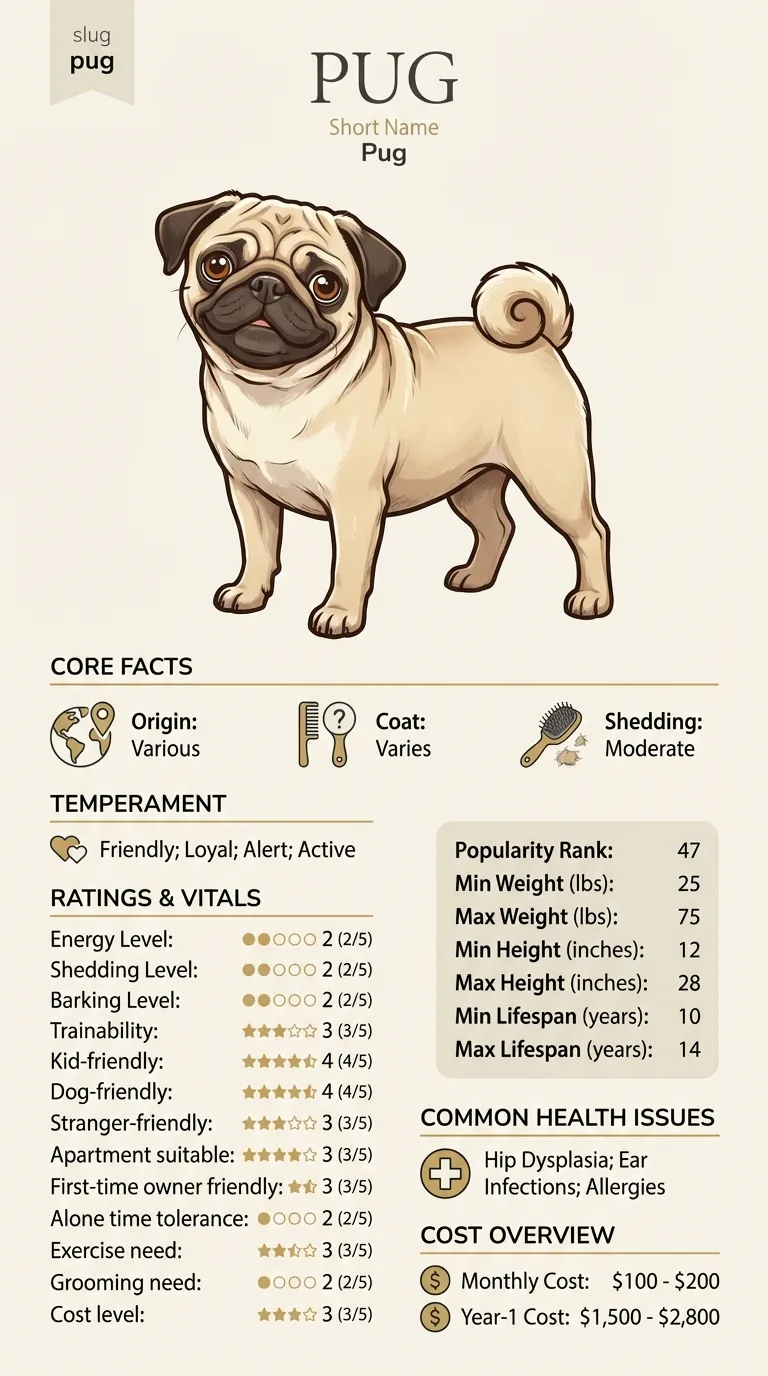
See all PUG health problems, which breeds are prone to bloat gdv, or the full PUG breed guide for temperament, exercise needs and ownership costs.
Feeding changes can be implemented immediately and habits typically adjust within one to two weeks as a dog adapts to a slow-feeder bowl or new meal schedule.
Success looks like a calmer, slower mealtime routine and one less controllable risk factor in the picture, not a guarantee that bloat will never occur, since some contributing factors remain outside any owner's control.
Brachycephalic dogs breathe through a narrower, more obstructed airway than dogs with a normal muzzle length, and that same airway restriction can affect how they eat. Some brachycephalic dogs gulp air, called aerophagia, more than average while eating or drinking, partly because rapid, effortful breathing and eating compete for the same narrow passage. More swallowed air means more gas sitting in the stomach to begin with, which is the raw material bloat needs. This isn't a reason for alarm on its own, but it's a real, plausible reason feeding pace matters even more in this breed than in one with an unobstructed airway.
Slowing down a fast eater is the single most actionable change most owners can make: a slow-feeder bowl with raised sections, or simply hand-feeding smaller portions, forces a dog to eat more deliberately and swallow less air along the way. Splitting the day's food into two or three smaller meals rather than one large one reduces how much a stomach has to process at once. Avoiding vigorous exercise for roughly an hour before and after meals gives digestion time to get underway before the stomach is jostled by movement. None of these guarantee bloat won't happen, but they address the everyday factors that are actually within an owner's control.

If you think your Pug has bloat, the plan is three steps: write down what you have seen and when it started, book a veterinary appointment rather than waiting for the next flare, and take video of the behaviour or symptom before you go — the thing you are worried about rarely happens in the consulting room. Screening in the parents covers brachycephalic airway syndrome (boas), pug dog encephalitis, corneal ulcers.
What the vet visit should produce is a diagnosis and a written plan, not just reassurance: what is being ruled out, what the monitoring interval is, and which signs mean you come back sooner. Ask what the treatment costs across a year rather than per visit, because that is the number that decides whether you are managing this condition or reacting to it.
Between appointments, keep a short log — dates, what you saw, what changed. It is the single most useful thing an owner brings to a follow-up, and for bloat it is often what separates a clear pattern from a guess.
Bruno, a three-year-old Pug, used to finish his meals in under thirty seconds flat, often followed by loud gulping sounds and a visibly swollen-looking belly for an hour afterward. After reading about the link between fast eating and bloat risk, his owner switched him to a slow-feeder bowl and split his single daily meal into two smaller ones. Within a couple of weeks, Bruno's mealtime stretched to five or six minutes, and the post-meal belly swelling and gulping noises noticeably decreased. His owner still keeps an eye out for bloat's warning signs, but describes the feeding change as one of the easiest, cheapest adjustments she's made as a Pug owner.
Key takeaway: Feeding pace is one of the few bloat-related factors an owner can directly control, and a simple bowl change can visibly reduce the everyday signs of excess gas and fast eating.
It can meaningfully slow down a fast eater, which reduces the amount of air swallowed along with food, one of the contributing factors to gas buildup in the stomach. It's a low-cost, low-effort change worth trying for any fast eater.
Two to three smaller meals a day, rather than one large meal, is generally recommended over letting a dog eat a big portion in one sitting.
There's no need to restrict water generally, but discouraging a dog from gulping large amounts very rapidly right after a big meal is a reasonable precaution.
Vigorous exercise or vigorous play soon after a meal is commonly advised against, since digestion and stomach movement combined with physical jostling may contribute to risk, even though the exact mechanism isn't fully settled.
Evidence on elevated bowls is mixed and some research has actually linked them to higher risk in certain breeds, so a floor-level bowl combined with slower eating pace is generally the safer default.
Competitive eating between dogs can speed up how fast each dog eats and how much air they swallow, so feeding dogs separately can help reduce that specific risk factor.
No product reliably prevents GDV. Feeding pace, meal frequency, and activity timing around meals are the practical, evidence-informed habits available to owners; talk to your vet about your dog's specific risk factors.
It's more commonly discussed for high-risk large breeds, but it's a reasonable conversation to have with your vet if your dog has other risk factors, like fast eating that hasn't responded to feeding changes, even though this breed's baseline risk is lower.
Slowing down a fast eater with a slow-feeder bowl or smaller, more frequent meals.
Avoiding vigorous exercise for about an hour before and after meals is a reasonable precaution.
Not reliably; some research links raised bowls to higher risk, so a floor-level bowl is generally preferred.
Brachycephalic dogs may swallow more air while eating due to their narrower airway, adding to gas buildup.
Most cost a modest, one-time amount and are a low-cost way to address a real contributing risk factor.
A one-page prep sheet for this condition: the signs, the questions to ask, what to get priced. Unlocks here.
You get: Vet visit prep sheet
No spam. One-click unsubscribe. See our privacy policy.
Preview page 1 before you decide.