Health
Is OCD the same as hip dysplasia?
No, OCD is a cartilage nutrition problem during growth, while hip dysplasia is a joint conformation issue; they're mechanically distinct conditions.

Quick answer
Is OCD the same as hip dysplasia?
No, OCD is a cartilage nutrition problem during growth, while hip dysplasia is a joint conformation issue; they're mechanically distinct conditions.
A joint can be shaped perfectly and still develop a cartilage flap simply because the puppy grew too fast for its own blood supply to keep up.
Owners of large-breed puppies between four and eight months old, particularly active, fast-growing puppies showing a limp that comes and goes with activity level.
This guide is not medical advice. If your dog shows pain, sudden behavior change, or worsening symptoms, consult a licensed veterinarian.
Some links may be affiliate links. We may earn a commission at no extra cost to you. We only suggest products we believe are helpful for dog owners.
We research and check what we publish, but we do not warrant that any figure, date, price, or statement is accurate, complete, or current, and we accept no liability for any loss, cost, injury, or other harm arising from the use of this site. Use it as one reference among several. You remain responsible for your own decisions and for your dog's care - confirm anything that matters with a licensed veterinarian or another qualified professional before you act on it. Full disclaimer.
Osteochondritis dissecans is a cartilage development disorder where cartilage growing faster than its blood supply becomes fragile and can crack within a joint, most often the shoulder in a large breed like this one. It's mechanically distinct from hip dysplasia, driven by rapid growth-phase biology rather than joint shape, and typically appears in puppies between four and eight months old.
OCD isn't among this breed's own specifically documented health issues, but it's a recognized risk across large-breed puppies generally during rapid growth, making an intermittent limp in a growing puppy worth a proper orthopedic workup rather than an assumption it will resolve on its own.
This breed's large adult size, up to a hundred pounds, means its puppies go through a substantial growth phase, and rapid growth is the central risk factor for cartilage outpacing its blood supply, the core mechanism behind OCD, regardless of any specific documented predisposition in this breed's own health record.
Overfeeding, excessive calorie-dense diets, over-supplementing calcium, and high-impact exercise or repeated jumping during the peak growth window all increase the mechanical and nutritional stress on developing cartilage.
Talk to your vet promptly about any limp in a growing puppy, especially one that comes and goes with activity level. Early diagnosis and activity restriction give the best chance of avoiding surgery, so don't wait to see if it resolves on its own.
See all OLD English Sheepdog health problems, which breeds are prone to osteochondritis dissecans ocd, or the full OLD English Sheepdog breed guide for temperament, exercise needs and ownership costs.
OCD typically appears and is diagnosed within the four-to-eight-month growth window. Conservative management with strict rest generally takes six to eight weeks to show improvement, while surgical cases typically need a similar recovery period afterward.
Success looks like resolved lameness and a stable joint as growth finishes, without significant secondary arthritis developing, achieved through prompt recognition and appropriate activity restriction or surgery during the growth phase itself.
During normal growth, cartilage at the ends of long bones gradually converts to bone as blood vessels grow into it. In OCD, that process outpaces its own blood supply, particularly during the rapid weight and height gains typical of large-breed puppies, leaving a patch of cartilage that doesn't get properly nourished and becomes fragile. Under normal joint stress, that weakened cartilage can crack or partially detach, forming a flap that moves within the joint and causes pain, swelling, and lameness. This most commonly affects the shoulder in this breed's size category, though the elbow, hock, or knee can also be involved. It's mechanically distinct from hip dysplasia, which is a problem with how the joint itself is shaped and fits together, not a cartilage nutrition issue during growth.
X-rays often reveal the affected area, sometimes showing the cartilage flap directly, though advanced imaging like CT or MRI can be needed for a clearer picture in some cases. Treatment ranges from strict rest and activity restriction for milder cases caught early, giving the cartilage a chance to stabilize, to arthroscopic surgery to remove a loose or detached cartilage fragment in more advanced cases. Outcomes are generally good with appropriate treatment, particularly when caught during the growth phase itself rather than after significant secondary arthritis has developed from the joint compensating for the unstable cartilage.

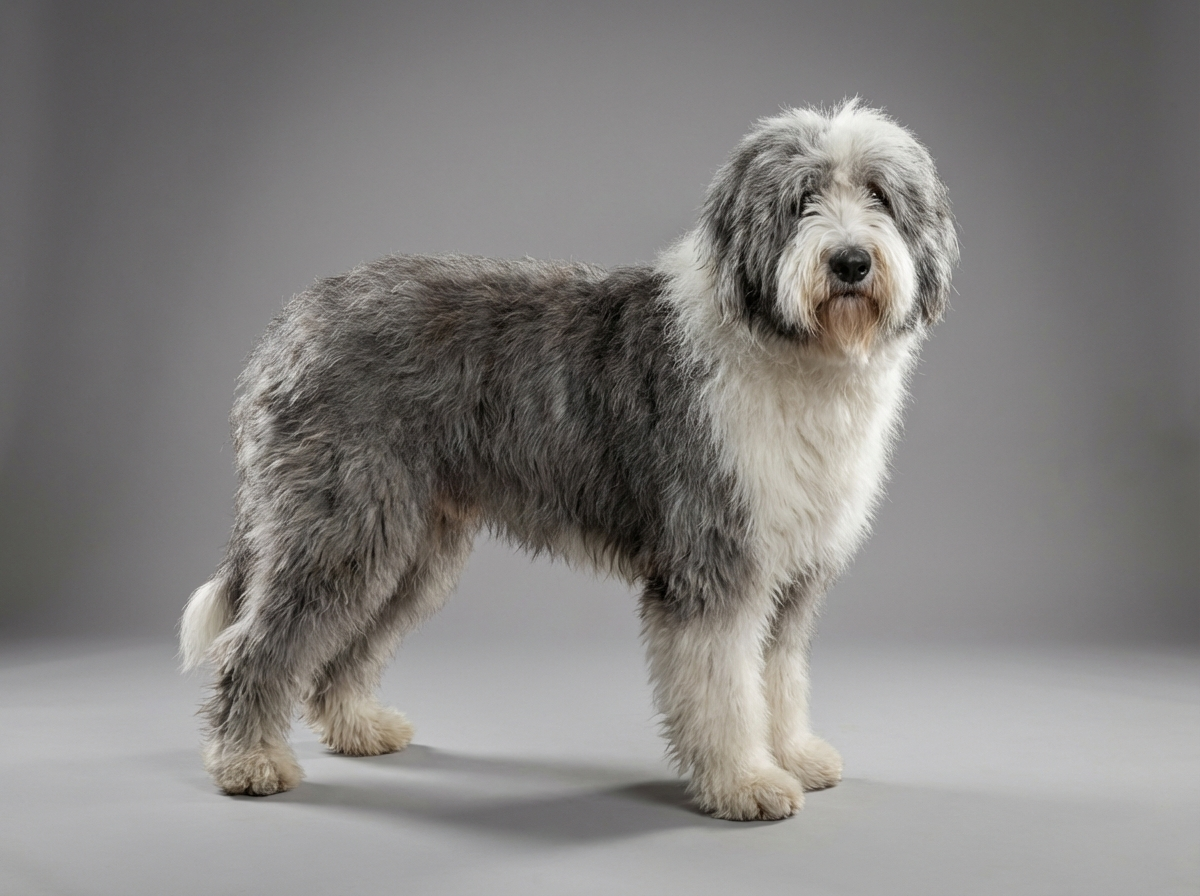
Tucker, a six-month-old Old English Sheepdog puppy in Richmond, had a limp on his front leg that seemed to come and go, worse after an active play session and barely noticeable the next morning. His owner Marco initially assumed it was ordinary puppy roughhousing catching up with him, but when the pattern continued for two weeks, he brought Tucker in for an exam. X-rays revealed OCD in his shoulder. Tucker's vet recommended strict activity restriction, leash walks only, no jumping or rough play, for eight weeks rather than jumping straight to surgery given how early it was caught. At his recheck, the lameness had fully resolved and follow-up imaging showed the cartilage had stabilized.
Key takeaway: An intermittent limp that seemed to fade on its own between play sessions was actually a developing cartilage problem, and catching it early meant strict rest, not surgery, was enough to fix it.
It's a cartilage development disorder where cartilage growing faster than its blood supply becomes fragile and can crack or partially detach within a joint, causing pain and lameness in growing puppies.
Hip dysplasia is a problem with how the joint itself is shaped and fits together. OCD is a cartilage nutrition and growth problem that can affect several different joints, most often the shoulder in large breeds, and isn't about joint conformation at all.
It typically shows up between four and eight months old, during the period of most rapid growth for a large-breed puppy like this one, though it can occasionally be diagnosed slightly outside that window.
A limp that comes and goes with activity level, often worse after exercise and easing somewhat with rest, is typical, distinct from the more constant stiffness patterns sometimes seen with joint conformation issues.
Not always. Milder cases caught early are sometimes managed successfully with strict rest and activity restriction alone, while more advanced cases with a detached cartilage fragment generally do better with arthroscopic surgical removal.
Not entirely, since rapid growth itself is a contributing factor, but avoiding excessive high-impact exercise and not over-supplementing calcium or overfeeding a growing large-breed puppy can reduce the risk and severity.
If treated promptly, many dogs recover well without lasting issues. Delayed treatment can allow secondary arthritis to develop as the joint compensates for the unstable cartilage, which is why early recognition matters.
No, OCD is a cartilage nutrition problem during growth, while hip dysplasia is a joint conformation issue; they're mechanically distinct conditions.
Typically between four and eight months old, during the fastest phase of growth for a large-breed puppy.
No, milder cases caught early can sometimes be managed with strict rest, while more advanced cases often benefit from arthroscopic surgery.
Diagnostic imaging plus potential arthroscopic surgery can range from several hundred to a few thousand dollars depending on severity and joint involved.
Yes, excessive calorie intake and rapid growth, along with over-supplementing calcium, are recognized contributing factors in large-breed puppies.
A one-page prep sheet for this condition: the signs, the questions to ask, what to get priced. Unlocks here.
You get: Vet visit prep sheet
No spam. One-click unsubscribe. See our privacy policy.
See a sample page before you decide.
Early access list
The free prep sheet covers the same-day warning signs, a symptom log and the questions to ask. We are considering a fuller kit that adds a cost worksheet for the usual tests and treatments (US price ranges with their sources) and a plain-English guide to ways of covering the bill. It is not built yet; this list tells us whether it is worth building.
One email, no spam, unsubscribe anytime. Information only, not veterinary advice.