Living
Which breed is smaller?
The Basset Hound stands just 12-15 inches tall versus the Sheepdog's 20-24 inches, despite similar weight ranges.

Quick answer
Which breed is smaller?
The Basset Hound stands just 12-15 inches tall versus the Sheepdog's 20-24 inches, despite similar weight ranges.
Basset Hound or Old English Sheepdog? On paper they differ most on grooming need, and on the scales Old English Sheepdog is the heavier at 60–100 lbs. Here is how the two compare on everything that shapes an ordinary week.
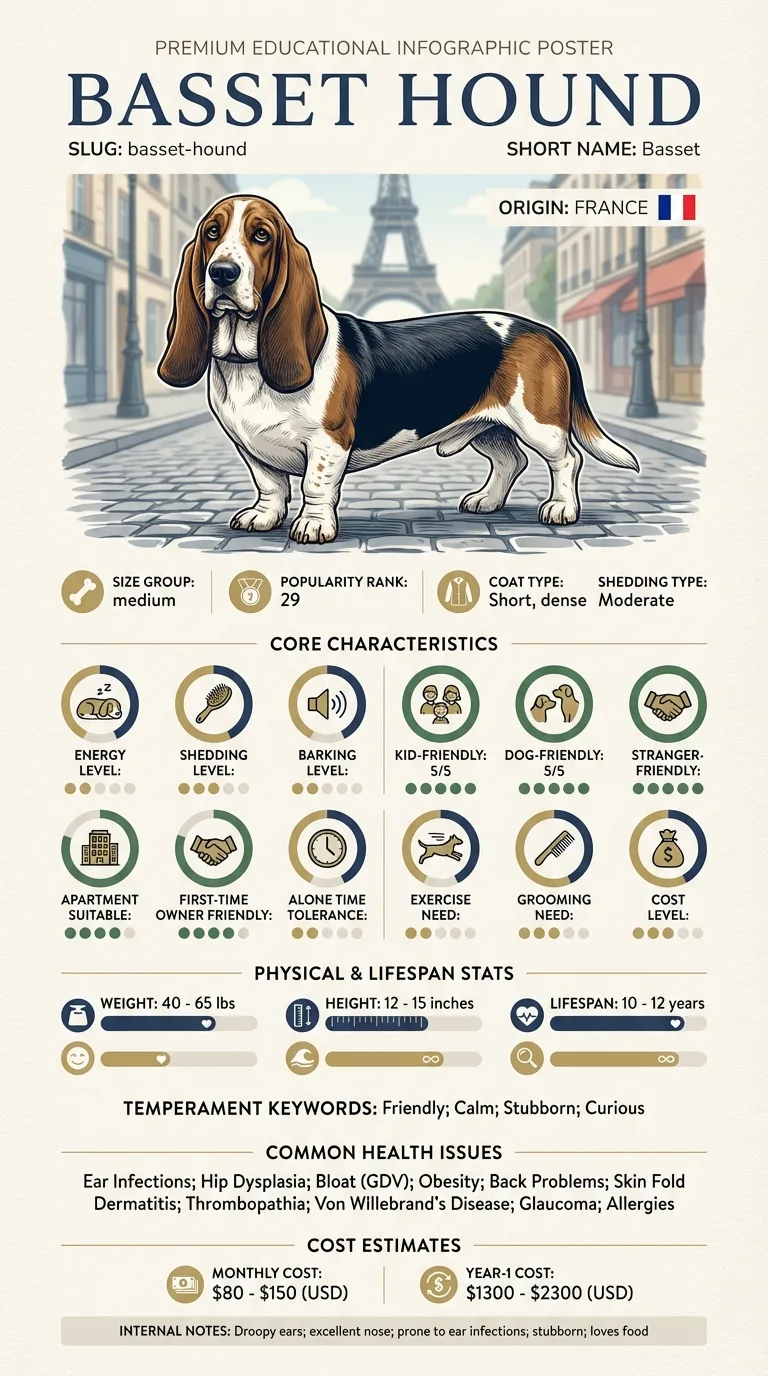
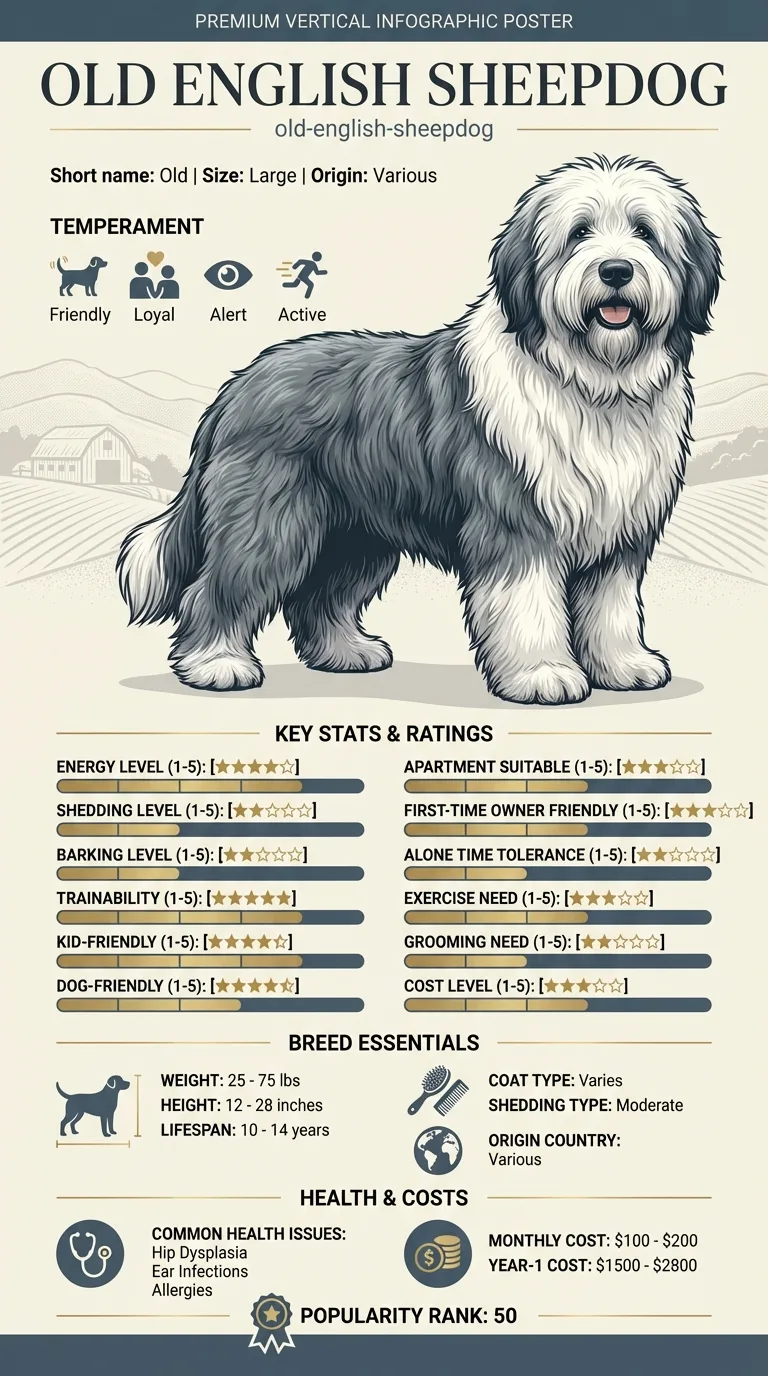
This is for someone already down to Basset Hound and Old English Sheepdog and deciding between them. For this pair the decision usually turns on grooming need and apartment suitability, so those are covered first and in most detail. Anyone choosing from a flat has a clear answer here: Basset Hound rates 4/5 against 2/5. It is written for the decision rather than the breed history.
Between Basset Hound and Old English Sheepdog, grooming need is what separates them, and Basset Hound is the lower-effort dog of the two to keep.
Choose Basset Hound if you are in a flat or a smaller home, this is your first dog and you do not want a standing grooming appointment.
Choose Old English Sheepdog if you want a dog that picks up training quickly, you want a dog that can keep up with an active routine and you want a dog that is more watchful with visitors.
| Feature | basset hound | old english sheepdog | Winner |
|---|---|---|---|
| Size class | medium | large | Equal |
| Weight | 40–65 lbs | 60–100 lbs | Equal |
| Height | 12–15 in | 20–24 in | Equal |
| Lifespan | 10–12 years | 10–12 years | Equal |
| Exercise need | Low (2/5) | Moderate (3/5) | basset hound |
| Grooming need | Moderate (3/5) | Very high (5/5) | basset hound |
| Shedding | Moderate (3/5) | High (4/5) | basset hound |
| Energy level | Low (2/5) | Moderate (3/5) | Equal |
| Barking | Low (2/5) | Moderate (3/5) | basset hound |
| Apartment suitability | High (4/5) | Low (2/5) | basset hound |
| Good for first-time owners | High (4/5) | Low (2/5) | basset hound |
| Tolerates being alone | Low (2/5) | Low (2/5) | Equal |
| Trainability | Low (2/5) | Moderate (3/5) | old english sheepdog |
| Good with kids | Very high (5/5) | Very high (5/5) | Equal |
| Good with other dogs | Very high (5/5) | High (4/5) | basset hound |
| Friendly to strangers | Very high (5/5) | High (4/5) | basset hound |
| Cost level | Moderate (3/5) | High (4/5) | basset hound |
| Coat | Short, dense | Long, shaggy double coat | Equal |
| Origin | France | Various | Equal |
| Typical monthly cost | $80–$150 | $110–$240 | Equal |
| Typical first-year cost | $1,300–$2,300 | $1,700–$3,200 | Equal |
Picture a dog stretched close to the ground next to one that stands almost as tall as a kitchen counter - that's the visual gap between the Basset Hound and the Old English Sheepdog. Height diverges sharply, twelve to fifteen inches against twenty to twenty-four, yet their weight ranges overlap almost exactly at forty to sixty-five pounds, so the Basset carries similar mass on a fraction of the leg length, producing that dense, low-slung silhouette bred for tracking scent without outrunning a hunter on foot. The Sheepdog's frame is upright, bulky and built for driving livestock. 'Medium dog' on a weight chart alone hides how differently these two occupy a room.
Ask a Basset Hound to sprint and you'll get a look of mild betrayal; this is a dog that would rather follow a scent trail at its own pace, and its low 2/5 exercise rating reflects that unhurried nature. The Old English Sheepdog wants more - not dramatically more, but enough that a couch-only routine leaves it restless, landing at a moderate 3/5. Energy level scores echo the same pattern: low for the Basset, moderate for the Sheepdog. Owners drawn to a genuinely low-key dog will find the Basset closer to that ideal, though its curiosity and nose can still lead it on unplanned detours around a yard or park.
Moderate versus very high tells most of the story: the Basset's short, dense coat needs a quick weekly brush and regular ear checks, landing at 3/5 for grooming, while the Sheepdog's long shaggy double coat demands near-daily attention and scores a full 5/5. Shedding follows the same direction, moderate for the Basset against high for the Sheepdog. What the Basset lacks in coat maintenance it makes up for in ear care - those long, low-hanging ears trap moisture and are prone to infection, a chore the Sheepdog's owners simply do not have on their list. Different dogs, different maintenance calendars, roughly the same overall time commitment either way.
Here the Basset pulls ahead decisively: high 4/5 apartment suitability against the Sheepdog's low 2/5, plus lower barking (2/5 versus 3/5) and a genuinely low exercise need that suits smaller living spaces. Both dogs tolerate being left alone poorly, tied at 2/5, so neither is ideal for owners gone ten hours a day. A Basset's calm, low-energy temperament translates well to city living once its baying tendency - a trait not captured directly in the barking score but well known among hound owners - is managed through training. The Sheepdog, being both larger and more active, is the harder sell for compact living.
Trainability actually favors the Sheepdog here, moderate 3/5 against the Basset's low 2/5, and the temperament list explains the Basset's side of that gap: stubborn sits right alongside friendly and curious. Basset Hounds are scent-driven and independent by design, bred to work a trail without constant handler input, which makes recall and off-leash reliability genuinely harder to build than with more biddable breeds. The Basset does score higher for first-time owners overall (4/5 versus the Sheepdog's 2/5) thanks to its calm nature and lower exercise demands - trainability and beginner-friendliness are not the same measurement, and this pair shows exactly why.
Both breeds tie for good-with-kids at a very high 5/5, so families are not choosing between them on that front. The gap opens elsewhere: the Basset edges ahead with other dogs (5/5 versus 4/5) and with strangers (5/5 versus 4/5), consistent with a temperament list built around friendly and curious rather than the Sheepdog's more watchful disposition. Neither breed is aloof, but the Basset's sociability runs a notch deeper across the board. Households that host often, or want a dog indifferent to a steady stream of unfamiliar faces at the door, will likely find the Basset's easygoing nature the more predictable fit.
Lifespan ties at ten to twelve years for both, but the health lists diverge in character. The Basset's ten conditions lean orthopedic and structural - back problems and hip dysplasia are almost inevitable risks of that long spine on short legs - plus bloat (GDV), thrombopathia and Von Willebrand's disease, both clotting disorders worth genetic screening for. The Sheepdog's shorter five-item list includes primary ciliary dyskinesia and its own bloat (GDV) risk alongside hip dysplasia, cataracts and hypothyroidism. Bloat appears on both lists, a reminder that deep-chested, large-boned dogs of very different shapes can share the same emergency risk.
The Basset runs cheaper on paper - $80-150 monthly and $1,300-2,300 for a first year, against the Sheepdog's $110-240 and $1,700-3,200 - and the cost-level scores confirm it, moderate 3/5 versus high 4/5. Grooming accounts for a chunk of that gap, since the Sheepdog's coat often requires professional attention the Basset's short coat never will. What the Basset budget doesn't fully capture is veterinary spending on ear infections and back issues, which can add up over a long life even without matching the Sheepdog's grooming bills. Neither breed is cheap to own well, but the Basset asks for less money more predictably.
Basset Hound weighs 40–65 lbs and lives 10–12 years; Old English Sheepdog weighs 60–100 lbs and lives 10–12 years. The two diverge most on grooming need, apartment suitability and good for first-time owners. They are level on tolerates being alone and good with kids, so those cannot decide it. In the table, a "winner" means easier for an ordinary household — not better. Size, coat and origin are recorded without a verdict. Because both breeds are scored the same way, the gaps are reliable even where the absolute numbers are rough.

Generally yes - the Basset's first-year cost runs $1,300-2,300 against the Sheepdog's $1,700-3,200, driven largely by the Sheepdog's much higher grooming needs.
The Basset Hound scores a high 4/5 for first-time-owner suitability compared to the Sheepdog's low 2/5, thanks to its calmer temperament and lower exercise demands.
Yes, both typically live ten to twelve years.
The Basset Hound, rated a moderate 3/5 for shedding against the Sheepdog's high 4/5.
Slightly - it scores a moderate 3/5 for trainability against the Basset's low 2/5, reflecting the Basset's independent, scent-driven nature.
Yes - both are prone to hip dysplasia and bloat (GDV), so both benefit from slow-feeding routines and monitoring for signs of gastric distress.
The Basset Hound, at a very high 5/5, compared with the Sheepdog's still-solid 4/5.
The Basset Hound stands just 12-15 inches tall versus the Sheepdog's 20-24 inches, despite similar weight ranges.
The Basset Hound, rated moderate 3/5 against the Sheepdog's very high 5/5.
The Basset Hound, scoring high 4/5 for apartment suitability versus the Sheepdog's low 2/5.
The Basset Hound's list runs to ten conditions versus the Sheepdog's five, though severity varies by condition.
Secure checkout on Stripe. We never see your card.
7-day money-back guarantee. Instant access.
Health information here is general and is not veterinary advice. If your dog shows pain, sudden behaviour change, or worsening symptoms, consult a licensed veterinarian.
Some links on this site are affiliate links. We may earn a commission at no extra cost to you, and we only suggest products we believe are helpful for dog owners.
We research and check what we publish, but we do not warrant that any figure, date, price, or statement is accurate, complete, or current, and we accept no liability for any loss, cost, injury, or other harm arising from the use of this site. Use it as one reference among several. You remain responsible for your own decisions and for your dog's care - confirm anything that matters with a licensed veterinarian or another qualified professional before you act on it. Full disclaimer.
Match your lifestyle to the right dog.
Take quizNot sure which breed is right for you? Take our 2-minute quiz to find out.
Take the quiz