Health
Is this breed brachycephalic?
No. It has a long, proportionate muzzle under its coat, structurally unrelated to flat-faced breeds.

Quick answer
Is this breed brachycephalic?
No. It has a long, proportionate muzzle under its coat, structurally unrelated to flat-faced breeds.
Pull back the hair on an Old English Sheepdog's face, and you'll find a long, normal muzzle, not the flattened structure that defines a genuinely brachycephalic breed.
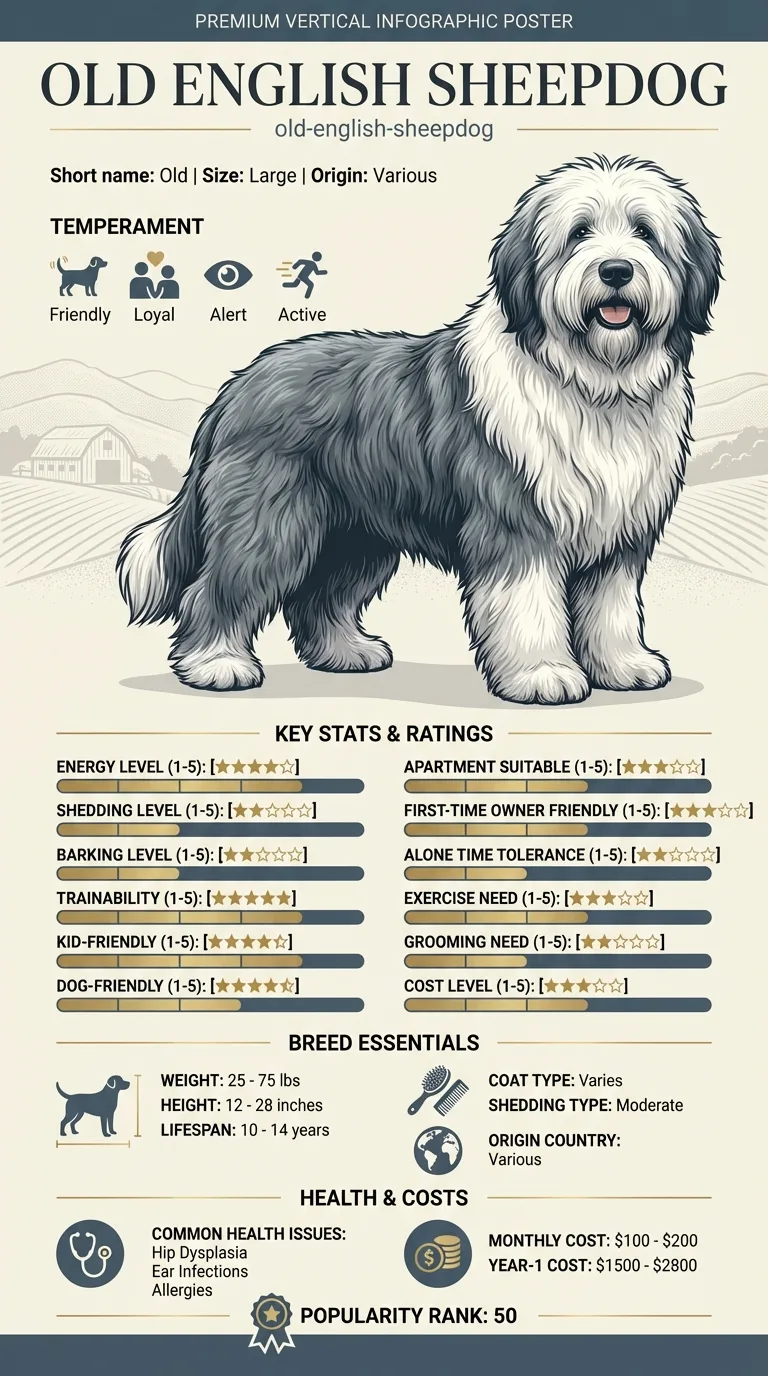
This mostly matters for owners trying to make sense of a generic breed health checklist, or anyone assuming a shaggy face automatically means a flat one underneath, when the two aren't related in this breed at all.
This guide is not medical advice. If your dog shows pain, sudden behavior change, or worsening symptoms, consult a licensed veterinarian.
Some links may be affiliate links. We may earn a commission at no extra cost to you. We only suggest products we believe are helpful for dog owners.
We research and check what we publish, but we do not warrant that any figure, date, price, or statement is accurate, complete, or current, and we accept no liability for any loss, cost, injury, or other harm arising from the use of this site. Use it as one reference among several. You remain responsible for your own decisions and for your dog's care - confirm anything that matters with a licensed veterinarian or another qualified professional before you act on it. Full disclaimer.
Check this first
Persistent eye redness, squinting, discharge, or visible cloudiness can result from ongoing hair-on-eye irritation and should be checked by a vet promptly, since untreated corneal irritation can worsen into an ulcer, which is a genuine emergency involving sudden eye pain, heavy squinting, and cloudiness that needs same-day veterinary attention.
This is a mechanical, coat-related problem rather than a structural or airway one. It's also very manageable: routine facial coat maintenance largely prevents it, which is a meaningfully different, and easier, fix than what a truly brachycephalic dog's owner faces with their breed's airway anatomy.
If any of these apply, call your vet or an emergency clinic now. The rest of this page is for the cases that are not an emergency.
Old English Sheepdogs are not a brachycephalic breed; their muzzle is long and proportionate under a coat that simply hides it from view. The genuine facial concern in this breed is mechanical: constant hair contact with the eyes and debris trapped in facial hair, both grooming issues rather than skull-structure ones.
True brachycephalic airway issues do not occur in this breed. Hair-related eye irritation from an unmanaged facial coat is a common, everyday grooming issue in dogs of this breed whose coat isn't kept trimmed or tied back.
This breed's coat type, long and shaggy, grows densely over the entire face including the eyes, which is a coat trait, not a skull trait. The muzzle underneath is long and proportionate, structurally unrelated to the flattened skulls of genuinely brachycephalic breeds.
Infrequent grooming, allowing facial hair to grow past the eyes without trimming or tying back, is the main environmental factor. Dusty or debris-heavy environments can also worsen eye irritation when hair is already in frequent contact with the eye surface.
Talk to your vet about persistent eye redness, discharge, squinting, or cloudiness that doesn't resolve with better grooming. Seek same-day care for sudden, severe eye pain, heavy squinting, or visible cloudiness, which can indicate a corneal ulcer.
Since the muzzle itself isn't the issue, the real, coat-related facial problems in this breed come from different mistakes.
See all OLD English Sheepdog health problems, which breeds are prone to brachycephalic features, or the full OLD English Sheepdog breed guide for temperament, exercise needs and ownership costs.
Mild hair-related eye irritation typically improves within days once hair is trimmed back and the eyes are kept clean. This is an ongoing grooming task rather than a one-time fix, since facial hair continues to grow.
Success looks like clear, comfortable eyes maintained through a regular trimming or tying routine, with no recurring irritation.
If you think your Old has brachycephalic features, the plan is three steps: write down what you have seen and when it started, book a veterinary appointment rather than waiting for the next flare, and take video of the behaviour or symptom before you go — the thing you are worried about rarely happens in the consulting room. Screening in the parents covers hip dysplasia, cataracts, hypothyroidism.
What the vet visit should produce is a diagnosis and a written plan, not just reassurance: what is being ruled out, what the monitoring interval is, and which signs mean you come back sooner. Ask what the treatment costs across a year rather than per visit, because that is the number that decides whether you are managing this condition or reacting to it.
Between appointments, keep a short log — dates, what you saw, what changed. It is the single most useful thing an owner brings to a follow-up, and for brachycephalic features it is often what separates a clear pattern from a guess.
Willow's new owner read a generic breed checklist online listing 'brachycephalic features' for Old English Sheepdogs and worried about airway risk before a planned trip to a warmer climate. At her next vet visit, the vet parted Willow's facial hair to show a long, entirely normal muzzle underneath, and explained that this breed doesn't carry the airway anatomy the checklist implied. What the vet did flag was mild eye irritation from hair contact, easily resolved with a topknot tie and a trim schedule every few weeks. Willow's owner traveled without any special brachycephalic precautions, just the standard heat awareness appropriate for a heavily coated large breed.
Key takeaway: A shaggy face doesn't mean a flat one. Checking the actual structure, not just a generic checklist, changes what precautions genuinely apply.
No. Brachycephalic breeds have short, flattened skulls, like Pugs and Bulldogs. Under this breed's shaggy coat is a long, well-proportioned muzzle, structurally unrelated to brachycephalic anatomy.
The dense facial hair completely obscures the muzzle's actual shape, and combined with occasional snoring or heavy panting, which have entirely different causes in this breed, it creates a surface-level resemblance that doesn't hold up structurally.
Yes, but a different kind: hair constantly touching the eyes can cause irritation and, if left unmanaged, contribute to corneal problems. This is a grooming and coat-management issue, not an airway or skull-shape issue.
Occasional snoring is common and usually benign in this breed, unrelated to the structural airway narrowing that causes concerning snoring in truly brachycephalic dogs. Snoring paired with visible breathing effort while awake is worth mentioning to your vet, but that's uncommon here.
Regular trims around the eyes, or a topknot tie to keep hair up and away from the eyes, meaningfully reduce direct contact and irritation. This is a routine grooming task rather than a medical procedure.
No, the airway-specific anesthesia precautions used for genuinely brachycephalic breeds aren't necessary here, since this breed doesn't share that airway anatomy. General large-breed and heat-related anesthesia considerations still apply, as with any dog this size.
Food debris, trapped moisture, and matting around the mouth and chin are common in this breed's facial hair and are worth a regular check and clean, separate from any eye-related grooming.
No. It has a long, proportionate muzzle under its coat, structurally unrelated to flat-faced breeds.
Hair constantly contacting the eyes, causing irritation, which is a grooming issue rather than a skull-shape issue.
Regularly enough to keep hair from constantly touching the eyes, often every few weeks depending on growth rate.
Usually not; it's typically benign and unrelated to the structural airway narrowing seen in truly brachycephalic breeds.
No special brachycephalic-specific precautions are needed, since this breed doesn't share that airway anatomy.
A one-page prep sheet for this condition: the signs, the questions to ask, what to get priced. Unlocks here.
You get: Vet visit prep sheet
No spam. One-click unsubscribe. See our privacy policy.
See a sample page before you decide.
Early access list
The free prep sheet covers the same-day warning signs, a symptom log and the questions to ask. We are considering a fuller kit that adds a cost worksheet for the usual tests and treatments (US price ranges with their sources) and a plain-English guide to ways of covering the bill. It is not built yet; this list tells us whether it is worth building.
One email, no spam, unsubscribe anytime. Information only, not veterinary advice.




