Living
Which is the better overall pick?
The Shiba fits small spaces and costs less, but its low trainability and wariness around other dogs and strangers make it a demanding choice despite the size; the OES is friendlier but needs far more space.

Quick answer
Which is the better overall pick?
The Shiba fits small spaces and costs less, but its low trainability and wariness around other dogs and strangers make it a demanding choice despite the size; the OES is friendlier but needs far more space.
Old English Sheepdog or Shiba Inu? On paper they differ most on grooming need, and on the scales Old English Sheepdog is the heavier at 60–100 lbs. Here is how the two compare on everything that shapes an ordinary week.
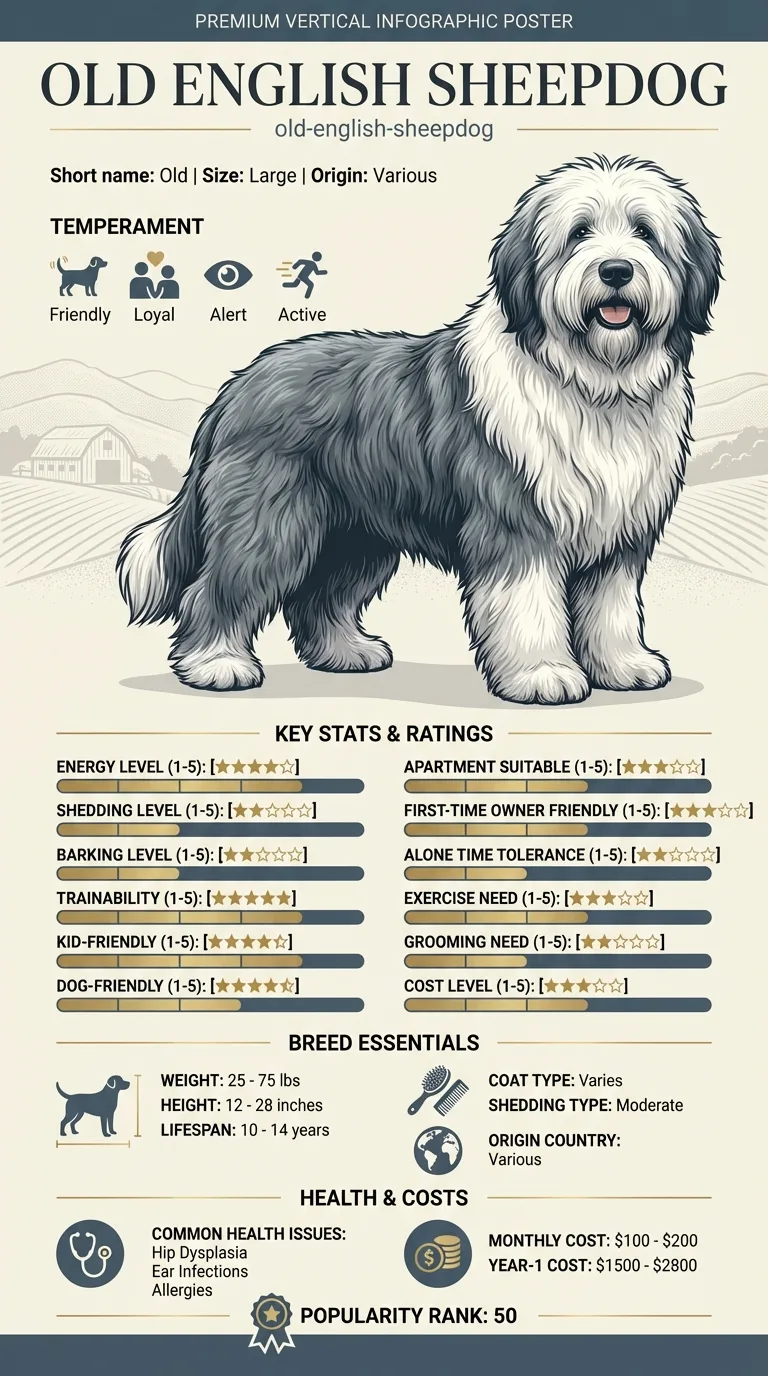
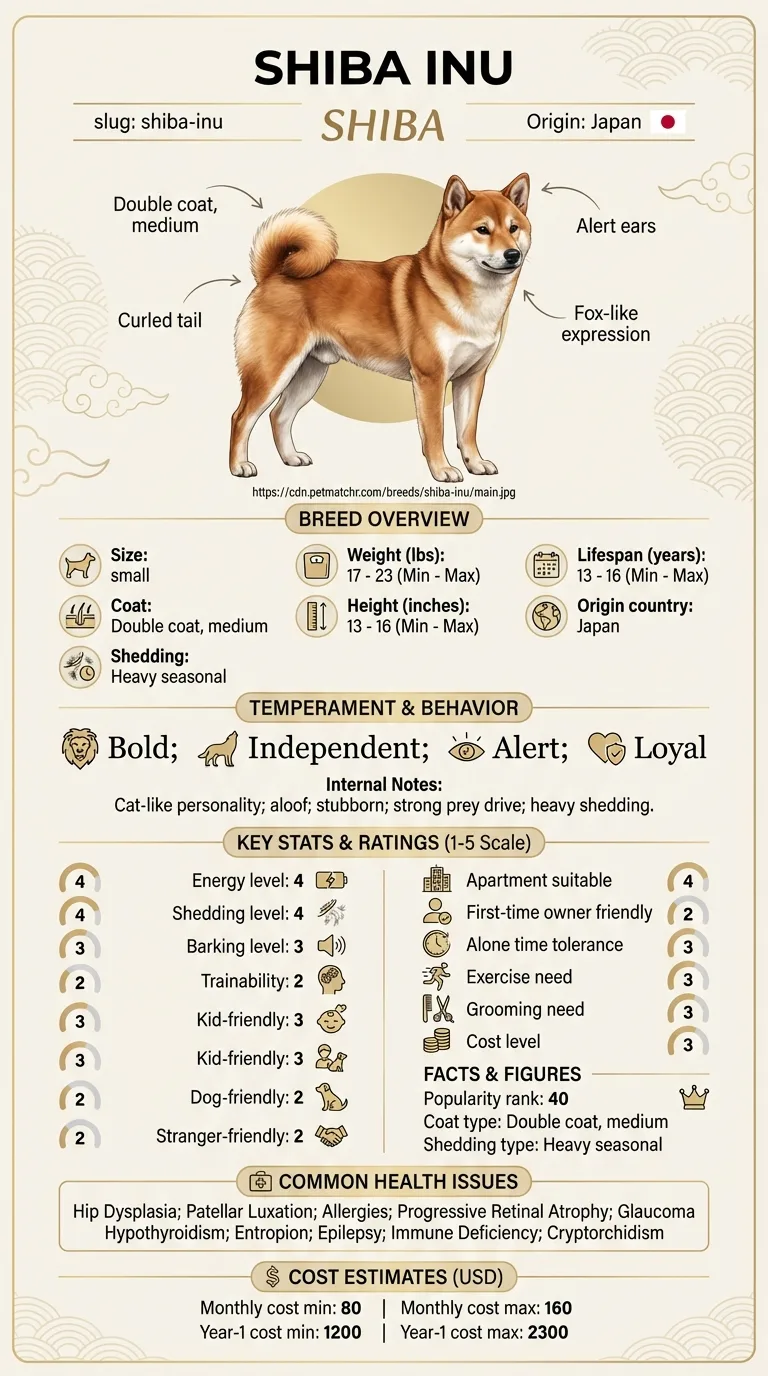
This is for someone already down to Old English Sheepdog and Shiba Inu and deciding between them. For this pair the decision usually turns on grooming need and apartment suitability, so those are covered first and in most detail. Anyone choosing from a flat has a clear answer here: Shiba Inu rates 4/5 against 2/5. The focus throughout is on daily consequences rather than breed background.
Between Old English Sheepdog and Shiba Inu, grooming need is what separates them, and Shiba Inu is the lower-effort dog of the two to keep.
Choose Old English Sheepdog if there are young children at home, you already have another dog and you want a dog that picks up training quickly.
Choose Shiba Inu if you are in a flat or a smaller home, you do not want a standing grooming appointment and the dog will be alone during the working day.
| Feature | old english sheepdog | shiba inu | Winner |
|---|---|---|---|
| Size class | large | small | Equal |
| Weight | 60–100 lbs | 17–23 lbs | Equal |
| Height | 20–24 in | 13–16 in | Equal |
| Lifespan | 10–12 years | 13–16 years | shiba inu |
| Exercise need | Moderate (3/5) | Moderate (3/5) | Equal |
| Grooming need | Very high (5/5) | Moderate (3/5) | shiba inu |
| Shedding | High (4/5) | High (4/5) | Equal |
| Energy level | Moderate (3/5) | High (4/5) | Equal |
| Barking | Moderate (3/5) | Moderate (3/5) | Equal |
| Apartment suitability | Low (2/5) | High (4/5) | shiba inu |
| Good for first-time owners | Low (2/5) | Low (2/5) | Equal |
| Tolerates being alone | Low (2/5) | Moderate (3/5) | shiba inu |
| Trainability | Moderate (3/5) | Low (2/5) | old english sheepdog |
| Good with kids | Very high (5/5) | Moderate (3/5) | old english sheepdog |
| Good with other dogs | High (4/5) | Low (2/5) | old english sheepdog |
| Friendly to strangers | High (4/5) | Low (2/5) | old english sheepdog |
| Cost level | High (4/5) | Moderate (3/5) | shiba inu |
| Coat | Long, shaggy double coat | Double coat, medium | Equal |
| Origin | Various | Japan | Equal |
| Typical monthly cost | $110–$240 | $80–$160 | Equal |
| Typical first-year cost | $1,700–$3,200 | $1,200–$2,300 | Equal |
Size doesn't get much more different: the OES runs 60-100 lbs and 20-24 inches, the Shiba Inu 17-23 lbs and 13-16 inches. But don't let the Shiba's compact frame suggest a lapdog temperament, this is a fox-like, alert breed with a personality that punches well above its weight class.
Exercise need actually ties at moderate (3/5) for both, which is a bit of a surprise given the size gap. The Shiba is a naturally athletic, agile breed that needs real activity despite its small frame, closer in that respect to the OES than most small breeds are. Skipping walks because of the small size is a common first-owner mistake with this breed.
The Shiba is easier to groom, moderate (3/5) against the OES's very high (5/5), but shedding ties at high (4/5) for both. Shiba Inus famously blow their coat twice a year, releasing a startling amount of fur in a short window, so don't assume the smaller dog means less total hair over a year.
The Shiba handles apartment living far better, rated 4 against the OES's 2, and barking ties at moderate for both. Alone-tolerance favors the Shiba too, 3 versus 2. Space-wise, the Shiba is the clear choice for smaller living situations, though its independent streak means it won't necessarily be a clingy apartment companion.
Here's the real surprise in this pairing: the Shiba rates low, 2 out of 5, for trainability, actually below the OES's moderate 3. First-time-owner suitability ties at a low 2 for both. Shiba Inus are famously independent and stubborn, closer in temperament to a cat than a typical trainable dog breed, and the numbers back that reputation up.
The OES rates higher across the board: kids 5 versus 3, other dogs 4 versus a low 2, strangers 4 versus a low 2. Shiba Inus tend to be selective with other dogs and aloof or wary with people they don't know. If you have young kids, other pets, or frequent guests, the OES is the more forgiving choice by a wide margin.
The Shiba lives longer, 13-16 years against the OES's 10-12, but carries a longer list of ten conditions including Glaucoma, Epilepsy, and Immune Deficiency. Hip Dysplasia and Hypothyroidism overlap with the OES's shorter list of five. That extra three-plus years of expected life is a real point in the Shiba's favor if longevity matters most to you.
The Shiba costs less to keep, moderate (3/5) against the OES's high (4/5). Monthly costs run $80-$160 versus $110-$240, and first-year costs run $1,200-$2,300 versus $1,700-$3,200. Combined with its better apartment fit and lower grooming need, the Shiba is the meaningfully cheaper dog to own on nearly every measure here except training ease.
Old English Sheepdog weighs 60–100 lbs and lives 10–12 years; Shiba Inu weighs 17–23 lbs and lives 13–16 years. The two diverge most on grooming need, apartment suitability and good with kids and 2 other rated axes. They are level on barking, exercise need and good for first-time owners, so those cannot decide it. The table below marks a winner only where one breed is genuinely easier for a typical owner; size and origin are facts rather than merits and stay level. Ratings come from one source applied to both breeds, so they are meaningful against each other rather than as absolute scores.

No, it rates a low 2 out of 5 for first-time-owner suitability, tied with the OES. Its independent, stubborn streak (2/5 trainability) makes it a poor match for a first-time owner despite the small size.
They're tied, both at 4 out of 5. The Shiba sheds in two dramatic seasonal blowouts rather than the OES's more constant year-round shedding.
The OES rates much higher, 4 versus the Shiba's low 2. Shiba Inus are often selective about which dogs they get along with.
Yes, rated 4 out of 5 against the OES's 2. Just don't expect it to be an easygoing, sociable apartment dog purely because of the size.
The Shiba runs cheaper: $80-$160 monthly versus $110-$240 for the OES, and $1,200-$2,300 versus $1,700-$3,200 in year one.
Two conditions overlap: Hip Dysplasia and Hypothyroidism. The Shiba's list runs to ten conditions total, roughly double the OES's five.
The Shiba, by a solid margin, 13-16 years against the OES's 10-12.
The Shiba fits small spaces and costs less, but its low trainability and wariness around other dogs and strangers make it a demanding choice despite the size; the OES is friendlier but needs far more space.
The Shiba runs cheaper at $80-$160 versus $110-$240 for the OES.
They're tied at moderate (3/5), the Shiba's compact size doesn't mean a lower activity requirement.
The Shiba, notably, 13-16 years versus 10-12 for the OES.
Secure checkout on Stripe. We never see your card.
7-day money-back guarantee. Instant access.
Health information here is general and is not veterinary advice. If your dog shows pain, sudden behaviour change, or worsening symptoms, consult a licensed veterinarian.
Some links on this site are affiliate links. We may earn a commission at no extra cost to you, and we only suggest products we believe are helpful for dog owners.
We research and check what we publish, but we do not warrant that any figure, date, price, or statement is accurate, complete, or current, and we accept no liability for any loss, cost, injury, or other harm arising from the use of this site. Use it as one reference among several. You remain responsible for your own decisions and for your dog's care - confirm anything that matters with a licensed veterinarian or another qualified professional before you act on it. Full disclaimer.
Match your lifestyle to the right dog.
Take quizNot sure which breed is right for you? Take our 2-minute quiz to find out.
Take the quiz