Health
What's the biggest risk factor for growth problems in this breed?
The sheer speed of growth to sixty-plus pounds within about eighteen months, which stresses developing bones and growth plates.

Quick answer
What's the biggest risk factor for growth problems in this breed?
The sheer speed of growth to sixty-plus pounds within about eighteen months, which stresses developing bones and growth plates.
The growth spurt that makes a puppy look noticeably bigger every few weeks is also the window where growth-plate problems are most likely to happen.
This is squarely a puppy and young-dog issue, most relevant to owners in the first 12-18 months, especially those who are eager to start serious exercise or add supplements before growth is complete.
This guide is not medical advice. If your dog shows pain, sudden behavior change, or worsening symptoms, consult a licensed veterinarian.
Some links may be affiliate links. We may earn a commission at no extra cost to you. We only suggest products we believe are helpful for dog owners.
We research and check what we publish, but we do not warrant that any figure, date, price, or statement is accurate, complete, or current, and we accept no liability for any loss, cost, injury, or other harm arising from the use of this site. Use it as one reference among several. You remain responsible for your own decisions and for your dog's care - confirm anything that matters with a licensed veterinarian or another qualified professional before you act on it. Full disclaimer.
Check this first
Occasional, mild stiffness after a big play session isn't automatically alarming in a fast-growing puppy. But limping that shifts from leg to leg, a puppy that's reluctant to bear weight at all, visible swelling over a long bone, or limping accompanied by fever and lethargy point toward a condition called panosteitis or a growth-plate injury, and deserve a vet visit within a day or two rather than being brushed off as growing pains.
A puppy that suddenly can't bear weight on a leg at all, especially after a fall or rough play, should be seen the same day, since this can indicate a growth-plate fracture, which heals very differently, and needs different management, than a fracture in a fully grown dog.
If any of these apply, call your vet or an emergency clinic now. The rest of this page is for the cases that are not an emergency.
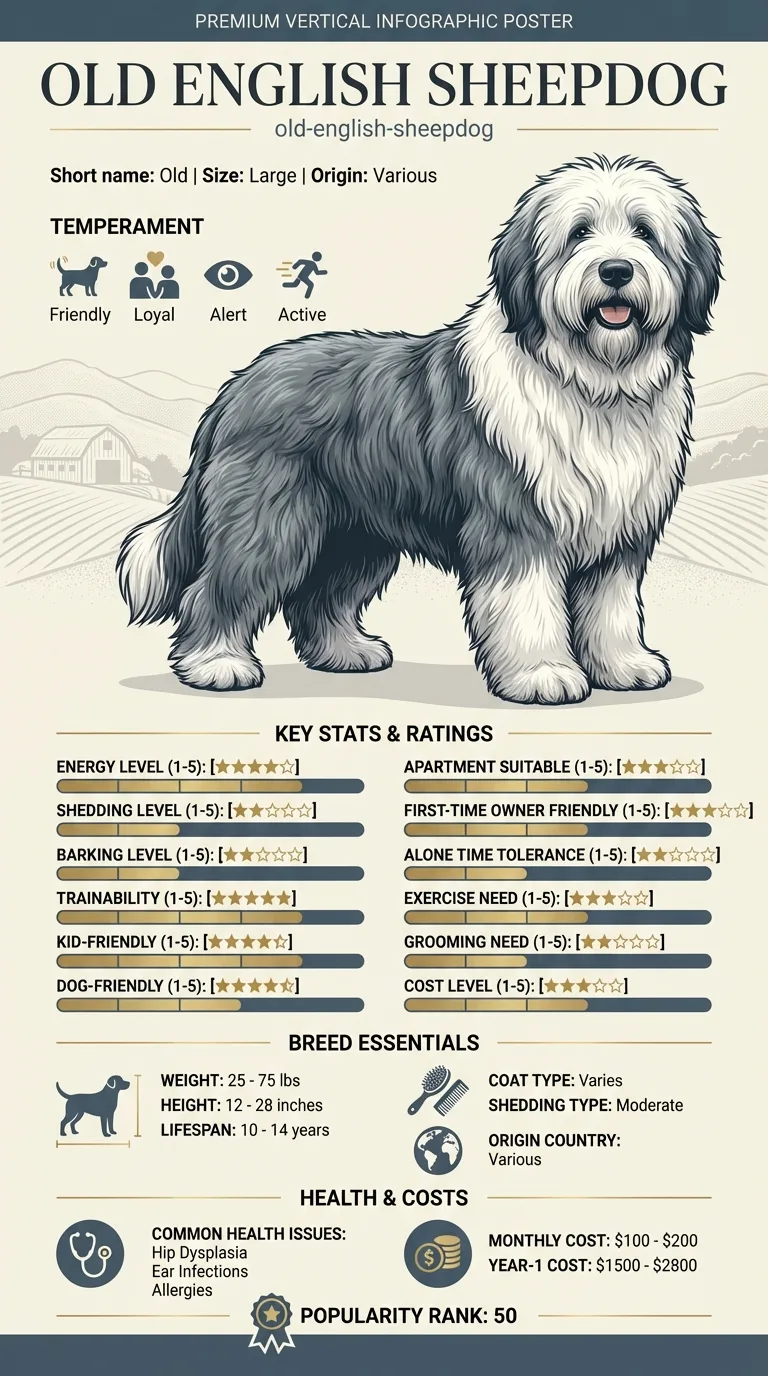
Bone and growth issues affect Old English Sheepdog puppies specifically during their rapid growth phase, when the breed's eventual large size, sixty to a hundred pounds, is reached in about eighteen months. This is a distinct concern from adult joint disease and is driven mainly by nutrition and exercise management during growth.
Mild growth-related discomfort, like temporary shifting-leg lameness, is fairly common in large-breed puppies generally during rapid growth phases, though it typically resolves as growth slows.
This breed's eventual large size, sixty to a hundred pounds, means puppies gain a substantial amount of skeletal mass in a relatively short window. That pace of growth is the underlying driver of growth-plate stress and conditions like panosteitis, which are specifically associated with fast-growing large-breed puppies rather than small or slow-growing breeds.
Diet and exercise management during the growth window matter enormously. Over-supplementation, inappropriate food formulation, and excessive high-impact activity all add avoidable stress on top of the growth process itself.
Talk to your vet about any limping that shifts between legs, persists more than a day or two, or comes with swelling. Seek same-day care for a puppy that suddenly won't bear weight at all, especially after a fall.
Most bone-growth issues in large-breed puppies come from well-intentioned owners trying to help growth along, rather than from neglect.
See all OLD English Sheepdog health problems, which breeds are prone to bone growth issues, or the full OLD English Sheepdog breed guide for temperament, exercise needs and ownership costs.
Conditions like panosteitis are typically self-limiting, with individual flare-ups lasting one to a few weeks and resolving as the dog finishes growing, usually by 18-24 months.
Success looks like a puppy that grows steadily without repeated lameness episodes, reaching adulthood with joints that were given the best possible conditions to develop normally.
If you think your Old has bone & growth issues, the plan is three steps: write down what you have seen and when it started, book a veterinary appointment rather than waiting for the next flare, and take video of the behaviour or symptom before you go — the thing you are worried about rarely happens in the consulting room. Screening in the parents covers hip dysplasia, cataracts, hypothyroidism.
What the vet visit should produce is a diagnosis and a written plan, not just reassurance: what is being ruled out, what the monitoring interval is, and which signs mean you come back sooner. Ask what the treatment costs across a year rather than per visit, because that is the number that decides whether you are managing this condition or reacting to it.
Between appointments, keep a short log — dates, what you saw, what changed. It is the single most useful thing an owner brings to a follow-up, and for bone & growth issues it is often what separates a clear pattern from a guess.
Biscuit, a nine-month-old Old English Sheepdog puppy, started limping on his front left leg, which resolved after a few days, only for a limp to appear on his back right leg two weeks later. His owner, worried about a serious injury, brought him in for X-rays. The vet diagnosed panosteitis, explaining that the shifting pattern was actually a useful clue pointing away from an injury and toward this self-limiting, growth-related condition. With activity moderated and pain managed as needed, Biscuit's episodes tapered off over the next two months as his growth rate slowed.
Key takeaway: A limp that moves between legs in a growing puppy is a specific, recognizable pattern that's more often growth-related than injury-related, but it still deserves a vet visit to confirm.
The speed of growth is the key factor. A puppy that reaches sixty to a hundred pounds within about eighteen months is putting more stress on developing bones and growth plates in a shorter window than a small breed that grows to fifteen pounds over the same period.
It's a bone inflammation condition seen in some large-breed puppies during rapid growth, causing shifting-leg lameness that moves from one leg to another over weeks. It's uncomfortable but generally self-limiting once growth slows.
No, not without specific veterinary guidance. Excess calcium during rapid growth is a documented risk factor for skeletal problems in large-breed puppies, and a properly formulated large-breed puppy food already accounts for calcium needs.
A large-breed-specific puppy formula, which is calibrated for controlled, slower growth rather than the fastest possible growth. This differs meaningfully from standard or small-breed puppy food.
Short, controlled walks and free play are generally fine, but long-distance running, repeated jumping, and forced exercise on hard surfaces are usually discouraged until growth plates close, typically somewhere around 12-18 months depending on the individual dog.
Not always, but shifting-leg lameness, reluctance to bear weight at all, or limping with swelling should be checked by a vet rather than assumed to be ordinary growing pains.
Hip dysplasia is a structural malformation of the hip joint itself, often present from a young age and contributing to arthritis later in life. Bone-growth issues like panosteitis are a separate, usually temporary, inflammatory process tied to the speed of growth rather than joint conformation.
The sheer speed of growth to sixty-plus pounds within about eighteen months, which stresses developing bones and growth plates.
Yes, it's specifically formulated for controlled growth and calcium levels appropriate for a large-breed puppy.
It's worth a vet visit; it's often panosteitis, a self-limiting condition, but a vet exam rules out anything more serious.
Long runs, repeated jumping, and hard-surface exercise are generally discouraged until growth plates close, roughly 12-18 months.
Mild cases often just need monitoring, but vet visits, X-rays, and pain management for a genuine growth issue can run a few hundred dollars.
A one-page prep sheet for this condition: the signs, the questions to ask, what to get priced. Unlocks here.
You get: Vet visit prep sheet
No spam. One-click unsubscribe. See our privacy policy.
Preview page 1 before you decide.