Maltese vs Mastiff (English Mastiff): Which Suits Your Home?
Quick answer
Which is the better overall choice?
Choose the Maltese for apartment living, lower cost, and longer lifespan. Choose the Mastiff if you have serious space, want a famously gentle giant with kids, and can absorb the higher cost of a very large dog.
Maltese or Mastiff (English Mastiff)? On paper they differ most on apartment suitability, and on the scales Mastiff (English Mastiff) is the heavier at 120–250 lbs. Here is how the two compare on everything that shapes an ordinary week.
This is for someone already down to Maltese and Mastiff (English Mastiff) and deciding between them. For this pair the decision usually turns on apartment suitability and grooming need, so those are covered first and in most detail. Anyone choosing from a flat has a clear answer here: Maltese rates 5/5 against 2/5. It is written for the decision rather than the breed history.
Quick verdict
Between Maltese and Mastiff (English Mastiff), apartment suitability is what separates them, and Maltese is the lower-effort dog of the two to keep.
Choose maltese if...
Choose Maltese if you are in a flat or a smaller home, this is your first dog and shedding is a problem in your house.
Choose mastiff if...
Choose Mastiff (English Mastiff) if you do not want a standing grooming appointment, the dog will be alone during the working day and there are young children at home.
Head-to-head comparison
Feature
maltese
mastiff
Winner
Size class
small
giant
Equal
Weight
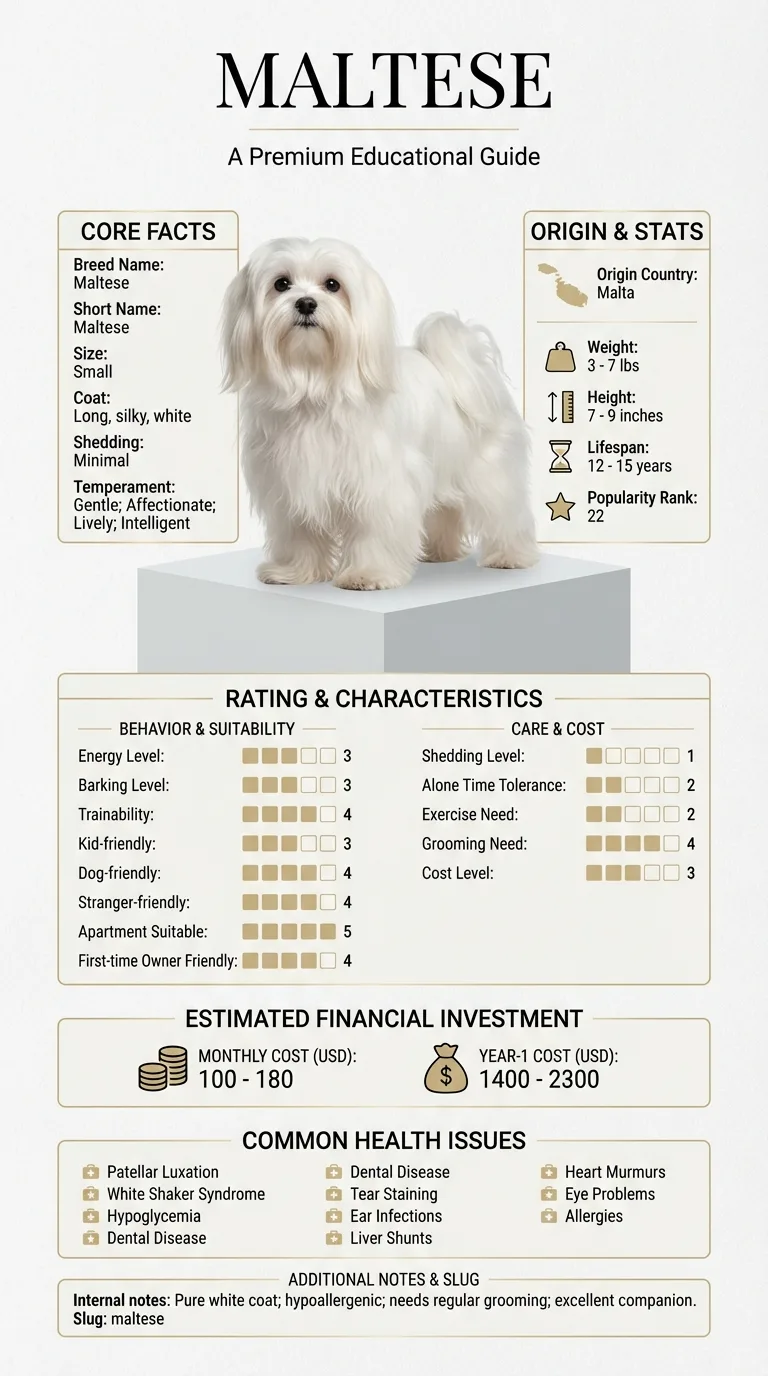
3–7 lbs
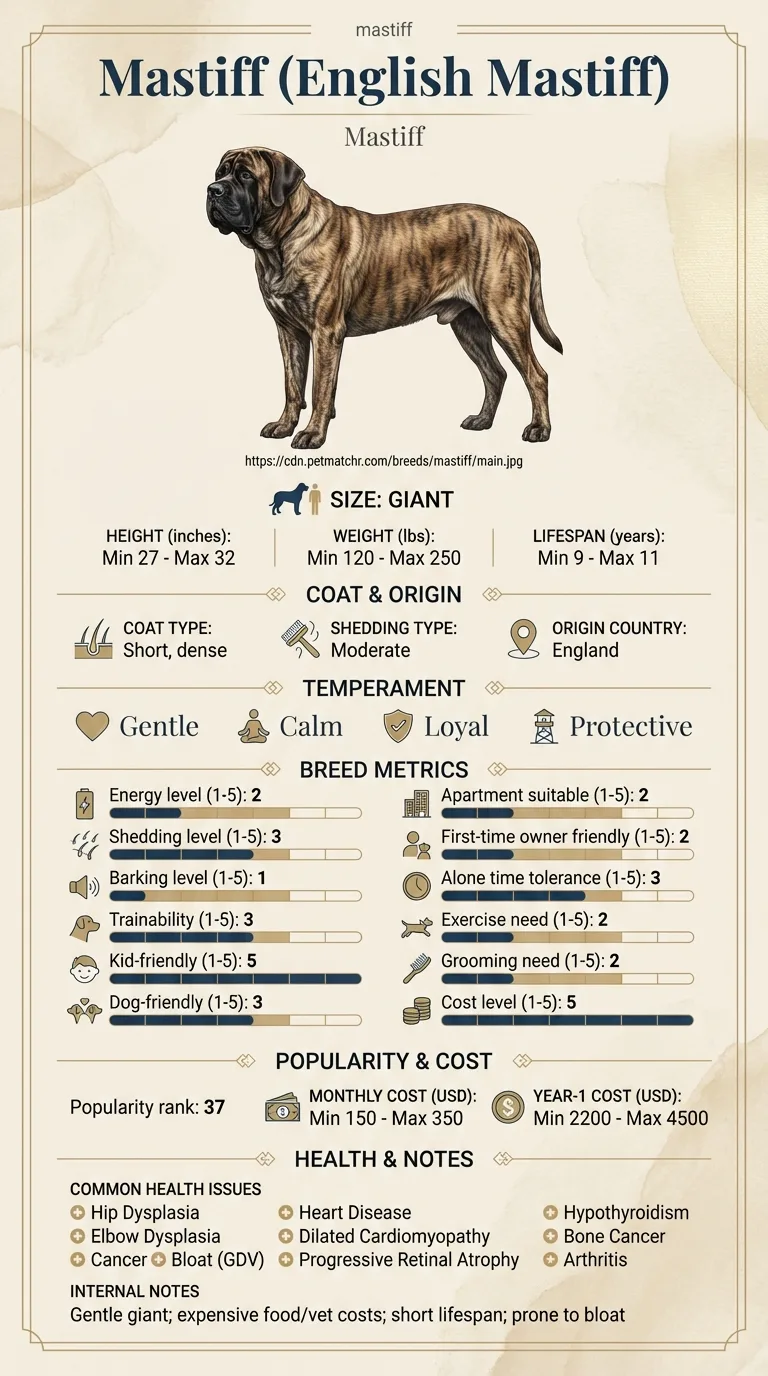
120–250 lbs
Equal
Height
7–9 in
27–32 in
Equal
Lifespan
12–15 years
9–11 years
maltese
Exercise need
Low (2/5)
Low (2/5)
Equal
Grooming need
High (4/5)
Low (2/5)
mastiff
Shedding
Very low (1/5)
Moderate (3/5)
maltese
Energy level
Moderate (3/5)
Low (2/5)
Equal
Barking
Moderate (3/5)
Very low (1/5)
mastiff
Apartment suitability
Very high (5/5)
Low (2/5)
maltese
Good for first-time owners
High (4/5)
Low (2/5)
maltese
Tolerates being alone
Low (2/5)
Moderate (3/5)
mastiff
Trainability
High (4/5)
Moderate (3/5)
maltese
Good with kids
Moderate (3/5)
Very high (5/5)
mastiff
Good with other dogs
High (4/5)
Moderate (3/5)
maltese
Friendly to strangers
High (4/5)
Moderate (3/5)
maltese
Cost level
Moderate (3/5)
Very high (5/5)
maltese
Coat
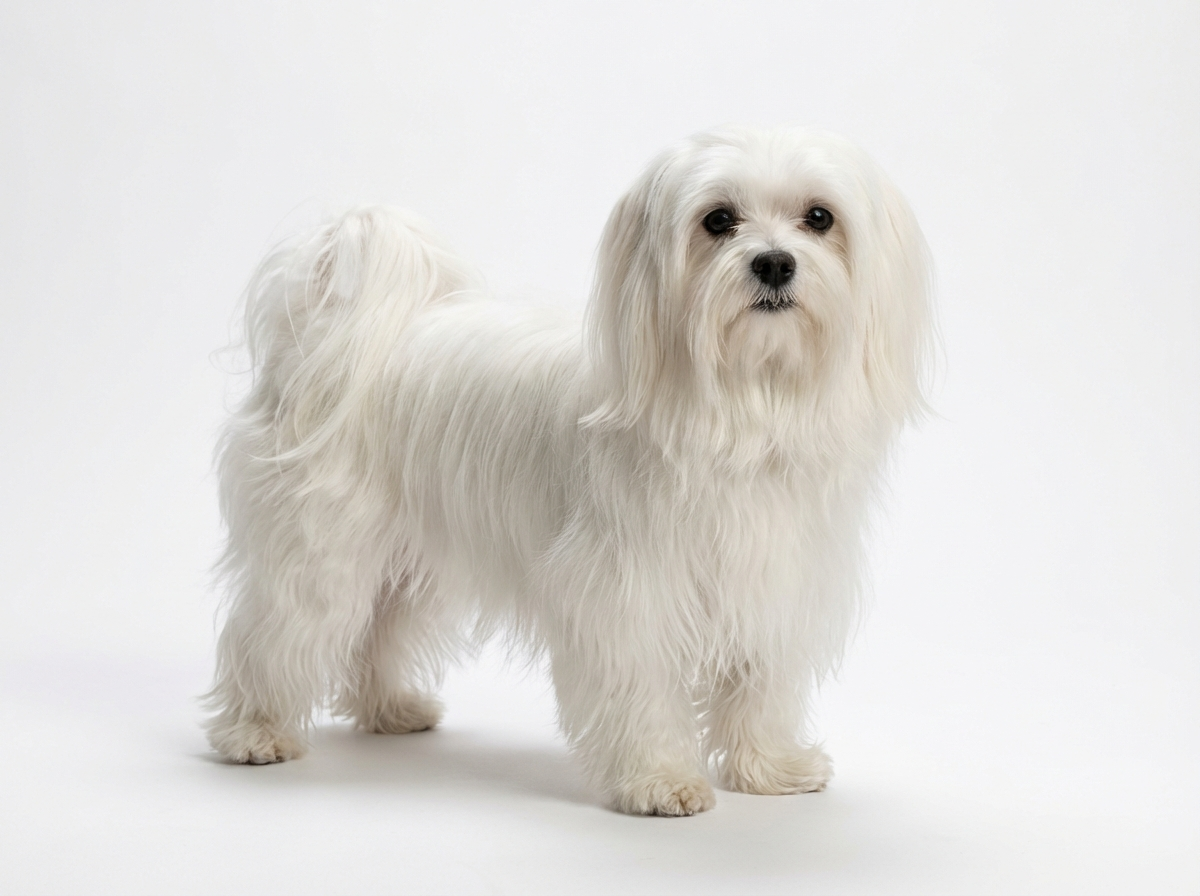
Long, silky, white
Short, dense
Equal
Origin
Malta
England
Equal
Typical monthly cost
$100–$180
$150–$350
Equal
Typical first-year cost
$1,400–$2,300
$2,200–$4,500
Equal
Deep dive
Size and build
This might be the most lopsided size comparison on the site: the Maltese weighs 3 to 7 pounds and stands 7 to 9 inches, while the Mastiff runs 120 to 250 pounds and 27 to 32 inches, a weight ratio that can exceed 30 to 1. These aren't variations on a theme; they're essentially different categories of dog, and that alone should drive most of your decision.
Energy and exercise
Both breeds actually land at the same low exercise need (2 out of 5), which surprises people expecting the giant Mastiff to demand marathon walks. In practice, Mastiffs are famously low-key for their size, content with modest daily exercise, while the tiny Maltese has just enough energy to enjoy short play sessions indoors. Neither breed suits an owner looking for a serious running partner.
Grooming and shedding
The numbers flip here: the Maltese needs heavy grooming (4 out of 5) for its long, silky coat but sheds almost nothing (1 out of 5), while the Mastiff needs comparatively little brushing (2 out of 5) but sheds moderately (3 out of 5). If you want minimal shedding and don't mind regular brushing sessions, the Maltese's coat trade-off works in your favor; the Mastiff flips that math the other way.
Apartment living, noise and time alone
The Maltese is rated the maximum 5 out of 5 for apartment suitability; the Mastiff sits at a low 2 out of 5, which tracks with its sheer size even given its calm temperament. Barking runs the opposite direction: the Maltese rates a moderate 3 out of 5, the Mastiff a very low 1 out of 5, since Mastiffs are known for being quiet dogs despite their size.
Training and owner experience
The Maltese is rated high for first-time owners (4 out of 5) and trainability (4 out of 5); the Mastiff comes in lower on both counts (2 out of 5 and 3 out of 5). A Mastiff's size means training isn't optional. A poorly trained 200-pound dog is a real management problem, so first-time owners should weigh that 2-out-of-5 rating seriously before committing.
Kids, other dogs and visitors
Here the giant breed pulls ahead: the Mastiff rates very high with kids (5 out of 5) against the Maltese's moderate 3 out of 5, reflecting its reputation for gentle patience despite its bulk. The Maltese does edge out the Mastiff with other dogs and strangers (4 out of 5 versus 3 on both), so the two breeds essentially trade advantages depending on which relationship matters most to you.
Health and lifespan
The Maltese lives dramatically longer, 12 to 15 years against the Mastiff's 9 to 11, a gap that's typical of small-versus-giant breed comparisons. The Mastiff's health list also reads heavier: hip and elbow dysplasia, cancer, bloat, heart disease, and bone cancer among ten conditions, reflecting the physical strain of carrying 150-plus pounds. The Maltese's list leans toward smaller-scale issues like tear staining and dental disease.
Cost to keep
The Mastiff costs considerably more to keep, a very high 5 out of 5 cost rating and $150 to $350 a month, against the Maltese's moderate 3 out of 5 and $100 to $180. First-year costs make the gap even clearer: $2,200 to $4,500 for the Mastiff versus $1,400 to $2,300 for the Maltese. Feeding and managing a 150-to-250-pound dog adds up fast.
Maltese vs Mastiff (English Mastiff) at a glance
Maltese weighs 3–7 lbs and lives 12–15 years; Mastiff (English Mastiff) weighs 120–250 lbs and lives 9–11 years. The two diverge most on apartment suitability, grooming need and shedding and 4 other rated axes. Almost every rated axis separates them at least slightly. In the table, a "winner" means easier for an ordinary household — not better. Size, coat and origin are recorded without a verdict. Because both breeds are scored the same way, the gaps are reliable even where the absolute numbers are rough.
Maltese vs Mastiff (English Mastiff): Which Suits Your Home? - Maltese vs Mastiff (English Mastiff) at a glance
Frequently asked questions
How different is their size?
About as different as two dogs can be, the Maltese weighs 3 to 7 pounds, the Mastiff 120 to 250 pounds. That's often a 30-plus-times difference in body weight.
Which sheds more?
The Maltese sheds almost nothing (1 out of 5); the Mastiff sheds moderately (3 out of 5) despite its short coat, simply due to sheer surface area.
Is either good for a first-time owner?
The Maltese is the safer first-timer pick, rated 4 out of 5 against the Mastiff's low 2 out of 5. A giant breed's size makes training mistakes much higher-stakes.
Which fits an apartment better?
The Maltese is ideal for small spaces (5 out of 5); the Mastiff is a poor fit (2 out of 5) simply due to its size, even though it's quiet and low-energy.
What will either cost me monthly?
The Mastiff costs substantially more, $150 to $350 monthly and up to $4,500 in the first year, against the Maltese's $100 to $180 monthly and roughly $2,300 max in year one.
Do they share health risks?
Almost no overlap in the data. The Mastiff's list is dominated by joint problems and cancer typical of giant breeds, while the Maltese's list centers on dental disease, tear staining, and small-breed eye issues.
Which is better with kids?
Surprisingly, the Mastiff, rated very high (5 out of 5) against the Maltese's moderate 3 out of 5. Despite its size, the breed's calm, gentle temperament is well documented.
Choose the Maltese for apartment living, lower cost, and longer lifespan. Choose the Mastiff if you have serious space, want a famously gentle giant with kids, and can absorb the higher cost of a very large dog.
Costs
What's the monthly cost?
The Maltese runs $100-$180 a month; the Mastiff runs $150-$350, nearly double at the upper end.
Behavior
How much exercise do they need?
Both are surprisingly low-key, tying at 2 out of 5 exercise need. Neither breed demands intense daily activity.
Health
Which breed lives longer?
The Maltese, by a wide margin, 12 to 15 years against the Mastiff's 9 to 11, typical of the small-versus-giant lifespan pattern.
Related DogBreedCompass guides
Maltese breed guide – Readers comparing the two usually want the full profile of Maltese before deciding.
Health information here is general and is not veterinary advice. If your dog shows pain, sudden behaviour change, or worsening symptoms, consult a licensed veterinarian.
Some links on this site are affiliate links. We may earn a commission at no extra cost to you, and we only suggest products we believe are helpful for dog owners.
We research and check what we publish, but we do not warrant that any figure, date, price, or statement is accurate, complete, or current, and we accept no liability for any loss, cost, injury, or other harm arising from the use of this site. Use it as one reference among several. You remain responsible for your own decisions and for your dog's care - confirm anything that matters with a licensed veterinarian or another qualified professional before you act on it. Full disclaimer.