Health
What usually causes recurrent ear infections?
Underlying allergic skin disease in most cases. The infection is a consequence, which is why treating it alone does not stop the recurrence.

Quick answer
What usually causes recurrent ear infections?
Underlying allergic skin disease in most cases. The infection is a consequence, which is why treating it alone does not stop the recurrence.
The question is never why did my dog get an ear infection. It is why does this ear keep providing such a good home.
Owners on their third or fourth course of drops in a year who suspect something is being missed, and owners of young Mastiffs wanting to establish a sensible ear routine that neither neglects nor over-treats.
This guide is not medical advice. If your dog shows pain, sudden behavior change, or worsening symptoms, consult a licensed veterinarian.
Some links may be affiliate links. We may earn a commission at no extra cost to you. We only suggest products we believe are helpful for dog owners.
We research and check what we publish, but we do not warrant that any figure, date, price, or statement is accurate, complete, or current, and we accept no liability for any loss, cost, injury, or other harm arising from the use of this site. Use it as one reference among several. You remain responsible for your own decisions and for your dog's care - confirm anything that matters with a licensed veterinarian or another qualified professional before you act on it. Full disclaimer.
Otitis externa is inflammation of the external ear canal, usually with secondary overgrowth of yeast or bacteria. It produces head shaking, scratching, odour, discharge and pain. In dogs with drop ears the canal is warm, humid and poorly ventilated, and in an allergic dog the canal lining is already inflamed, so infection establishes easily and returns readily once treatment stops.
Ear disease is one of the most frequent reasons dogs are presented to veterinary practices, and drop-eared breeds are heavily over-represented. While ear infection is not itself on the English Mastiff's documented health issue list, the breed's ear conformation and its skin make it a familiar problem, and recurrence rather than first occurrence is what dominates owners' experience of it.
Structure explains most of it. A pendulous ear covers the canal opening and holds warmth and humidity against it. A giant breed's canal is correspondingly large, produces a substantial volume of wax, and has a longer path for debris to travel before it can escape. The breed's short dense coat is easy to dry, which helps, but the skin under the ear flap where it lies against the head stays damp long after the rest of the dog looks dry. Underneath all of this, an allergic dog has a canal lining that is already inflamed before any organism arrives.
Water is the recurring theme: swimming, baths, and walks in wet weather all leave moisture where it cannot easily evaporate. Late summer brings grass seeds, which are a genuine hazard for a dog whose ears sweep through long grass at exactly the wrong height. Humid indoor environments and inconsistent parasite control both play smaller parts. Human behaviour matters too, since over-enthusiastic cleaning and abandoned courses of medication are among the most common perpetuating factors of all.
Book an appointment for any smell, discharge, redness, persistent scratching or head shaking, and specifically ask what the underlying cause is thought to be if this is not the first episode. Seek same-day attention for sudden violent head shaking or pawing, which suggests a foreign body, for severe pain when the ear is touched, or for a swollen ear flap. Treat as urgent any head tilt, loss of balance, circling, flicking eye movements or facial weakness, since those indicate middle or inner ear involvement. Never put anything into an ear that may have a damaged eardrum, which is not something you can assess by looking.
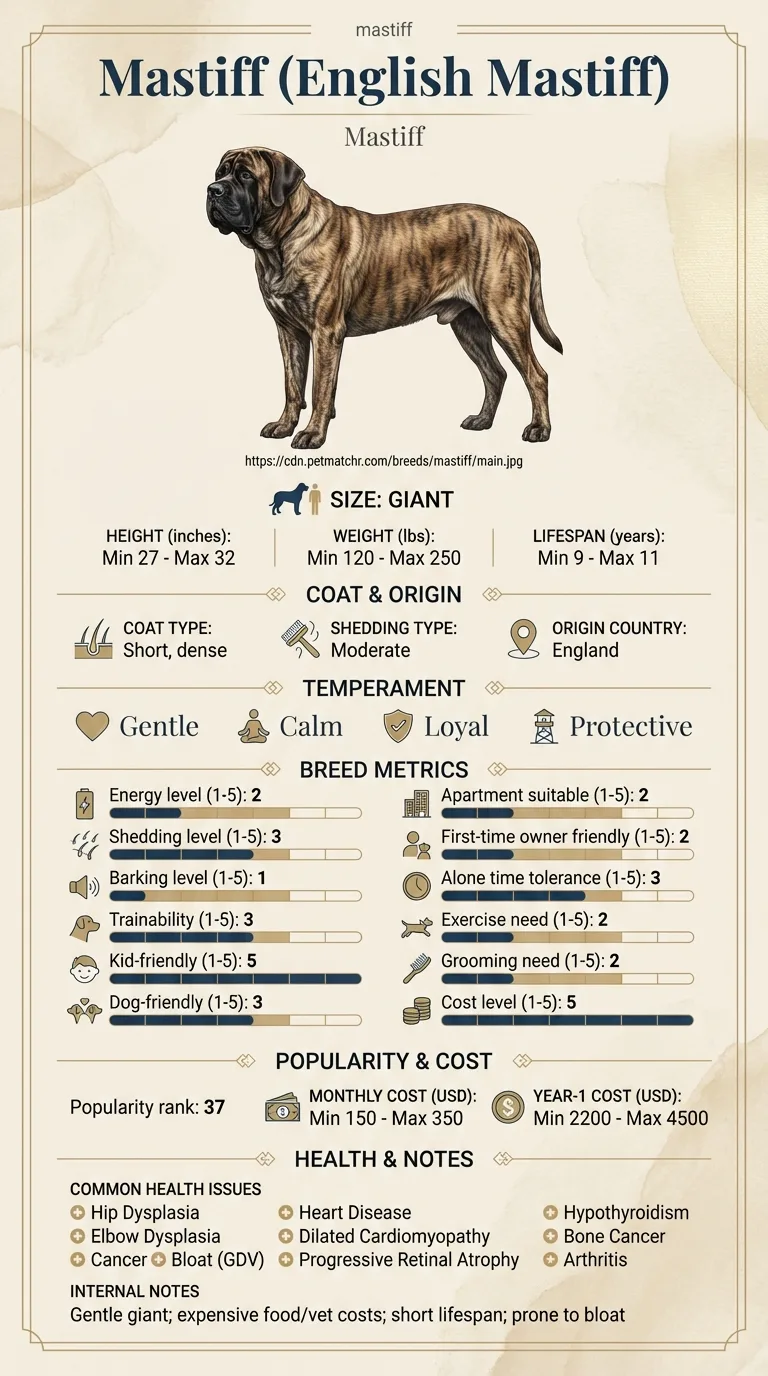
See all Mastiff health problems, which breeds are prone to ear infections, or the full Mastiff breed guide for temperament, exercise needs and ownership costs.
An uncomplicated first infection usually clears in two to three weeks with a full course and a recheck. A recurrent case takes longer, because the underlying cause has to be investigated in parallel, and allergy work-ups run over months. Chronically thickened canals may never return fully to normal. Expect the first year of managing a genuinely allergic dog to involve trial, adjustment and some frustration.
Success is ears that stay clean between routine checks, no odour, no head shaking, and no more than an occasional mild flare that you catch early. It is not necessarily a dog that never has another ear problem. The clearest marker of success is the interval: episodes measured in years rather than in weeks, and courses of drops that finish rather than restart.
Veterinary dermatologists analyse ear disease in layers, and the reason drops alone fail is that they address only one of them.
Over-cleaning causes real harm, and it is one of the most common mistakes made by conscientious owners. An inflamed canal that is flushed daily stays wet, stays irritated, and does not heal. Frequency should be set by your vet for your dog, not adopted from a routine that suited somebody else's spaniel.
When cleaning is appropriate, the method matters. Warm the solution slightly in your hand, since cold liquid in an ear canal produces a violent head shake and a soaked kitchen. Fill the canal properly rather than dribbling a little in, then massage the base of the ear firmly for twenty seconds. You should hear a squelch, and that sound is the point: it means the solution has reached where debris actually sits, at the bend of the L. Then let the dog shake, which is what lifts the loosened material up and out, and wipe only what appears at the opening.
Never push cotton buds into the canal. On a Mastiff-sized ear it feels as though you have plenty of room, and that is exactly why owners of this breed do it. What actually happens is that debris is compacted down against the eardrum where nothing can retrieve it.
Dry the ear after swimming and after baths, and dry under the flap where it lies against the head, since that skin stays damp long after the coat looks dry.
The most important discipline, though, is finishing courses. Ear infections relapse constantly because drops are stopped as soon as the dog seems comfortable, which is usually days before the infection has actually cleared. Book the recheck, attend it, and let your vet look down the canal before declaring it over. A resolved ear on examination is a different thing from a comfortable dog.

Norah's Mastiff Barnaby had been treated for right ear infections four times in eighteen months. Each course worked. Each relapse came about two months later, and Norah had begun cleaning both ears every second day in an attempt to prevent the next one. At the fifth visit a locum asked two questions that had not come up before: was the left ear ever affected, and what were his feet like. The answer was no and stained brown, respectively. Barnaby was examined properly under sedation. There was no allergy driving it. There was scar tissue and a narrowed canal on the right, and a small mass at the bend that had been shielding infection from every course of drops he had ever had. It was removed, and the infection resolved for good. Norah also stopped cleaning both ears every second day, which her vet suspected had been keeping the healthy left canal permanently irritated for no reason at all.
Key takeaway: One ear that keeps relapsing while the other stays clean is not an allergy pattern. Asymmetry is a signal that something physical is being missed inside that specific canal.
Because something is making the ear hospitable and it has not been addressed. Allergic skin disease is by far the most common underlying cause. Treating the infection alone clears the current episode and does nothing about the environment that produced it, so it returns within weeks or months.
Ask your vet to set the frequency for your individual dog. Over-cleaning an inflamed canal keeps it wet and delays healing, while under-cleaning a wax-heavy ear allows debris to accumulate. There is no universal number, and copying a routine designed for another breed is how people get this wrong.
No. Home solutions can be irritating, can worsen an inflamed canal, and are actively dangerous if the eardrum is damaged, which you cannot determine by looking. Use only products your vet has recommended after examining the ear.
Sudden, dramatic and one-sided. A dog that was fine an hour ago is shaking its head violently, tilting it, pawing at the ear and clearly distressed. It is a same-day veterinary problem, because a seed migrates inward and can perforate the eardrum.
Yes. A persistent head tilt, loss of balance, flicking eye movements or circling suggests the middle or inner ear is involved rather than just the outer canal. That needs prompt veterinary assessment and often imaging, not another course of drops.
This is more debated than it used to be, and routine plucking can inflame the canal in some dogs. Trimming hair around the opening to improve airflow is generally uncontroversial. Ask your vet what they recommend for your dog rather than following a groomer's default.
It can reach a point where the canal has thickened and calcified so much that medication cannot penetrate, and at that stage surgical removal of the canal becomes the option that resolves the pain. That outcome is largely preventable, and preventing it is the whole argument for chasing the underlying cause early.
Underlying allergic skin disease in most cases. The infection is a consequence, which is why treating it alone does not stop the recurrence.
Fill the canal with a warmed vet-recommended solution, massage the base for twenty seconds until it squelches, let the dog shake, then wipe the opening only.
Never inside the canal. They compact debris down against the eardrum, and a large ear tempts owners to push further than they should.
Sudden violent head shaking, a head tilt, loss of balance, flicking eyes, or severe pain all need same-day veterinary attention.
Usually because the course was stopped early or the underlying cause was never treated, allowing the same infection to re-establish.
A one-page prep sheet for this condition: the signs, the questions to ask, what to get priced. Unlocks here.
You get: Vet visit prep sheet
No spam. One-click unsubscribe. See our privacy policy.
Preview page 1 before you decide.