Health
How can I tell a cataract from normal ageing?
Ageing gives an even bluish haze in both eyes. A cataract looks whiter and more solid and blocks the view into the back of the eye.

Quick answer
How can I tell a cataract from normal ageing?
Ageing gives an even bluish haze in both eyes. A cataract looks whiter and more solid and blocks the view into the back of the eye.
Most owners who notice a bluish haze in an older dog's eyes are looking at normal ageing, not a cataract. Telling them apart is a two-minute job for a vet with a light.
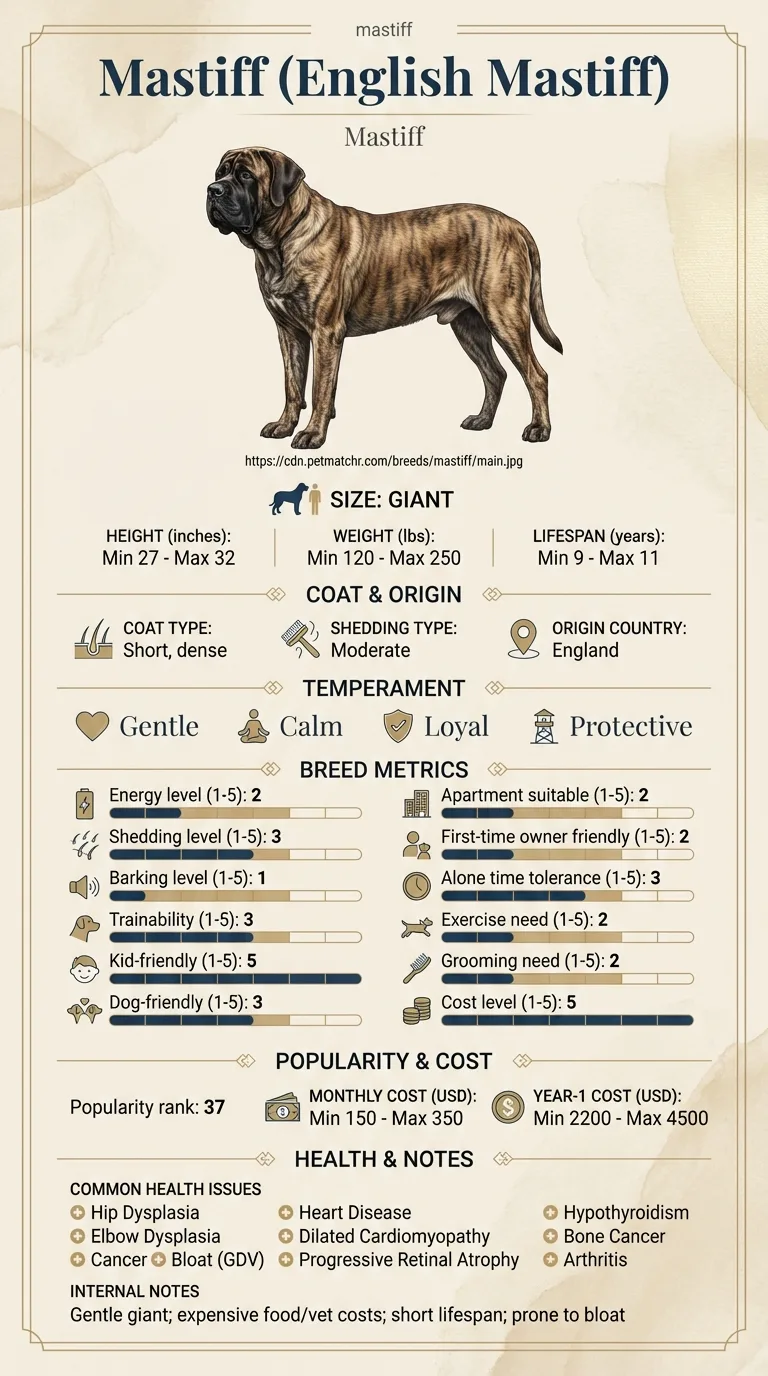
Owners of Mastiffs over six who have noticed a change in the eyes and want to know whether it matters, and owners of younger dogs where clouding has appeared unexpectedly early, which raises a different and more urgent set of questions.
This guide is not medical advice. If your dog shows pain, sudden behavior change, or worsening symptoms, consult a licensed veterinarian.
Some links may be affiliate links. We may earn a commission at no extra cost to you. We only suggest products we believe are helpful for dog owners.
We research and check what we publish, but we do not warrant that any figure, date, price, or statement is accurate, complete, or current, and we accept no liability for any loss, cost, injury, or other harm arising from the use of this site. Use it as one reference among several. You remain responsible for your own decisions and for your dog's care - confirm anything that matters with a licensed veterinarian or another qualified professional before you act on it. Full disclaimer.
A cataract is a loss of transparency in the lens of the eye. It ranges from a small dot that never affects sight to a completely white lens that blocks vision entirely. It may be inherited, may follow diabetes or injury, or may develop with age. Its practical significance depends on how much of the lens is involved and how fast it is changing, both of which need an ophthalmological examination to judge.
Cataracts are common across dogs generally but are not among the defining health concerns for the English Mastiff, whose documented eye issue is progressive retinal atrophy. What is close to universal in this breed, as in every breed, is the harmless age-related hardening of the lens that owners mistake for a cataract. Distinguishing the two is where most of the value in this topic lies.
There is no strong breed-specific cataract association to report for the English Mastiff, and inventing one would not help anyone. What is documented is progressive retinal atrophy, an unrelated disease of the retina that also causes vision loss and is worth distinguishing. Where the breed does contribute is in scale: a very heavy dog losing its sight has bigger practical consequences than a small one, both for the dog's own safety and for the household it moves through.
The environment plays little part in whether a cataract forms, but it determines almost everything about how well a visually impaired dog lives. A stable, predictable house with unmoved furniture allows a blind dog to build a reliable map. A household that rearranges rooms, leaves obstacles in walkways or has unfenced water is genuinely dangerous. Lighting matters too, since a dog with partial vision navigates far better in even, bright light than in shadow.
Book an appointment for any new cloudiness, for a change in one eye that is not matched in the other, or for a dog that has started bumping into things or hesitating at steps. Seek same-day or emergency attention if the eye becomes red, if the dog is squinting, holding the eye closed, pawing at it or shying from light, if there is discharge, or if the eye appears enlarged or the surface looks hazy and dull. A painful eye can lose vision permanently within hours, and raised pressure inside the eye is an emergency. Do not put anything into a painful eye before it has been examined.
See all Mastiff health problems, which breeds are prone to cataracts, or the full Mastiff breed guide for temperament, exercise needs and ownership costs.
An ophthalmological examination gives an answer in one visit. Established cataracts do not resolve, and the honest options are surgery or adaptation. If surgery is chosen, the procedure is a single day with several weeks of intensive aftercare and a longer period of follow-up examinations. Dogs adapting to gradual vision loss typically settle into a confident routine within four to eight weeks in a stable house.
For a dog with harmless age-related lens change, success is simply an owner who has stopped worrying about it. For a genuinely cataractous dog, success is either restored functional vision after surgery, or a dog that moves confidently around a familiar home, walks a familiar route without collisions, and shows no sign of anxiety about the dark. Blind dogs can be entirely content, and this breed manages it better than most.
The single most useful thing to know about cloudy eyes is that the common cause is harmless. Here is how the two differ.
The reassuring part of this subject is that dogs adapt to gradual blindness far better than owners expect, and a Mastiff has several advantages in doing so. It is a calm, low-energy breed that spends most of its day in a familiar house, moves slowly, and relies heavily on scent. A blind Mastiff in a stable home often navigates so well that visitors do not notice.
The adaptations that matter are practical and cheap. Stop rearranging furniture, and tell everyone in the household why. Keep water bowls, beds and doorways in fixed positions. Put a distinct texture underfoot at the top and bottom of any staircase, and at the door to the garden, so the dog has tactile landmarks. Talk before you touch, because a blind dog that is startled awake by a hand is a dog that may snap, and this breed is powerful enough that the habit matters.
Outdoors, the difficulties are size-related. A two-hundred-pound dog that walks into a gatepost does so with real force, and steps down from a kerb become a genuine hazard. A short lead, a consistent route, and a verbal cue for step down, which most dogs learn within a fortnight, solves most of it. Fence off ponds and pools without exception, because a blind giant breed that falls into water is difficult to retrieve.
On surgery: cataract removal in dogs is a genuine, effective procedure performed by veterinary ophthalmologists, and it restores useful vision in suitable candidates. Suitability depends on the state of the retina, which is assessed beforehand, on the absence of other eye disease, and on the dog's ability to tolerate weeks of eye drops and restricted activity afterwards. That last point is not trivial with a Mastiff, and it is worth being honest with yourself about whether you can deliver it.

Bess was nine, and her owner Colm had been watching a blue haze develop in both eyes for two years without acting, having read that it was probably just age. It probably was. What eventually took them to the vet was different: Bess had started stopping at the back step, and once walked into an open cupboard door. The examination confirmed nuclear sclerosis in both lenses, which was harmless, and also identified retinal changes consistent with a progressive degeneration, which was not. The cloudy lens Colm had been watching was not the reason Bess was losing her sight. There was no surgical option for the retina. What there was instead was a plan: fixed furniture, a rubber mat at the back step, cues for step up and step down taught over a fortnight while Bess still had useful light perception, and a fence around the pond. Eighteen months on Bess is functionally blind and, in Colm's words, gets around the house better than he does in the dark.
Key takeaway: The cloudy lens you can see is often not the reason the dog is bumping into things. A proper eye examination distinguishes an appearance from a diagnosis.
Statistically, probably not. A uniform bluish haze in both eyes of a dog over seven is usually nuclear sclerosis, a normal age change that affects vision very little. A vet can distinguish it from a cataract in minutes with a bright light, and it is worth confirming rather than assuming either way.
Two possibilities matter most. Inherited cataract occurs in many breeds and appears in young or middle-aged dogs. Diabetes causes cataracts that can develop remarkably fast, sometimes over days. A cataract in a dog under six warrants a general workup including a blood glucose test, not just an eye examination.
The opacity itself does not, but a mature or hypermature cataract can leak lens protein into the eye and trigger inflammation, which is painful and can lead to glaucoma. A cloudy eye that becomes red, squinting or watery has stopped being a vision problem and become an urgent one.
It can be, and size is not itself a barrier. The considerations are the state of the retina, other eye disease, the anaesthetic plan for a giant patient, and above all whether you can realistically administer frequent eye drops and enforce restricted activity for weeks afterwards on a very large, strong dog.
No product has been shown to reverse an established cataract. Products marketed for this purpose are not a substitute for ophthalmological assessment, and money spent on them is better spent on the examination that tells you whether surgery is an option.
It depends entirely on the type. Some cataracts remain small and static for years and never affect vision meaningfully. Diabetic cataracts can mature within weeks. Only an ophthalmological examination can indicate which pattern you are dealing with, and repeat examinations track it.
Yes. An annual eye examination by a qualified ophthalmologist is standard practice for breeding stock in many breeds, and it is a reasonable thing to ask any Mastiff breeder for alongside hip, elbow and cardiac screening. Ask to see the certificate rather than take the claim.
Ageing gives an even bluish haze in both eyes. A cataract looks whiter and more solid and blocks the view into the back of the eye.
It warrants prompt investigation, including a check for diabetes, because diabetic cataracts can mature within weeks.
When it becomes red, painful, watery or the dog is squinting. That suggests inflammation or raised pressure and needs same-day attention.
Keep furniture, bowls and beds in fixed places, add texture underfoot at stairs and doors, and always speak before touching a sleeping dog.
Yes, and it is demanding: frequent eye drops and weeks of restricted activity, which is a real commitment with a very large dog.
A one-page prep sheet for this condition: the signs, the questions to ask, what to get priced. Unlocks here.
You get: Vet visit prep sheet
No spam. One-click unsubscribe. See our privacy policy.
Preview page 1 before you decide.