Health
Is a cloudy eye in an older Lab always a cataract?
Not always — it's often nuclear sclerosis, a normal age-related change, and a veterinary ophthalmology exam can tell the difference.

Quick answer
Is a cloudy eye in an older Lab always a cataract?
Not always — it's often nuclear sclerosis, a normal age-related change, and a veterinary ophthalmology exam can tell the difference.
A Lab that passes an eye exam clean at age two isn't guaranteed to stay that way at age eight — several of the conditions this breed is prone to are specifically age-dependent, which is why ongoing screening matters more than a single clearance early in life.
Owners assuming one clean puppy eye exam covers them for life, and owners of middle-aged or senior Labs noticing cloudiness or vision changes for the first time.
This guide is not medical advice. If your dog shows pain, sudden behavior change, or worsening symptoms, consult a licensed veterinarian.
Some links may be affiliate links. We may earn a commission at no extra cost to you. We only suggest products we believe are helpful for dog owners.
We research and check what we publish, but we do not warrant that any figure, date, price, or statement is accurate, complete, or current, and we accept no liability for any loss, cost, injury, or other harm arising from the use of this site. Use it as one reference among several. You remain responsible for your own decisions and for your dog's care - confirm anything that matters with a licensed veterinarian or another qualified professional before you act on it. Full disclaimer.
Ocular disease in Labrador Retrievers spans several distinct conditions across different life stages, most notably progressive retinal atrophy in young to middle adulthood and cataracts in middle-aged and senior dogs. These conditions have very different causes, progressions, and treatment options, which makes an ongoing, age-adjusted screening approach far more useful than a single early-life eye clearance.
Eye conditions collectively are common enough across a Labrador's lifetime that annual eye exams have become a standard recommendation for the breed, though any individual condition's likelihood varies significantly by age, genetics, and overall health.
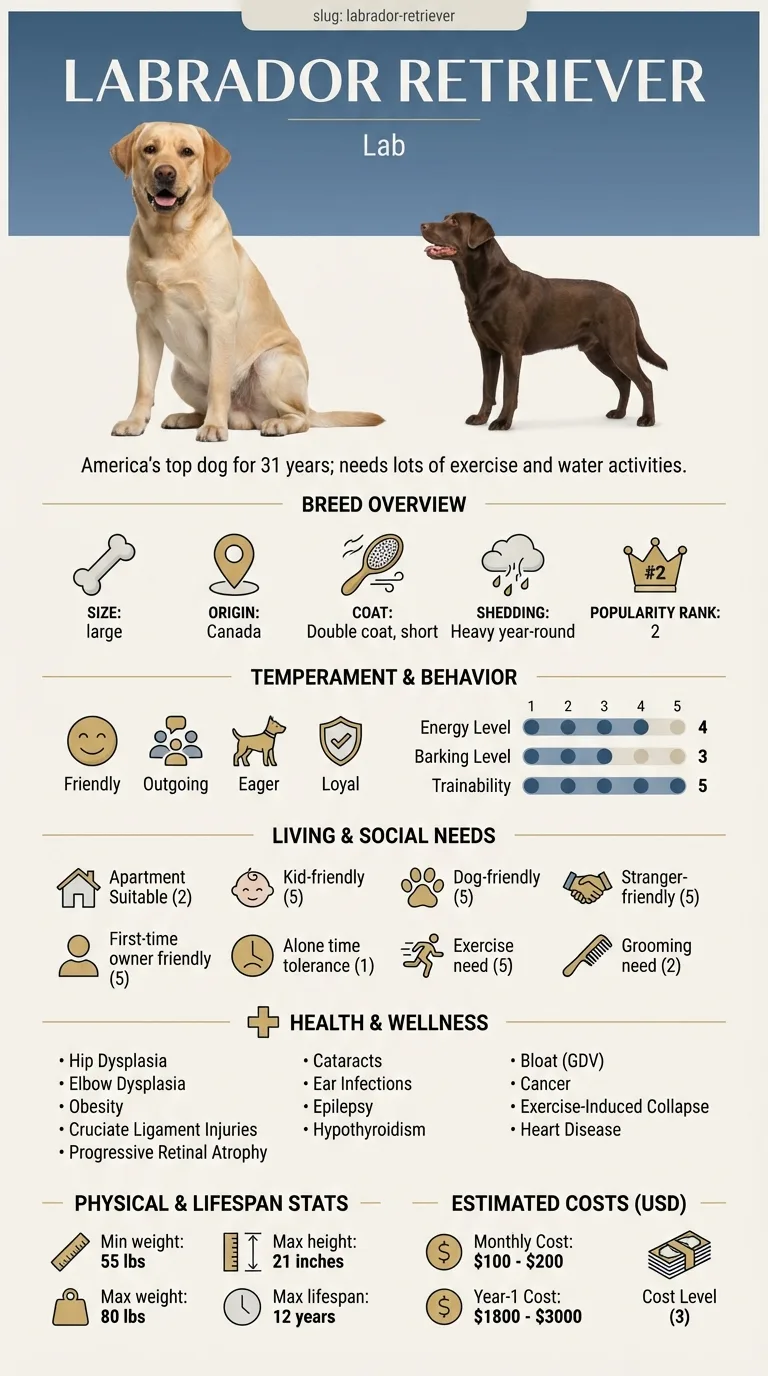
Labradors carry documented genetic predisposition toward specific inherited eye conditions like certain forms of PRA, which is why breed health registries specifically track ocular health in this breed. Their long 10 to 12 year lifespan also means more years for age-related conditions like cataracts to develop, layering acquired risk on top of any inherited predisposition.
Diabetes is one of the more significant environmental and metabolic contributors to accelerated cataract formation, developing rapidly in some diabetic dogs. General UV exposure and age-related wear also contribute to gradual lens changes over a dog's lifetime, independent of any specific disease process.
Schedule a prompt eye exam for any new cloudiness, reduced night vision, or apparent vision changes, and seek same-day care for a sudden red, painful, or swollen eye, or sudden apparent blindness, since these can indicate an acute emergency like glaucoma requiring urgent treatment.
See all Labrador Retriever health problems, which breeds are prone to ocular disease, or the full Labrador Retriever breed guide for temperament, exercise needs and ownership costs.
PRA progresses gradually over months to years with no treatment that reverses it, though most dogs adapt well given a familiar environment. Cataract surgery, when pursued, typically involves a same-day outpatient procedure with a recovery period of a few weeks before vision fully stabilizes.
For PRA, success means a well-adapted dog navigating a familiar environment confidently despite vision loss, since there's no treatment that restores retinal function. For cataracts, success often means genuinely restored functional vision after successful surgery — a meaningfully different outcome depending on which condition is involved.
Progressive retinal atrophy (PRA) is a genetic condition that typically becomes apparent in young to middle adulthood, causing gradual, irreversible vision loss starting with night vision and progressing over months to years. Because it's inherited, responsible breeders test for known genetic markers, though not every form of PRA has an identified genetic test, which means clinical monitoring still matters even in tested lines.
Cataracts are a separate issue entirely — a clouding of the eye's lens rather than retinal degeneration — and while they can occur at any age, they become meaningfully more common in middle-aged and senior Labs. Unlike PRA, cataracts are often surgically treatable, restoring vision in many cases, which is an important distinction for owners to understand rather than assuming all vision loss is equally permanent.
Beyond these two headline conditions, general age-related lens changes (nuclear sclerosis, which causes a bluish haze but doesn't significantly impair vision) are frequently confused with cataracts by owners, which is exactly why a proper veterinary ophthalmology exam, not just a glance at cloudy-looking eyes, matters for getting an accurate read on what's actually happening.

Given how much risk shifts by age for this breed, here's a realistic ongoing plan rather than a single one-time check.
At age four, Maria's Lab, Willow, started hesitating on the stairs at night, which an ophthalmology exam confirmed was early progressive retinal atrophy. Maria adjusted her home with consistent furniture placement and night lights, and Willow adapted well over the following two years as her vision gradually declined, still navigating the house and yard confidently by scent and memory. Four years later, at age eight, Maria noticed a different change — cloudy white eyes rather than the vision changes she'd already come to expect. This time it was cataracts, unrelated to the earlier PRA. Willow had successful cataract surgery, and her ophthalmologist confirmed she regained meaningful functional vision afterward, on top of whatever limited vision the earlier retinal disease had left her with.
Key takeaway: Two completely different eye conditions can affect the same dog at different life stages, which is exactly why ongoing screening — not a single early clearance — is what actually protects a Lab's eye health over a full lifetime.
Progressive retinal atrophy, cataracts, and general age-related lens changes are the most commonly discussed, each with a different typical age of onset, cause, and treatability, making 'ocular disease' really a collection of distinct conditions rather than one issue.
Progressive retinal atrophy does cause irreversible, progressive vision loss over time. Cataracts, by contrast, are often surgically treatable, and many dogs regain functional vision after successful surgery, so not every eye condition in this list leads to permanent blindness.
PRA is a genetic degeneration of the retina itself, causing progressive and irreversible vision loss, usually starting with night vision. Cataracts are a clouding of the eye's lens, a structural change that's often surgically correctable, restoring vision in many affected dogs.
Not necessarily — it's often nuclear sclerosis, a normal age-related lens change that causes a bluish haze but doesn't significantly impair vision, and it's frequently confused with true cataracts. A veterinary ophthalmology exam can distinguish between the two.
Cataract surgery typically runs $3,000–$4,500 per eye when performed by a veterinary ophthalmologist, reflecting the specialized equipment and expertise required.
An annual eye exam is a reasonable baseline for adult Labs, increasing to closer monitoring for any dog showing early signs of vision changes or coming from a line with known genetic eye conditions.
For forms of PRA with an identified genetic marker, testing breeding stock can meaningfully reduce the risk of producing affected puppies, though not every form of PRA has a known genetic test yet, so clinical monitoring remains important even in tested lines.
Not always — it's often nuclear sclerosis, a normal age-related change, and a veterinary ophthalmology exam can tell the difference.
Yes, surgical removal is often successful and can restore functional vision in many affected dogs.
No — it causes progressive, irreversible vision loss, though affected dogs often adapt very well to gradual blindness.
Typically $3,000–$4,500 per eye when performed by a veterinary ophthalmologist.
Reduced night vision, such as increased hesitation or bumping into furniture in dim light, is often the earliest noticeable sign.
A one-page prep sheet for this condition: the signs, the questions to ask, what to get priced. Unlocks here.
You get: Vet visit prep sheet
No spam. One-click unsubscribe. See our privacy policy.
Preview page 1 before you decide.