Living
Which is the better overall choice?
The Labrador for families, multi-dog homes, and first-time owners; the Am Staff for anyone who's away from home a lot or wants a longer-lived dog.

Quick answer
Which is the better overall choice?
The Labrador for families, multi-dog homes, and first-time owners; the Am Staff for anyone who's away from home a lot or wants a longer-lived dog.
American Staffordshire Terrier or Labrador Retriever? On paper they differ most on good with other dogs, and on the scales Labrador Retriever is the heavier at 55–80 lbs. Here is how the two compare on everything that shapes an ordinary week.
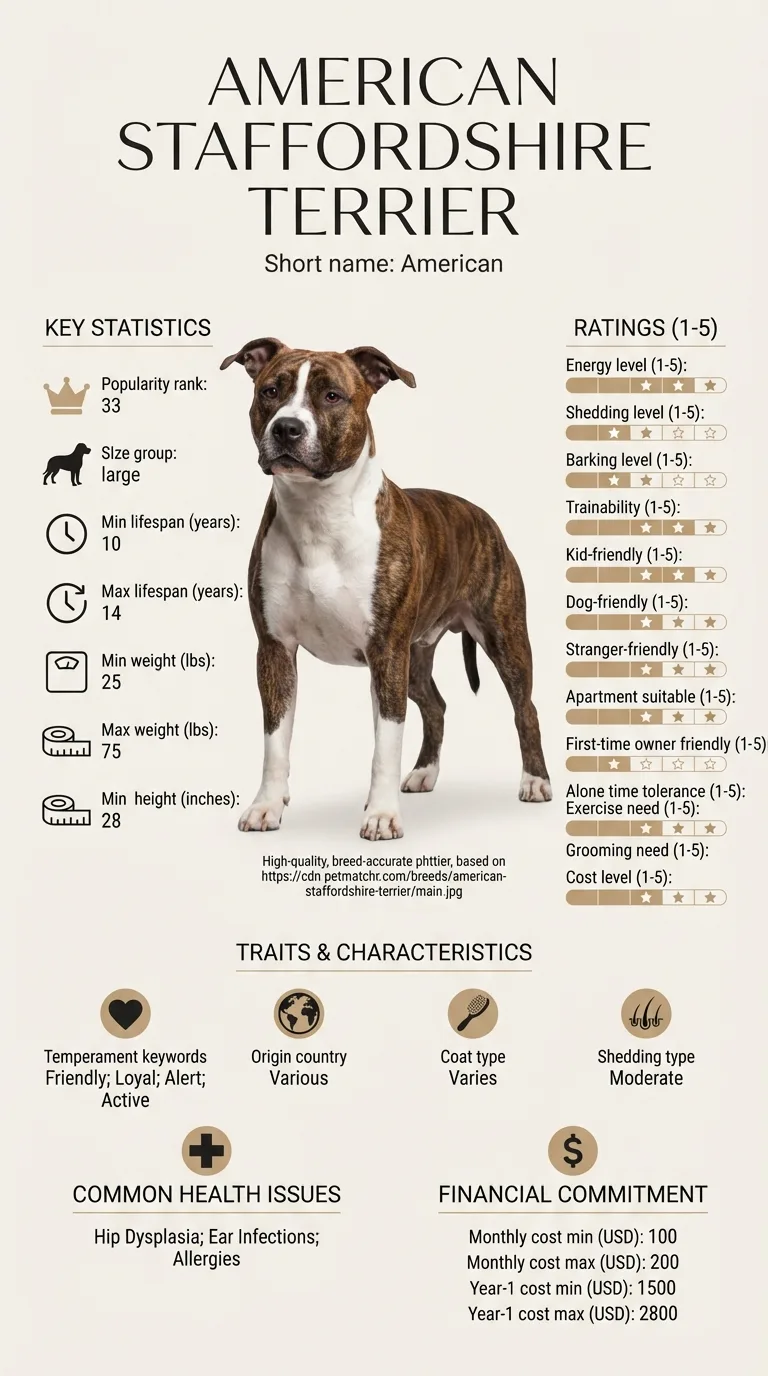
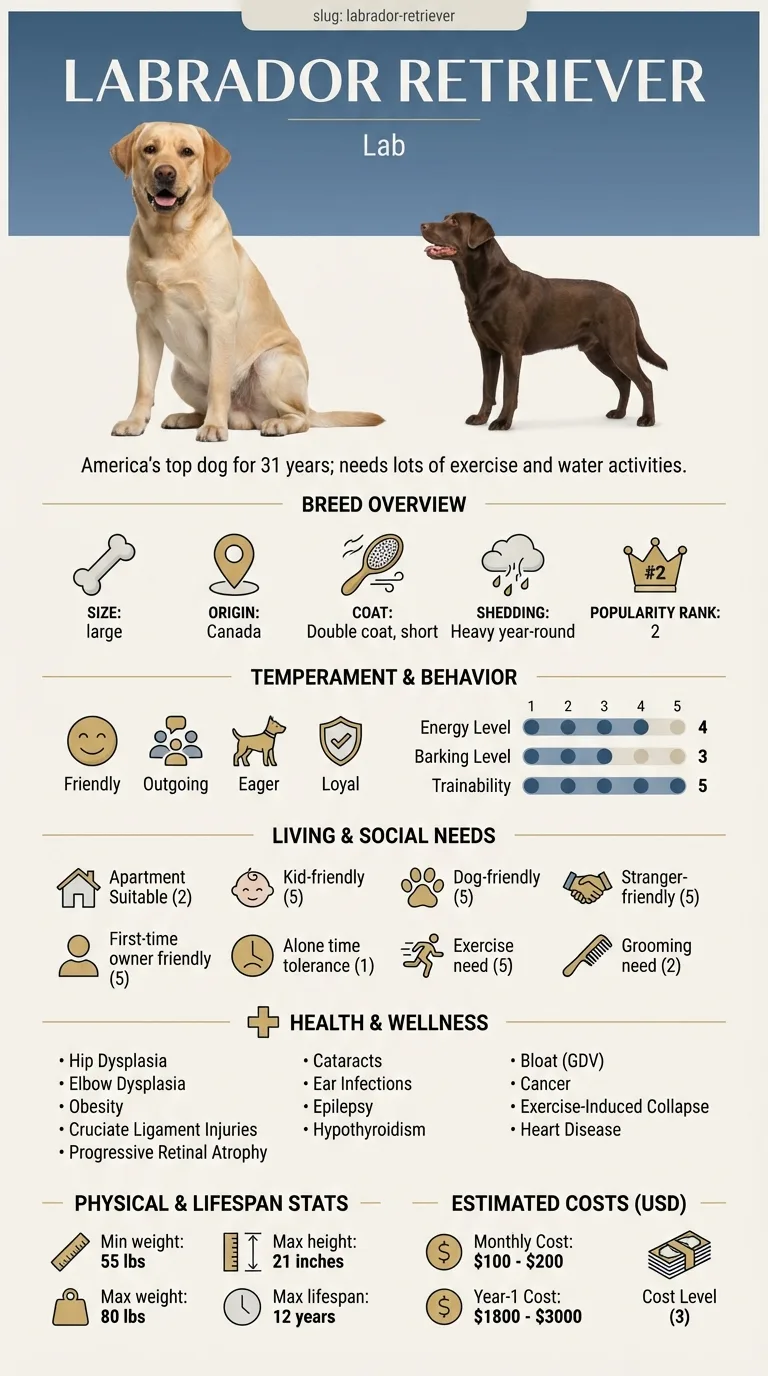
This is for someone already down to American Staffordshire Terrier and Labrador Retriever and deciding between them. For this pair the decision usually turns on good with other dogs and good for first-time owners, so those are covered first and in most detail. Anyone choosing from a flat has a clear answer here: American Staffordshire Terrier rates 3/5 against 2/5. Breed history is left out; what follows is what you will actually live with.
Between American Staffordshire Terrier and Labrador Retriever, good with other dogs is what separates them, and American Staffordshire Terrier is the lower-effort dog of the two to keep.
Choose American Staffordshire Terrier if you are in a flat or a smaller home, you do not want a standing grooming appointment and shedding is a problem in your house.
Choose Labrador Retriever if this is your first dog, there are young children at home and you already have another dog.
| Feature | american staffordshire terrier | labrador retriever | Winner |
|---|---|---|---|
| Size class | medium | large | Equal |
| Weight | 40–70 lbs | 55–80 lbs | Equal |
| Height | 17–19 in | 21–24 in | Equal |
| Lifespan | 12–16 years | 10–12 years | american staffordshire terrier |
| Exercise need | High (4/5) | Very high (5/5) | american staffordshire terrier |
| Grooming need | Very low (1/5) | Low (2/5) | american staffordshire terrier |
| Shedding | Moderate (3/5) | High (4/5) | american staffordshire terrier |
| Energy level | High (4/5) | High (4/5) | Equal |
| Barking | Low (2/5) | Moderate (3/5) | american staffordshire terrier |
| Apartment suitability | Moderate (3/5) | Low (2/5) | american staffordshire terrier |
| Good for first-time owners | Moderate (3/5) | Very high (5/5) | labrador retriever |
| Tolerates being alone | Moderate (3/5) | Very low (1/5) | american staffordshire terrier |
| Trainability | High (4/5) | Very high (5/5) | labrador retriever |
| Good with kids | High (4/5) | Very high (5/5) | labrador retriever |
| Good with other dogs | Low (2/5) | Very high (5/5) | labrador retriever |
| Friendly to strangers | High (4/5) | Very high (5/5) | labrador retriever |
| Cost level | Moderate (3/5) | Moderate (3/5) | Equal |
| Coat | Short, stiff and glossy | Double coat, short | Equal |
| Origin | Various | Canada | Equal |
| Typical monthly cost | $100–$200 | $100–$200 | Equal |
| Typical first-year cost | $1,400–$2,900 | $1,800–$3,000 | Equal |
The Am Staff is medium at 40-70 lbs and 17-19 inches; the Labrador is large, 55-80 lbs and 21-24 inches. The weight ranges overlap in the middle, but a Lab at the top of its range outweighs an Am Staff at the top of its range by 10 pounds and stands two to five inches taller. Expect the Lab to feel like the bigger dog in most day-to-day encounters.
The Labrador rates the higher exercise need — 5 out of 5 versus the Am Staff's 4 — while energy level itself is an even tie at high for both. Labs were bred to retrieve for hours in cold water and it hasn't left the breed; without a real daily outlet, that energy tends to turn into chewed furniture rather than calm.
The Am Staff needs almost nothing (1/5 grooming) and sheds moderately (3/5). The Labrador needs slightly more grooming (2/5) but sheds noticeably more (4/5) — its double coat blows out seasonally in a way that's hard to miss on dark furniture. Neither dog demands a groomer's bill, but the Lab will demand more of your vacuum.
Apartment suitability favors the Am Staff, moderate 3 out of 5 against the Labrador's low 2, and the Am Staff barks less too (2/5 versus 3/5). The bigger gap is solitude tolerance: the Labrador rates a very low 1 out of 5 for being left alone, the lowest score in this entire comparison — Labs are a genuinely social breed that struggles with long stretches of isolation.
The Labrador rates very high for both trainability (5/5, against the Am Staff's 4) and first-time-owner suitability (5/5, against 3). It's one of the most consistently recommended breeds for new owners precisely because of this combination — eager to please, quick to learn, and forgiving of training mistakes in a way fewer breeds are.
The Labrador wins every category here: 5 out of 5 with kids against the Am Staff's 4, 5 out of 5 with other dogs against a low 2, and 5 out of 5 with strangers against the Am Staff's still-strong 4. If your household includes kids, other pets, and frequent visitors all at once, the numbers point clearly toward the Lab.
The Am Staff lives longer on paper — 12-16 years versus the Labrador's 10-12 — a gap that's easy to overlook given the Lab's reputation as a hardy, easygoing breed. Both share hip dysplasia, cruciate ligament injuries, and heart disease. The Labrador's list is considerably longer, adding obesity, cancer, and bloat, conditions not listed for the Am Staff.
Cost level is a rare tie here, both moderate at 3 out of 5, and monthly cost is identical: $100-$200 for both breeds. First-year costs diverge more — $1,400-$2,900 for the Am Staff versus $1,800-$3,000 for the Labrador, likely reflecting the Lab's larger size and higher food volume in that first year of growth.
American Staffordshire Terrier weighs 40–70 lbs and lives 12–16 years; Labrador Retriever weighs 55–80 lbs and lives 10–12 years. The two diverge most on good with other dogs, good for first-time owners and tolerates being alone. They are level on cost level and energy level, so those cannot decide it. The comparison marks an easier option only where one exists. Facts like weight and country of origin are not scored. Both dogs are rated from the same dataset, which is what makes the numbers comparable with each other even though any individual dog sits somewhere inside its breed's range.

The Labrador — 55-80 lbs and 21-24 inches versus the Am Staff's 40-70 lbs and 17-19 inches.
The Labrador, rated very high (5/5) versus the Am Staff's moderate 3. It's one of the most commonly recommended first dogs for a reason.
The Labrador, 4 out of 5 versus the Am Staff's moderate 3 — its double coat sheds heavily on a seasonal cycle.
Neither is ideal, but the Am Staff handles it better — moderate 3 out of 5 tolerance for being alone versus the Labrador's very low 1, the lowest score in this comparison.
They're tied — $100-$200 for both. First-year costs differ slightly, $1,400-$2,900 for the Am Staff versus $1,800-$3,000 for the Lab.
Yes — hip dysplasia, cruciate ligament injuries, and heart disease appear on both lists. The Lab's list is longer, adding obesity and cancer.
The Am Staff, 12-16 years versus the Labrador's 10-12.
The Labrador for families, multi-dog homes, and first-time owners; the Am Staff for anyone who's away from home a lot or wants a longer-lived dog.
Identical on the low range — $100-$200 for both — though the Lab's first-year total runs a few hundred dollars higher.
The Lab needs slightly more, 5 out of 5 versus the Am Staff's 4, but both need genuine daily activity.
The Am Staff, 12-16 years versus the Labrador's 10-12 — a meaningful two-to-four-year gap.
Secure checkout on Stripe. We never see your card.
7-day money-back guarantee. Instant access.
Health information here is general and is not veterinary advice. If your dog shows pain, sudden behaviour change, or worsening symptoms, consult a licensed veterinarian.
Some links on this site are affiliate links. We may earn a commission at no extra cost to you, and we only suggest products we believe are helpful for dog owners.
We research and check what we publish, but we do not warrant that any figure, date, price, or statement is accurate, complete, or current, and we accept no liability for any loss, cost, injury, or other harm arising from the use of this site. Use it as one reference among several. You remain responsible for your own decisions and for your dog's care - confirm anything that matters with a licensed veterinarian or another qualified professional before you act on it. Full disclaimer.
Match your lifestyle to the right dog.
Take quizNot sure which breed is right for you? Take our 2-minute quiz to find out.
Take the quiz