Health
Are ear infections common in German Shorthaired Pointers?
Yes. They appear explicitly on the breed's documented health list, driven by a drop ear over an L-shaped canal in a dog that swims and works wet cover.

Quick answer
Are ear infections common in German Shorthaired Pointers?
Yes. They appear explicitly on the breed's documented health list, driven by a drop ear over an L-shaped canal in a dog that swims and works wet cover.
A drop ear over a canal that bends at right angles, filled with water twice a week, is an environment. Bacteria and yeast are simply what grows there.
Owners of dogs that swim or work wet cover, owners on their third round of drops in a year, and anyone whose dog has come out of a stubble field shaking its head violently and tilting to one side.
This guide is not medical advice. If your dog shows pain, sudden behavior change, or worsening symptoms, consult a licensed veterinarian.
Some links may be affiliate links. We may earn a commission at no extra cost to you. We only suggest products we believe are helpful for dog owners.
We research and check what we publish, but we do not warrant that any figure, date, price, or statement is accurate, complete, or current, and we accept no liability for any loss, cost, injury, or other harm arising from the use of this site. Use it as one reference among several. You remain responsible for your own decisions and for your dog's care - confirm anything that matters with a licensed veterinarian or another qualified professional before you act on it. Full disclaimer.
Ear infection is overgrowth of bacteria or yeast in the ear canal, producing inflammation, discharge, odour and pain. It is documented as a typical German Shorthaired Pointer problem. The breed's drop ear, the natural L-shaped bend of the canal, and a working life spent in water and wet cover combine to create the conditions.
Common, and explicitly listed among the German Shorthaired Pointer's documented health issues. Most GSPs that swim regularly will have at least one episode in their lives, and a smaller group develop the recurring pattern that signals an underlying cause. Grass awn incidents cluster sharply in late summer and autumn.
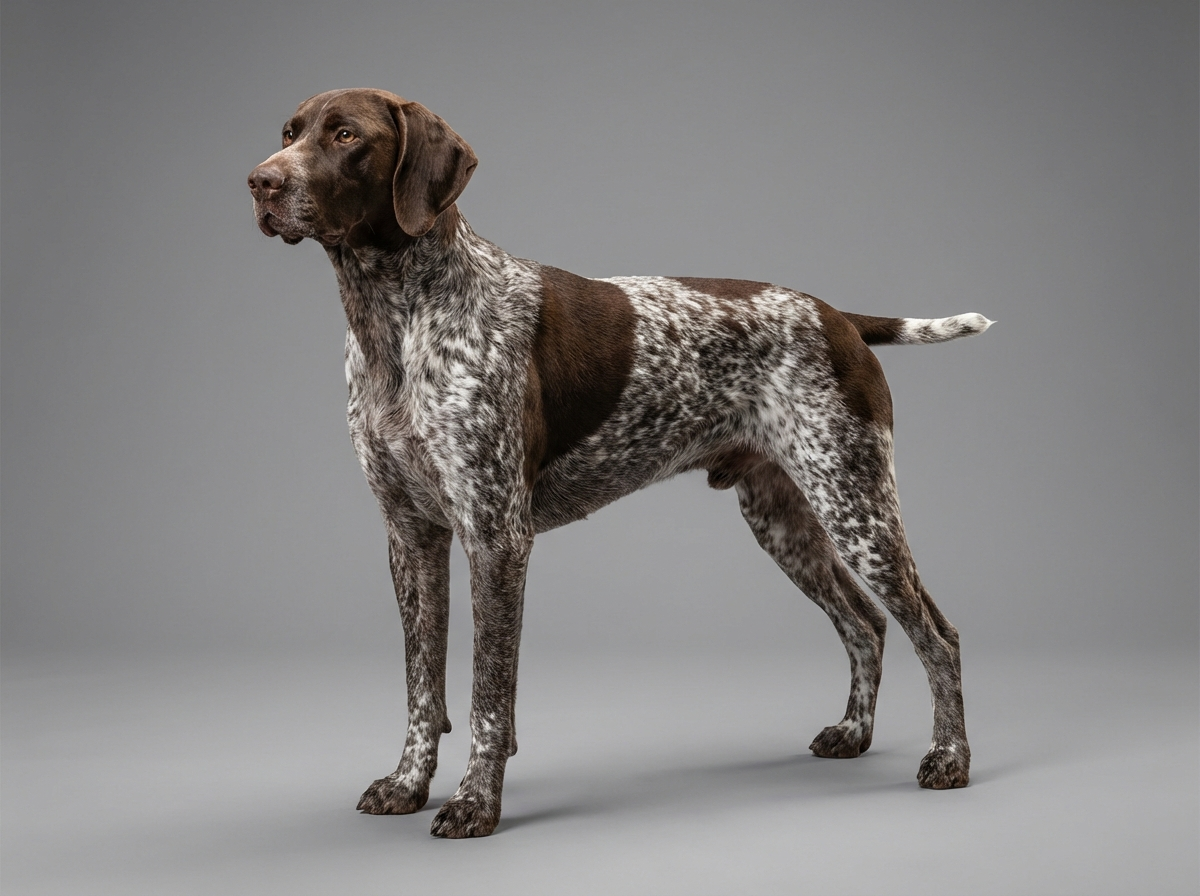
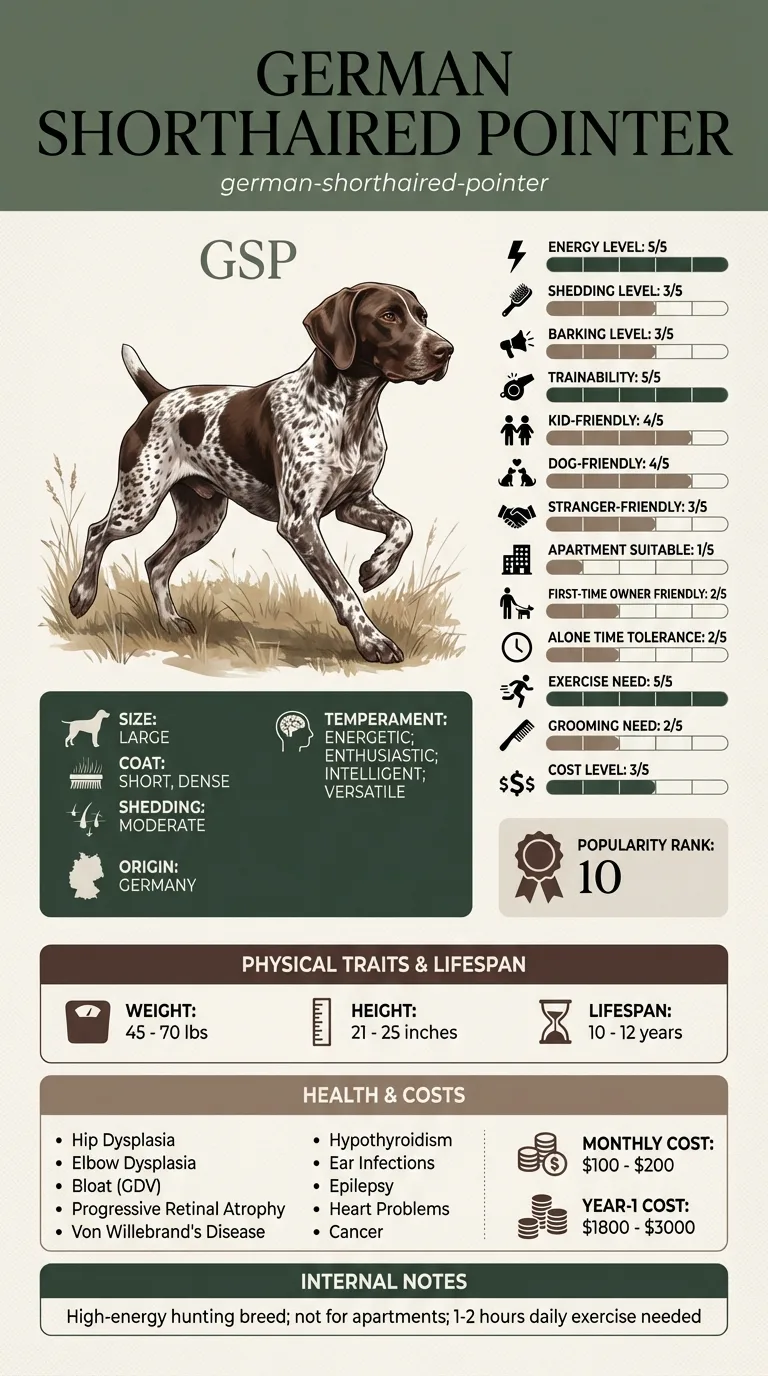
Two inherited features do the damage. The German Shorthaired Pointer carries a drop ear that lies flat over the canal opening, cutting ventilation and holding warmth and moisture against the skin inside. The canal itself, as in all dogs, turns a sharp corner before reaching the eardrum, so anything that gets in struggles to get out. Add a breed developed in Germany to retrieve from water and quarter dense cover, rated at the top of the scale for exercise need, and the ear is repeatedly filled with exactly what it cannot easily clear.
Water is the dominant factor. Dogs that swim several times a week, work marshes, or hunt after rain have far more episodes than dogs kept dry. Seeding grasses in late summer create the second peak, and stubble fields are the classic setting. Damp bedding, a crate in a horsebox and gear that never dries add a mould reservoir. Owner habits matter too: enthusiastic cleaning with buds does more harm than neglect.
Book an appointment for an ear that is red, smelly, discharging or that the dog is scratching or shaking, and stop cleaning it in the meantime. Ask for a proper workup rather than another course of drops once your dog has had a third episode in a year. Go the same day, treating it as urgent, for violent head shaking that has come on suddenly, for a head held tilted to one side, for a dog crying when the ear is touched, for loss of balance or a wobbly, drunken gait, or for any facial droop. Those point at a foreign body or middle ear involvement, and an awn against the eardrum can perforate it within a day.
See all German Shorthaired Pointer health problems, which breeds are prone to ear infections, or the full German Shorthaired Pointer breed guide for temperament, exercise needs and ownership costs.
A straightforward outer ear infection should be visibly better within a week and should be rechecked at two, which owners frequently skip and should not. A grass awn removed the same day gives immediate relief. Middle ear infection needs weeks of treatment and imaging. Where an underlying allergy is driving repeat episodes, expect several months to establish a stable management plan.
Ears that are pale, dry and odourless at the weekly check, a dog that still swims, and infections that are occasional rather than routine. Where recurrence has been the pattern, success is finding the underlying cause and cutting the episode count, rather than getting faster at treating them.
A dog's ear canal is not a straight tube. It runs down from the opening for a distance, then turns sharply inward towards the eardrum, forming an L. That shape protects the eardrum from direct injury, and it also means that anything entering the canal, water, wax, debris or a grass seed, has to travel around a corner and cannot simply fall back out.
On top of that geometry, the German Shorthaired Pointer has a drop ear that lies flat against the head, covering the opening. The result is a canal that is warm, dark and poorly ventilated. Add water from swimming or wet cover and you have created near-perfect conditions for yeast and bacteria, both of which live harmlessly on normal skin and multiply enthusiastically when the conditions favour them.
The grass seed problem is the sharper edge of the same anatomy. An awn that works into the ear canal of a dog hunting head-down in stubble travels inward, cannot reverse because its barbs point one way, and lodges against the bend or the eardrum. That produces a dog in sudden and severe distress: violent head shaking, a head held tilted to the affected side, and crying if the ear is touched. It needs removing that day, not next week, because an awn can perforate the eardrum.
More harm is done by over-enthusiastic cleaning than by too little. These are the practical rules that matter.

Pip was hunting cut barley on a hot September afternoon and was entirely normal until they got back to the truck, when she started shaking her head hard enough that her ears cracked. Within ten minutes she was holding her head tilted left and would not let her owner near that side. He knew the pattern and did not wait. The practice fitted her in at the end of surgery, sedated her, and removed a barley awn from deep in the left canal, sitting against a reddened but intact eardrum. She went home with drops and was comfortable by the next morning. Her owner now checks both ears at the tailgate before she gets into the vehicle, which has since found two more awns in the outer part of the canal, both lifted out with fingers in the car park.
Key takeaway: Sudden violent head shaking after a walk in seeding grass is not an infection developing; it is a foreign body, and the same-day response is what kept an intact eardrum intact.
Usually because something keeps setting the ear up: repeated water exposure, or an underlying allergy that keeps the canal inflamed. Infections that recur three or more times a year are a pattern, and the useful question shifts from which drops to what is causing this.
You could, and for a water-loving retrieving breed it is a poor trade. Drying the ears properly after every swim addresses most of the risk without taking away something the dog was bred for and clearly enjoys.
The onset. Allergic or infectious ear disease builds over days; a grass awn produces a dog that was fine an hour ago and is now shaking its head frantically, tilting, and objecting to the ear being touched. That story after a walk in stubble is a same-day veterinary problem.
Not routinely, and not in a German Shorthaired Pointer, whose ears are not heavily haired. Plucking causes inflammation in the canal and can make matters worse. It is occasionally advised for specific dogs, on veterinary recommendation.
Outer ear infection is confined to the canal and is what most dogs have. Middle ear infection is behind the eardrum and is more serious, producing head tilt, loss of balance and sometimes facial changes. It needs imaging and a longer, more aggressive course of treatment.
Yes. Repeated inflammation thickens and eventually scars the canal, narrowing it so that it drains badly and treatment can no longer reach the depths. In severe end-stage cases the only remaining option is surgery to remove the canal, which is a good argument for taking the third infection seriously.
Yes. They appear explicitly on the breed's documented health list, driven by a drop ear over an L-shaped canal in a dog that swims and works wet cover.
Drying the ear opening after every swim or wet outing. It takes fifteen seconds and removes the main condition that infections need.
Sudden violent head shaking with a head tilt after a walk in seeding grass, or an ear so painful the dog will not let it be touched. Same day, not next week.
Each episode is a modest exam and medication cost, but three or four a year adds up, and end-stage surgery is very expensive. Investigating the cause early is the cheaper path.
A one-page prep sheet for this condition: the signs, the questions to ask, what to get priced. Unlocks here.
You get: Vet visit prep sheet
No spam. One-click unsubscribe. See our privacy policy.
Preview page 1 before you decide.