Health
Why is my Chow puppy stiff only for the first minute?
Stiffness that eases as the dog keeps moving, called the warm-up phenomenon, is characteristic of myotonia rather than joint disease. Ask your vet about it specifically.

Quick answer
Why is my Chow puppy stiff only for the first minute?
Stiffness that eases as the dog keeps moving, called the warm-up phenomenon, is characteristic of myotonia rather than joint disease. Ask your vet about it specifically.
The signature is backwards from arthritis: worst on the first few steps after rest, better the longer the dog keeps moving, and worse again in the cold.
Owners of Chow puppies and young adults who look stiff, bunny hop, or fall over when startled, and owners who have been treating a young dog for suspected hip disease without any real response.
This guide is not medical advice. If your dog shows pain, sudden behavior change, or worsening symptoms, consult a licensed veterinarian.
Some links may be affiliate links. We may earn a commission at no extra cost to you. We only suggest products we believe are helpful for dog owners.
We research and check what we publish, but we do not warrant that any figure, date, price, or statement is accurate, complete, or current, and we accept no liability for any loss, cost, injury, or other harm arising from the use of this site. Use it as one reference among several. You remain responsible for your own decisions and for your dog's care - confirm anything that matters with a licensed veterinarian or another qualified professional before you act on it. Full disclaimer.
Myotonia congenita is an inherited muscle membrane disorder in which muscles are slow to relax after contracting. Puppies show stiffness, a stilted bunny-hopping gait and falls when startled, with the distinctive feature that everything improves as the dog keeps moving. It is diagnosed with electromyography and managed with medication, warmth and routine rather than cured.
Rare in absolute terms, but genuinely associated with this breed, which sets it apart from most conditions attached to Chow health lists. It is a young dog's condition, typically evident within the first few months of life, and it does not appear later in a previously normal adult.
This is a genuinely inherited Chow Chow condition rather than a borrowed one, arising from a defect in the chloride channel that resets muscle membranes after contraction. It is recessive, which means two apparently healthy parents can produce affected puppies and that a diagnosis says something about the whole family rather than one dog. The Chow's ordinary conformation makes recognition harder: this breed already moves with a short, stilted, comparatively straight-legged rear action, so a stiff gait in a young Chow does not stand out the way it would in a Labrador. The heavy coat then hides the exaggerated muscle bulk that is one of the visible clues.
Nothing environmental causes myotonia, but temperature and arousal both change how severe it looks on a given day. Cold floors and cold mornings measurably worsen stiffness, which is one of the few situations where a heat-intolerant breed genuinely benefits from warmth. Busy, noisy households with frequent doorbell rushes produce more startle-triggered falls. Slippery flooring turns a manageable episode of locked limbs into a fall with an injury attached.
Book promptly for any young Chow with unexplained stiffness, a stilted or bunny-hopping gait, episodes of falling, or muscles that look unusually bulky, and mention the warm-up pattern explicitly because it points a vet straight at the right diagnosis. Some presentations need same-day attention: difficulty breathing, noisy laboured breathing, choking or repeated difficulty swallowing, since the muscles of the throat and airway can be involved. Treat any collapse where the dog appears unconscious, rather than stiff but aware, as an emergency, since that is a different problem. Before any anaesthetic, including a routine neuter, make sure the diagnosis is on the front of the record.
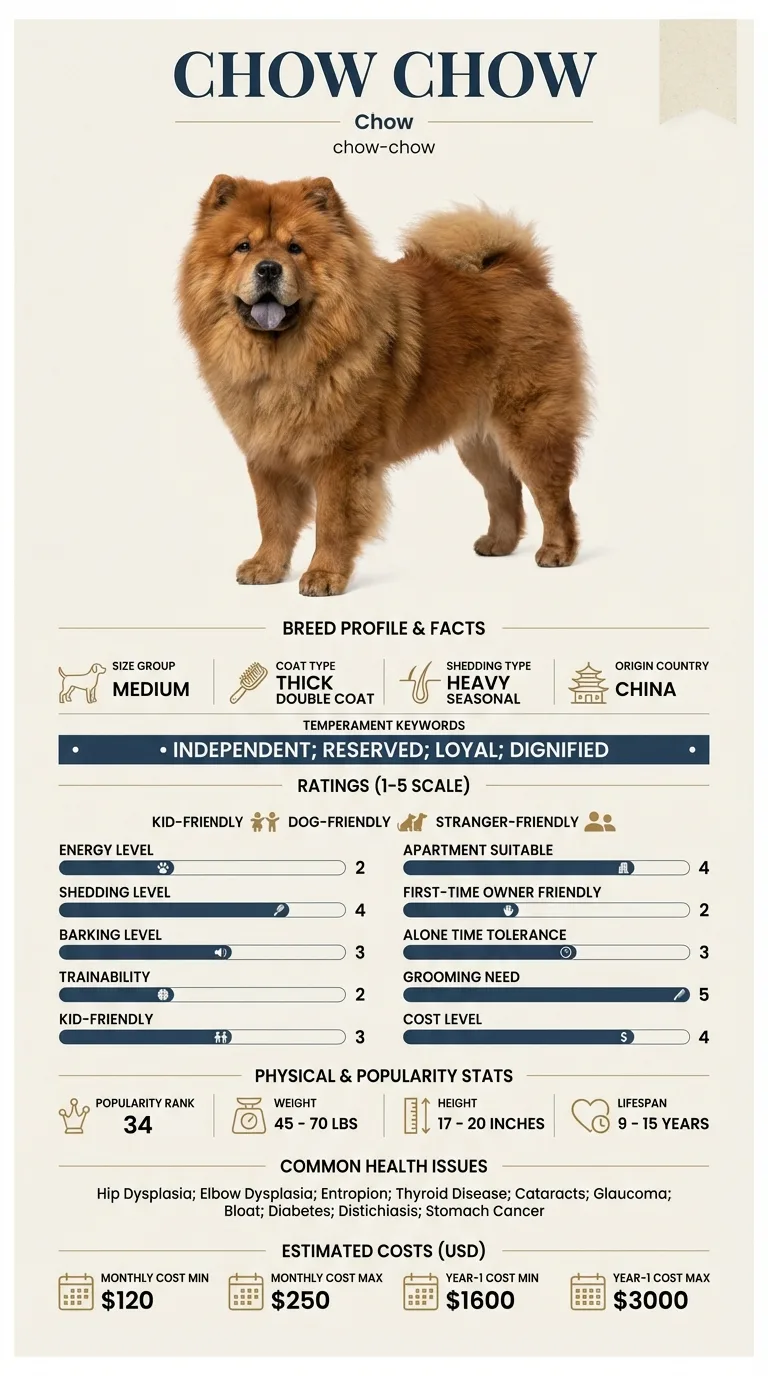
See all Chow Chow health problems, which breeds are prone to myotonia congenita, or the full Chow Chow breed guide for temperament, exercise needs and ownership costs.
Signs are usually apparent within the first two to six months of life. Diagnosis typically takes a referral appointment plus electromyography under sedation. If medication is trialled, an effect is usually apparent within one to two weeks, and dose adjustment follows. The condition itself is lifelong and generally stable rather than progressive.
Success is a dog who rises stiffly, warms up within a minute, walks a modest daily route without falling, and lives an ordinary life in a household that has adapted its floors, its temperature and its doorbell. It is not a normal gait, and it never will be.
The age is what should prompt the thought. Joint disease is possible in a young Chow, but a stiff four-month-old whose stiffness improves as the walk goes on is describing a muscle membrane problem, not a hip.
Diagnosis usually begins with the clinical picture and the percussion dimple, both of which are highly suggestive. Electromyography, performed under sedation, is the test that confirms it: affected muscle produces a characteristic sustained electrical discharge that has been likened to a dive-bomber sound on the recording. Muscle biopsy and, where available for the specific variant, genetic testing complete the picture. Radiographs are often taken along the way and come back normal, which is itself useful information.
There is no cure, because the fault is in the structure of a muscle membrane channel. Some dogs are prescribed medication that reduces membrane excitability and improves stiffness, and that is a conversation for a neurologist rather than a decision to make from a website. Many affected dogs live long, reasonably comfortable lives with the condition managed rather than treated.
The environmental levers matter more here than in most conditions. Cold makes myotonia measurably worse, so a Chow with this diagnosis needs warmth before movement rather than after. Excitement and sudden startle trigger episodes, so a calm, predictable household reduces the number of falls. And because the dog's stiffness is worst immediately after rest, a short, gentle warm-up before any real activity becomes a permanent part of the routine.

Bao-Bao was referred at five months for suspected hip dysplasia. He bunny hopped, struggled to rise, and had twice gone over when the postman knocked. Radiographs of his hips and elbows were entirely normal, which is what redirected the investigation. His vet tapped his thigh muscle and watched a dimple sit there for four seconds. Electromyography under sedation confirmed myotonia. His breeder was contacted and two littermates were checked; one had milder signs nobody had noticed. The changes that helped most were unglamorous. His owner Rowena moved his bed off the tile onto a heated mat, put runners through the kitchen, and started walking him slowly indoors for a minute before opening the front door. He still stiffens every time he gets up. He has not fallen in two years.
Key takeaway: Normal hip radiographs in a stiff young Chow are not a dead end. They are the point at which the muscles, rather than the joints, become the question.
Yes. Congenital myotonia has been described specifically in Chow Chows, and it is one of the few inherited neuromuscular conditions genuinely associated with the breed rather than borrowed from another. It is rare, but it is real, and Chow puppies with unexplained stiffness deserve to have it considered.
Timing and direction. Myotonia is worst in the first strides after rest and improves with continued movement, often within a minute. Hip pain is present throughout and worsens with distance. Myotonia also appears far younger, sometimes by two or three months, and produces stiffness in the front limbs as well.
The stiffness itself is not thought to be painful in the way arthritis is, though it is clearly distressing when a dog falls and cannot rise. Secondary problems from abnormal loading, and the falls themselves, can cause pain. That is worth treating even though the underlying condition cannot be fixed.
The classical description is of signs appearing in the first months and then remaining relatively stable rather than progressing steadily. Individual dogs vary, and secondary orthopaedic wear from an abnormal gait can make an unchanged condition look like it is worsening.
No. It is an inherited condition, and breeding an affected dog is indefensible. Because the inheritance is recessive in the forms described, clinically normal relatives can be carriers, which is why a diagnosis in one puppy is information the whole litter's breeder needs.
It requires care. Muscle-affecting conditions can complicate anaesthesia, and stiffness of the throat and airway muscles is relevant to intubation and recovery. Tell any anaesthetist about the diagnosis well before a procedure so the protocol can be planned rather than adjusted mid-course.
Stiffness that eases as the dog keeps moving, called the warm-up phenomenon, is characteristic of myotonia rather than joint disease. Ask your vet about it specifically.
Not necessarily. In myotonia the limbs lock and the dog topples while fully conscious. A vet can distinguish this from a seizure, and video of an episode helps enormously.
Yes, measurably. Warm the dog before movement and allow a gentle indoor warm-up before going out in cold conditions.
No. The fault is in a muscle membrane channel. Medication and management can reduce stiffness, and many affected dogs live long lives.
A one-page prep sheet for this condition: the signs, the questions to ask, what to get priced. Unlocks here.
You get: Vet visit prep sheet
No spam. One-click unsubscribe. See our privacy policy.
Preview page 1 before you decide.