Living
Which is better with kids?
The Newfoundland, rated very high (5/5) versus the Chihuahua's low (2/5).

Quick answer
Which is better with kids?
The Newfoundland, rated very high (5/5) versus the Chihuahua's low (2/5).
Chihuahua or Newfoundland? On paper they differ most on apartment suitability, and on the scales Newfoundland is the heavier at 100–150 lbs. Here is how the two compare on everything that shapes an ordinary week.
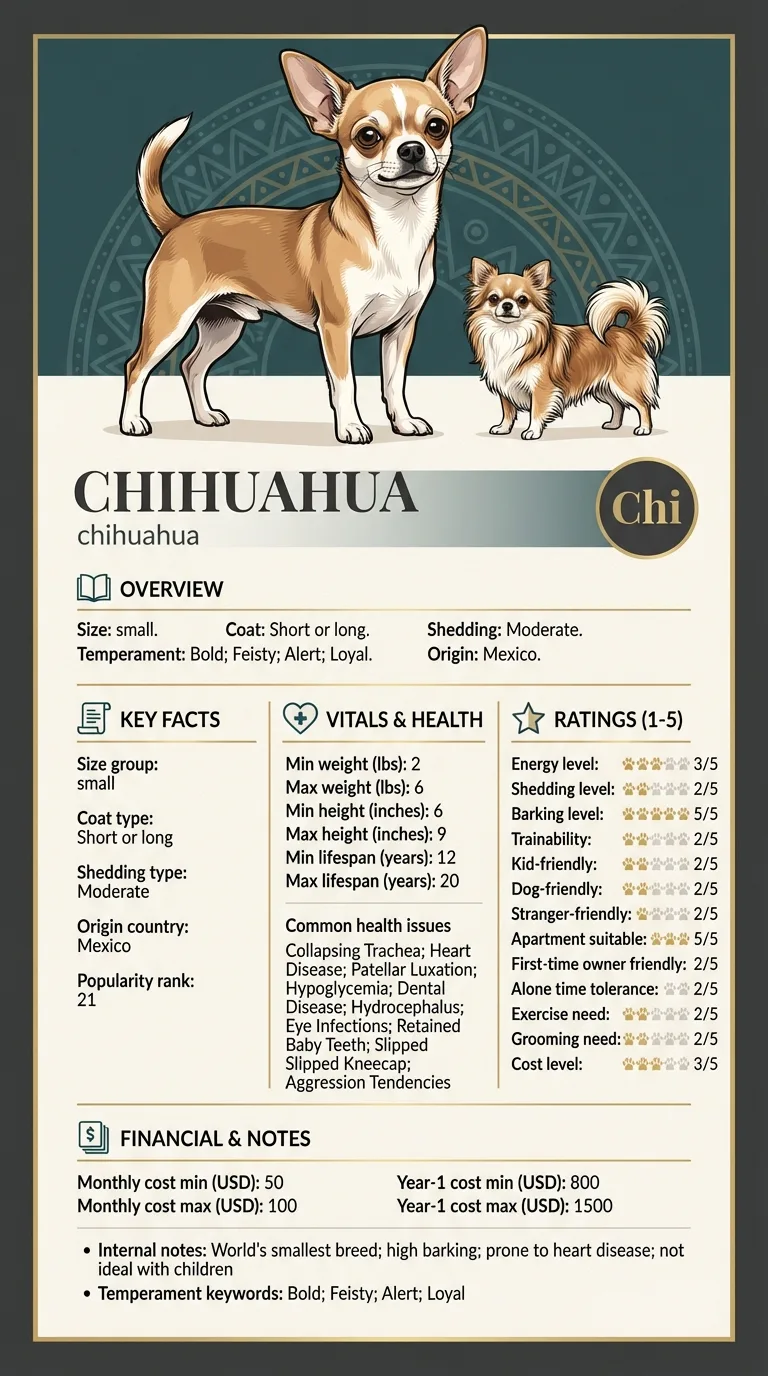
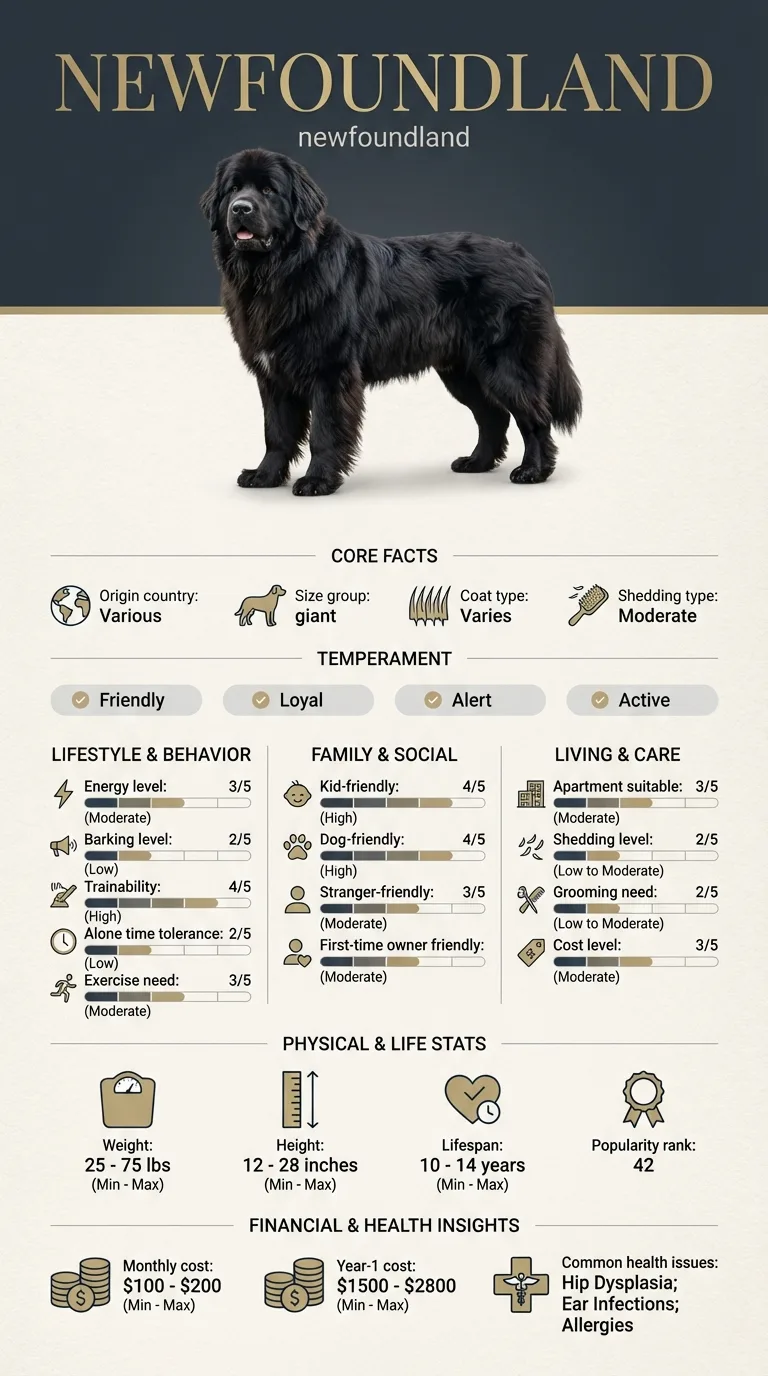
This is for someone already down to Chihuahua and Newfoundland and deciding between them. For this pair the decision usually turns on apartment suitability and shedding, so those are covered first and in most detail. Anyone choosing from a flat has a clear answer here: Chihuahua rates 5/5 against 1/5. Breed history is left out; what follows is what you will actually live with.
Between Chihuahua and Newfoundland, apartment suitability is what separates them, and Chihuahua is the lower-effort dog of the two to keep.
Choose Chihuahua if you are in a flat or a smaller home, you do not want a standing grooming appointment and shedding is a problem in your house.
Choose Newfoundland if this is your first dog, the dog will be alone during the working day and there are young children at home.
| Feature | chihuahua | newfoundland | Winner |
|---|---|---|---|
| Size class | small | giant | Equal |
| Weight | 2–6 lbs | 100–150 lbs | Equal |
| Height | 6–9 in | 26–28 in | Equal |
| Lifespan | 12–20 years | 9–10 years | chihuahua |
| Exercise need | Low (2/5) | Moderate (3/5) | chihuahua |
| Grooming need | Low (2/5) | High (4/5) | chihuahua |
| Shedding | Low (2/5) | Very high (5/5) | chihuahua |
| Energy level | Moderate (3/5) | Low (2/5) | Equal |
| Barking | Very high (5/5) | Low (2/5) | newfoundland |
| Apartment suitability | Very high (5/5) | Very low (1/5) | chihuahua |
| Good for first-time owners | Low (2/5) | Moderate (3/5) | newfoundland |
| Tolerates being alone | Low (2/5) | Moderate (3/5) | newfoundland |
| Trainability | Low (2/5) | High (4/5) | newfoundland |
| Good with kids | Low (2/5) | Very high (5/5) | newfoundland |
| Good with other dogs | Low (2/5) | High (4/5) | newfoundland |
| Friendly to strangers | Low (2/5) | High (4/5) | newfoundland |
| Cost level | Moderate (3/5) | Very high (5/5) | chihuahua |
| Coat | Short or long | Heavy water-resistant double coat | Equal |
| Origin | Mexico | Various | Equal |
| Typical monthly cost | $50–$100 | $150–$310 | Equal |
| Typical first-year cost | $800–$1,500 | $2,200–$4,200 | Equal |
The Newfoundland dwarfs the Chihuahua on every measurement: 100-150 lbs and 26-28 inches tall against the Chihuahua's 2-6 lbs and 6-9 inches, a dog that can weigh 50 times more than its counterpart in this comparison. That size difference isn't just visual; a Newfoundland's heavy, water-resistant double coat and broad frame were built for cold-water rescue work, while the Chihuahua's small, short-or-long coat evolved for a warm climate and portability. Homes considering a Newfoundland need to think about furniture, stairs, and car space in ways a Chihuahua household never does.
The ratings essentially swap: the Newfoundland needs moderate (3/5) exercise despite its low (2/5) energy level, while the Chihuahua needs only low (2/5) exercise despite a moderate (3/5) energy rating. In practice, a Newfoundland is calm indoors but benefits from a real daily walk to manage its size and joint health, while the smaller Chihuahua's moderate energy shows up as short bursts that don't require much outdoor time. Neither breed is a jogging partner, but the Newfoundland's bulk means sustained low-impact activity matters more for long-term joint health than it does for the Chihuahua.
Coat care is the starkest contrast in this pairing. The Chihuahua needs only low (2/5) grooming and sheds low (2/5), while the Newfoundland rates high (4/5) for grooming and very high (5/5) for shedding, its heavy, water-resistant double coat blowing out seasonally and leaving visible hair on floors and furniture year-round. Newfoundland owners typically invest in a strong vacuum and regular brushing sessions just to keep up, plus the breed's well-known drool. A household sensitive to loose hair or slobber will find the Chihuahua dramatically easier to keep tidy.
Living space needs run in almost opposite directions. The Chihuahua rates very high (5/5) for apartment life and can comfortably live in a small unit, but barks at a very high (5/5) rate. The Newfoundland rates only very low (1/5) for apartment suitability, since a 100-150 lb dog simply needs room to move, yet it barks at a low (2/5) rate, consistent with its calm, patient temperament. A Newfoundland in a house with a yard will likely be the quieter of the two despite its size, while an apartment-bound Chihuahua trades space efficiency for a noisier home.
The Newfoundland edges out the Chihuahua for new owners, rating moderate (3/5) for first-timers against the Chihuahua's low (2/5), and it trains noticeably better too, high (4/5) trainability versus low (2/5). That tracks with temperament: a sweet, patient, devoted dog is naturally more receptive to structured training than a bold, feisty one. That said, a first-time Newfoundland owner still needs to manage a dog that can eventually weigh 150 lbs, so obedience training isn't optional the way it might feel with a small, easily-carried Chihuahua; size makes early training a safety issue, not just a convenience.
For families, the Newfoundland is the clear standout: very high (5/5) with kids, a rating that matches its reputation as a nanny dog, against the Chihuahua's low (2/5). The gap holds with other dogs, high (4/5) versus low (2/5), and strangers, high (4/5) versus low (2/5); the sweet, devoted Newfoundland temperament makes it broadly sociable, while the loyal, feisty Chihuahua stays more reserved and can react defensively around unfamiliar people or pets. Households that entertain often or have young kids in and out of the house will find the Newfoundland's temperament far more forgiving.
Lifespan tells a giant-breed story: the Chihuahua's 12-20 years can more than double the Newfoundland's 9-10 year range. The Newfoundland's health list reflects large-breed strain, including hip dysplasia, subaortic stenosis, dilated cardiomyopathy, and bloat (GDV), the last a genuine emergency risk in deep-chested giant breeds. The Chihuahua's list is shorter but chronic in nature: collapsing trachea, heart disease, hypoglycemia, and dental disease among them. Owners choosing between them are really choosing between a shorter life with cardiac and orthopedic risk versus a much longer one shadowed by smaller, more manageable chronic conditions.
The Newfoundland's very high (5/5) cost rating reflects its size at every turn: $150-$310 monthly and $2,200-$4,200 in the first year, compared to the Chihuahua's moderate (3/5) rating at $50-$100 monthly and $800-$1,500. Food volume alone for a 100-150 lb dog is substantial, and larger dogs typically mean larger vet bills, bigger crates, and pricier flea and heartworm prevention dosed by weight. Over a Newfoundland's shorter 9-10 year life, that cost concentrates into fewer years, while the Chihuahua's lower per-month spend stretches across a potentially 20-year commitment.
Chihuahua weighs 2–6 lbs and lives 12–20 years; Newfoundland weighs 100–150 lbs and lives 9–10 years. The two diverge most on apartment suitability, shedding and barking and 6 other rated axes. Almost every rated axis separates them at least slightly. The comparison marks an easier option only where one exists. Facts like weight and country of origin are not scored. Both dogs are rated from the same dataset, which is what makes the numbers comparable with each other even though any individual dog sits somewhere inside its breed's range.

Yes, it rates very high (5/5) for compatibility with kids, well above the Chihuahua's low (2/5), consistent with its reputation as a gentle nanny dog.
Yes, very high (5/5), the top shedding rating in this comparison, driven by a heavy water-resistant double coat, versus the Chihuahua's low (2/5).
Not comfortably. It rates very low (1/5) for apartment suitability given its 100-150 lb size, versus the Chihuahua's very high (5/5).
The Chihuahua, at very high (5/5), versus the Newfoundland's low (2/5); the giant breed is the quieter one here.
Roughly two to three times as much monthly, $150-$310 versus $50-$100, driven mainly by food volume and size-scaled vet care.
The Chihuahua by a wide margin, 12-20 years versus the Newfoundland's 9-10 years.
It rates moderate (3/5) for first-timers, ahead of the Chihuahua's low (2/5), thanks to a patient, trainable temperament, though its eventual size still calls for confident handling.
The Newfoundland, rated very high (5/5) versus the Chihuahua's low (2/5).
The Newfoundland, rated very high (5/5) versus the Chihuahua's low (2/5).
The Chihuahua, rated very high (5/5) versus the Newfoundland's very low (1/5).
The Newfoundland, rated low (2/5) for barking versus the Chihuahua's very high (5/5).
Secure checkout on Stripe. We never see your card.
7-day money-back guarantee. Instant access.
Health information here is general and is not veterinary advice. If your dog shows pain, sudden behaviour change, or worsening symptoms, consult a licensed veterinarian.
Some links on this site are affiliate links. We may earn a commission at no extra cost to you, and we only suggest products we believe are helpful for dog owners.
We research and check what we publish, but we do not warrant that any figure, date, price, or statement is accurate, complete, or current, and we accept no liability for any loss, cost, injury, or other harm arising from the use of this site. Use it as one reference among several. You remain responsible for your own decisions and for your dog's care - confirm anything that matters with a licensed veterinarian or another qualified professional before you act on it. Full disclaimer.
Match your lifestyle to the right dog.
Take quizNot sure which breed is right for you? Take our 2-minute quiz to find out.
Take the quiz