Health
What does cardiomyopathy actually mean?
Disease of the heart muscle itself, either thinned and weak or thickened and stiff. It is not a general term for any heart problem.

Quick answer
What does cardiomyopathy actually mean?
Disease of the heart muscle itself, either thinned and weak or thickened and stiff. It is not a general term for any heart problem.
A stethoscope can tell you a heart is noisy. It cannot tell you whether the problem is a leaking door or a failing pump, and those two problems have different treatments, different monitoring and different outlooks.
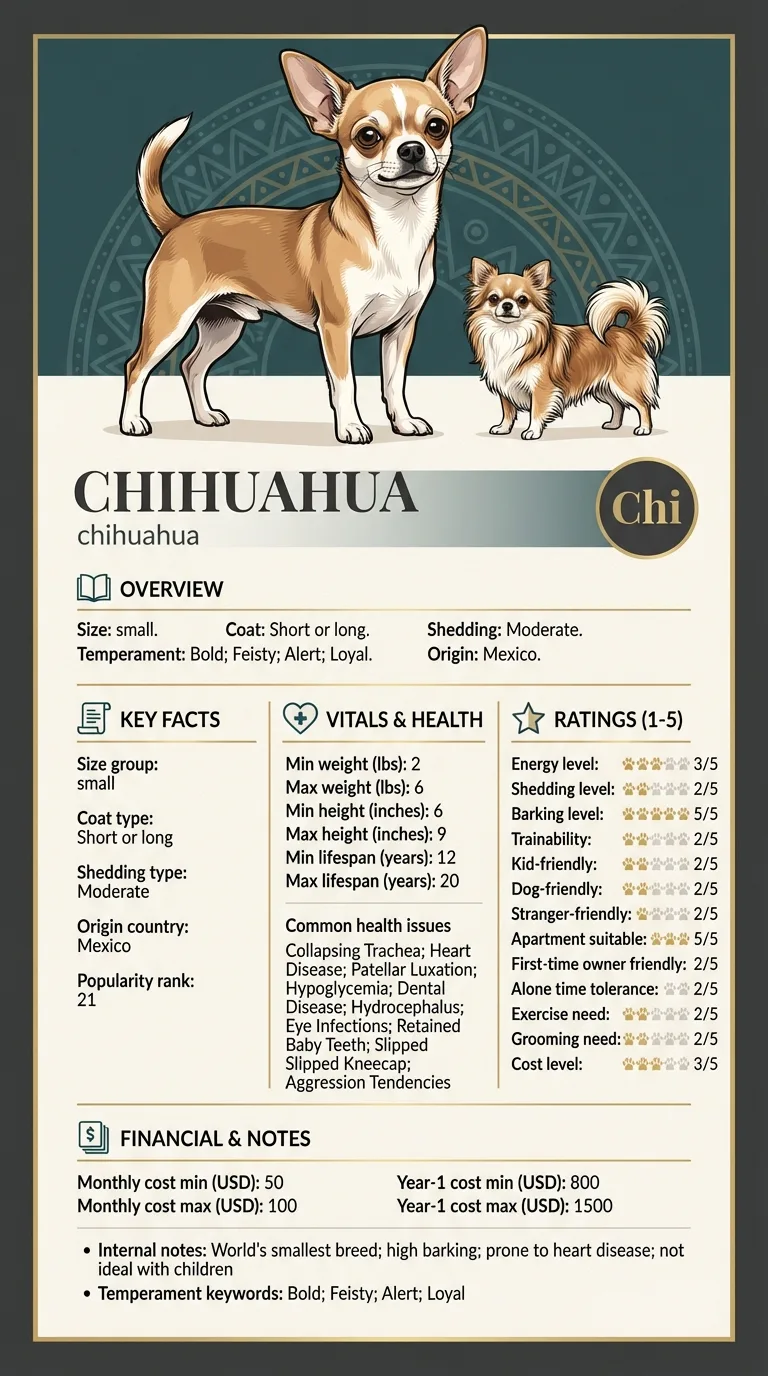
Owners who have been told their Chihuahua has cardiomyopathy and want to know how that conclusion was reached, owners weighing whether an echocardiogram is worth the money, and anyone confused by having heard several different heart terms about the same dog.
This guide is not medical advice. If your dog shows pain, sudden behavior change, or worsening symptoms, consult a licensed veterinarian.
Some links may be affiliate links. We may earn a commission at no extra cost to you. We only suggest products we believe are helpful for dog owners.
We research and check what we publish, but we do not warrant that any figure, date, price, or statement is accurate, complete, or current, and we accept no liability for any loss, cost, injury, or other harm arising from the use of this site. Use it as one reference among several. You remain responsible for your own decisions and for your dog's care - confirm anything that matters with a licensed veterinarian or another qualified professional before you act on it. Full disclaimer.
Cardiomyopathy is disease of the heart muscle, either dilated, where the wall thins and the chamber stretches and contracts weakly, or hypertrophic, where the wall thickens and the chamber cannot fill. Neither is what most Chihuahuas with a heart murmur actually have; toy breeds overwhelmingly develop mitral valve degeneration instead. The two are distinguished only by echocardiography, and the distinction matters because muscle disease brings arrhythmia risk and a different monitoring plan.
Uncommon in Chihuahuas. Heart disease is on the breed's documented health list, but the pattern is valve degeneration, which becomes increasingly frequent with age in toy dogs. True cardiomyopathy is a diagnosis to reach through imaging rather than assume from a murmur, and in this breed it will be the less likely answer most of the time.
The important breed fact here is a negative one that owners deserve to be told plainly. The Chihuahua is a toy breed, and toy breeds are predisposed to valve degeneration, not to muscle disease. Dilated cardiomyopathy is concentrated in large and giant breeds, where the sheer mass of ventricular wall and the genetics of those lines both play a part. Where a Chihuahua does develop muscle disease, it is generally not explained by breed at all but by an individual, sometimes idiopathic, process. The breed does contribute two complicating factors: an exceptional lifespan of twelve to twenty years, which means plenty of time for cardiac disease of any kind, and a documented tendency to collapsing trachea that muddies the respiratory picture.
The environmental question in canine muscle disease that has attracted most attention is diet, and it remains under investigation rather than resolved, so any dog diagnosed with dilated cardiomyopathy should have its full diet history recorded. Beyond that, the modifiable environment is the same as for any cardiac patient: body weight, because even a few ounces of excess on a two-to-six-pound dog adds workload; oral health, since chronic periodontal infection is a persistent burden; and arousal, since a breed with maximum barking drive spends a lot of its day with an elevated heart rate.
Go to an emergency clinic immediately for collapse, for breathing difficulty at rest, for pale, grey or blue gums, or for repeated fainting in one day. Book promptly for a dog that has become suddenly less willing to do its normal short walks, for an irregular or unusually fast resting pulse, for a single fainting episode, or for unexplained weight loss. If your dog has been told it has cardiomyopathy without an echocardiogram, it is entirely reasonable to ask whether imaging would change the plan, because in this breed the working assumption should be valve disease until an ultrasound says otherwise.
See all Chihuahua health problems, which breeds are prone to cardiomyopathy, or the full Chihuahua breed guide for temperament, exercise needs and ownership costs.
Reaching a definite answer usually takes two to four weeks, running from examination and radiographs to echocardiography and, if the rhythm is in question, monitoring. Where the diagnosis turns out to be valve disease, which it usually will, the outlook is measured in years and the plan is staged monitoring. Where genuine muscle disease is confirmed, monitoring is closer and rhythm assessment becomes part of routine care. Neither condition reverses, and both are managed rather than cured.
Success is having the correct name for what is wrong, obtained from an image of the moving heart rather than inferred from a noise. An owner who knows whether their Chihuahua has a leaking valve or a failing pump knows what to monitor, what an emergency looks like and what the medication is doing. Success is not a normal echocardiogram; it is a plan that matches the actual structure at fault.
Think of the heart as a pump with four one-way doors. Valve disease is a door problem: the leaflets thicken, stop sealing, and blood slips backward with each beat. The muscle itself is initially healthy and works harder to compensate. This is by far the most common cardiac diagnosis in small breeds.
Cardiomyopathy is a pump problem. In the dilated form, the muscle wall thins and weakens, the chambers stretch, and each contraction ejects less blood. In the hypertrophic form, the wall thickens and stiffens so the chamber cannot fill properly between beats. The doors may be perfectly normal in both.
Why the distinction matters practically: a dog with valve disease often has a loud murmur years before it feels unwell, and treatment decisions turn on whether the heart has enlarged. A dog with dilated cardiomyopathy may have a quiet murmur or none at all while the muscle is already failing, and may present first with an arrhythmia, weakness or sudden collapse rather than a cough. Monitoring a muscle disease with only a stethoscope is therefore unreliable in a way that is less true for valve disease.
The only way to distinguish them is to look at the heart moving. An echocardiogram measures wall thickness, chamber size and how forcefully the muscle contracts, which is precisely the information neither a stethoscope nor a radiograph can provide.

Owners often feel they are being sold a sequence of tests. Knowing what each one answers makes the sequence make sense.
If you think your Chi has cardiomyopathy, the plan is three steps: write down what you have seen and when it started, book a veterinary appointment rather than waiting for the next flare, and take video of the behaviour or symptom before you go — the thing you are worried about rarely happens in the consulting room. Screening in the parents covers collapsing trachea, heart disease, patellar luxation.
What the vet visit should produce is a diagnosis and a written plan, not just reassurance: what is being ruled out, what the monitoring interval is, and which signs mean you come back sooner. Ask what the treatment costs across a year rather than per visit, because that is the number that decides whether you are managing this condition or reacting to it.
Between appointments, keep a short log — dates, what you saw, what changed. It is the single most useful thing an owner brings to a follow-up, and for cardiomyopathy it is often what separates a clear pattern from a guess.
Tavo is an eleven-year-old, 4-pound Chihuahua in Naples, Florida, whose record carried the word cardiomyopathy for three years. It had been written after a locum heard a murmur and an irregular beat during a busy Saturday clinic, and nobody had revisited it. When Tavo's owner Marisol moved cities, the new practice went back to first principles before renewing any prescription. Radiographs showed a moderately enlarged heart. The echocardiogram showed thickened, poorly sealing mitral valve leaflets, a normal ventricular wall thickness and normal contractile strength. The muscle was fine. The door was not. The diagnosis was changed to degenerative valve disease at stage B2, and his medication was adjusted accordingly. Marisol's strongest reaction was not relief but irritation: for three years she had been reading about a disease Tavo did not have, and monitoring for signs that were never the right ones.
Key takeaway: A heart murmur plus a busy afternoon is not a diagnosis. If the word cardiomyopathy is on a Chihuahua's record without an echocardiogram behind it, it is worth asking what the ultrasound actually showed.
No. Heart disease is documented in this breed, but the overwhelmingly typical pattern in toy dogs is degeneration of the mitral valve rather than disease of the heart muscle. Dilated cardiomyopathy is chiefly a large and giant breed condition. It can occur in small dogs, but a Chihuahua with a murmur is far more likely to have a valve problem, and the diagnosis should be made by imaging rather than assumed.
If the answer would change what happens next, yes. It distinguishes valve disease from muscle disease, it establishes whether the heart has enlarged, and enlargement is what determines whether medication should start. Deciding treatment from a stethoscope alone means guessing at both the structure involved and the stage, and in a breed that may live another decade that is a consequential guess.
Yes, and this is one of the reasons muscle disease can be missed. A weakened pump does not necessarily create turbulent flow, so a dog can have a significantly impaired heart with only a soft murmur or none at all. Presenting signs may instead be exercise intolerance, weakness, fainting or an irregular pulse, which is why any of those deserve investigation even in a dog whose chest sounds clean.
In the dilated form the muscle thins and stretches, so the chamber becomes large and floppy and contracts weakly. In the hypertrophic form the muscle thickens and stiffens, so the chamber is small and struggles to fill. Both reduce output but by opposite mechanisms, and they are managed differently. Hypertrophic cardiomyopathy is far more a feline condition than a canine one.
There has been significant investigation into an association between certain diets and dilated cardiomyopathy in dogs, and it remains an area of ongoing research rather than settled fact. If you are feeding an unusual or restricted diet and your dog has been diagnosed with muscle disease, tell your vet exactly what it eats, since diet history is genuinely part of the workup in these cases.
Because diseased heart muscle is electrically unstable in a way that a diseased valve generally is not. Abnormal rhythms arising in a weakened ventricle can reduce output abruptly and cause weakness, fainting or worse. That is why muscle disease workups tend to include rhythm monitoring, and why an owner may be asked to record episodes on video between appointments.
Disease of the heart muscle itself, either thinned and weak or thickened and stiff. It is not a general term for any heart problem.
Most likely not. In toy breeds a murmur usually means valve degeneration. Only an echocardiogram can distinguish the two.
The echocardiogram. It is the only test that measures wall thickness, chamber size and how strongly the muscle contracts.
Yes. A weakened pump may make no abnormal noise, presenting instead as weakness, fainting or an irregular pulse.
It requires specialist equipment and an operator trained to interpret a moving heart. It is usually the last test needed rather than one of many.
A one-page prep sheet for this condition: the signs, the questions to ask, what to get priced. Unlocks here.
You get: Vet visit prep sheet
No spam. One-click unsubscribe. See our privacy policy.
Preview page 1 before you decide.