Health
What is the earliest sign of arthritis in a Chihuahua?
Refusing a jump the dog used to make. Waiting beside the sofa instead of getting on it is usually the first thing owners can date.

Quick answer
What is the earliest sign of arthritis in a Chihuahua?
Refusing a jump the dog used to make. Waiting beside the sofa instead of getting on it is usually the first thing owners can date.
Arthritis in a 4-pound dog is rarely about load. A Chihuahua's joints do not wear out from carrying weight; they wear out because a kneecap has been sliding out of its groove since the dog was two.
Owners of Chihuahuas past about eight who have noticed the dog asking to be lifted onto the sofa it used to jump on, and owners of younger dogs already diagnosed with a luxating patella who want to know what that means for the next fifteen years.
This guide is not medical advice. If your dog shows pain, sudden behavior change, or worsening symptoms, consult a licensed veterinarian.
Some links may be affiliate links. We may earn a commission at no extra cost to you. We only suggest products we believe are helpful for dog owners.
We research and check what we publish, but we do not warrant that any figure, date, price, or statement is accurate, complete, or current, and we accept no liability for any loss, cost, injury, or other harm arising from the use of this site. Use it as one reference among several. You remain responsible for your own decisions and for your dog's care - confirm anything that matters with a licensed veterinarian or another qualified professional before you act on it. Full disclaimer.
Osteoarthritis is the permanent degeneration of joint cartilage and the bone beneath it, producing stiffness, reduced range of motion and pain that worsens gradually. In Chihuahuas it is usually secondary rather than primary: an unstable kneecap, a hip damaged in puppyhood or an old injury creates abnormal loading, and years of that abnormal loading wear the joint out. Because the breed regularly reaches sixteen or older, most Chihuahuas that live a full life develop it somewhere.
Very common in older Chihuahuas, and under-diagnosed because the breed's low exercise requirement disguises early loss of function. Patellar luxation is one of the breed's defining orthopaedic problems, and since arthritis is its natural consequence, a large proportion of Chihuahuas reaching double figures carry some degree of it whether or not anyone has named it.
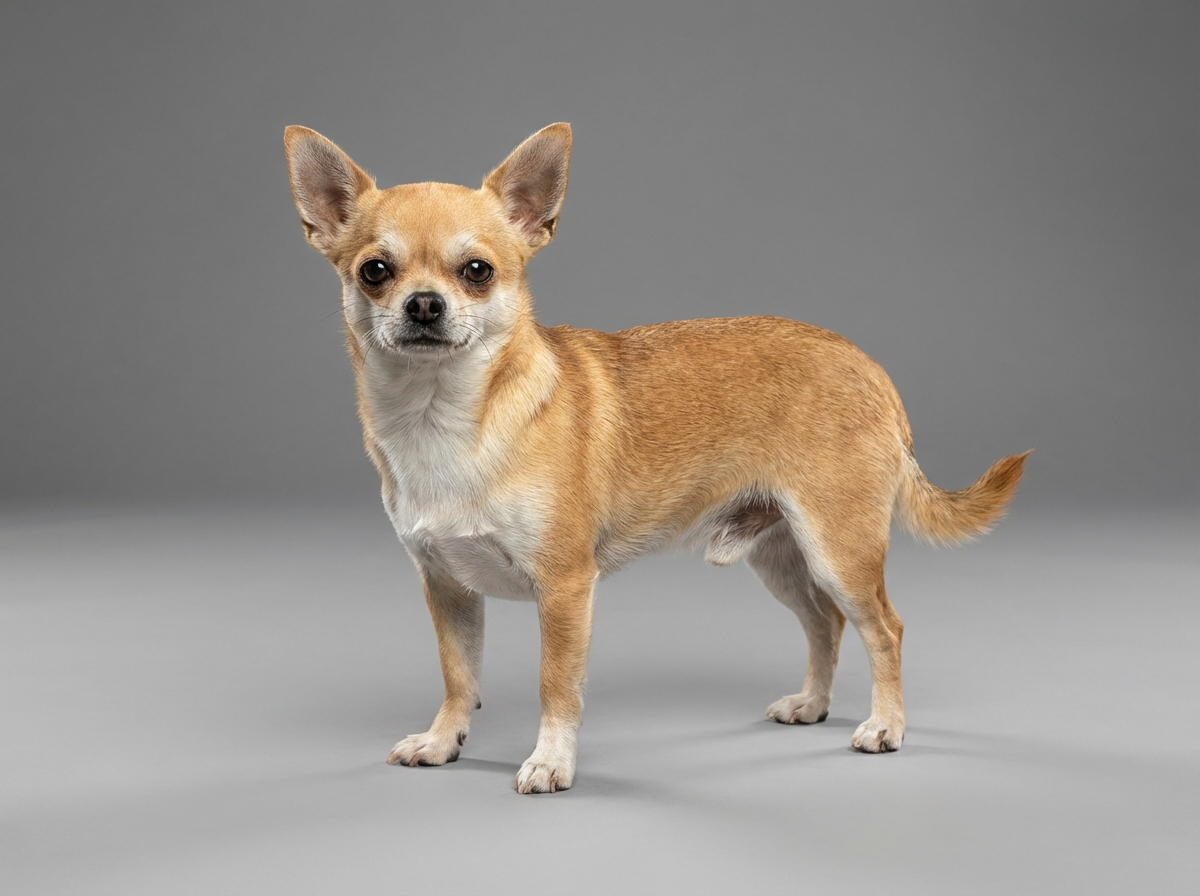
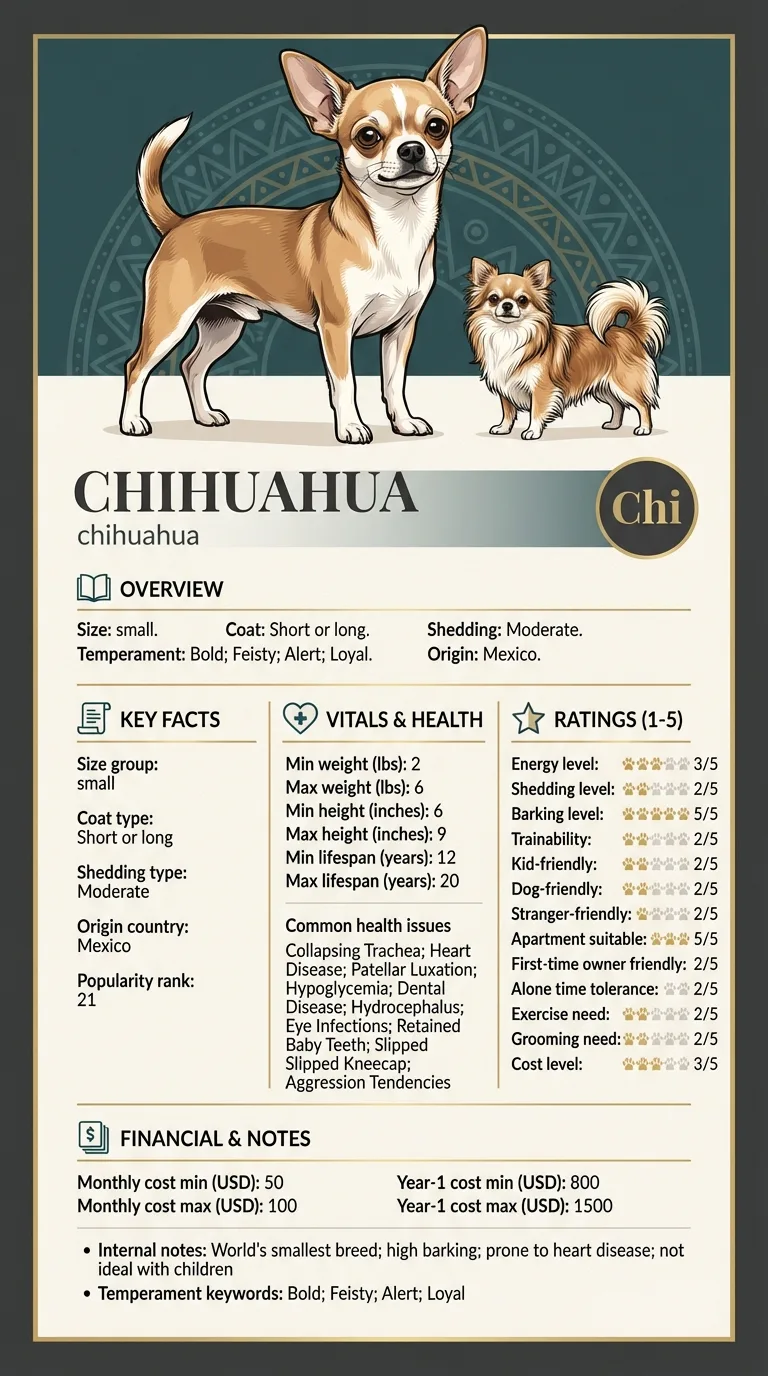
Two features of the Chihuahua drive this. The first is joint conformation: the breed is documented as prone to patellar luxation, where the kneecap does not sit securely in its femoral groove and slides sideways during movement. Every slip scrapes cartilage, and a dog can do that thousands of times a year without ever appearing lame. The second is lifespan. At twelve to twenty years the Chihuahua outlives most breeds by a wide margin, so the same low-grade damage that would never become symptomatic in an eight-year-lived giant breed has all the time it needs to become full osteoarthritis. Body weight, at 2 to 6 pounds, is almost irrelevant as a cause but very relevant as a multiplier once gained.
Modern flooring is the biggest avoidable factor. Laminate, tile and polished boards give a small dog with tiny feet no grip, and every scrabbling slip loads an unstable stifle sideways. Furniture height matters too: sofas and beds designed for humans require a 7-inch dog to make repeated hard landings. Cold rooms stiffen joints in a breed with very little insulation. And a sedentary indoor life without regular short walks lets the muscle that stabilises a wobbly knee waste away, which makes the joint worse rather than resting it.
Book an examination for any new reluctance to jump, a skipping back leg, a change in how your Chihuahua tolerates being handled, or stiffness that is obvious on first getting up. Go the same day for a leg that is being held completely off the ground, sudden severe pain, or any hind limb that is dragging or knuckling over, because dragging is a neurological sign and belongs to a different and more urgent problem than arthritis. Never give a human anti-inflammatory; several are seriously toxic to dogs and the margin in a 4-pound patient is minute.
See all Chihuahua health problems, which breeds are prone to arthritis, or the full Chihuahua breed guide for temperament, exercise needs and ownership costs.
Environmental changes and weight loss show benefit within four to eight weeks, and owners often report the dog attempting jumps again before the joint has changed at all, simply because it hurts less. Prescribed pain relief usually shows within days. What does not happen on any timeline is reversal, so plan for a management programme reviewed every six months for the rest of a life that in this breed may run another decade.
Success is a Chihuahua that moves willingly, rises without a long stiff shuffle, sleeps comfortably and stays interested in its walks, on the smallest amount of medication that achieves that. It is not a dog with clean radiographs. Owners who chase a normal-looking joint get discouraged; owners who track function - can she get to her ramp, does she still want the evening walk - stay on top of it for years.
The Chihuahua has a modest exercise requirement and a middling energy level. It is entirely normal for a healthy adult to spend most of the day asleep in a patch of sun. That baseline is the problem: a dog whose job description already includes lying down does not obviously slow down when it starts hurting.
So the early signs are behavioural rather than athletic. The dog stops making the jump onto the sofa and waits at the edge instead. It hesitates for half a second at the bottom of the stairs. It changes its sleeping position, or stops curling as tightly. It becomes less tolerant of being handled around the hindquarters, which in a breed already described as bold and feisty gets misread as temperament rather than pain.
Limping is a late sign, not an early one, and in Chihuahuas it is often intermittent because the classic cause - a kneecap that pops out and pops back - produces a skip-step for two or three strides and then a normal walk. Owners describe it as a hop, or say the dog carries a back leg for a moment then forgets about it.
The other thing worth knowing is that dogs distribute pain silently. A Chihuahua with two sore stifles will not favour one leg, because there is no good leg to favour, so it just does less.

Environment work matters more in this breed than in most, because the height of ordinary furniture is absurd relative to a 7-inch dog.
Pepita is a ten-year-old, 5.5-pound Chihuahua in Bristol whose owner Tom booked an appointment because she had become snappy when he picked her up. He expected to be told she was getting cantankerous with age. Instead the vet found grade two patellar luxation in both stifles and clear arthritic change on radiographs. The changes were unglamorous. Tom laid cheap runners along the hallway and put a foam step at the sofa, which Pepita ignored for a fortnight and then adopted entirely. He started weighing her food rather than filling the bowl, and she went from 5.5 to 4.9 pounds over three months. A heated pad went in her bed for the winter. She still has arthritis and always will. But she stopped objecting to being lifted, and Tom's honest summary is that he had been listening to what he assumed was her personality for about two years.
Key takeaway: In a breed with a reputation for being prickly, new irritability is a pain sign until proven otherwise. The cheapest interventions - grip on the floor, a step to the sofa and half a pound off - often do more visible good than anything else.
Because in this breed arthritis is a consequence of joint alignment rather than joint load. Patellar luxation and slipped kneecaps both appear on the Chihuahua's documented health list, and a kneecap that repeatedly rides out of its groove damages cartilage every time. Add twelve to twenty years of that and osteoarthritis follows regardless of how little the dog weighs.
The joint damage often begins in young adulthood, but owners typically notice functional change between eight and twelve. Because this breed frequently lives to sixteen or beyond, a Chihuahua diagnosed at nine may have most of its life still ahead, which is a strong argument for taking early treatment seriously rather than waiting.
Assume sore until proven otherwise if the change is new. A dog that has always disliked having its back end touched is a temperament story; a dog that started objecting this year is a pain story. Chihuahuas score low on tolerance generally, and that reputation causes real pain to be dismissed as breed character.
No. Milder grades are frequently managed for years with weight control, muscle maintenance and pain relief, while higher grades and dogs that are visibly lame benefit from surgical correction. The decision belongs to your vet and often an orthopaedic surgeon, and it turns on the grade, the dog's age and how much function is being lost.
The evidence is mixed and they are not a substitute for a treatment plan. Discuss any supplement with your vet before starting it, particularly because products are dosed for average dogs and a 4-pound Chihuahua sits far below any label band. Weight control and consistent gentle exercise have better evidence behind them than any tub on a shelf.
No. Cartilage damage does not regrow and the underlying joint shape does not change. What can improve substantially is comfort and function, and many Chihuahuas with radiographically ugly joints live active, cheerful lives on a good management plan. Treat it as a long-term condition to be managed, not a problem to be finished.
Refusing a jump the dog used to make. Waiting beside the sofa instead of getting on it is usually the first thing owners can date.
That skipping gait is the signature of a kneecap slipping out and back. It is the most common route to arthritis in this breed and deserves an examination.
Yes, noticeably. A thin, small dog with little coat stiffens in cold rooms, so heated bedding and a jumper are practical pain management rather than fuss.
A single pound on a 4-pound Chihuahua is a quarter of its body weight. Weigh on a kitchen scale monthly, because eyeballing a small dog does not work.
Ongoing medication, periodic rechecks with bloodwork, and one-off costs for ramps or heated bedding. Over a fifteen-year life it becomes one of the larger recurring lines.
A one-page prep sheet for this condition: the signs, the questions to ask, what to get priced. Unlocks here.
You get: Vet visit prep sheet
No spam. One-click unsubscribe. See our privacy policy.
Preview page 1 before you decide.