Living
Chihuahua or Rottweiler for a small apartment?
The Chihuahua, rated very high (5/5) for apartment suitability against the Rottweiler's low (2/5).

Quick answer
Chihuahua or Rottweiler for a small apartment?
The Chihuahua, rated very high (5/5) for apartment suitability against the Rottweiler's low (2/5).
Chihuahua or Rottweiler? On paper they differ most on apartment suitability, and on the scales Rottweiler is the heavier at 80–135 lbs. Here is how the two compare on everything that shapes an ordinary week.
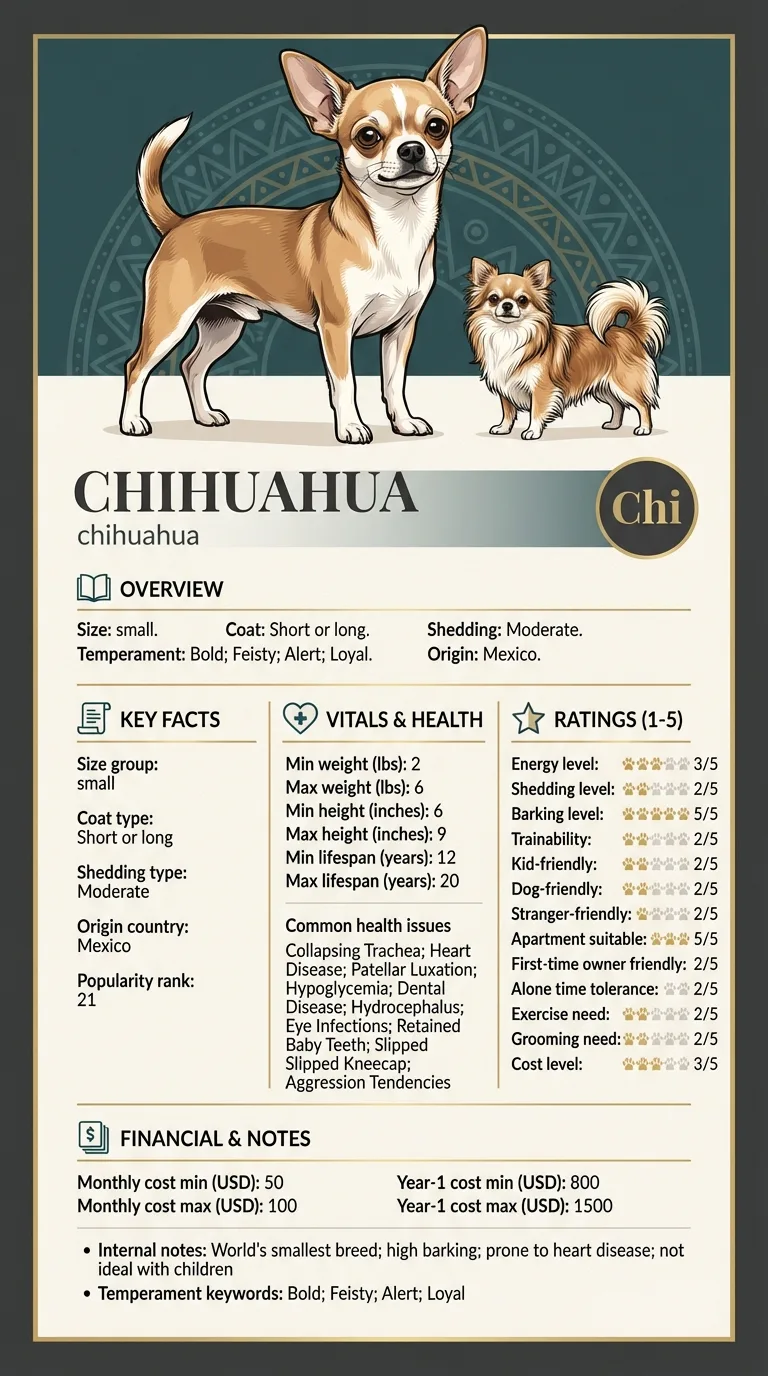
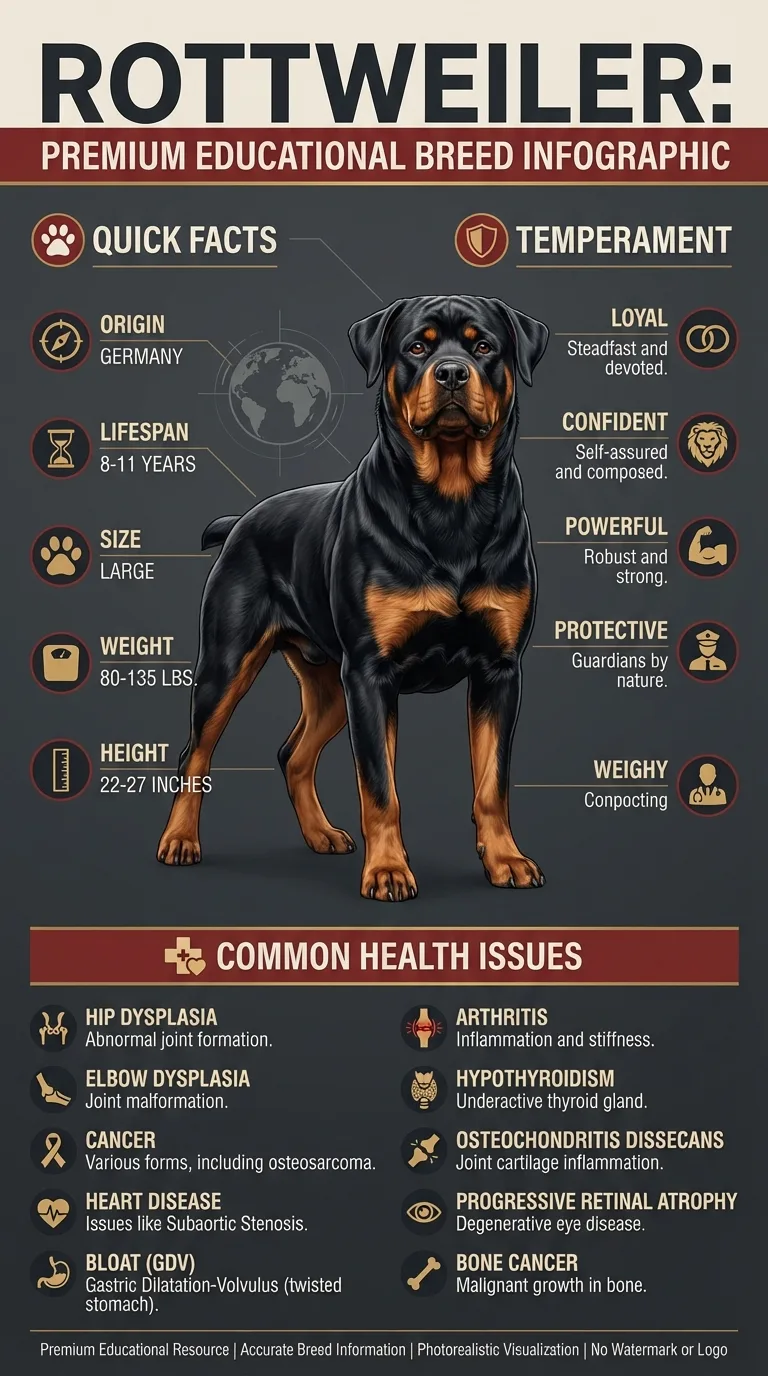
This is for someone already down to Chihuahua and Rottweiler and deciding between them. For this pair the decision usually turns on apartment suitability and exercise need, so those are covered first and in most detail. Anyone choosing from a flat has a clear answer here: Chihuahua rates 5/5 against 2/5. It is written for the decision rather than the breed history.
Between Chihuahua and Rottweiler, apartment suitability is what separates them, and Chihuahua is the lower-effort dog of the two to keep.
Choose Chihuahua if you are in a flat or a smaller home, shedding is a problem in your house and your walking routine is modest.
Choose Rottweiler if there are young children at home, you already have another dog and you want a dog that picks up training quickly.
| Feature | chihuahua | rottweiler | Winner |
|---|---|---|---|
| Size class | small | large | Equal |
| Weight | 2–6 lbs | 80–135 lbs | Equal |
| Height | 6–9 in | 22–27 in | Equal |
| Lifespan | 12–20 years | 8–11 years | chihuahua |
| Exercise need | Low (2/5) | High (4/5) | chihuahua |
| Grooming need | Low (2/5) | Low (2/5) | Equal |
| Shedding | Low (2/5) | High (4/5) | chihuahua |
| Energy level | Moderate (3/5) | High (4/5) | Equal |
| Barking | Very high (5/5) | Moderate (3/5) | rottweiler |
| Apartment suitability | Very high (5/5) | Low (2/5) | chihuahua |
| Good for first-time owners | Low (2/5) | Low (2/5) | Equal |
| Tolerates being alone | Low (2/5) | Low (2/5) | Equal |
| Trainability | Low (2/5) | High (4/5) | rottweiler |
| Good with kids | Low (2/5) | High (4/5) | rottweiler |
| Good with other dogs | Low (2/5) | Moderate (3/5) | rottweiler |
| Friendly to strangers | Low (2/5) | Low (2/5) | Equal |
| Cost level | Moderate (3/5) | High (4/5) | chihuahua |
| Coat | Short or long | Double coat, short | Equal |
| Origin | Mexico | Germany | Equal |
| Typical monthly cost | $50–$100 | $125–$250 | Equal |
| Typical first-year cost | $800–$1,500 | $2,000–$3,500 | Equal |
The scale difference here is enormous: a Chihuahua weighs 2-6 pounds and stands 6-9 inches tall, while a Rottweiler weighs 80-135 pounds and stands 22-27 inches at the shoulder - roughly twenty times the mass on a frame more than double the height. The Chihuahua sits in the small size class and the Rottweiler in the large class, and that gap shapes almost every other comparison on this page, from exercise needs to living space. A Rottweiler's broad chest and dense double coat give it a powerful, blocky build built for work, while the Chihuahua's tiny apple-domed head and delicate legs are built for portability, not power.
Exercise need splits clearly: the Chihuahua rates low (2/5) while the Rottweiler rates high (4/5), and energy level follows the same pattern at moderate (3/5) versus high (4/5). A Rottweiler bred for driving and guarding livestock needs real daily work - structured walks, training drills, or purposeful play - or that energy turns into destructive boredom. The Chihuahua, by contrast, can burn off its moderate energy with a short walk and some indoor chasing. Owners drawn to the Rottweiler's confident, powerful nature should be honest about whether they can commit to sustained daily exercise, since an under-exercised large dog is a much bigger management problem than an under-exercised small one.
Both breeds are low-maintenance in the brush-and-bath sense, with grooming need rated low (2/5) for each, but shedding diverges sharply: the Chihuahua sheds lightly (2/5) while the Rottweiler's short double coat sheds heavily (4/5), especially during seasonal blowouts. A Rottweiler owner should expect regular vacuuming and a deshedding tool in rotation, while a Chihuahua owner deals with comparatively little hair despite the coat coming in short or long varieties. Neither breed needs trims or professional grooming visits. The practical difference shows up less in effort per session and more in the sheer volume of hair a large-bodied Rottweiler produces compared to a two-to-six-pound Chihuahua.
Apartment suitability is where the size gap bites hardest: the Chihuahua rates very high (5/5) while the Rottweiler rates low (2/5), reflecting how much space and exercise a powerful large breed needs to stay content indoors. Barking runs the opposite direction - the Chihuahua is very high (5/5) and notoriously vocal at every sound, while the Rottweiler is moderate (3/5), tending toward purposeful alert barks rather than constant chatter. Both dogs tolerate being alone poorly, rated low (2/5) for each, so neither is a great fit for owners gone all day. A small apartment favors the Chihuahua strongly, but a quieter building might still prefer the Rottweiler's more measured bark.
First-time-owner suitability ties at low (2/5) for both breeds, but for very different reasons - the Chihuahua's independence and feisty streak make it stubborn in training, while the Rottweiler's sheer size and strength mean handling mistakes carry bigger consequences even though it rates high (4/5) for trainability. That trainability gap matters: a Rottweiler's loyal, confident temperament makes it genuinely responsive to structured obedience work, while the Chihuahua's low (2/5) trainability score reflects a dog that trains on its own terms. A first-time owner considering either should budget for real obedience classes, since a poorly trained Rottweiler is a far greater liability than a poorly trained Chihuahua.
The Rottweiler outscores the Chihuahua for kids (high 4/5 versus low 2/5) and other dogs (moderate 3/5 versus low 2/5), which surprises people who expect the opposite from a guardian breed - its protective, loyal nature extends readily to family members it's raised with. Both breeds score low (2/5) for friendliness to strangers, so neither is the dog to expect a warm welcome from at the door; the Rottweiler's watchful instincts and the Chihuahua's wariness both call for early, deliberate socialization. Households with kids already in the picture should weigh the Rottweiler's size carefully even with its good kid-compatibility score, since accidental knockdowns are a real risk with any large dog.
Lifespan tilts heavily toward the Chihuahua, which can live 12-20 years against the Rottweiler's 8-11 - nearly double in the best case. The Rottweiler's health list is long and serious: hip and elbow dysplasia, cancer, bloat (GDV), and bone cancer all carry real veterinary and emotional cost, reflecting the elevated cancer risk large purebred dogs like the Rottweiler are known for. The Chihuahua's list runs longer in item count but skews toward manageable small-dog issues - collapsing trachea, hypoglycemia, dental disease - though heart disease and hydrocephalus appear on both breeds' radar in different forms. Prospective Rottweiler owners should factor bloat and cancer screening into their long-term health budget.
Cost level is rated moderate (3/5) for the Chihuahua and high (4/5) for the Rottweiler, and the dollar figures back that up clearly: $50-100 monthly and $800-1,500 in year one for the Chihuahua versus $125-250 monthly and $2,000-3,500 in year one for the Rottweiler. A Rottweiler's larger body means more food, larger-dose medications, bigger boarding and grooming bills, and costlier orthopedic care if hip or elbow dysplasia develops. The Chihuahua's tiny size keeps most ongoing costs modest even though dental work can add up. Anyone comparing these two on budget alone should plan for the Rottweiler running two to three times the Chihuahua's typical spend.
Chihuahua weighs 2–6 lbs and lives 12–20 years; Rottweiler weighs 80–135 lbs and lives 8–11 years. The two diverge most on apartment suitability, exercise need and shedding and 3 other rated axes. They are level on tolerates being alone, good for first-time owners and grooming need, so those cannot decide it. In the table, a "winner" means easier for an ordinary household — not better. Size, coat and origin are recorded without a verdict. Because both breeds are scored the same way, the gaps are reliable even where the absolute numbers are rough.

They can, but the size gap - a 2-6 pound Chihuahua next to an 80-135 pound Rottweiler - means play needs close supervision, since a Rottweiler's moderate rating for compatibility with other dogs doesn't guarantee gentleness with something this much smaller.
No, it's actually the opposite on paper - the Rottweiler rates high (4/5) for trainability against the Chihuahua's low (2/5), since the Rottweiler's loyal, confident temperament responds well to structured obedience work.
The Rottweiler costs meaningfully more, at $125-250 a month and $2,000-3,500 in the first year, compared to the Chihuahua's $50-100 a month and $800-1,500 first-year range.
Chihuahuas live substantially longer, with a lifespan of 12-20 years against the Rottweiler's 8-11 years, a gap tied partly to the larger breed's elevated cancer and orthopedic disease risk.
Yes - the Rottweiler rates high (4/5) for compatibility with kids while the Chihuahua rates low (2/5), though any large breed around young children still needs supervision to prevent accidental knockdowns.
The Chihuahua, rated very high (5/5) for barking against the Rottweiler's moderate (3/5) - Chihuahuas tend to vocalize at nearly every stimulus, while Rottweilers bark more selectively.
Not really - the Rottweiler rates low (2/5) for apartment suitability against the Chihuahua's very high (5/5), reflecting how much space and daily exercise a large, high-energy guardian breed needs.
The Chihuahua, rated very high (5/5) for apartment suitability against the Rottweiler's low (2/5).
The Rottweiler, rated high (4/5) for exercise need versus the Chihuahua's low (2/5).
The Rottweiler, whose protective, confident temperament is purpose-built for guarding in a way the Chihuahua's small size can't match.
The Chihuahua, at $50-100 monthly against the Rottweiler's $125-250.
Secure checkout on Stripe. We never see your card.
7-day money-back guarantee. Instant access.

Health information here is general and is not veterinary advice. If your dog shows pain, sudden behaviour change, or worsening symptoms, consult a licensed veterinarian.
Some links on this site are affiliate links. We may earn a commission at no extra cost to you, and we only suggest products we believe are helpful for dog owners.
We research and check what we publish, but we do not warrant that any figure, date, price, or statement is accurate, complete, or current, and we accept no liability for any loss, cost, injury, or other harm arising from the use of this site. Use it as one reference among several. You remain responsible for your own decisions and for your dog's care - confirm anything that matters with a licensed veterinarian or another qualified professional before you act on it. Full disclaimer.
Match your lifestyle to the right dog.
Take quizNot sure which breed is right for you? Take our 2-minute quiz to find out.
Take the quiz