Health
What does an OFA 'Excellent' hip rating mean?
It's the highest passing grade, indicating a hip joint with ideal conformation and no evidence of laxity or arthritis on the X-ray.

Quick answer
What does an OFA 'Excellent' hip rating mean?
It's the highest passing grade, indicating a hip joint with ideal conformation and no evidence of laxity or arthritis on the X-ray.
Two Brittany puppies from two different litters can carry very different real-world hip dysplasia risk, and the breeder's screening paperwork is where that difference actually shows up.
Prospective buyers researching breeders often feel overwhelmed by unfamiliar acronyms and rating scales. Current owners of adult dogs face a different challenge: deciding whether to screen a dog that shows no symptoms at all, purely for breeding-decision or long-term planning purposes.
This guide is not medical advice. If your dog shows pain, sudden behavior change, or worsening symptoms, consult a licensed veterinarian.
Some links may be affiliate links. We may earn a commission at no extra cost to you. We only suggest products we believe are helpful for dog owners.
We research and check what we publish, but we do not warrant that any figure, date, price, or statement is accurate, complete, or current, and we accept no liability for any loss, cost, injury, or other harm arising from the use of this site. Use it as one reference among several. You remain responsible for your own decisions and for your dog's care - confirm anything that matters with a licensed veterinarian or another qualified professional before you act on it. Full disclaimer.
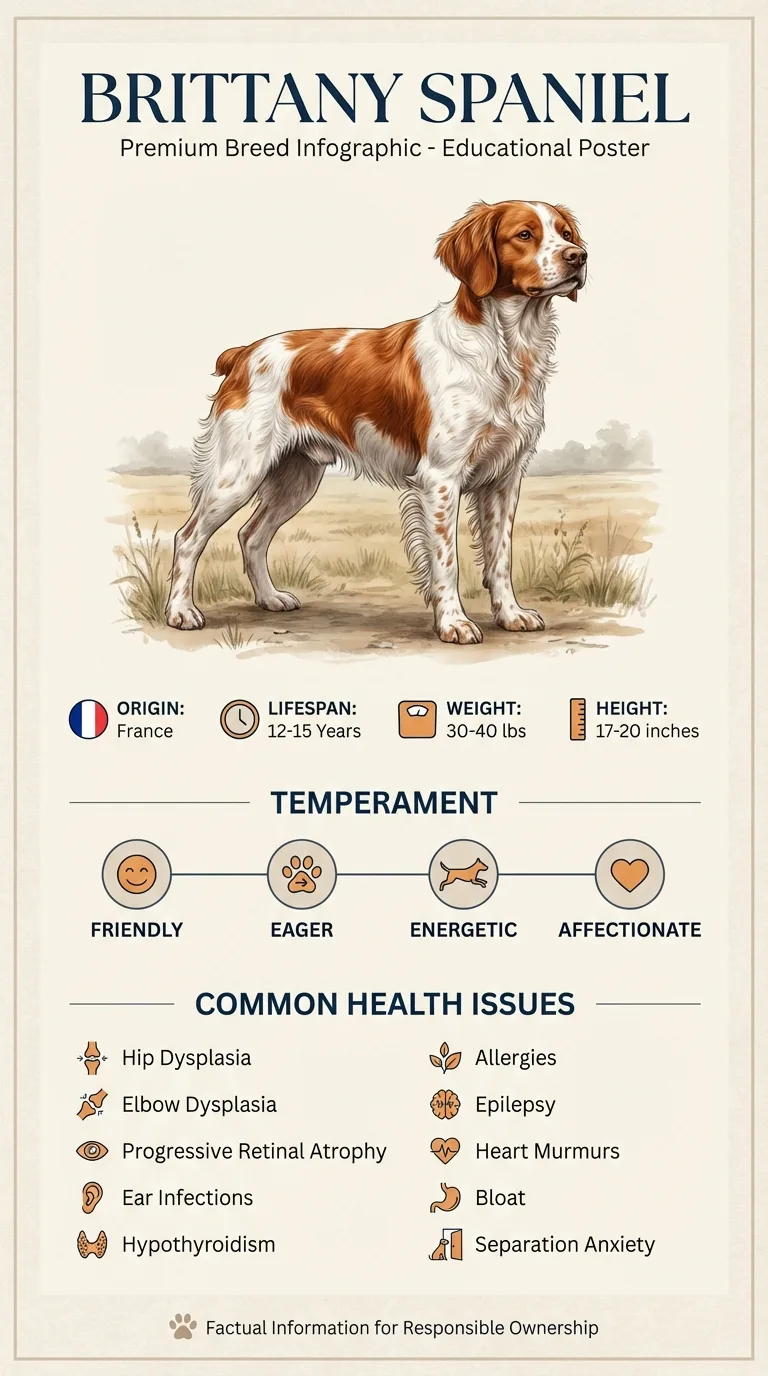
Hip dysplasia is documented as a health concern in Brittanys, and like many breeds affected by this condition, prevalence isn't a fixed, uniform number — it shifts based on which population is measured and how carefully individual breeding lines have been screened over generations. Understanding the screening systems themselves is more useful to an owner or buyer than memorizing any single percentage.
Because hip dysplasia is a named item on this breed's documented health profile, it's recognized as a real, non-trivial risk category for Brittanys as a whole, even though any individual dog's or line's actual risk can vary substantially from the breed average.
As a breed with hip dysplasia already flagged in its documented health issues, Brittanys carry some baseline genetic risk that responsible breeding programs actively work to reduce through selective screening over successive generations.
How a specific breeding program screens and selects its dogs, more than any broad breed statistic, determines the realistic prevalence a buyer should expect from a given litter. Growth management and weight control in individual puppies then determine how a genetic predisposition actually plays out.
Bring up hip screening proactively at wellness visits if you're planning to breed your dog, buying from a line with limited health testing history, or noticing any early gait changes worth investigating with imaging.
See all Brittany health problems, which breeds are prone to hip dysplasia prevalence, or the full Brittany breed guide for temperament, exercise needs and ownership costs.
PennHIP results are available almost immediately after imaging around 16 weeks; a final OFA certification typically requires waiting until the dog is two years old for the standard evaluation.
Success looks like a buying or breeding decision based on actual documented results rather than assumptions, and a realistic understanding that good screening reduces but never fully eliminates risk in any individual dog.
None of these methods is perfect, and none replaces looking at a specific dog's or line's actual results rather than relying on a general breed reputation alone.
Prevalence estimates for hip dysplasia in any breed depend heavily on which population is being measured. Numbers drawn only from dogs whose owners chose to screen them tend to skew toward more health-conscious breeding programs, potentially understating the risk in the wider pet population. Numbers drawn from general veterinary caseloads, on the other hand, may skew toward dogs who were screened because they were already showing symptoms.
This is exactly why a single 'X% of this breed has hip dysplasia' figure is less useful than asking a specific breeder for their own dogs' OFA or PennHIP results directly, along with those of the sire and dam.

When researching Brittany breeders, one prospective owner compared two available litters. The first breeder could only describe the parents as 'healthy and active.' The second provided OFA certificates showing both parents rated Good, along with three generations of documented hip ratings in the pedigree. She chose the second breeder specifically because of the documentation, not because of any promise about her future puppy's outcome. Her puppy, now three, has since been PennHIP screened himself and shows tight, healthy joint laxity consistent with his parents' ratings. She still can't guarantee he'll never develop joint issues, but she made her decision with real information rather than a general impression of the breed.
Key takeaway: A specific breeding pair's documented hip ratings tell you far more than any breed-wide prevalence statistic ever could.
Fair, Good, or Excellent are all considered passing ratings suitable for breeding. Borderline or dysplastic ratings suggest that dog shouldn't be bred, regardless of how the dog looks or moves in daily life.
Yes, this is common. Radiographic evidence of joint laxity or early arthritic change can be present well before a dog shows any visible lameness.
They measure different things. PennHIP quantifies joint laxity numerically and can be done earlier in life; OFA relies on a standard positioned X-ray reviewed by radiologists. Many breeders use one or both.
No rating guarantees an individual outcome, since hip dysplasia has both genetic and environmental components. Good parental ratings meaningfully reduce risk but don't eliminate it entirely.
It can still be worthwhile for early detection purposes, giving you and your vet a clearer picture of joint health before symptoms would otherwise appear.
Selective breeding choices over generations, prioritizing screened, passing-rated parents, can meaningfully shift a specific line's risk profile compared to the breed's overall average.
It's the highest passing grade, indicating a hip joint with ideal conformation and no evidence of laxity or arthritis on the X-ray.
PennHIP can be done from around 16 weeks; standard OFA evaluation is typically done at two years or older for a final certified rating.
Yes — asking to see the sire and dam's actual OFA or PennHIP paperwork is a reasonable and common request when buying a puppy.
It typically involves sedation, X-rays, and a certification fee, often totaling a few hundred dollars depending on the clinic and organization used.
Not entirely — moderate, joint-friendly exercise habits are still worthwhile for any dog, since environment also plays a role in long-term joint health.
A one-page prep sheet for this condition: the signs, the questions to ask, what to get priced. Unlocks here.
You get: Vet visit prep sheet
No spam. One-click unsubscribe. See our privacy policy.
Preview page 1 before you decide.