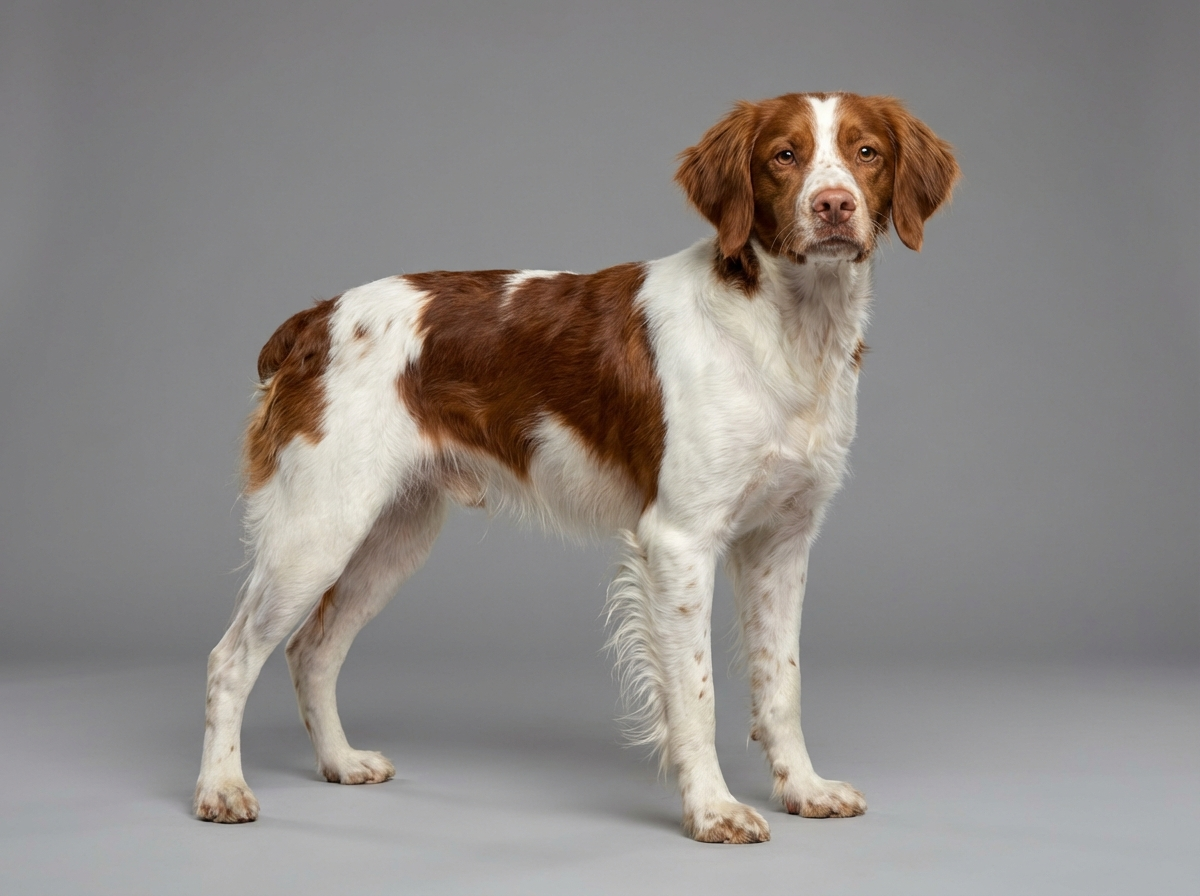
Health
Is Type I IVDD a real risk for Brittanys?
It's uncommon in this breed since it's most strongly tied to the short-legged, long-backed build Brittanys don't have.

Quick answer
Is Type I IVDD a real risk for Brittanys?
It's uncommon in this breed since it's most strongly tied to the short-legged, long-backed build Brittanys don't have.
If you've read about sudden, dramatic disc ruptures causing overnight paralysis, that's Type I IVDD — and it's a condition this breed's body shape mostly protects it from.
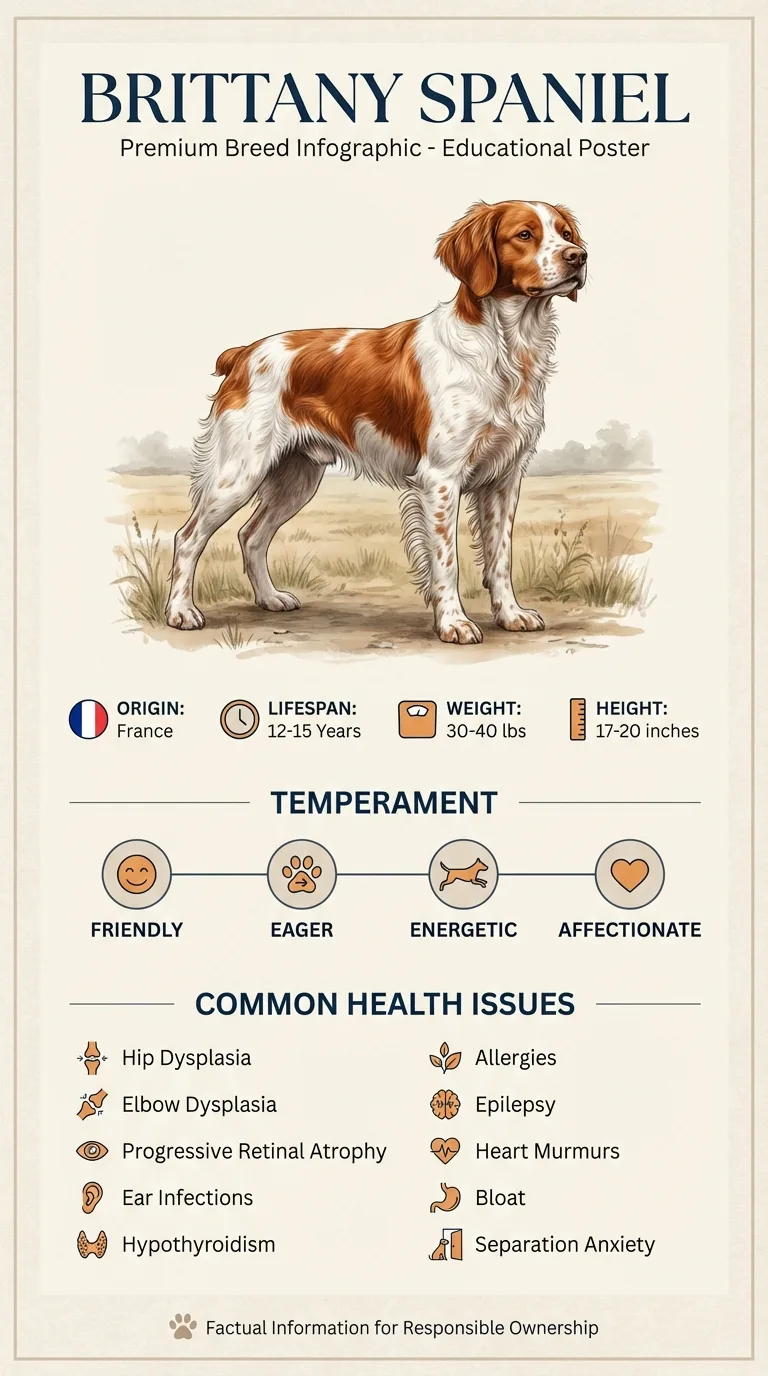
Owners who've researched IVDD broadly, perhaps because a friend's Dachshund had a sudden disc emergency, sometimes worry needlessly that their Brittany faces the same specific risk. The more useful concern for this breed is knowing that any sudden neurological sign still needs urgent attention, regardless of which exact type is or isn't likely.
This guide is not medical advice. If your dog shows pain, sudden behavior change, or worsening symptoms, consult a licensed veterinarian.
Some links may be affiliate links. We may earn a commission at no extra cost to you. We only suggest products we believe are helpful for dog owners.
We research and check what we publish, but we do not warrant that any figure, date, price, or statement is accurate, complete, or current, and we accept no liability for any loss, cost, injury, or other harm arising from the use of this site. Use it as one reference among several. You remain responsible for your own decisions and for your dog's care - confirm anything that matters with a licensed veterinarian or another qualified professional before you act on it. Full disclaimer.
Type I intervertebral disc disease is the acute, calcification-driven form most closely tied to chondrodystrophic body types. Brittanys, as a normally proportioned medium sporting breed, don't carry the anatomy that makes this specific disc pathology common, which sets this condition apart from most of this breed's genuinely documented health concerns.
This specific type is not part of Brittany's documented health profile and is considered uncommon in normally proportioned breeds generally, standing in contrast to genuinely documented concerns like hip dysplasia or heart murmurs in this breed.
Because Brittanys lack the chondrodystrophic build associated with early disc calcification, this breed doesn't carry the anatomical predisposition that makes Type I IVDD common in breeds like Dachshunds or Corgis, making it a condition worth understanding mainly to rule out rather than to actively expect.
Since breed anatomy is the dominant factor for this specific type, environmental factors play a comparatively smaller role here than they do for the age-related disc degeneration that's actually more relevant to this breed.
Treat any sudden crying out, hind-limb weakness, dragging, loss of bladder or bowel control, or inability to stand as a same-day emergency, regardless of how likely this specific diagnosis is for the breed.
See all Brittany health problems, which breeds are prone to intervertebral disc disease ivdd type i, or the full Brittany breed guide for temperament, exercise needs and ownership costs.
Because this type is uncommon in this breed, most owners will never need to navigate an actual diagnosis or treatment timeline for it specifically, though any acute neurological emergency, whatever its cause, typically requires immediate same-day evaluation and rapid decision-making.
Success here looks like accurate awareness — understanding that this specific type is unlikely given the breed's build, while still knowing the general emergency signs that would warrant an immediate vet visit for any cause.
Type I disc disease happens when a disc's soft center calcifies and hardens prematurely, a change strongly linked to the chondrodystrophy gene responsible for the short, curved legs seen in breeds like Dachshunds and Corgis. When a calcified disc ruptures, it does so suddenly, extruding material that can compress the spinal cord within hours, sometimes causing acute pain, weakness, or paralysis in a young or middle-aged dog with no prior warning.
Brittanys are a normally proportioned sporting breed without that chondrodystrophic build, and there's no documented breed-specific predisposition to this particular disc pathology here. That doesn't mean disc problems are impossible in this breed — it means the far more likely disc issue in a Brittany is the slower, age-related degeneration seen in normally built dogs generally, not this acute, breed-linked type.
These signs matter regardless of whether the underlying cause turns out to be a disc problem, a spinal injury, or something else entirely — the urgency of a sudden neurological change doesn't depend on which specific diagnosis is most statistically likely for a given breed.

If you think your Brittany has intervertebral disc disease (ivdd) type i, the plan is three steps: write down what you have seen and when it started, book a veterinary appointment rather than waiting for the next flare, and take video of the behaviour or symptom before you go — the thing you are worried about rarely happens in the consulting room. Screening in the parents covers hip dysplasia, elbow dysplasia, progressive retinal atrophy.
What the vet visit should produce is a diagnosis and a written plan, not just reassurance: what is being ruled out, what the monitoring interval is, and which signs mean you come back sooner. Ask what the treatment costs across a year rather than per visit, because that is the number that decides whether you are managing this condition or reacting to it.
Between appointments, keep a short log — dates, what you saw, what changed. It is the single most useful thing an owner brings to a follow-up, and for intervertebral disc disease (ivdd) type i it is often what separates a clear pattern from a guess.
When Percy, a five-year-old Brittany, suddenly yelped and refused to move one evening, his owner, who'd read about Dachshund disc emergencies online, feared the worst and rushed him to an emergency vet. Examination and X-rays found no evidence of the calcified disc rupture associated with Type I disease, consistent with Percy's normal body build. Instead, the vet diagnosed a muscle strain, likely from an awkward landing during play earlier that day. Percy recovered fully within a week on rest and anti-inflammatory medication, with no further episodes since. His vet noted that while the fear was understandable, this specific type of disc emergency was never a strong statistical likelihood for his body type.
Key takeaway: A sudden neurological sign always deserves urgent evaluation, but for a normally built breed like the Brittany, the classic short-legged-breed disc emergency usually isn't the actual cause.
It's uncommon and not a documented breed predisposition, since Brittanys lack the chondrodystrophic build most strongly associated with this specific disc pathology, though rare individual cases outside a breed's typical pattern are never impossible.
Type I involves sudden calcified disc rupture, most common in chondrodystrophic breeds. Type II is a slower, age-related bulging seen more broadly across breeds, including normally proportioned ones like the Brittany.
Yes — while the acute, breed-linked type is uncommon here, any sudden neurological sign like hind-limb weakness or loss of coordination always warrants immediate veterinary evaluation, regardless of the underlying cause.
It reduces risk of this specific acute disc pathology, but doesn't eliminate the possibility of age-related disc degeneration, muscle strain, arthritis, or other spinal issues later in life.
Treat this as an emergency and get to a vet immediately. Minimize movement and handling on the way, since further movement of an injured spine can worsen the outcome.
The surgical approach can be similar in principle, removing material compressing the spinal cord, but the urgency, presentation, and typical age of the patient differ meaningfully between the two types.
It's uncommon in this breed since it's most strongly tied to the short-legged, long-backed build Brittanys don't have.
Chondrodystrophic breeds like Dachshunds, Corgis, and Basset Hounds are the classic examples, due to their calcification-prone disc anatomy.
Go to an emergency vet immediately — this is always urgent regardless of the underlying cause or how statistically likely it is for the breed.
It varies widely, but emergency imaging and possible surgery for a suspected disc emergency can run into the thousands of dollars.
Reasonable moderation, like using ramps for an aging or already-diagnosed dog, is sensible, but healthy young Brittanys don't need extreme restriction based on a condition uncommon to their build.
A one-page prep sheet for this condition: the signs, the questions to ask, what to get priced. Unlocks here.
You get: Vet visit prep sheet
No spam. One-click unsubscribe. See our privacy policy.
Preview page 1 before you decide.