Health
What exactly is hip dysplasia?
A developmental condition where the hip joint's ball and socket don't fit tightly together, causing abnormal wear and eventually arthritis.

Quick answer
What exactly is hip dysplasia?
A developmental condition where the hip joint's ball and socket don't fit tightly together, causing abnormal wear and eventually arthritis.
A Brittany with hip dysplasia might run circles in the yard as a puppy and still develop arthritis by middle age. The two aren't contradictory — that's exactly how this condition tends to unfold.
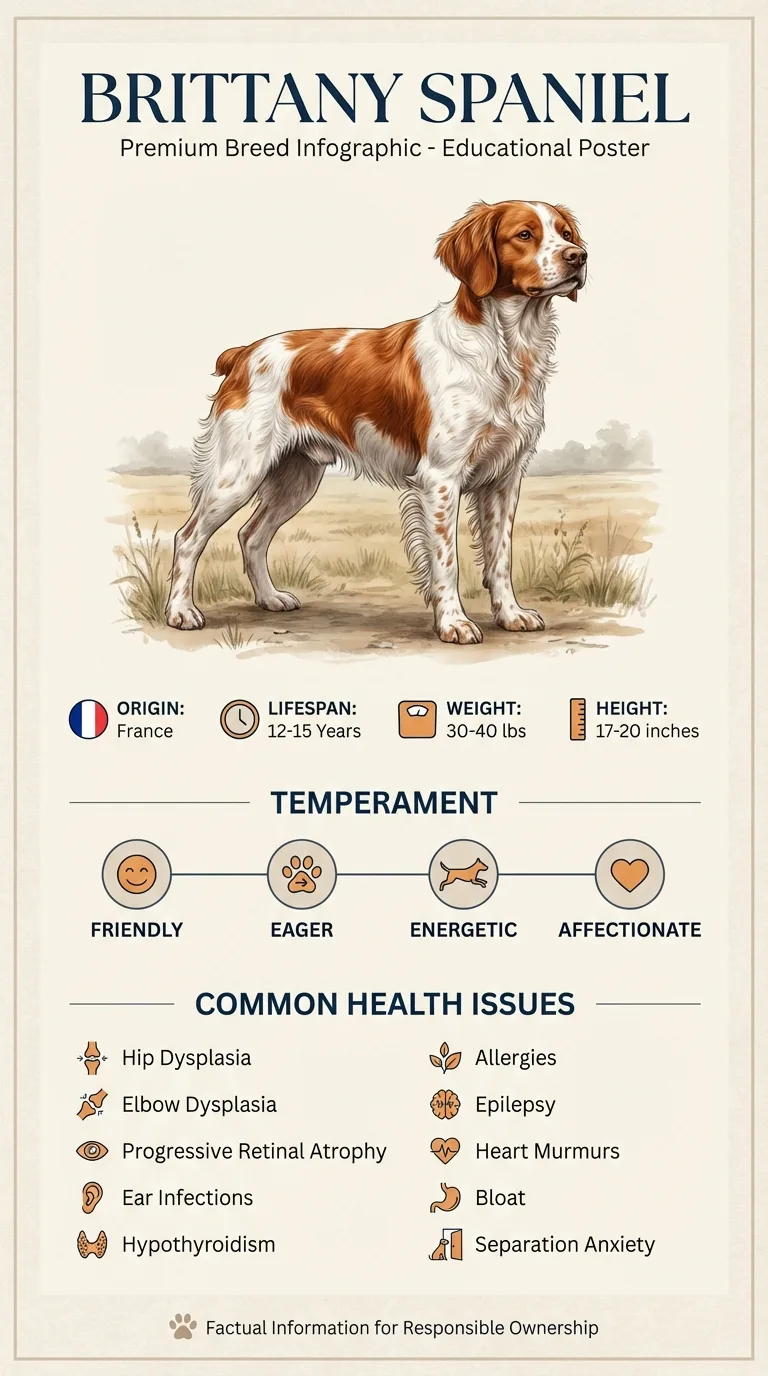
Owners of working and field-trial Brittanys feel this the hardest, since a dog's livelihood in the field depends on hip function holding up. Owners of young, seemingly healthy puppies also struggle, because early hip dysplasia often produces no visible symptoms at all, which makes it easy to dismiss until arthritis shows up later.
This guide is not medical advice. If your dog shows pain, sudden behavior change, or worsening symptoms, consult a licensed veterinarian.
Some links may be affiliate links. We may earn a commission at no extra cost to you. We only suggest products we believe are helpful for dog owners.
We research and check what we publish, but we do not warrant that any figure, date, price, or statement is accurate, complete, or current, and we accept no liability for any loss, cost, injury, or other harm arising from the use of this site. Use it as one reference among several. You remain responsible for your own decisions and for your dog's care - confirm anything that matters with a licensed veterinarian or another qualified professional before you act on it. Full disclaimer.
Hip dysplasia is a developmental joint condition on this breed's documented health list, where the hip's ball and socket fail to fit together properly during growth. For an active, medium-sized sporting dog whose value and enjoyment of life is tied closely to physical stamina, this joint instability and its eventual arthritis are a genuinely significant, not cosmetic, concern.
As a named item on this breed's documented health issues, hip dysplasia is recognized as a real risk in Brittanys, though severity varies enormously between individual dogs depending on genetics, growth, and weight management.
Hip dysplasia is documented specifically in Brittanys, pointing to a genetic predisposition within the breed toward hip joint laxity. As a medium-sized dog built for stamina rather than bulk, a Brittany's hips are still asked to absorb significant repeated impact over a working lifetime, which magnifies the consequences of any underlying looseness.
Growth rate, weight, and exercise type during the first year have an outsized influence on how severely a genetic predisposition actually plays out. A lean, gradually conditioned puppy with controlled exercise tends to fare better than one that grew too fast or carried excess weight early.
See your vet if you notice bunny-hopping, reluctance to jump, stiffness after rest, or any change in gait, especially after exercise — early diagnosis through X-rays gives the most management options before arthritis sets in.
See all Brittany health problems, which breeds are prone to hip dysplasia, or the full Brittany breed guide for temperament, exercise needs and ownership costs.
Hip dysplasia is a lifelong structural condition rather than something that resolves. Many dogs are comfortable for years with conservative management before arthritis becomes a daily concern, typically in middle age or later.
Success is a Brittany that stays active and comfortable on a management plan suited to its specific severity, with arthritis progression slowed through weight control and appropriate exercise rather than accelerated by neglect.
In a normal hip, the ball at the top of the thigh bone sits snugly inside the pelvis's socket, cushioned by cartilage and held by supporting ligaments and muscle. In hip dysplasia, that socket is too shallow, too shallow-angled, or the ligaments too lax, so the ball shifts and rubs rather than gliding cleanly. Every step of running, jumping, or even standing puts uneven pressure on cartilage that wasn't designed to absorb it that way.
Over months and years, that abnormal wear breaks down cartilage and triggers the bone underneath to remodel, which is what osteoarthritis actually is in this context — the joint's long-term response to instability that started when the dog was still growing.
Because early hip dysplasia can be silent, an X-ray at a young age, rather than waiting for visible symptoms, is the only reliable way to know what's actually happening in the joint before arthritis sets in.

Finn, a Brittany, showed no lameness at all as a puppy, but his breeder had recommended preliminary hip X-rays at six months given the line's known history. The films showed moderate laxity in both hips. His owner adjusted his routine immediately: controlled leash walks instead of unrestricted off-leash sprinting during his final growth months, a lean feeding plan, and joint supplements started early. Finn is now six, still hunting on weekends with a modified warm-up routine, and hasn't needed pain medication despite a diagnosis that, left unmanaged, often leads to earlier arthritis.
Key takeaway: A hip dysplasia diagnosis in a puppy with no symptoms yet is actually the best time to act — management started early changes how the condition plays out over a lifetime.
Often yes, at least initially. Early-stage hip dysplasia frequently produces no visible lameness, which is exactly why imaging rather than watching for symptoms is the reliable way to detect it.
Preliminary X-rays can be done as early as a few months old, though a formal evaluation like OFA scoring is typically done at two years, once skeletal maturity is closer.
No. Many dogs are managed successfully with weight control, moderate exercise, joint supplements, and pain management, reserving surgery for more severe cases or dogs that don't respond to conservative management.
It has a strong genetic component, though environment and growth-rate factors also influence severity. Reputable breeders screen breeding dogs' hips specifically to reduce passing on this risk.
Yes — controlled, gradual growth through appropriate large-breed or medium-breed puppy nutrition, rather than rapid weight gain, is thought to reduce the severity of hip dysplasia in genetically predisposed puppies.
Some dogs do, particularly once arthritis has developed, while others manage well with weight control and joint support alone. Your vet will tailor this to your dog's specific severity and comfort level.
A developmental condition where the hip joint's ball and socket don't fit tightly together, causing abnormal wear and eventually arthritis.
It can be — running with both hind legs together rather than independently is a commonly noted early sign, though not every dog shows it.
Controlled, moderate exercise and avoiding forced repetitive jumping in the first year is generally recommended over either extreme of no exercise or unrestricted high-impact activity.
It ranges widely, from ongoing supplements and weight management costing relatively little, up to surgical options that can run into the thousands of dollars.
Chronic joint discomfort can make a normally eager dog more reluctant to jump, play, or go on long walks, which owners sometimes mistake for a behavior change rather than a physical one.
A one-page prep sheet for this condition: the signs, the questions to ask, what to get priced. Unlocks here.
You get: Vet visit prep sheet
No spam. One-click unsubscribe. See our privacy policy.
Preview page 1 before you decide.