Living
Why are Bichon Frises prone to eye irritation?
Dense facial hair that falls across the eyes if ungroomed, combined with a flat facial plane offering little natural buffer, makes the eyes more exposed than in breeds with a longer muzzle.

Quick answer
Why are Bichon Frises prone to eye irritation?
Dense facial hair that falls across the eyes if ungroomed, combined with a flat facial plane offering little natural buffer, makes the eyes more exposed than in breeds with a longer muzzle.
Long before a Bichon ever sees a vet for an eye condition, its own facial hair is usually the first thing bumping into its eyes, day after day.
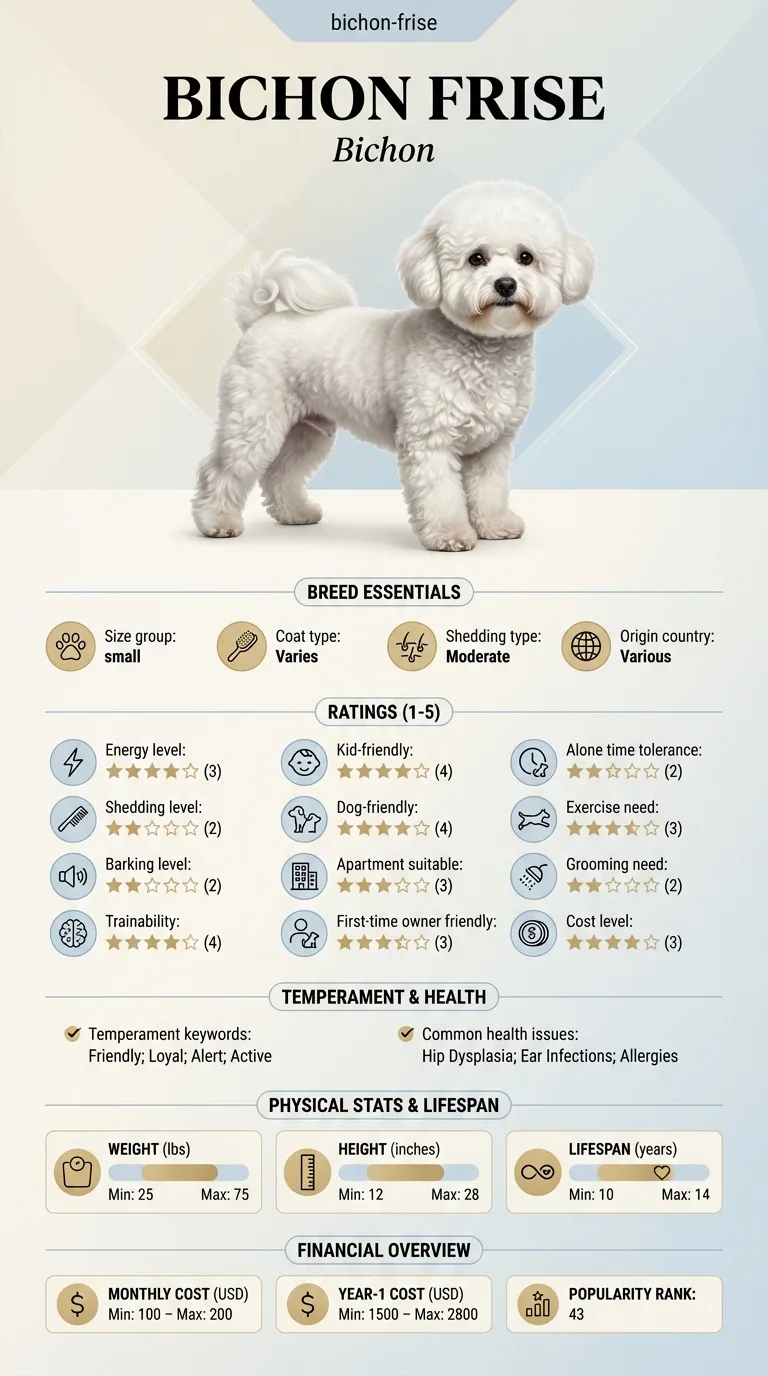
This affects owners who keep the face coat long for looks, who let grooming slide between appointments, or who have a Bichon living alongside rougher-playing dogs or small children, where accidental contact with the face is routine.
This guide is not medical advice. If your dog shows pain, sudden behavior change, or worsening symptoms, consult a licensed veterinarian.
Some links may be affiliate links. We may earn a commission at no extra cost to you. We only suggest products we believe are helpful for dog owners.
We research and check what we publish, but we do not warrant that any figure, date, price, or statement is accurate, complete, or current, and we accept no liability for any loss, cost, injury, or other harm arising from the use of this site. Use it as one reference among several. You remain responsible for your own decisions and for your dog's care - confirm anything that matters with a licensed veterinarian or another qualified professional before you act on it. Full disclaimer.
Beyond any diagnosed eye disease, Bichon Frises face everyday exposure risk to their eyes from their own facial coat, their small size and flat facial profile, and the grooming products used to maintain that coat. This is a prevention and husbandry problem rather than a single inherited condition.
Mild, exposure-related eye irritation is very common in coated small breeds and is frequently mistaken for allergies, since the underlying cause — hair or debris contact rather than an immune reaction — is rarely obvious without a close look.
The Bichon's documented coat type is a curly, dense double coat with a very low shedding rate, meaning facial hair grows continuously and does not thin out seasonally the way it does in other breeds. Combined with the breed's small size and a facial profile without a protruding muzzle, there is less natural distance and buffer between the eye and the surrounding environment.
Households with larger, more physical dogs, outdoor access to long grass or brush, and frequent at-home grooming without careful attention around the face all increase the day-to-day chance of contact injury or product irritation to the eyes.
Talk to a vet about any redness, discharge, or squinting that follows a grooming session, rough play, or outdoor exposure, since these situations are common triggers for surface irritation or scratches in this breed. Treat sudden pain, an eye held shut, or visible cloudiness as same-day concerns.
See all Bichon Frise health problems, which breeds are prone to eye problems, or the full Bichon Frise breed guide for temperament, exercise needs and ownership costs.
Simple exposure-related irritation, once the cause is removed, typically clears within a few days to a week with basic care and monitoring.
Success looks like fewer recurring bouts of eye irritation overall, not the complete elimination of every risk, since some exposure from play and outdoor time is a normal part of an active dog's life.
A Bichon's face grows a dense mass of curly hair that, left untrimmed, falls directly across the eyes. Beyond the mechanical lash and lid conditions covered elsewhere, simple overgrown fringe rubs the cornea with every blink and head movement, and traps dust, pollen and dried tear residue against the eye's surface. A dog living with hair constantly in its eyes also loses part of its normal blink-triggered avoidance reflex — debris that would make another dog flinch and move away barely registers when hair is already brushing the eye all day.
This is separate from any inherited eyelid or eyelash fault. Even a Bichon with a perfectly normal lid margin will develop surface irritation, and a higher risk of scratches from its own hair, coat products, or debris caught in the fringe, if the face is left ungroomed between appointments.
At 12 to 18 pounds and roughly knee height on an adult, a Bichon's eyes sit at exactly the height of low branches, tall grass seed heads, coffee tables, and other dogs' paws during play. A breed with sparkling dark eyes set in a relatively flat facial plane, without a protruding muzzle to deflect contact, has comparatively little natural buffer between the environment and the eye itself.
Rough play with larger dogs, off-leash time in long grass or brush, and even enthusiastic greetings from small children at eye level all carry real scratch risk that has nothing to do with genetics and everything to do with where the dog's face happens to be during ordinary daily life.

Because the breed's grooming needs are rated at the high end, a Bichon encounters more shampoo, conditioner, and detangling spray near its face than most breeds do. Any of these products reaching the eye directly, even briefly, can cause a chemical-style irritation that looks identical to allergy or dust irritation from the outside. Owners who groom at home should treat the face as the highest-risk zone for product exposure, not an afterthought.
If you think your Bichon has eye problems, the plan is three steps: write down what you have seen and when it started, book a veterinary appointment rather than waiting for the next flare, and take video of the behaviour or symptom before you go — the thing you are worried about rarely happens in the consulting room. Screening in the parents covers skin allergies, patellar luxation, bladder stones.
What the vet visit should produce is a diagnosis and a written plan, not just reassurance: what is being ruled out, what the monitoring interval is, and which signs mean you come back sooner. Ask what the treatment costs across a year rather than per visit, because that is the number that decides whether you are managing this condition or reacting to it.
Between appointments, keep a short log — dates, what you saw, what changed. It is the single most useful thing an owner brings to a follow-up, and for eye problems it is often what separates a clear pattern from a guess.
Bella's eyes had been intermittently red and watery for a couple of months, worst in the days right after her monthly bath at home. Her owner tried a hypoallergenic shampoo, assuming a product sensitivity, but the pattern continued. A vet asked exactly how the bath was done, and it turned out Bella's face was washed the same way as the rest of her body, with shampoo worked in close to the eyes and rinsed quickly rather than carefully. Small amounts of residue were likely reaching the eye's surface each time. Switching to a hand-shielded face wash with plain water only, and trimming the fringe shorter around the eyes, ended the pattern within two bath cycles. No product change was needed — just a different technique around the face.
Key takeaway: Recurring eye irritation in this breed is often a technique or exposure problem rather than a product or disease problem, and it can take walking through the actual routine step by step to find it.
Yes. Overgrown facial fringe rubbing the cornea repeatedly, and trapping dust or debris against the eye, is a genuine source of surface irritation and scratch risk, separate from any inherited eyelid or eyelash condition.
Most owners keep face hair trimmed short around the eyes between full grooming appointments, roughly every few weeks, rather than letting it grow long enough to fall across the eye.
Their small size, relatively flat facial plane without a protruding muzzle, and dense facial coat combine to give them less natural buffer between the eye and everyday hazards like grass, low branches, and play contact with larger dogs.
Yes. Products reaching the eye during bathing or grooming can cause chemical-style irritation that looks similar to allergy or dust irritation. The face should be treated as the highest-risk zone during at-home grooming.
Rough play with larger dogs, off-leash time in long grass or brush, overgrown facial hair, and close-range contact with small children are the most common everyday exposure risks for this breed.
Yes. Any suspected corneal scratch should be checked by a vet, since even small surface injuries can become infected or worsen quickly, and over-the-counter products are not a substitute for a proper eye exam.
Dense facial hair that falls across the eyes if ungroomed, combined with a flat facial plane offering little natural buffer, makes the eyes more exposed than in breeds with a longer muzzle.
Keep facial hair trimmed short around the eyes, supervise rough play with larger dogs, and take extra care to shield the eyes during bathing and grooming.
Yes, shampoo or detangling spray reaching the eye can cause irritation that looks like allergies from the outside, so the face needs extra care during at-home grooming.
Yes. Any suspected scratch to the eye's surface should be examined by a vet promptly, since small injuries can worsen or become infected quickly.
Yes, at 12 to 18 pounds a Bichon's face sits at the height of many everyday hazards, including other dogs' paws during play, which increases incidental contact with the eyes.
A one-page prep sheet for this condition: the signs, the questions to ask, what to get priced. Unlocks here.
You get: Vet visit prep sheet
No spam. One-click unsubscribe. See our privacy policy.
Preview page 1 before you decide.

