Living
Much bigger dog?
The Newfoundland, at 100-150 lbs versus the Shar-Pei's 45-60 lbs.

Quick answer
Much bigger dog?
The Newfoundland, at 100-150 lbs versus the Shar-Pei's 45-60 lbs.
Chinese Shar-Pei or Newfoundland? On paper they differ most on apartment suitability, and on the scales Newfoundland is the heavier at 100–150 lbs. Here is how the two compare on everything that shapes an ordinary week.
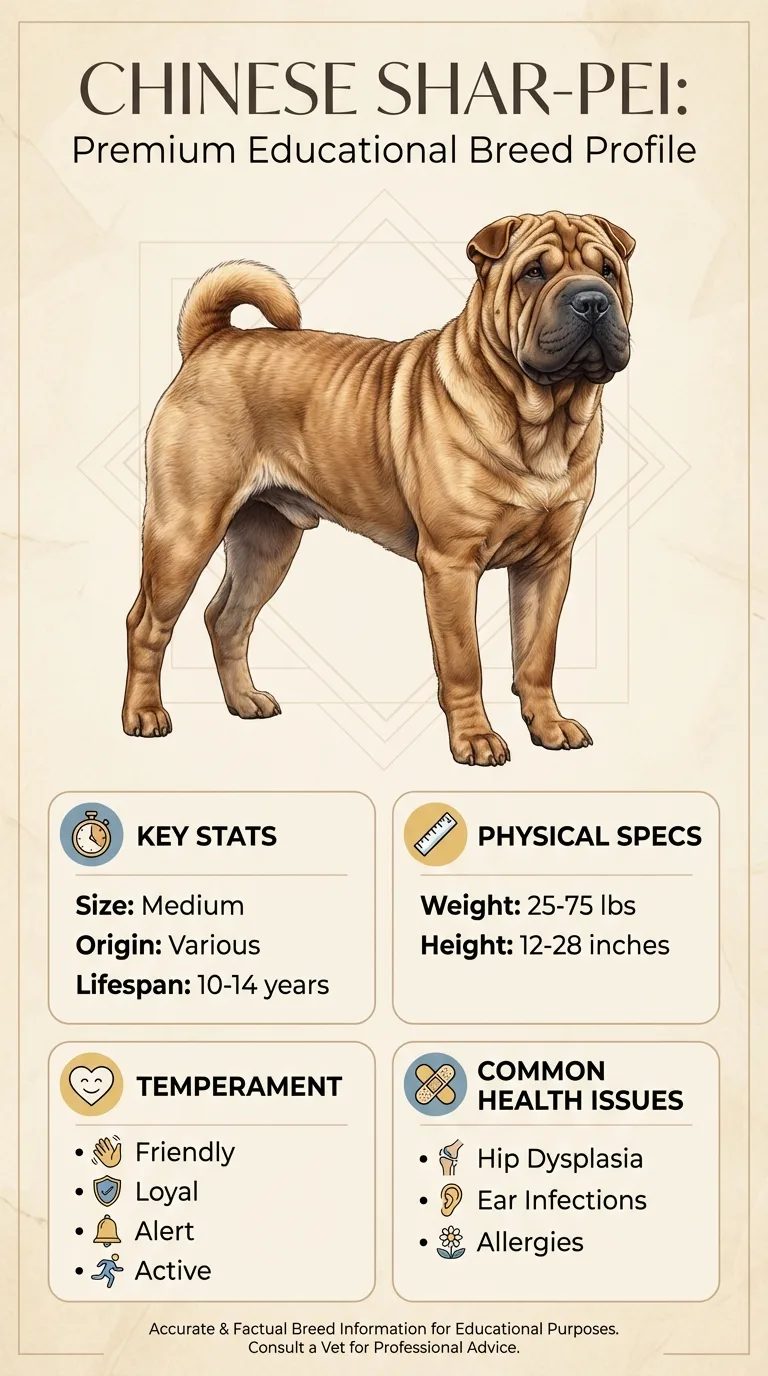
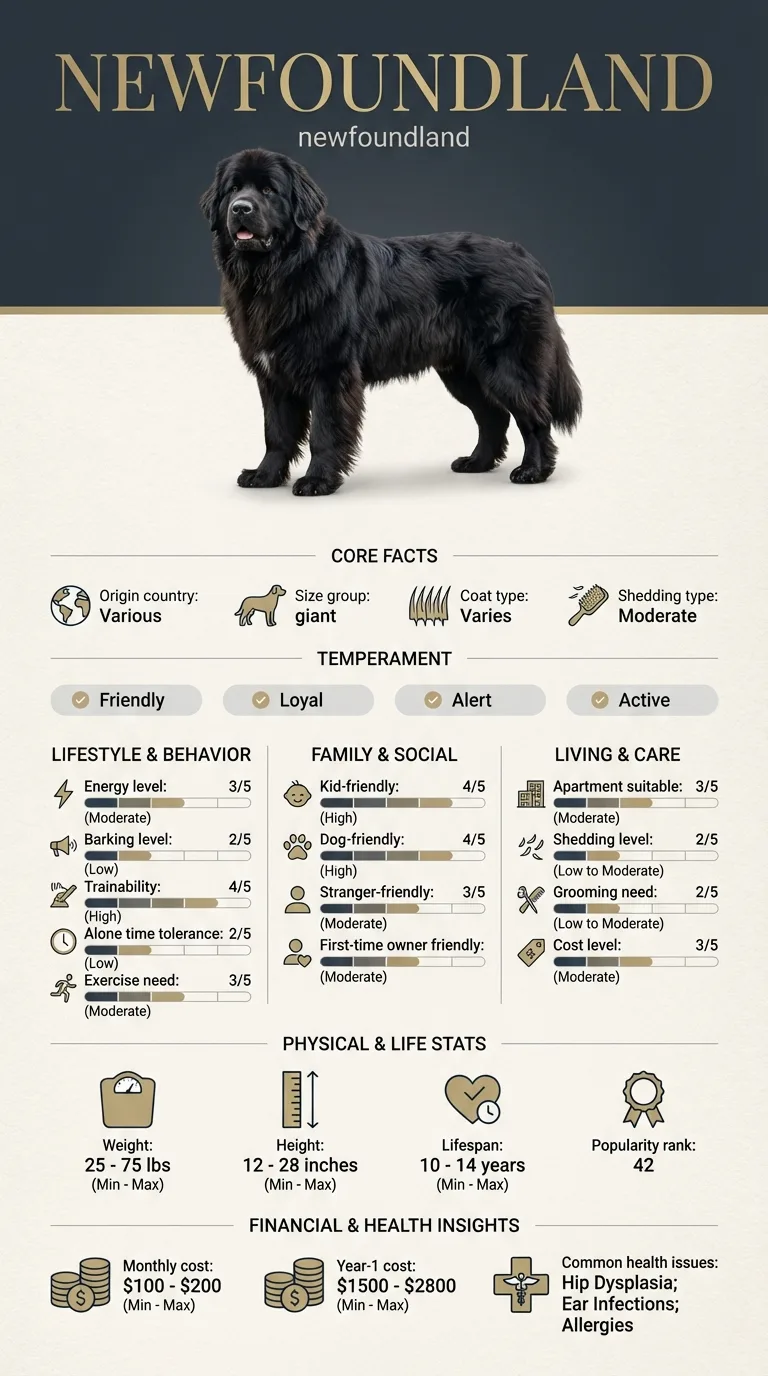
This is for someone already down to Chinese Shar-Pei and Newfoundland and deciding between them. For this pair the decision usually turns on apartment suitability and shedding, so those are covered first and in most detail. Anyone choosing from a flat has a clear answer here: Chinese Shar-Pei rates 4/5 against 1/5. There is no origin story here — only what changes about your week.
Between Chinese Shar-Pei and Newfoundland, apartment suitability is what separates them, and Chinese Shar-Pei is the lower-effort dog of the two to keep.
Choose Chinese Shar-Pei if you are in a flat or a smaller home, you do not want a standing grooming appointment and shedding is a problem in your house.
Choose Newfoundland if this is your first dog, there are young children at home and you already have another dog.
| Feature | chinese shar pei | newfoundland | Winner |
|---|---|---|---|
| Size class | medium | giant | Equal |
| Weight | 45–60 lbs | 100–150 lbs | Equal |
| Height | 18–20 in | 26–28 in | Equal |
| Lifespan | 8–12 years | 9–10 years | chinese shar pei |
| Exercise need | Low (2/5) | Moderate (3/5) | chinese shar pei |
| Grooming need | Low (2/5) | High (4/5) | chinese shar pei |
| Shedding | Low (2/5) | Very high (5/5) | chinese shar pei |
| Energy level | Low (2/5) | Low (2/5) | Equal |
| Barking | Low (2/5) | Low (2/5) | Equal |
| Apartment suitability | High (4/5) | Very low (1/5) | chinese shar pei |
| Good for first-time owners | Low (2/5) | Moderate (3/5) | newfoundland |
| Tolerates being alone | Moderate (3/5) | Moderate (3/5) | Equal |
| Trainability | Low (2/5) | High (4/5) | newfoundland |
| Good with kids | Moderate (3/5) | Very high (5/5) | newfoundland |
| Good with other dogs | Low (2/5) | High (4/5) | newfoundland |
| Friendly to strangers | Low (2/5) | High (4/5) | newfoundland |
| Cost level | High (4/5) | Very high (5/5) | chinese shar pei |
| Coat | Short and harsh | Heavy water-resistant double coat | Equal |
| Origin | Various | Various | Equal |
| Typical monthly cost | $100–$200 | $150–$310 | Equal |
| Typical first-year cost | $1,400–$2,900 | $2,200–$4,200 | Equal |
Nearly three times the weight separates these two: a Newfoundland runs 100 to 150 pounds and stands 26 to 28 inches, dwarfing the Shar-Pei's 45-to-60-pound, 18-to-20-inch frame. The size classes reflect it plainly — medium against giant. Newfoundlands were bred as water-rescue dogs, with webbed feet and a heavy, water-resistant coat built for hauling weight through cold water; the Shar-Pei's compact build and thick wrinkled skin trace back to guarding and fighting roles in China. A Newfoundland's sheer bulk alone changes what's practical — car size, furniture, even how much space it needs just to turn around indoors.
The Newfoundland needs a bit more structured activity than the Shar-Pei, rating Moderate, 3/5, on exercise need against the Shar-Pei's Low, 2/5, but the two land at the same relaxed Low, 2/5, energy level day to day. That combination is typical of giant working breeds — capable of real exertion, like swimming or pulling, but not restless without it. A Newfoundland benefits from a real walk or a swim session a few times a week; a Shar-Pei is content with shorter, more casual outings. Neither dog is the right pick for someone chasing a running partner.
This is one of the widest gaps in the whole comparison. The Newfoundland's heavy, water-resistant double coat rates High, 4/5, for grooming and a striking Very High, 5/5, for shedding — expect regular brushing sessions and a near-constant dusting of fur, especially during seasonal blowouts. The Shar-Pei, by contrast, sits at Low, 2/5, for both grooming and shedding thanks to its short, harsh coat. A Newfoundland owner should plan for a dedicated vacuum, an outdoor brushing routine, and dark-clothing avoidance; a Shar-Pei owner deals with essentially none of that.
Apartment suitability draws a hard line between these two: the Shar-Pei rates High, 4/5, while the Newfoundland sits at Very Low, 1/5 — a dog that can weigh as much as an adult person simply isn't built for compact living. Barking and tolerance for being alone are both tied, Low 2/5 barking and Moderate 3/5 alone tolerance for each breed, so noise and separation aren't the deciding factors here — space is. A Newfoundland genuinely needs a house with room to stretch out, while the Shar-Pei can thrive in a condo without issue.
The Newfoundland rates High, 4/5, for trainability, well ahead of the Shar-Pei's Low, 2/5, and its temperament — sweet, patient, devoted, calm — makes it one of the more forgiving giant breeds to raise. Its first-time-owner suitability is only Moderate, 3/5, though, because its size alone demands a confident handler for leash work, even if its personality is easygoing. The Shar-Pei's Low, 2/5, rating on both measures reflects its independent, reserved nature rather than any lack of intelligence. A first-timer drawn to the Newfoundland should focus early training on leash manners; a first-timer with a Shar-Pei should focus on socialization from puppyhood.
Newfoundlands have a reputation as gentle giants, and the numbers back it up: Very High, 5/5, with kids, High, 4/5, with other dogs, and High, 4/5, friendliness to strangers — all well ahead of the Shar-Pei's Moderate 3/5 with kids and Low 2/5 on the other two. That said, supervision still matters with a Newfoundland around small children simply because of its size; a friendly 130-pound dog can still knock someone over by accident. The Shar-Pei's more guarded nature with unfamiliar dogs and people suits a quieter household that isn't regularly hosting playdates or dog-park visits.
Lifespan actually favors the Shar-Pei here, 8 to 12 years against the Newfoundland's narrower 9 to 10 — one of the shorter giant-breed spans, driven partly by cardiac risk. The Newfoundland's five listed conditions include two heart-specific issues, Subaortic Stenosis and Dilated Cardiomyopathy, plus Hip Dysplasia and Bloat (GDV), both common in large, deep-chested breeds, and Cystinuria, a urinary condition. The Shar-Pei's five conditions are almost entirely skin-related — Skin Fold Dermatitis, Entropion, and Familial Shar-Pei Fever — with Hypothyroidism and Ear Infections rounding out the list. Prospective Newfoundland owners should ask breeders about cardiac screening; prospective Shar-Pei owners should ask about fold-care routines.
The Newfoundland costs more to keep on every measure: a Very High, 5/5, overall rating against the Shar-Pei's High, 4/5, with monthly costs of $150 to $310 versus $100 to $200, and a first-year range of $2,200 to $4,200 compared with $1,400 to $2,900. Food volume is the obvious driver for a 100-to-150-pound dog, but grooming tools, larger-breed veterinary dosing, and bigger everyday gear — beds, crates, collars — all scale up too. Anyone budgeting for a Newfoundland should plan closer to the top of that first-year range rather than the bottom.
Chinese Shar-Pei weighs 45–60 lbs and lives 8–12 years; Newfoundland weighs 100–150 lbs and lives 9–10 years. The two diverge most on apartment suitability, shedding and grooming need and 4 other rated axes. They are level on tolerates being alone, barking and energy level, so those cannot decide it. Where the table declares a winner it means less work for the owner, nothing more; descriptive rows are left as ties on purpose. The value here is in the differences between the two columns; treat any single score as approximate.

Yes — it rates Very Low (1/5) for apartment suitability, the opposite of the Shar-Pei's High (4/5), largely due to its 100-150 lb frame.
The Newfoundland, dramatically so — Very High (5/5) shedding against the Shar-Pei's Low (2/5), a difference owners notice within days of bringing one home.
Yes, rated Very High (5/5) with kids, well ahead of the Shar-Pei's Moderate (3/5), though their size still calls for supervision around toddlers.
The Shar-Pei, at 8-12 years, actually edges out the Newfoundland's shorter 9-10 year range, partly due to the Newfoundland's cardiac health risks.
Roughly $2,200 to $4,200, notably more than the Shar-Pei's $1,400 to $2,900, driven by food volume and larger vet bills.
The Newfoundland, rated High (4/5) trainability against the Shar-Pei's Low (2/5), reflecting its patient, devoted temperament.
Subaortic Stenosis and Dilated Cardiomyopathy both appear on its health list, so cardiac screening from a reputable breeder is worth asking about.
The Newfoundland, at 100-150 lbs versus the Shar-Pei's 45-60 lbs.
The Shar-Pei, rated High (4/5) apartment suitability versus the Newfoundland's Very Low (1/5).
The Shar-Pei, rated Low (2/5) versus the Newfoundland's Very High (5/5).
The Newfoundland, rated High (4/5) versus the Shar-Pei's Low (2/5).
Secure checkout on Stripe. We never see your card.
7-day money-back guarantee. Instant access.
Health information here is general and is not veterinary advice. If your dog shows pain, sudden behaviour change, or worsening symptoms, consult a licensed veterinarian.
Some links on this site are affiliate links. We may earn a commission at no extra cost to you, and we only suggest products we believe are helpful for dog owners.
We research and check what we publish, but we do not warrant that any figure, date, price, or statement is accurate, complete, or current, and we accept no liability for any loss, cost, injury, or other harm arising from the use of this site. Use it as one reference among several. You remain responsible for your own decisions and for your dog's care - confirm anything that matters with a licensed veterinarian or another qualified professional before you act on it. Full disclaimer.
Match your lifestyle to the right dog.
Take quizNot sure which breed is right for you? Take our 2-minute quiz to find out.
Take the quiz