DogBreedCompass

Malamute or Pomeranian: Same Family, Twenty Times the Difference

A 5 pound Pomeranian and a 95 pound Malamute share more than the table suggests: both are spitz breeds, both carry double coats, both blow that coat seasonally, and both rate 4/5 for energy and 4/5 for grooming.

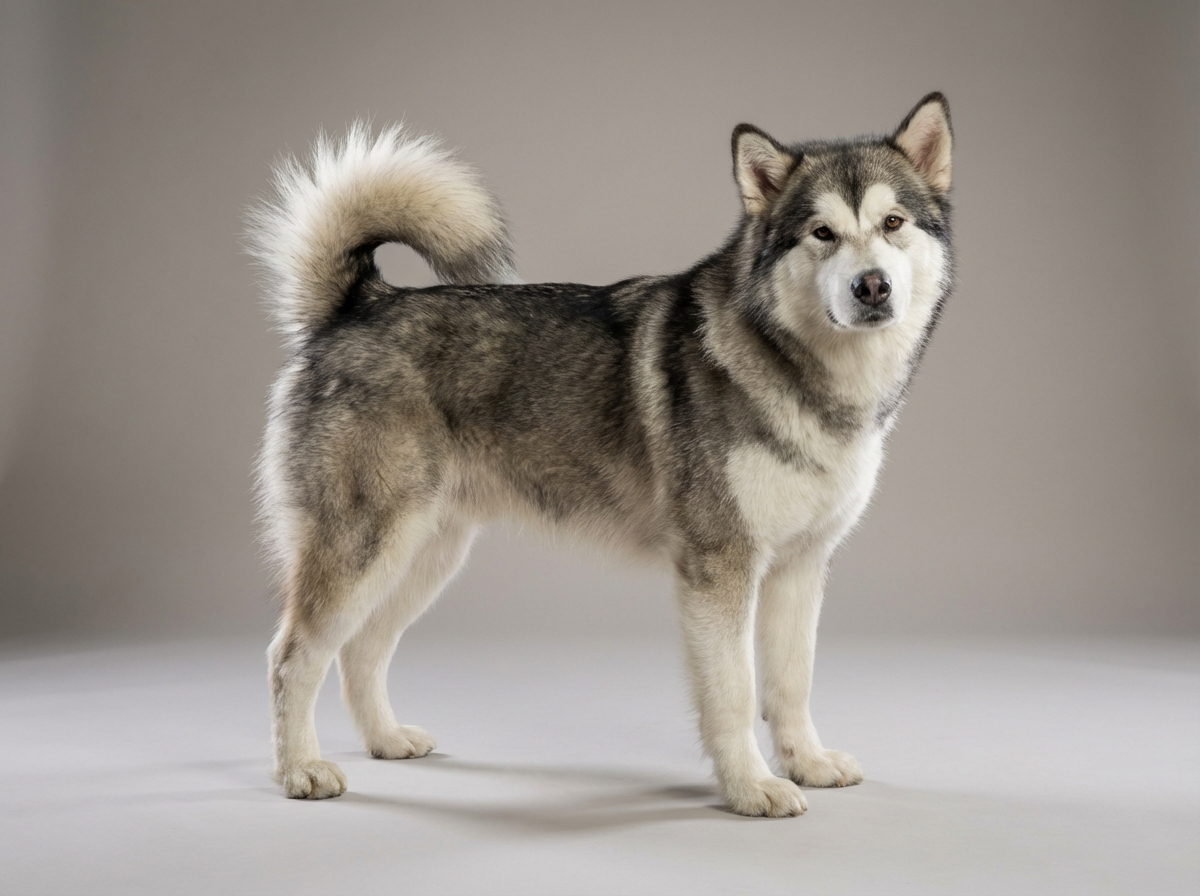
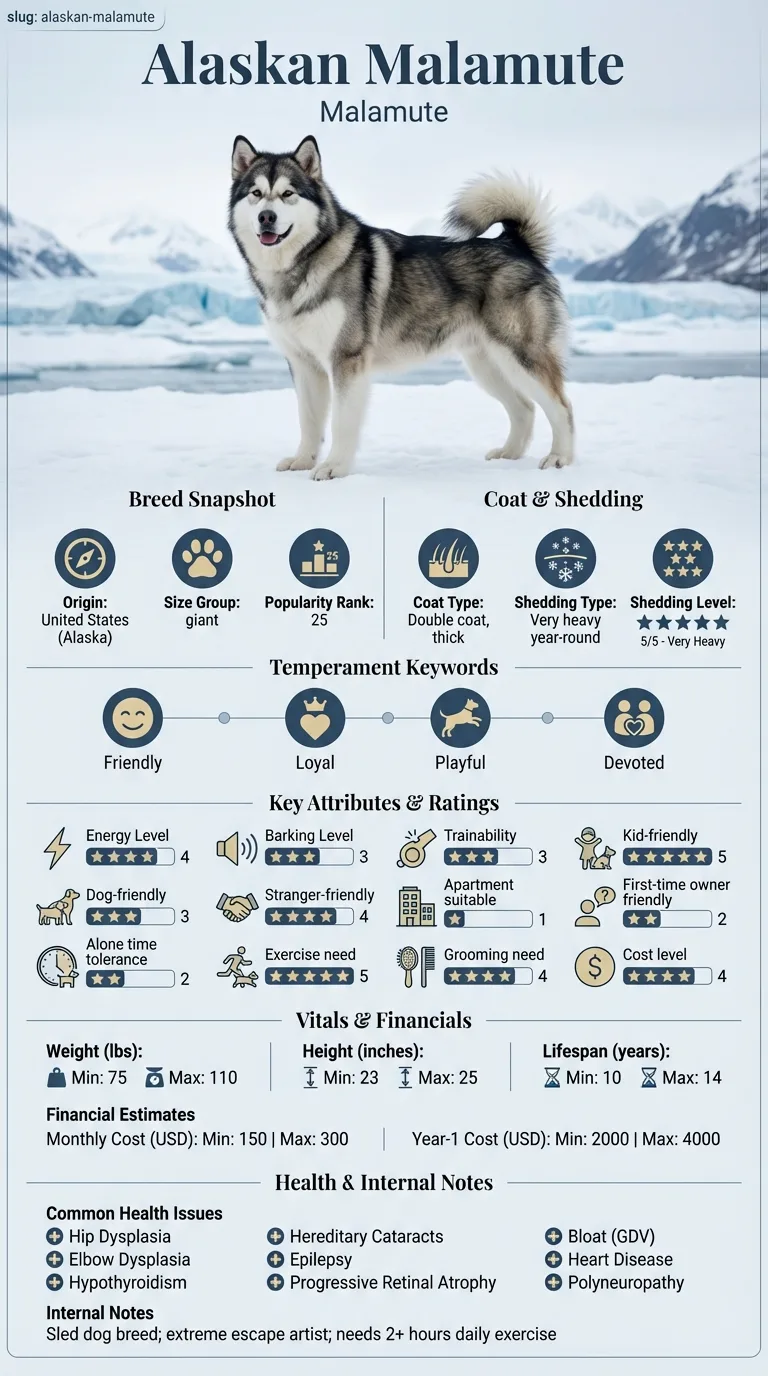
alaskan malamute infographic
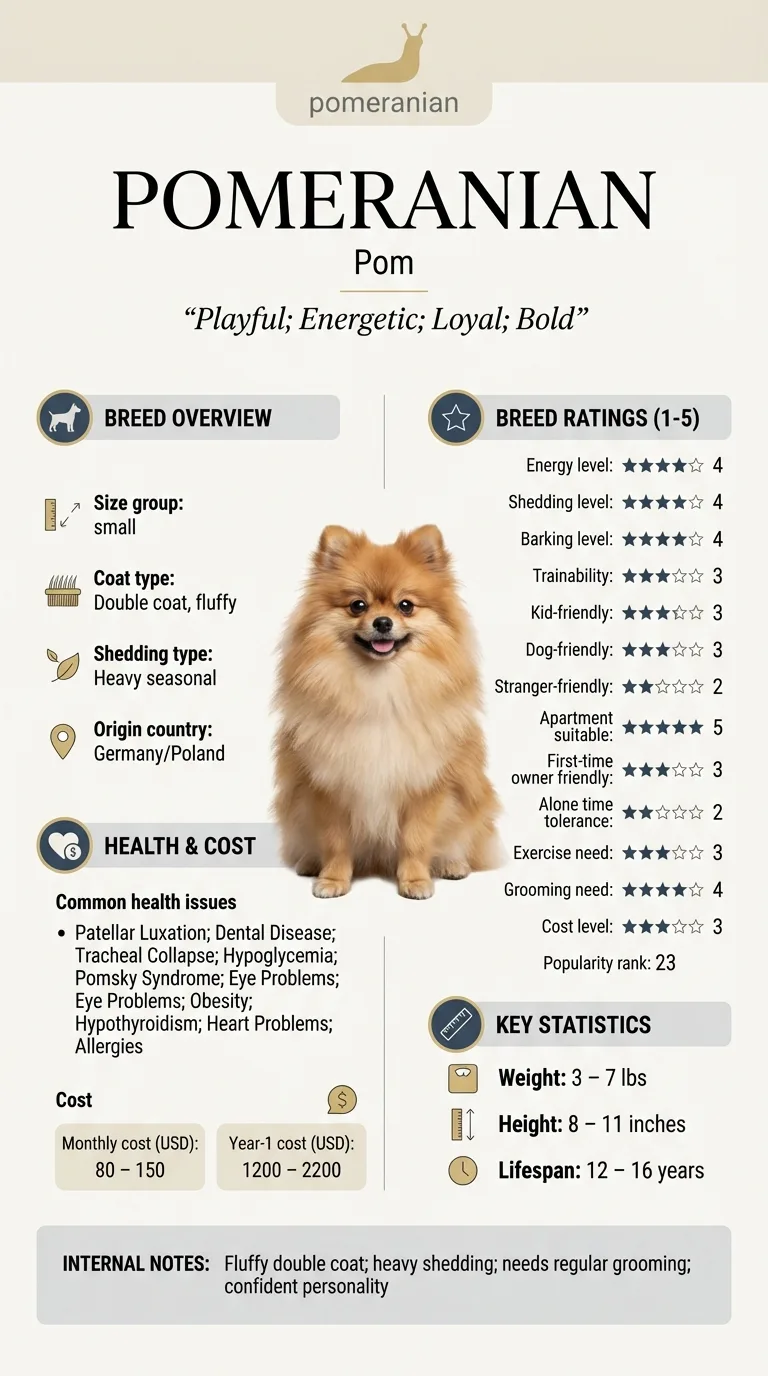
pomeranian infographic

This page is for someone who loves the northern-breed look and needs it to fit a flat, and for anyone assuming a toy dog with a fluffy coat will be less work than a big one.

Quick verdict

The Pomeranian delivers the spitz appearance and temperament in a package that fits any home and lives longer, at the price of a 4/5 barking rating, real fragility, and a coat that is just as much work per square inch.

Choose alaskan malamute if...

Choose the Alaskan Malamute if you want the working reality behind the look — cold weather, hauling work, two hours a day — and you have secure fencing and space, plus children young enough to be rough with a dog.

Choose pomeranian if...

Choose the Pomeranian if you want a bold, alert, long-lived spitz in a 5/5 apartment-friendly package, and you will brush it properly, protect its teeth and trachea, and accept that it will announce everything.

Head-to-head comparison

Featurealaskan malamutepomeranianWinner
Weight75–110 lbs3–7 lbsEqual
Height23–25 in8–11 inEqual
Lifespan10–14 years12–16 yearspomeranian
CoatThick double coatFluffy double coatEqual
Grooming need4/54/5Equal
Shedding5/5 — very heavy year-round4/5 — heavy seasonalpomeranian
Energy level4/54/5Equal
Exercise need5/53/5pomeranian
Trainability3/53/5Equal
Barking3/54/5alaskan malamute
Good with kids5/53/5alaskan malamute
Good with other dogs3/53/5Equal
Friendly to strangers4/52/5alaskan malamute
Apartment suitability1/55/5pomeranian
Good for first-time owners2/53/5pomeranian
Tolerates being alone2/52/5Equal
Typical monthly cost$150–300$80–150pomeranian
Typical first-year cost$2,000–4,000$1,200–2,200pomeranian

Deep dive

Two spitz breeds, one shrunk over two centuries

The physical resemblance between these two is not coincidental. Both belong to the spitz group — northern dogs characterised by prick ears, a wedge-shaped head, small thick-furred feet, a plumed tail carried over the back and a stand-off double coat. The Pomeranian descends from larger German spitz-type sled and farm dogs and was bred progressively smaller from the eighteenth century onward, losing about ninety percent of its body weight without losing much of its temperament.

That inherited temperament is visible in the ratings. Both rate 4/5 for energy — the Pomeranian is a busy, self-important dog rather than a passive lapdog. Both rate 3/5 for trainability, and for the same underlying reason: spitz breeds were selected to make their own decisions, and both will consider an instruction before acting on it. Both rate 3/5 with other dogs, and the Pomeranian's willingness to confront a Rottweiler is spitz confidence at a size that makes it dangerous to itself.

The divergence is in what a working frame becomes when it is miniaturised. The Malamute retains everything the sled dog needed: mass, joint structure, a five-out-of-five exercise requirement and a functional cold-weather coat. The Pomeranian keeps the coat and the attitude but arrives with a toy dog's skeleton, a toy dog's windpipe and a toy dog's dentition crammed into a smaller jaw — which is where its entire health list comes from.

Understanding the shared ancestry makes the grooming section make sense too. These are the same coat, and they behave the same way.

Both 4/5 for grooming, and neither coat should ever be shaved

This is the tie that surprises people. A 5 pound dog and a 95 pound dog carry the same grooming rating because they carry the same kind of coat.

Both have a harsh stand-off outer coat over a dense soft undercoat. Both shed steadily and then release the undercoat wholesale on a seasonal cycle — the Malamute at 5/5, very heavy year-round with two dramatic blows; the Pomeranian at 4/5, heavy seasonal, with a blow that produces a startling volume of fluff from a very small animal. In both cases the tool is the same: a pin brush and an undercoat rake worked in sections down to the skin, two or three times a week, more during a blow. Brushing the surface only tidies the top while dead undercoat compacts underneath.

The risk points differ with size. On the Malamute they are behind the ears, the armpits and the trousers. On the Pomeranian they are the ruff around the neck, behind the ears, the britches and the tail plume — and because the dog is small, a neglected patch becomes a solid mat quickly.

The shaving rule applies to both and matters more for the Pomeranian than most owners realise. A double coat insulates in both directions and shields the skin from sun; removing it does not cool the dog. In Pomeranians specifically there is an additional risk: the breed is prone to a coat-loss condition affecting the trunk, sometimes described as alopecia X or black skin disease, and clipping can trigger or worsen it, with regrowth that is patchy, woolly or absent. Some Poms never recover a full coat after a summer shave. A tidy-up around the feet, the sanitary area and the ear edges is fine. Taking the body coat off is not.

Both breeds are, in short, hair-in-the-house dogs. Neither is a low-shedding choice at any size.

What five pounds means: teeth, trachea and blood sugar

The Pomeranian's health list is a toy-breed list, and three entries on it shape daily ownership.

Dental disease is first, and across a 12 to 16 year life it is likely to be the largest recurring veterinary cost. A dog this small carries the same forty-two adult teeth as a Malamute, in a jaw a fraction of the size. They crowd, they overlap, plaque sits where the tongue cannot reach, and tartar, gum recession and tooth loss arrive early. Daily brushing from puppyhood is the intervention that decides whether the dog reaches twelve with a functional mouth, and professional scaling under general anaesthetic every one to three years is normal rather than exceptional.

Tracheal collapse is second, and it comes with a free fix: use a harness, never a collar. The windpipe's cartilage rings can weaken and flatten, producing a dry honking cough that worsens with excitement, heat or pressure on the throat. Lead pressure on a five pound neck is a contributor you can remove entirely.

Hypoglycaemia is third, and it matters most in puppies and in the smallest adults. A very small dog has almost no glycogen reserve, so a missed meal or a long stressful day can drop blood sugar into wobbling, weakness and, untreated, collapse. Frequent small meals are standard advice for Pomeranian puppies, and many owners keep a glucose gel in the house.

Patellar luxation, eye problems, heart problems, hypothyroidism, allergies and obesity complete the list. Obesity is worth taking seriously in a dog where a single extra pound is a fifth of its body weight.

The Malamute's list is orthopaedic and northern instead: hip and elbow dysplasia, bloat, epilepsy, progressive retinal atrophy, hereditary cataracts, zinc-responsive dermatosis and inherited polyneuropathy. Its risks are larger and less frequent; the Pomeranian's are smaller and constant.

Barking 4/5 and strangers 2/5: the small dog is the suspicious one

This is the sharpest temperament reversal on the page. The Malamute rates 4/5 with strangers and the Pomeranian rates 2/5 — the small fluffy dog is the wary one, and the 95 pound sled dog is the one that will greet a burglar.

The Pomeranian is described as playful, energetic, loyal and bold, and bold is the operative word. It is a watchful, territorial little dog that alerts readily and does not back down, which produces a 4/5 barking rating against the Malamute's 3/5. In a flat with shared walls that is the most likely source of friction, and it is the trait most often behind a Pomeranian being rehomed.

It is manageable but the tools are specific. Blocking visual access to windows and doors removes most triggers. Teaching a quiet cue works, though at 3/5 trainability it takes more repetition than it would in a biddable breed. Meeting the 3/5 exercise requirement matters, because an under-occupied Pom barks more. And early, deliberate socialisation matters more here than most owners expect — a 2/5 stranger rating in an unsocialised small dog slides into genuine reactivity, and small-dog reactivity is tolerated for so long that it becomes entrenched.

The Malamute's noise profile is different rather than absent. It barks little and howls instead, and a howl carries a long way. But its 1/5 apartment rating is driven by the exercise requirement, not the noise.

On children the Malamute leads 5/5 to 3/5, and again the reason is fragility rather than temperament: a 5 pound dog is genuinely injured by a toddler's grip or a fall from a sofa, and it will defend itself if handled roughly.

Exercise, cost and the long view

The Pomeranian's 3/5 exercise rating means roughly thirty to forty-five minutes a day, split, with indoor play and training filling the rest of its 4/5 energy. It enjoys walks, learns tricks, and is perfectly capable of a decent outing — this is not a dog to carry everywhere, and carrying it everywhere is how you get an under-exercised, over-vocal, overweight Pom.

The Malamute's 5/5 has no small version. Two hours minimum, with physical resistance, in all weathers, and in a warm climate the routine moves to first and last light for months because the Arctic coat sets a hard ceiling.

On heat, both breeds suffer more than short-coated dogs, and the Pomeranian's small body mass makes it overheat quickly — another reason its walks belong at the cool ends of a summer day, and another reason shaving is the wrong response.

Cost favours the Pomeranian at $80–150 a month against $150–300, and $1,200–2,200 in the first year against $2,000–4,000, with cost levels of 3/5 and 4/5. The gap is narrower than a twentyfold weight difference implies, because the Pom's spend is dentals, grooming and a long life rather than food.

Lifespan is the Pomeranian's clearest advantage: 12 to 16 years against 10 to 14. That is a genuinely different commitment, and it is worth noting that both breeds rate 2/5 for tolerating solitude, so neither suits a household that is empty all day.

The honest summary: if the northern-breed look is what draws you and your life cannot support a working dog, the Pomeranian is not a substitute — it is the same family, honestly scaled, with a different set of demands that happen to fit a smaller home.

Alaskan Malamute vs Pomeranian at a glance

A 5 pound Pomeranian and a 95 pound Malamute share more than the size difference suggests: both are spitz breeds, both carry double coats that blow out seasonally, and both rate 4/5 for energy and 4/5 for grooming.

The Pomeranian delivers the spitz appearance and temperament in a package that fits any home and lives longer than the Malamute. The price is a 4/5 barking rating, real physical fragility that makes it a poor match for very young children, and a coat that is just as much work per square inch as the Malamute's, despite the size difference.

Choose the Malamute if you want the working reality behind the spitz look — cold weather, hauling work, two hours a day — and you have secure fencing, space, and children old enough to be rough with a dog. Choose the Pomeranian if you want a bold, alert, long-lived spitz that fits an apartment, and you will brush it properly and accept that it announces everything.

Frequently asked questions

Are Pomeranians really related to sled dogs?

They belong to the same spitz group and descend from larger German spitz-type working dogs, bred progressively smaller from the eighteenth century. The prick ears, wedge head, curled plumed tail and stand-off double coat are all shared spitz features.

Can I shave a Pomeranian in summer?

No. The double coat insulates in both directions and shields the skin from sun. Pomeranians are also prone to a coat-loss condition sometimes called alopecia X, and clipping can trigger or worsen it, leaving patchy or absent regrowth.

Which sheds more?

The Malamute at 5/5 against 4/5 in absolute terms, but the Pomeranian's seasonal blow produces a startling volume of undercoat for a 5 pound dog. Both rate 4/5 for grooming, and neither is a low-hair choice.

Why does the Pomeranian rate only 2/5 with strangers?

It is a watchful, territorial breed that alerts readily and does not back down. That is spitz confidence in a small body. Deliberate early socialisation matters more here than most owners expect, because small-dog reactivity is often tolerated until it is entrenched.

Why should a Pomeranian wear a harness?

Tracheal collapse is on the breed's health list. The windpipe's cartilage rings can weaken and flatten, and lead pressure on a five pound neck contributes. A harness removes that pressure and costs nothing extra.

Which lives longer?

The Pomeranian at 12 to 16 years against the Malamute's 10 to 14, and dental care is one of the biggest factors in whether an individual Pom reaches the upper end comfortably.

Is a Pomeranian good with young children?

It rates 3/5 against the Malamute's 5/5. The concern is fragility — a fall or a firm grip can injure a 5 pound dog, and it will defend itself if handled roughly. Older, calmer children suit the breed much better.

Quick answers

View more answers
Living

Malamute or Pomeranian: which should I choose?

The Pomeranian if you want a bold, long-lived spitz that fits a flat at 5/5 and you can manage the barking, the teeth and the coat. The Malamute if you want the working version — cold weather, hauling work and two hours a day.

Costs

Which is cheaper to own?

The Pomeranian at $80–150 a month against $150–300, and $1,200–2,200 in the first year against $2,000–4,000. The gap is narrower than the size difference implies because of dentals and grooming.

Health

What is the biggest health cost for a Pomeranian?

Dental disease. Forty-two teeth in a tiny jaw means daily brushing from puppyhood and professional scaling under anaesthetic every one to three years across a 12 to 16 year life.

Training

Which is easier to train?

Neither — both rate 3/5, and for the same spitz reason. Both were selected to make their own decisions, so both will consider an instruction before acting on it. Short, well-paid sessions work best with either.

Related DogBreedCompass guides

  • Alaskan Malamute breed guideThe Malamute profile covers coat raking, the never-shave rule and the breed's exercise load.
  • Pomeranian breed guideThe Pomeranian profile covers coat care, small-breed handling and the breed's bold temperament.
  • dental disease in PomeraniansDental disease is the breed's dominant lifetime cost and the reason daily brushing matters from week one.
  • patellar luxation in PomeraniansPatellar luxation is the common orthopaedic complaint in toy breeds and ranges from mild to surgical.
  • allergies in Alaskan MalamutesSkin and allergy problems affect both breeds, and coat conditions are easy to misread in a double coat.
  • Alaskan Malamute vs Siberian HuskyReaders drawn to the northern look usually want the other spitz sled breed weighed up as well.

Related guides

Important reminder

Health information here is general and is not veterinary advice. Toy-breed concerns such as tracheal collapse and hypoglycaemia should be discussed with your own veterinarian.

Some links on this site are affiliate links. We may earn a commission if you buy through them, at no additional cost to you.

Find Your Perfect Breed

Match your lifestyle to the right dog.

Take quiz

Find your match

Not sure which breed is right for you? Take our 2-minute quiz to find out.

Take the quiz