Living
Great Dane or Pomeranian -- which should you get?
It comes down to space and life expectancy: the Dane needs room and asks less of your grooming routine, while the Pomeranian fits small spaces and will likely be around twice as long.

Quick answer
Great Dane or Pomeranian -- which should you get?
It comes down to space and life expectancy: the Dane needs room and asks less of your grooming routine, while the Pomeranian fits small spaces and will likely be around twice as long.
Great Dane or Pomeranian? On paper they differ most on apartment suitability, and on the scales Great Dane is the heavier at 110–175 lbs. Here is how the two compare on everything that shapes an ordinary week.
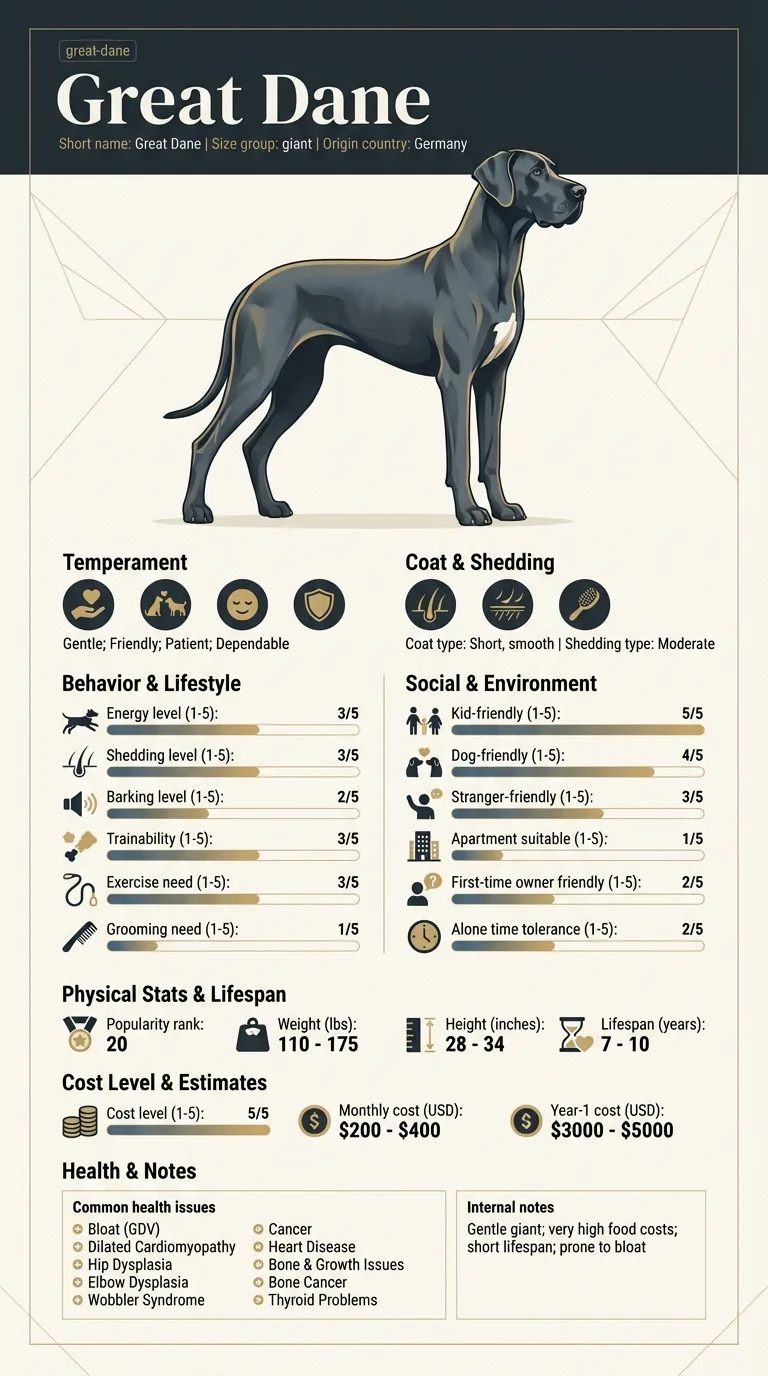
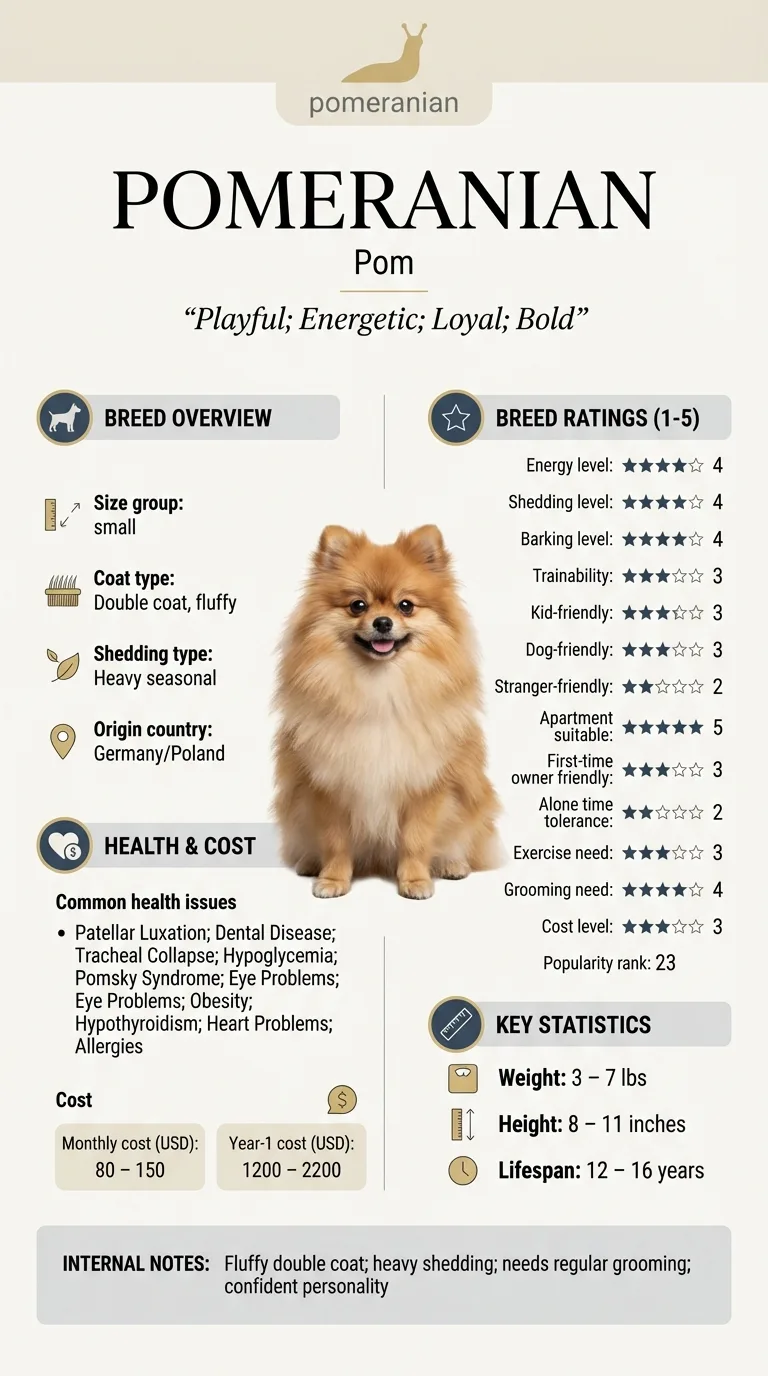
This is for someone already down to Great Dane and Pomeranian and deciding between them. For this pair the decision usually turns on apartment suitability and grooming need, so those are covered first and in most detail. Anyone choosing from a flat has a clear answer here: Pomeranian rates 5/5 against 1/5. There is no origin story here — only what changes about your week.
Between Great Dane and Pomeranian, apartment suitability is what separates them, and Pomeranian is the lower-effort dog of the two to keep.
Choose Great Dane if you do not want a standing grooming appointment, shedding is a problem in your house and there are young children at home.
Choose Pomeranian if you are in a flat or a smaller home, this is your first dog and a smaller dog suits your car, your home or your back.
| Feature | great dane | pomeranian | Winner |
|---|---|---|---|
| Size class | giant | small | Equal |
| Weight | 110–175 lbs | 3–7 lbs | Equal |
| Height | 28–34 in | 8–11 in | Equal |
| Lifespan | 7–10 years | 12–16 years | pomeranian |
| Exercise need | Moderate (3/5) | Moderate (3/5) | Equal |
| Grooming need | Very low (1/5) | High (4/5) | great dane |
| Shedding | Moderate (3/5) | High (4/5) | great dane |
| Energy level | Moderate (3/5) | High (4/5) | Equal |
| Barking | Low (2/5) | High (4/5) | great dane |
| Apartment suitability | Very low (1/5) | Very high (5/5) | pomeranian |
| Good for first-time owners | Low (2/5) | Moderate (3/5) | pomeranian |
| Tolerates being alone | Low (2/5) | Low (2/5) | Equal |
| Trainability | Moderate (3/5) | Moderate (3/5) | Equal |
| Good with kids | Very high (5/5) | Moderate (3/5) | great dane |
| Good with other dogs | High (4/5) | Moderate (3/5) | great dane |
| Friendly to strangers | Moderate (3/5) | Low (2/5) | great dane |
| Cost level | Very high (5/5) | Moderate (3/5) | pomeranian |
| Coat | Short, smooth | Double coat, fluffy | Equal |
| Origin | Germany | Germany/Poland | Equal |
| Typical monthly cost | $200–$400 | $80–$150 | Equal |
| Typical first-year cost | $3,000–$5,000 | $1,200–$2,200 | Equal |
A Great Dane runs 110-175 lbs and stands 28-34 inches at the shoulder; a Pomeranian tops out around 7 lbs and 11 inches, so you're looking at roughly a 20-to-1 weight difference in the same match-up. There's no middle ground here -- one breed can rest its head on a kitchen counter, the other fits in a tote bag. Physical handling, vet equipment, even the size of dog beds you'll shop for start from opposite ends of the catalog.
Both breeds sit at a moderate 3 out of 5 for baseline exercise need, but that number hides very different profiles. The Dane's moderate rating comes from long, easy walks rather than sustained activity, since a growing giant frame doesn't want repeated high-impact exercise. The Pomeranian rates higher on general energy (4/5) and burns it off in short indoor bursts rather than long outings.
Coat care is where this pair splits hardest: Great Danes score a 1 out of 5 for grooming, just an occasional brush and a wipe-down. Pomeranians score a 4 out of 5, with a double coat that needs regular brushing to prevent matting and blows out seasonally. Shedding follows the same pattern -- moderate for the Dane, high for the Pomeranian -- so the giant breed is the lower-maintenance choice despite its size.
This is the Pomeranian's category to win: a 5 out of 5 for apartment suitability against the Dane's 1 out of 5, and a bark rating of 4 versus 2. A Great Dane in a small unit is a space and mobility problem -- turning around in a galley kitchen, using stairs, finding furniture that fits. The Pomeranian's higher barking score means thin walls and reactive alerting can become their own issue. Both dogs score low (2/5) on tolerating time alone.
Trainability comes out even at a moderate 3 out of 5 for both breeds, but the practical stakes differ. A Great Dane rates low (2/5) for first-time owners mostly because of size -- a poorly leash-trained giant is a safety issue in a way a poorly leash-trained toy breed isn't. The Pomeranian rates moderate (3/5) for beginners; its main challenge is small-dog stubbornness rather than physical control.
Great Danes score higher across the board here -- very high (5/5) with kids versus moderate (3/5) for Pomeranians, high (4/5) with other dogs versus moderate (3/5), and moderate (3/5) with strangers versus low (2/5). The gentle, patient temperament that defines the breed shows up directly in these numbers. Pomeranians aren't unfriendly, but their smaller bodies and bolder personality make them a worse match for rough toddler play.
Lifespan is the starkest number in this comparison: 7-10 years for the Great Dane against 12-16 for the Pomeranian, nearly double. The Dane's list leans toward serious, size-driven conditions -- bloat, dilated cardiomyopathy, hip and elbow dysplasia, Wobbler syndrome, several cancers. The Pomeranian's risks are different in kind: patellar luxation, tracheal collapse, dental disease, hypoglycemia. The two lists barely overlap.
Cost level rates very high (5/5) for the Great Dane against moderate (3/5) for the Pomeranian, and the dollar figures back it up: $200-400 a month and $3,000-5,000 in year one for the Dane, versus $80-150 a month and $1,200-2,200 for the Pomeranian. Food volume alone explains a lot of the gap, and giant-breed vet visits widen it further over a lifetime.
Great Dane weighs 110–175 lbs and lives 7–10 years; Pomeranian weighs 3–7 lbs and lives 12–16 years. The two diverge most on apartment suitability, grooming need and barking and 2 other rated axes. They are level on tolerates being alone, exercise need and trainability, so those cannot decide it. Where the table declares a winner it means less work for the owner, nothing more; descriptive rows are left as ties on purpose. The value here is in the differences between the two columns; treat any single score as approximate.

A Great Dane can weigh 25 times more than a Pomeranian -- 110-175 lbs against 3-7 lbs -- and stands up to 34 inches at the shoulder compared to the Pomeranian's 11-inch max. It's one of the largest weight gaps in any breed comparison on this site.
The Pomeranian, rated high (4/5) for shedding against the Great Dane's moderate (3/5), plus it needs far more grooming (4/5 versus 1/5) to manage its double coat.
The Pomeranian rates moderate (3/5) for first-time owners and the Great Dane rates low (2/5). The Dane's size makes basic handling and leash manners higher-stakes for someone without dog experience.
The Pomeranian is rated very high (5/5) for apartment suitability; the Great Dane is rated very low (1/5). A giant breed in a small unit struggles with space and mobility regardless of its actual exercise needs.
Plan on $200-400 a month for a Great Dane and $80-150 for a Pomeranian, reflecting the very high (5/5) versus moderate (3/5) cost ratings and the difference in food volume.
Not really. The Great Dane's list is dominated by bloat, heart disease, and joint conditions tied to its size, while the Pomeranian's risks -- patellar luxation, tracheal collapse, hypoglycemia -- are typical toy-breed issues.
The Pomeranian, by a wide margin -- 12-16 years against the Great Dane's 7-10. That's one of the largest lifespan gaps in any size-mismatched comparison on this site.
It comes down to space and life expectancy: the Dane needs room and asks less of your grooming routine, while the Pomeranian fits small spaces and will likely be around twice as long.
A Great Dane runs $200-400 a month; a Pomeranian runs $80-150.
Both rate moderate (3/5) for exercise need, though the Pomeranian's higher energy (4/5) shows up as bursts of indoor activity rather than long walks.
The Pomeranian, typically 12-16 years versus 7-10 for the Great Dane.
Secure checkout on Stripe. We never see your card.
7-day money-back guarantee. Instant access.
Health information here is general and is not veterinary advice. If your dog shows pain, sudden behaviour change, or worsening symptoms, consult a licensed veterinarian.
Some links on this site are affiliate links. We may earn a commission at no extra cost to you, and we only suggest products we believe are helpful for dog owners.
We research and check what we publish, but we do not warrant that any figure, date, price, or statement is accurate, complete, or current, and we accept no liability for any loss, cost, injury, or other harm arising from the use of this site. Use it as one reference among several. You remain responsible for your own decisions and for your dog's care - confirm anything that matters with a licensed veterinarian or another qualified professional before you act on it. Full disclaimer.
Match your lifestyle to the right dog.
Take quizNot sure which breed is right for you? Take our 2-minute quiz to find out.
Take the quiz