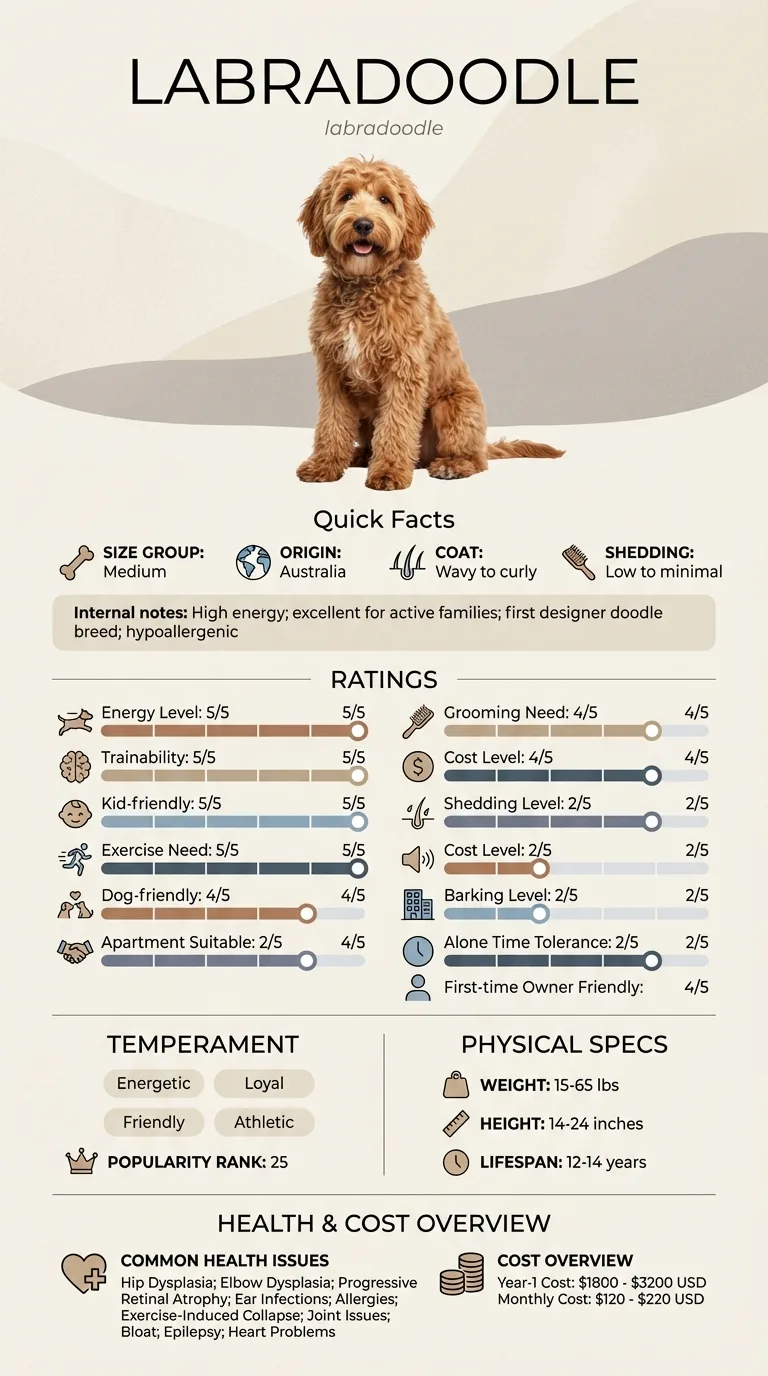
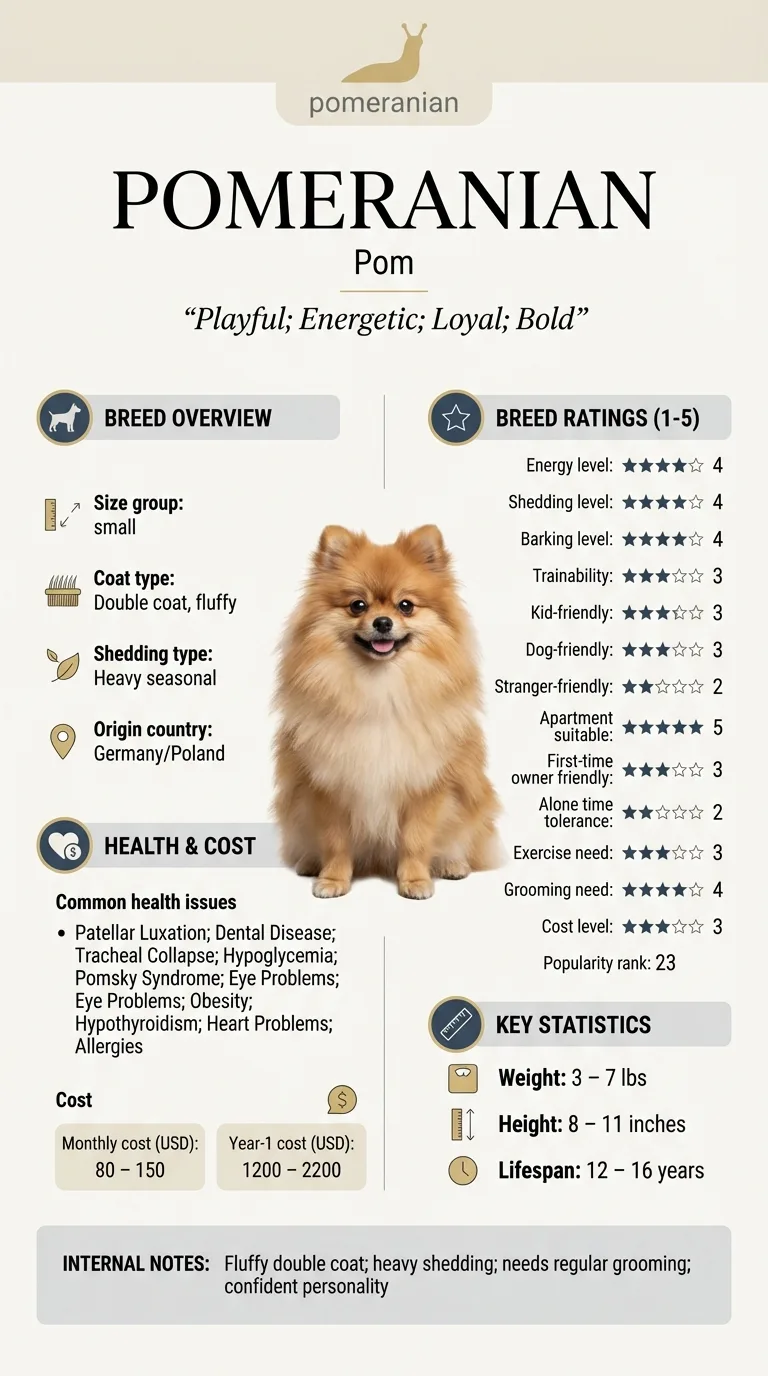
In a small apartment with a preference for a low-cost, long-lived companion, the Pomeranian's 5/5 apartment score and $80-150 monthly cost fit well, if you can manage the barking. With kids or frequent guests, the Labradoodle's higher scores across kids, strangers, and trainability make it the steadier choice.
Labradoodle or Pomeranian? On paper they differ most on apartment suitability, and on the scales Labradoodle is the heavier at 15–65 lbs. Here is how the two compare on everything that shapes an ordinary week.
This is for someone already down to Labradoodle and Pomeranian and deciding between them. For this pair the decision usually turns on apartment suitability and exercise need, so those are covered first and in most detail. Anyone choosing from a flat has a clear answer here: Pomeranian rates 5/5 against 2/5. It is written for the decision rather than the breed history.
Quick verdict
Between Labradoodle and Pomeranian, apartment suitability is what separates them, and Pomeranian is the lower-effort dog of the two to keep.
Choose labradoodle if...
Choose Labradoodle if this is your first dog, shedding is a problem in your house and there are young children at home.
Choose pomeranian if...
Choose Pomeranian if you are in a flat or a smaller home, your walking routine is modest and a smaller dog suits your car, your home or your back.
Head-to-head comparison
Feature
labradoodle
pomeranian
Winner
Size class
medium
small
Equal
Weight
15–65 lbs
3–7 lbs
Equal
Height
14–24 in
8–11 in
Equal
Lifespan
12–14 years
12–16 years
pomeranian
Exercise need
Very high (5/5)
Moderate (3/5)
pomeranian
Grooming need
High (4/5)
High (4/5)
Equal
Shedding
Low (2/5)
High (4/5)
labradoodle
Energy level
Very high (5/5)
High (4/5)
Equal
Barking
Low (2/5)
High (4/5)
labradoodle
Apartment suitability
Low (2/5)
Very high (5/5)
pomeranian
Good for first-time owners
High (4/5)
Moderate (3/5)
labradoodle
Tolerates being alone
Low (2/5)
Low (2/5)
Equal
Trainability
Very high (5/5)
Moderate (3/5)
labradoodle
Good with kids
Very high (5/5)
Moderate (3/5)
labradoodle
Good with other dogs
High (4/5)
Moderate (3/5)
labradoodle
Friendly to strangers
High (4/5)
Low (2/5)
labradoodle
Cost level
High (4/5)
Moderate (3/5)
pomeranian
Coat
Wavy to curly
Double coat, fluffy
Equal
Origin
Australia
Germany/Poland
Equal
Typical monthly cost
$120–$220
$80–$150
Equal
Typical first-year cost
$1,800–$3,200
$1,200–$2,200
Equal
Deep dive
Size and build
The Pomeranian is one of the smallest breeds on this site, 3-7 lbs and 8-11 inches, against the Labradoodle's 15-65 lbs and 14-24 inch range. At the top of its range, a Labradoodle can weigh close to twenty times what a Pomeranian does; this is about as wide a size gap as you'll find in any comparison on this site.
Energy and exercise
The Labradoodle rates 5/5 on exercise need against the Pomeranian's 3/5, moderate. The Pom is livelier than its fluffy, decorative look suggests, but it still needs meaningfully less daily activity than a Labradoodle does. Energy levels follow the same pattern between the two, so plan your daily routine and available time accordingly before choosing, especially if you work long hours away from home.
Grooming and shedding
Both breeds tie at 4/5 grooming need, which surprises people who assume a 3-7 lb dog is automatically low-maintenance. The Pomeranian's fluffy double coat needs as much regular brushing as the Labradoodle's curls do. Shedding tips toward the Labradoodle, 2/5 versus the Pomeranian's 4/5; that "pom fluff" you see on furniture and clothing is genuinely real and hard to fully avoid.
Apartment living, noise and time alone
The Pomeranian wins apartment suitability decisively, 5/5 against the Labradoodle's 2/5, but it's also the far louder dog, 4/5 barking versus 2/5. Poms are notoriously vocal for their size. Both breeds tolerate alone time poorly, tying at 2/5, so a long-hours household with an empty apartment most of the day isn't ideal for either breed on its own merits alone.
Training and owner experience
The Labradoodle wins clearly here: 4/5 versus the Pomeranian's 3/5 for first-time owners, and 5/5 versus 3/5 for trainability, the largest trainability gap in this entire batch. Pomeranians can be stubborn and are prone to small-dog behavioral issues like excessive barking if training is inconsistent from the start of puppyhood, so early structure genuinely pays off in the long run.
Kids, other dogs and visitors
The Labradoodle is the stronger family pick across the board: kids (5/5 vs. 3/5), other dogs (4/5 vs. 3/5), and strangers (4/5 vs. 2/5, the widest gap here). A Pomeranian's tiny frame makes it more injury-prone around rough play, and its "Bold" temperament trait doesn't extend to warmth toward strangers it hasn't been properly introduced to ahead of time by its owner.
Health and lifespan
The Pomeranian lives longer, 12-16 years against the Labradoodle's 12-14, with a notably higher ceiling. Its health list, ten conditions, includes tracheal collapse and pomsky syndrome alongside allergies, its one point of overlap with the Labradoodle's list, plus obesity and hypothyroidism risk common in small breeds prone to overfeeding by well-meaning owners who treat far too generously at every opportunity.
Cost to keep
The Pomeranian is the cheaper breed to keep, 3/5 cost level against the Labradoodle's 4/5. Monthly costs run $80-150 versus $120-220, and first-year costs land at $1,200-2,200 against $1,800-3,200, a straightforward function of the size difference between the two breeds and how much food and medication each one needs over the course of a full calendar year of ownership and care.
Labradoodle vs Pomeranian at a glance
Labradoodle weighs 15–65 lbs and lives 12–14 years; Pomeranian weighs 3–7 lbs and lives 12–16 years. The two diverge most on apartment suitability, exercise need and shedding and 4 other rated axes. They are level on tolerates being alone and grooming need, so those cannot decide it. In the table, a "winner" means easier for an ordinary household — not better. Size, coat and origin are recorded without a verdict. Because both breeds are scored the same way, the gaps are reliable even where the absolute numbers are rough.
Labradoodle vs Pomeranian: Which Suits Your Home? - Labradoodle vs Pomeranian at a glance
Frequently asked questions
Is a Pomeranian low-maintenance because it's small?
Not on the coat front. It ties the Labradoodle at 4/5 grooming need; that fluffy double coat requires regular brushing just like the Labradoodle's curls do. Size doesn't correlate with grooming effort here.
Which barks more?
The Pomeranian, notably, 4/5 against the Labradoodle's 2/5. Poms have a reputation for being vocal watchdogs despite their tiny size, and this data backs that up.
Is a Pomeranian good with kids?
It rates 3/5, moderate, against the Labradoodle's 5/5. Part of that gap is simple physics: a 3-7 lb dog is far more easily hurt during rough play than a dog several times its size.
Which is friendlier to strangers?
The Labradoodle, by the widest margin in this comparison, 4/5 against the Pomeranian's 2/5, low. Despite a bold temperament, Pomeranians tend to be reserved or wary around unfamiliar people.
Which lives longer?
The Pomeranian, with a higher ceiling, 12-16 years against the Labradoodle's 12-14. Small breeds generally outlast larger ones, and this pairing follows that pattern.
How much does each cost to keep?
The Pomeranian is notably cheaper, $80-150 monthly against $120-220 for the Labradoodle, and $1,200-2,200 in year one against $1,800-3,200.
Which is easier to train?
The Labradoodle, by a clear margin, 5/5 versus the Pomeranian's 3/5, the largest trainability gap of any pairing in this batch. Pomeranians can be stubborn, and inconsistent training often shows up as excessive barking.
In a small apartment with a preference for a low-cost, long-lived companion, the Pomeranian's 5/5 apartment score and $80-150 monthly cost fit well, if you can manage the barking. With kids or frequent guests, the Labradoodle's higher scores across kids, strangers, and trainability make it the steadier choice.
Costs
What's the monthly cost?
$80-150 for a Pomeranian versus $120-220 for a Labradoodle, one of the larger cost gaps in this batch.
Behavior
How much exercise does each need?
The Labradoodle needs more, 5/5 versus the Pomeranian's 3/5, moderate, though the Pom is more active than its size suggests.
Health
Which lives longer?
The Pomeranian, with a ceiling of 16 years against the Labradoodle's 14, typical of the size-lifespan tradeoff between the two.
Related DogBreedCompass guides
Labradoodle breed guide – Readers comparing the two usually want the full profile of Labradoodle before deciding.
Pomeranian breed guide – The same for Pomeranian, so the comparison can be checked against the detail.
Labradoodle vs Bernedoodle – Bernedoodle is the closest breed to Labradoodle on the measured axes, so it is the natural next comparison.
Pomeranian vs Yorkshire Terrier – Yorkshire Terrier sits closest to Pomeranian, which makes it the alternative worth ruling out.
What Labradoodle costs to keep – Anyone weighing these two is usually also pricing them, and the cost pages carry city-level figures.
Pomeranian health problems – The health pages set out what each breed is actually screened for.
Health information here is general and is not veterinary advice. If your dog shows pain, sudden behaviour change, or worsening symptoms, consult a licensed veterinarian.
Some links on this site are affiliate links. We may earn a commission at no extra cost to you, and we only suggest products we believe are helpful for dog owners.
We research and check what we publish, but we do not warrant that any figure, date, price, or statement is accurate, complete, or current, and we accept no liability for any loss, cost, injury, or other harm arising from the use of this site. Use it as one reference among several. You remain responsible for your own decisions and for your dog's care - confirm anything that matters with a licensed veterinarian or another qualified professional before you act on it. Full disclaimer.