Living
Which fits your household better?
For a social household with kids and visitors, the Cocker fits better; for a quiet single-person apartment, the Pomeranian's size and space rating win out.

Quick answer
Which fits your household better?
For a social household with kids and visitors, the Cocker fits better; for a quiet single-person apartment, the Pomeranian's size and space rating win out.
English Cocker Spaniel or Pomeranian? On paper they differ most on good with kids, and on the scales English Cocker Spaniel is the heavier at 26–34 lbs. Here is how the two compare on everything that shapes an ordinary week.
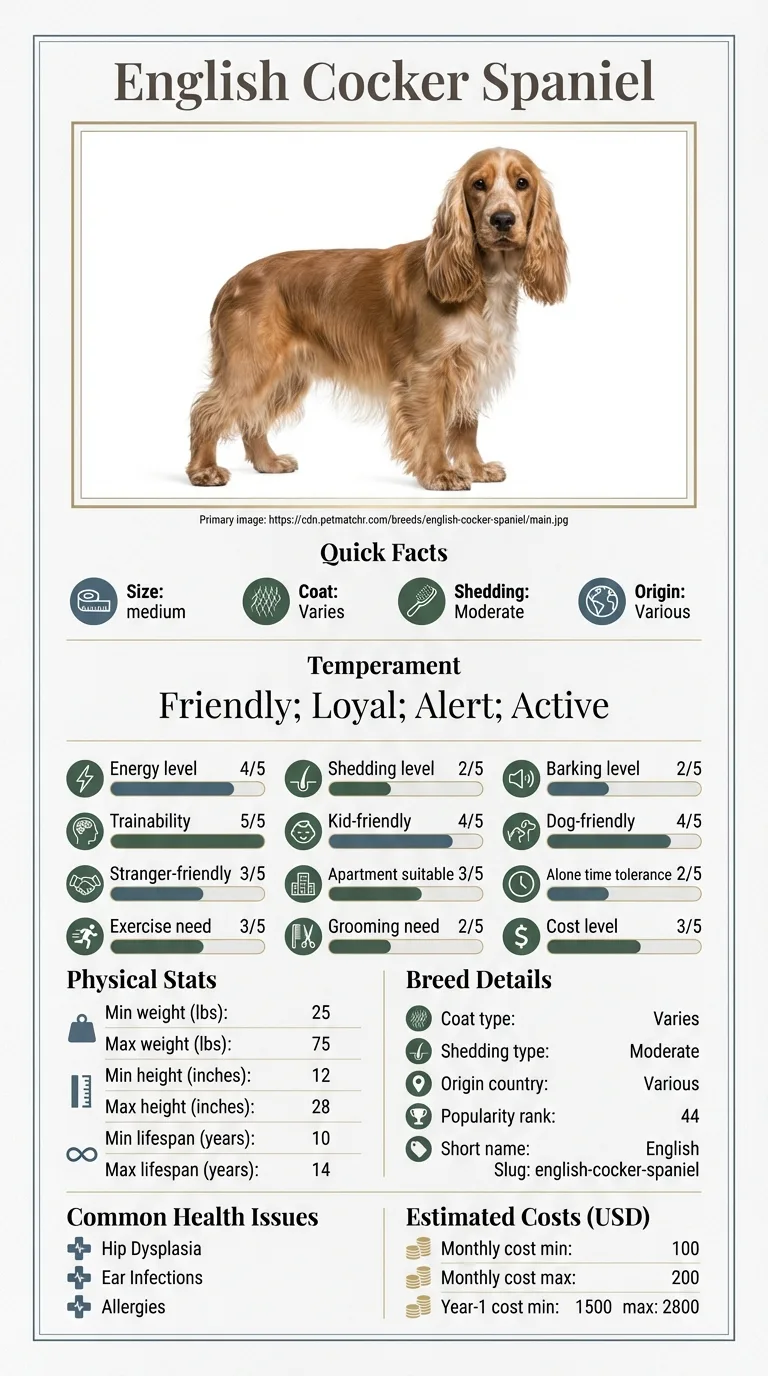
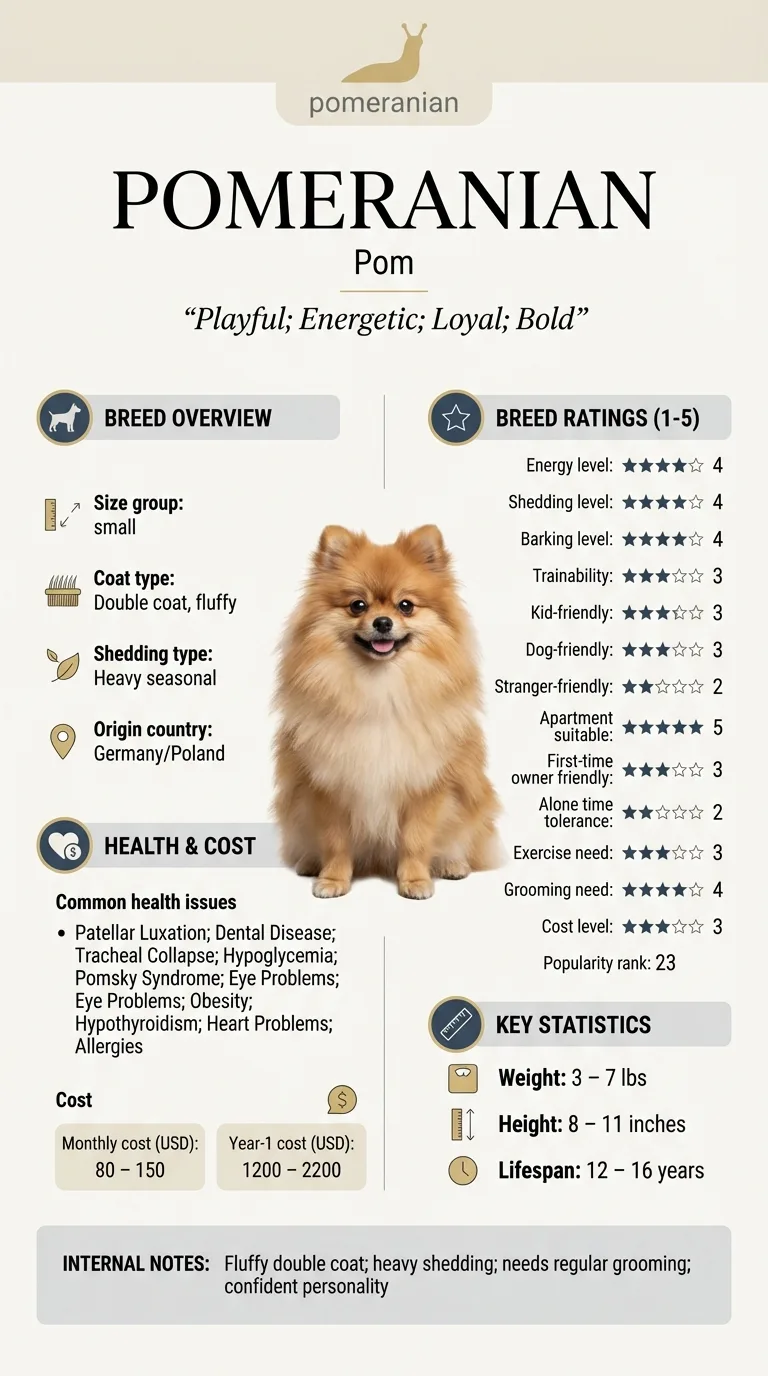
This is for someone already down to English Cocker Spaniel and Pomeranian and deciding between them. For this pair the decision usually turns on good with kids and friendly to strangers, so those are covered first and in most detail. Anyone choosing from a flat has a clear answer here: Pomeranian rates 5/5 against 4/5. Breed history is left out; what follows is what you will actually live with.
Between English Cocker Spaniel and Pomeranian, good with kids is what separates them, and Pomeranian is the lower-effort dog of the two to keep.
Choose English Cocker Spaniel if this is your first dog, shedding is a problem in your house and there are young children at home.
Choose Pomeranian if you are in a flat or a smaller home, your walking routine is modest and a smaller dog suits your car, your home or your back.
| Feature | english cocker spaniel | pomeranian | Winner |
|---|---|---|---|
| Size class | medium | small | Equal |
| Weight | 26–34 lbs | 3–7 lbs | Equal |
| Height | 15–17 in | 8–11 in | Equal |
| Lifespan | 12–14 years | 12–16 years | pomeranian |
| Exercise need | High (4/5) | Moderate (3/5) | pomeranian |
| Grooming need | High (4/5) | High (4/5) | Equal |
| Shedding | Moderate (3/5) | High (4/5) | english cocker spaniel |
| Energy level | High (4/5) | High (4/5) | Equal |
| Barking | Moderate (3/5) | High (4/5) | english cocker spaniel |
| Apartment suitability | High (4/5) | Very high (5/5) | pomeranian |
| Good for first-time owners | High (4/5) | Moderate (3/5) | english cocker spaniel |
| Tolerates being alone | Low (2/5) | Low (2/5) | Equal |
| Trainability | High (4/5) | Moderate (3/5) | english cocker spaniel |
| Good with kids | Very high (5/5) | Moderate (3/5) | english cocker spaniel |
| Good with other dogs | High (4/5) | Moderate (3/5) | english cocker spaniel |
| Friendly to strangers | High (4/5) | Low (2/5) | english cocker spaniel |
| Cost level | Moderate (3/5) | Moderate (3/5) | Equal |
| Coat | Medium, silky and feathered | Double coat, fluffy | Equal |
| Origin | Various | Germany/Poland | Equal |
| Typical monthly cost | $100–$200 | $80–$150 | Equal |
| Typical first-year cost | $1,400–$2,900 | $1,200–$2,200 | Equal |
The Pomeranian is barely a third of the Cocker's weight at the low end - 3-7 lbs against 26-34 lbs - and both breeds top out under 17 inches tall, but for very different reasons: the Cocker is a compact sporting dog, the Pomeranian is a Spitz bred down to toy size. Pick up a Pomeranian and it fits in one hand; a Cocker needs both arms and some effort.
Energy level is identical on paper - both High (4/5) - but exercise need isn't. The Cocker's sporting-dog heritage means it wants real walks and off-leash time to work through that energy, rated High (4/5). The Pomeranian burns through its energy in shorter bursts around the house and yard, rated Moderate (3/5) for exercise need. A tired Pomeranian is achievable in twenty minutes; a tired Cocker takes longer.
Grooming demands are equally high for both - High (4/5) - so don't assume the smaller dog is the easier upkeep. The Pomeranian actually sheds more, High (4/5) against the Cocker's Moderate (3/5); that famous double coat blows out hard twice a year. Between the two, expect regular brushing either way, with the Pomeranian generating more loose fur despite being a fraction of the size.
The Pomeranian is the better fit for small spaces on paper, Very High (5/5) apartment suitability against the Cocker's High (4/5). But it's also the louder roommate - High (4/5) barking versus Moderate (3/5) - a trait many Pomeranian owners will confirm without hesitation. Neither dog handles solitude well; both rate Low (2/5) for tolerating being alone, so plan around that regardless of square footage.
The Cocker outranks the Pomeranian on both counts that matter to a new owner: trainability High (4/5) versus Moderate (3/5), and first-time-owner suitability High (4/5) versus Moderate (3/5). Pomeranians can be trained well, but they're more prone to small-dog stubbornness and selective hearing than their rating numbers might suggest to someone expecting an easy toy breed. Someone new to dogs will generally have an easier time with the Cocker.
This is where the two breeds really separate. The Cocker rates Very High (5/5) with kids, High (4/5) with other dogs, and High (4/5) with strangers. The Pomeranian trails on all three - Moderate (3/5) with kids, Moderate (3/5) with other dogs, and just Low (2/5) with strangers. A Pomeranian tends to be a one-household, wary-of-outsiders kind of dog; the Cocker is built for a busier, more social home.
The Pomeranian can live noticeably longer - up to 16 years against the Cocker's ceiling of 14. Their health risks don't overlap on this data: the Cocker's concerns center on ears, hips, and kidneys, while the Pomeranian's toy-breed frame brings patellar luxation, tracheal collapse, and hypoglycemia, plus a long tail of other watch items including heart and thyroid issues. Neither list is short; budget for veterinary care either way.
Cost level rates as Moderate (3/5) for both breeds, but the dollar figures still favor the Pomeranian: $80-150 a month against the Cocker's $100-200, and $1,200-2,200 for a first year against $1,400-2,900. The difference comes mostly from food volume and grooming scale - a 5 lb dog simply costs less to feed and clip than a 30 lb one, even with a comparably demanding coat.
English Cocker Spaniel weighs 26–34 lbs and lives 12–14 years; Pomeranian weighs 3–7 lbs and lives 12–16 years. The two diverge most on good with kids and friendly to strangers. They are level on tolerates being alone, cost level and energy level, so those cannot decide it. The comparison marks an easier option only where one exists. Facts like weight and country of origin are not scored. Both dogs are rated from the same dataset, which is what makes the numbers comparable with each other even though any individual dog sits somewhere inside its breed's range.

Substantially - the Cocker runs 26-34 lbs to the Pomeranian's 3-7 lbs, roughly five to ten times the weight.
The Cocker, rated High (4/5) trainability against the Pomeranian's Moderate (3/5).
Rated Moderate (3/5), noticeably behind the Cocker's Very High (5/5). Their small size makes rough play riskier, and the breed tends to be less tolerant of it.
The Pomeranian, High (4/5) against the Cocker's Moderate (3/5), despite being the much smaller dog.
The Pomeranian on raw dollars - about $200 less over a first year - even though both rate Moderate (3/5) on the general cost scale.
Not on this data. The Cocker's risks center on ears, hips, and kidneys; the Pomeranian's on joints, teeth, trachea, and blood sugar. Different profiles, similar overall vigilance required.
The Pomeranian, potentially up to 16 years against the Cocker's 14-year ceiling.
For a social household with kids and visitors, the Cocker fits better; for a quiet single-person apartment, the Pomeranian's size and space rating win out.
The Pomeranian is the lighter cost by month - roughly $80-150 versus the Cocker's $100-200.
The Cocker needs more real exercise, rated High (4/5) versus the Pomeranian's Moderate (3/5), despite both sharing High (4/5) energy.
The Pomeranian tends to live longer, up to 16 years against the Cocker's 12-14.
Secure checkout on Stripe. We never see your card.
7-day money-back guarantee. Instant access.

Health information here is general and is not veterinary advice. If your dog shows pain, sudden behaviour change, or worsening symptoms, consult a licensed veterinarian.
Some links on this site are affiliate links. We may earn a commission at no extra cost to you, and we only suggest products we believe are helpful for dog owners.
We research and check what we publish, but we do not warrant that any figure, date, price, or statement is accurate, complete, or current, and we accept no liability for any loss, cost, injury, or other harm arising from the use of this site. Use it as one reference among several. You remain responsible for your own decisions and for your dog's care - confirm anything that matters with a licensed veterinarian or another qualified professional before you act on it. Full disclaimer.
Match your lifestyle to the right dog.
Take quizNot sure which breed is right for you? Take our 2-minute quiz to find out.
Take the quiz