Living
Which breed weighs less?
The Pomeranian, at 3-7 lbs, is far lighter than the Cavalier's 13-18 lbs.

Quick answer
Which breed weighs less?
The Pomeranian, at 3-7 lbs, is far lighter than the Cavalier's 13-18 lbs.
Cavalier King Charles Spaniel or Pomeranian? On paper they differ most on good for first-time owners, and on the scales Cavalier King Charles Spaniel is the heavier at 13–18 lbs. Here is how the two compare on everything that shapes an ordinary week.
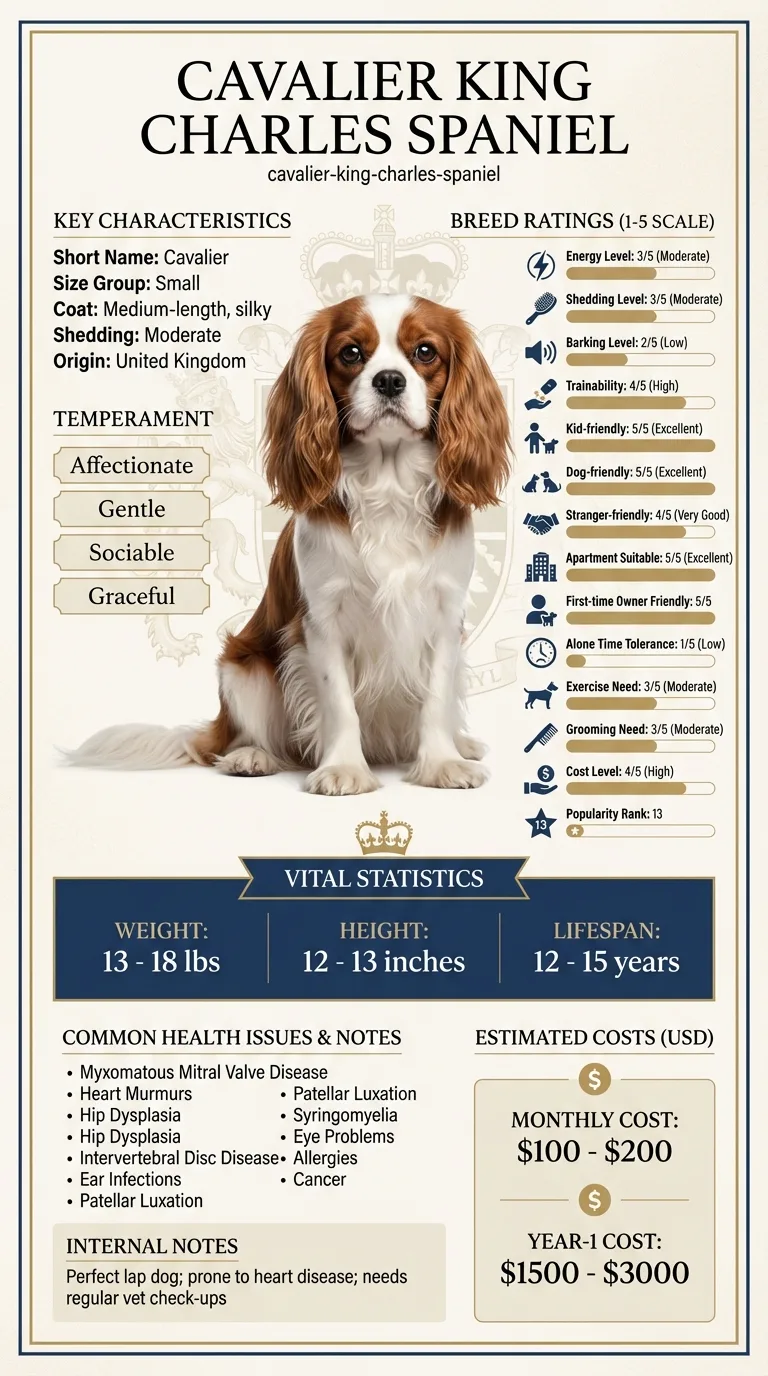
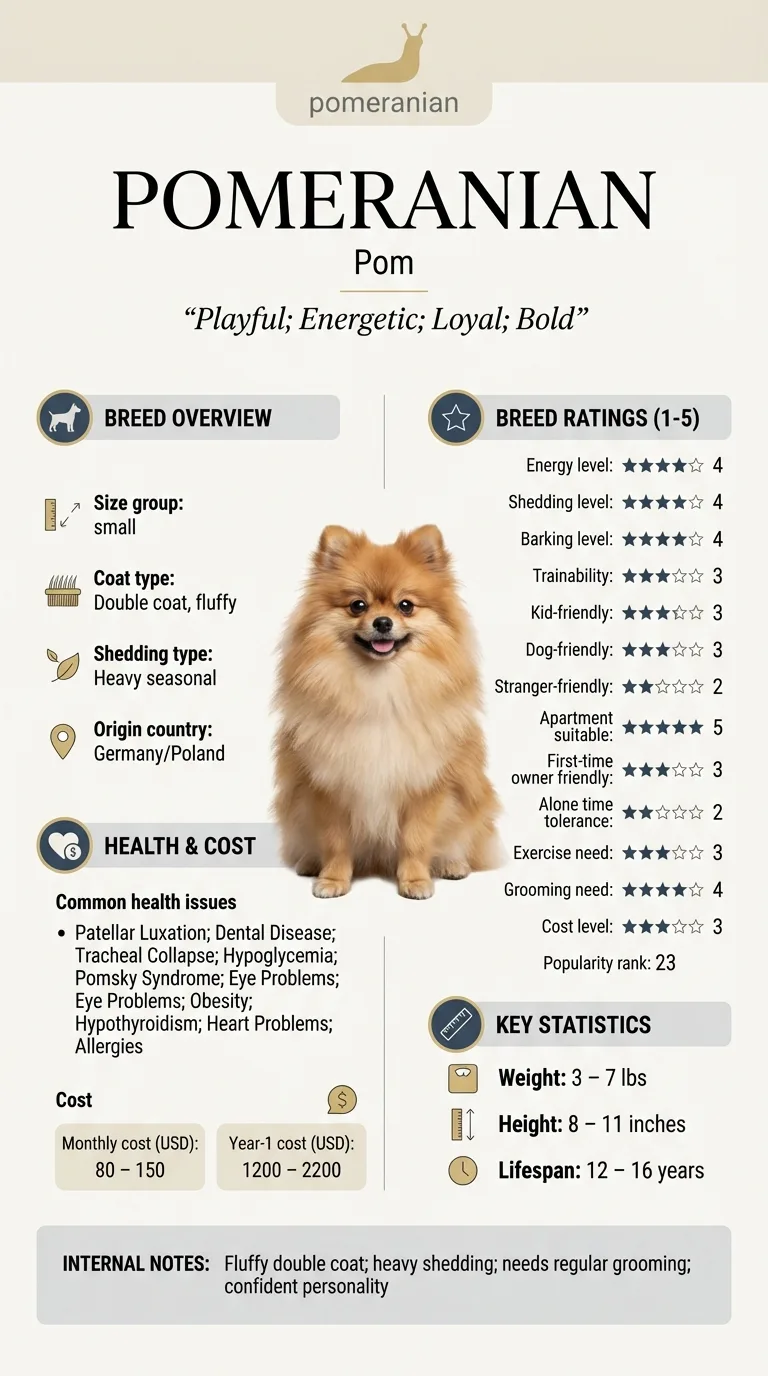
This is for someone already down to Cavalier King Charles Spaniel and Pomeranian and deciding between them. For this pair the decision usually turns on good for first-time owners and barking, so those are covered first and in most detail. Both rate 5/5 for flats, so housing does not settle this one. Breed history is left out; what follows is what you will actually live with.
Between Cavalier King Charles Spaniel and Pomeranian, good for first-time owners is what separates them, and Cavalier King Charles Spaniel is the lower-effort dog of the two to keep.
Choose Cavalier King Charles Spaniel if this is your first dog, you do not want a standing grooming appointment and shedding is a problem in your house.
Choose Pomeranian if a smaller dog suits your car, your home or your back and you want a dog that is more watchful with visitors.
| Feature | cavalier king charles spaniel | pomeranian | Winner |
|---|---|---|---|
| Size class | small | small | Equal |
| Weight | 13–18 lbs | 3–7 lbs | Equal |
| Height | 12–13 in | 8–11 in | Equal |
| Lifespan | 12–15 years | 12–16 years | pomeranian |
| Exercise need | Moderate (3/5) | Moderate (3/5) | Equal |
| Grooming need | Moderate (3/5) | High (4/5) | cavalier king charles spaniel |
| Shedding | Moderate (3/5) | High (4/5) | cavalier king charles spaniel |
| Energy level | Moderate (3/5) | High (4/5) | Equal |
| Barking | Low (2/5) | High (4/5) | cavalier king charles spaniel |
| Apartment suitability | Very high (5/5) | Very high (5/5) | Equal |
| Good for first-time owners | Very high (5/5) | Moderate (3/5) | cavalier king charles spaniel |
| Tolerates being alone | Very low (1/5) | Low (2/5) | pomeranian |
| Trainability | High (4/5) | Moderate (3/5) | cavalier king charles spaniel |
| Good with kids | Very high (5/5) | Moderate (3/5) | cavalier king charles spaniel |
| Good with other dogs | Very high (5/5) | Moderate (3/5) | cavalier king charles spaniel |
| Friendly to strangers | High (4/5) | Low (2/5) | cavalier king charles spaniel |
| Cost level | High (4/5) | Moderate (3/5) | pomeranian |
| Coat | Medium-length, silky | Double coat, fluffy | Equal |
| Origin | United Kingdom | Germany/Poland | Equal |
| Typical monthly cost | $100–$200 | $80–$150 | Equal |
| Typical first-year cost | $1,500–$3,000 | $1,200–$2,200 | Equal |
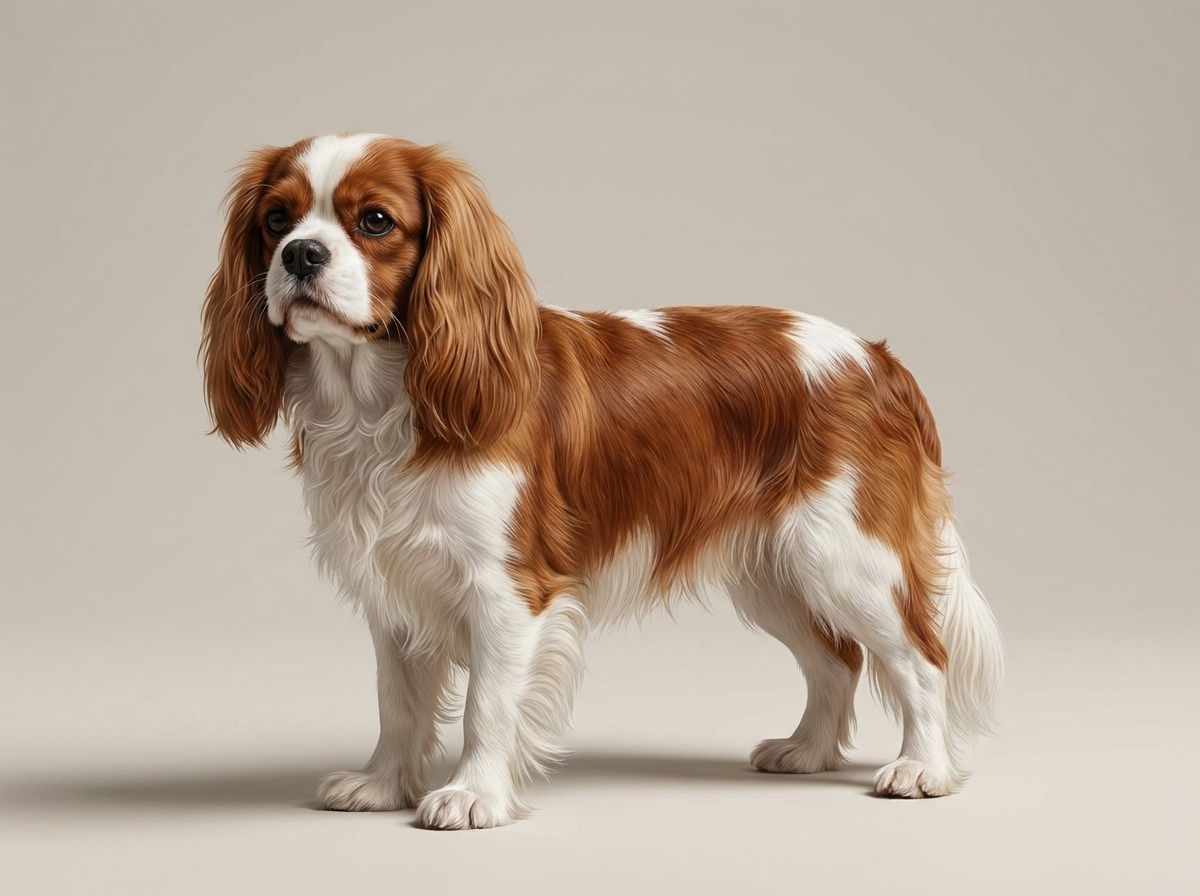
Hold a Pomeranian and a Cavalier King Charles Spaniel side by side and the difference is almost comedic - three to seven pounds against thirteen to eighteen, roughly a third the weight despite both being classified as small dogs under thirteen inches tall. The Pomeranian's tiny frame is closer to a large housecat's weight than to most dogs, wrapped in a dramatically fluffy double coat that makes it look bigger than it actually is. The Cavalier has a more conventional small-spaniel build: silky medium-length coat, longer ears, sturdier bone structure. Anyone who has held both will notice the Pomeranian feels almost weightless by comparison, which affects handling and injury risk around young children.
Bold and playful describe the Pomeranian's temperament, and that shows up as near-constant motion indoors even when its exercise needs - tied with the Cavalier's at a moderate 3/5 - are met with modest walks. Energy level actually tips toward the Pomeranian at a high 4/5 against the Cavalier's moderate 3/5, a distinction between how much activity a dog needs and how much restless energy it carries around the house day to day. The Cavalier, described as gentle and affectionate, tends toward calmer indoor behavior between outings. Both are genuinely small-dog exercise commitments, nothing like a working or sporting breed's demands, but the Pomeranian fills that time with more visible energy.
High 4/5 grooming and shedding scores for the Pomeranian outpace the Cavalier's moderate 3/5 on both counts, driven by that dense double coat built for cold climates and now mostly serving as a striking, high-maintenance accessory. Regular brushing - several times a week during seasonal coat blows - keeps the Pomeranian's fur from matting into the skin. The Cavalier's silky coat still needs consistent attention, particularly around the ears and feathering on the legs, but tangles less aggressively. Owners drawn to the Pomeranian's fox-like fluff should expect grooming to be a standing weekly commitment rather than an occasional chore.
Both breeds tie at a very high 5/5 for apartment suitability, and both are genuinely well-suited to compact living given their small size and moderate exercise needs. Barking is where they split sharply: the Pomeranian rates high 4/5 against the Cavalier's low 2/5, a real consideration for anyone in a shared building with thin walls. Alone-tolerance also favors the Pomeranian slightly, low 2/5 against the Cavalier's very low 1/5 - though neither breed handles long stretches of solitude well, and the Cavalier in particular is known for developing separation-related anxiety when left alone regularly for extended periods.
High 4/5 trainability for the Cavalier against moderate 3/5 for the Pomeranian, paired with a wide gap in first-time-owner suitability - very high 5/5 versus moderate 3/5 - makes the Cavalier the more forgiving choice for a new dog owner. The Cavalier's sociable, affectionate temperament translates into eagerness to please during training sessions. The Pomeranian's bold, loyal nature can tip into stubbornness, and its small size sometimes leads owners to skip consistent training altogether, a mistake that tends to produce a demanding, barky adult dog. Neither breed is difficult by working-dog standards, but the Cavalier makes the process noticeably smoother.
The gaps here are wide: very high 5/5 for the Cavalier with kids against a moderate 3/5 for the Pomeranian, and very high 5/5 with other dogs against the Pomeranian's moderate 3/5. Strangers show the same pattern, high 4/5 for the Cavalier versus low 2/5 for the Pomeranian. The Cavalier's temperament list - affectionate, gentle, sociable, graceful - reads like a description built for family life, while the Pomeranian's playful, bold, loyal profile suits a more single-owner or adult-focused household. Families with young children or a busy household of visitors will likely find the Cavalier the notably easier social fit of the two.
The Cavalier's lifespan runs slightly shorter, twelve to fifteen years against the Pomeranian's twelve to sixteen, and its health list carries real weight: myxomatous mitral valve disease and heart murmurs top a ten-condition list that also includes syringomyelia, a neurological condition linked to the breed's skull shape, and intervertebral disc disease. The Pomeranian's own ten-item list includes tracheal collapse, hypoglycemia and dental disease - all common small-breed concerns - plus the oddly named Pomsky Syndrome. Both share patellar luxation, eye problems and allergy risk. Given MMVD's prevalence in the breed, cardiac screening is particularly important for anyone considering a Cavalier.
Cost level favors the Pomeranian, moderate 3/5 against the Cavalier's high 4/5, and the first-year estimates confirm it - $1,200-2,200 for the Pomeranian versus $1,500-3,000 for the Cavalier. Monthly costs run $80-150 against $100-200 respectively. Some of that gap likely reflects the Cavalier's higher purchase price and potential veterinary costs tied to its cardiac and neurological risk profile, both of which can mean earlier or more frequent specialist visits. The Pomeranian's grooming needs are higher, but that expense doesn't fully offset the difference in overall cost level between the two breeds.
Cavalier King Charles Spaniel weighs 13–18 lbs and lives 12–15 years; Pomeranian weighs 3–7 lbs and lives 12–16 years. The two diverge most on good for first-time owners, barking and good with kids and 2 other rated axes. They are level on apartment suitability and exercise need, so those cannot decide it. The comparison marks an easier option only where one exists. Facts like weight and country of origin are not scored. Both dogs are rated from the same dataset, which is what makes the numbers comparable with each other even though any individual dog sits somewhere inside its breed's range.

The Pomeranian, at just 3-7 lbs compared with the Cavalier's 13-18 lbs - roughly a third the weight.
The Pomeranian, rated high 4/5 for barking against the Cavalier's low 2/5.
Yes, significantly - the Cavalier scores a very high 5/5 for kid-friendliness against the Pomeranian's moderate 3/5.
Myxomatous mitral valve disease, a heart condition that appears at the top of the breed's health list alongside heart murmurs.
The Pomeranian, rated high 4/5 for shedding against the Cavalier's moderate 3/5, due to its dense double coat.
The Cavalier King Charles Spaniel, rated very high 5/5 for first-time-owner suitability against the Pomeranian's moderate 3/5.
The Pomeranian, at $1,200-2,200 for a first year against the Cavalier's $1,500-3,000.
The Pomeranian, at 3-7 lbs, is far lighter than the Cavalier's 13-18 lbs.
The Cavalier King Charles Spaniel, rated low 2/5 for barking versus the Pomeranian's high 4/5.
The Pomeranian, at twelve to sixteen years versus the Cavalier's twelve to fifteen.
The Cavalier King Charles Spaniel, at high 4/5 against the Pomeranian's low 2/5.
Secure checkout on Stripe. We never see your card.
7-day money-back guarantee. Instant access.
Health information here is general and is not veterinary advice. If your dog shows pain, sudden behaviour change, or worsening symptoms, consult a licensed veterinarian.
Some links on this site are affiliate links. We may earn a commission at no extra cost to you, and we only suggest products we believe are helpful for dog owners.
We research and check what we publish, but we do not warrant that any figure, date, price, or statement is accurate, complete, or current, and we accept no liability for any loss, cost, injury, or other harm arising from the use of this site. Use it as one reference among several. You remain responsible for your own decisions and for your dog's care - confirm anything that matters with a licensed veterinarian or another qualified professional before you act on it. Full disclaimer.
Match your lifestyle to the right dog.
Take quizNot sure which breed is right for you? Take our 2-minute quiz to find out.
Take the quiz