DogBreedCompass

Malamute or Bloodhound: A Dog That Pulls and One That Follows

The Bloodhound needs less exercise than people expect — 3/5 against the Malamute's 5/5 — and lives far less long than its size suggests, at 7 to 10 years. Bloat is the reason, and it sits high on a condition list that also includes both eyelid disorders and chronic ear disease. This is a maintenance-heavy dog.

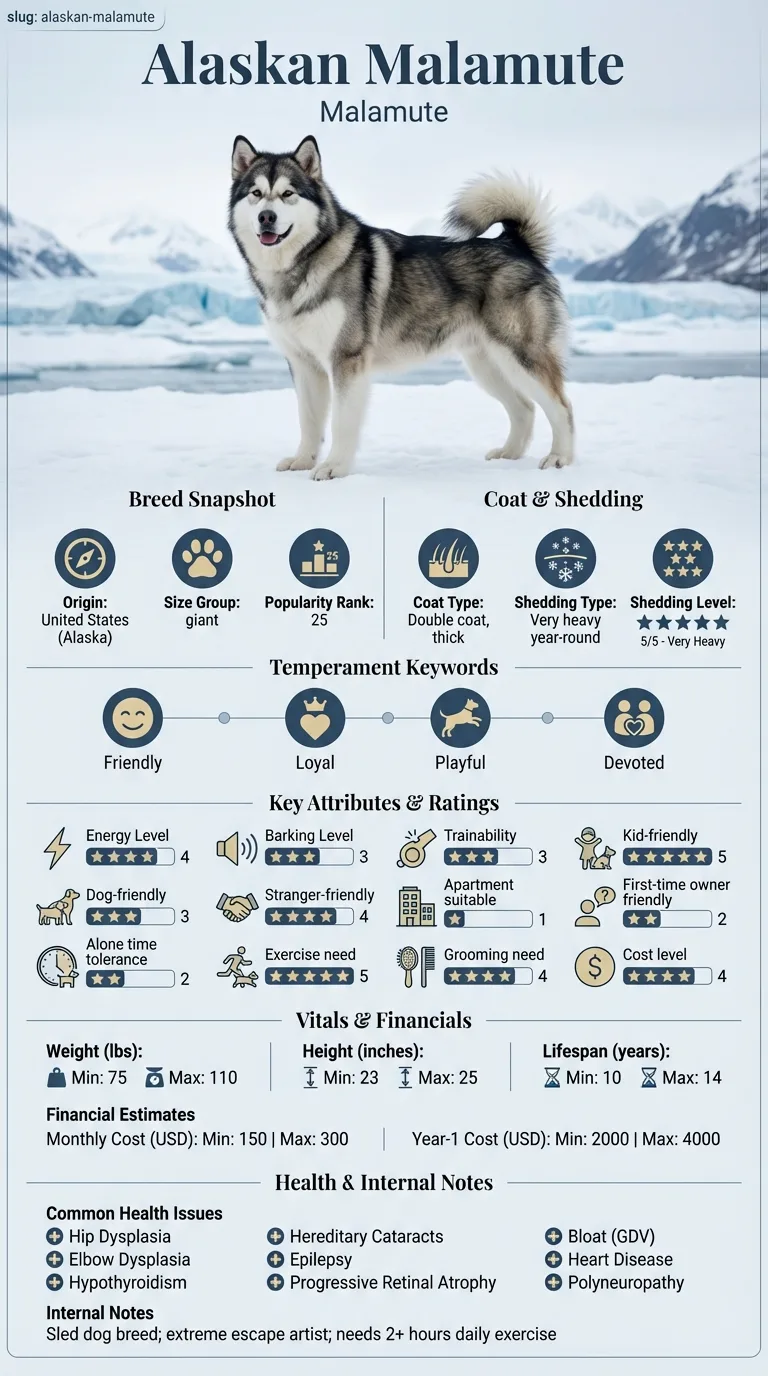
alaskan malamute infographic
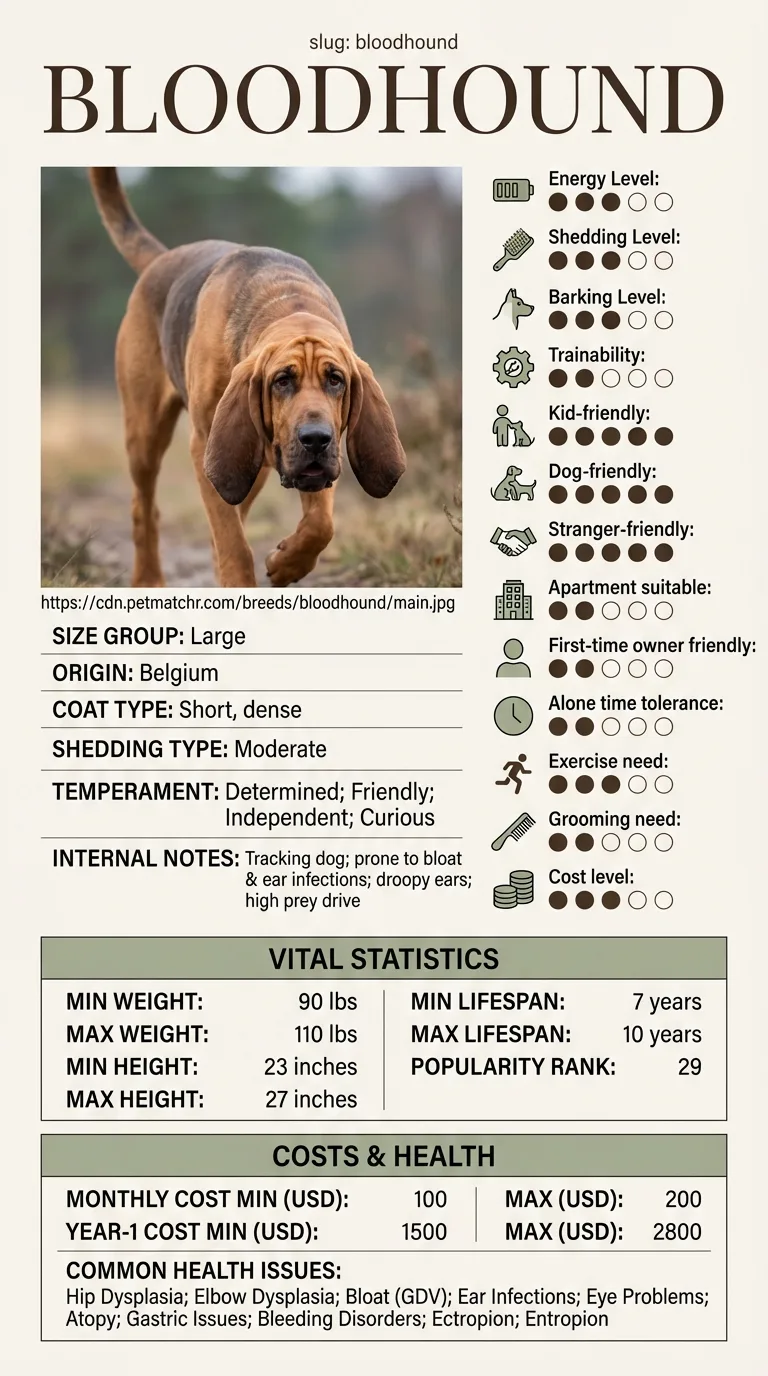
bloodhound infographic

This page is for someone weighing a large scent hound against a large sled dog. It covers bloat and lifespan, the exercise difference, ear and eyelid maintenance, drool, recall and containment, and what each costs to keep.

Quick verdict

The Bloodhound asks for far less exercise and far more daily maintenance, and it has the shorter life; the Malamute is the fitter, hardier, more expensive dog.

Choose alaskan malamute if...

Choose the Alaskan Malamute if you are athletic and longevity matters. It lives 10 to 14 years against the Bloodhound's 7 to 10, does not drool, and needs no daily ear or eyelid care. You are accepting 5/5 exercise against 3/5, 5/5 shedding against 3/5, 4/5 grooming against 2/5 and $150–$300 a month.

Choose bloodhound if...

Choose the Bloodhound if you want a gentle, sociable tracking dog and can meet the maintenance. It needs only 3/5 exercise, grooms at 2/5, sheds at 3/5, rates 4/5 with children, other dogs and strangers, and costs $100–$200 a month. You are accepting heavy drool, chronic ear risk and a serious bloat burden.

Head-to-head comparison

Featurealaskan malamutebloodhoundWinner
Weight75–110 lbs90–110 lbsEqual
Height23–25 in23–27 inEqual
Lifespan10–14 years7–10 yearsalaskan malamute
CoatThick double coatShort and denseEqual
Grooming needHigh (4/5)Low (2/5)bloodhound
SheddingVery high (5/5)Moderate (3/5)bloodhound
Energy levelHigh (4/5)Moderate (3/5)Equal
Exercise needVery high (5/5)Moderate (3/5)bloodhound
TrainabilityModerate (3/5)Low (2/5)alaskan malamute
BarkingModerate (3/5)Moderate (3/5)Equal
Good with kidsVery high (5/5)High (4/5)alaskan malamute
Good with other dogsModerate (3/5)High (4/5)bloodhound
Friendly to strangersHigh (4/5)High (4/5)Equal
Apartment suitabilityVery low (1/5)Low (2/5)bloodhound
Good for first-time ownersLow (2/5)Low (2/5)Equal
Tolerates being aloneLow (2/5)Low (2/5)Equal
Typical monthly cost$150–$300$100–$200bloodhound
Typical first-year cost$2,000–$4,000$1,500–$2,800bloodhound

Deep dive

Bloat is the Bloodhound's leading killer

Gastric dilatation-volvulus sits high on the Bloodhound's condition list, and the breed carries one of the highest recorded rates of it in dogs. It is the main reason a 100-pound hound lives 7 to 10 years rather than 11 or 12.

In GDV the stomach fills with gas and rotates, cutting off its own blood supply. Without surgery it is fatal, usually within hours. A deep, narrow chest is the predisposing shape, and the Bloodhound has it.

Every household with this breed should know the signs cold: unproductive retching, a swelling or drum-tight abdomen, restlessness and inability to settle, drooling beyond the usual, and pale gums. Any of them is an immediate emergency.

Because the risk is so high, a preventive gastropexy at the time of neutering is a genuine conversation to have with a vet. It does not stop the stomach distending but it prevents the rotation that kills, and in this breed the arithmetic favours it more clearly than in most.

The Malamute is also deep-chested and carries a real bloat risk, though a lower one. Both households should know where the nearest out-of-hours surgery is before they need it.

Ears, eyelids and drool

The Bloodhound's 2/5 grooming rating covers the coat and almost nothing else, and the rest is daily.

The ears are the first job. They are long, heavy, and designed to sweep scent from the ground toward the nose, which means they trail through everything and seal warmth and moisture over the canal. Check inside every day, dry thoroughly after any water, and treat head shaking or a smell as a reason to be seen. Each infection thickens the canal and makes the next one harder to treat.

The eyes are the second. Ectropion and entropion both appear on the list: the lower lid rolling outward leaves the surface exposed and dry, and the lid rolling inward lets lashes abrade the cornea. Both are surgically correctable, and a persistently weeping or squinting eye should be examined rather than wiped.

The folds around the face and neck need wiping and drying, because trapped moisture in a fold reliably becomes an infection.

And the drool is constant. Loose flews pool saliva that is then distributed by a head shake. Households keep towels in every room, and if that would bother you it is a sufficient reason to choose differently.

The Malamute has a dry mouth and its maintenance is seasonal rather than daily.

A nose that does not negotiate

The Bloodhound's 2/5 trainability is not a comment on intelligence. It is the most single-minded scenting breed there is, and a Bloodhound on a trail is genuinely unavailable — it will follow for miles, across roads, at its own steady pace, and it will not hear you.

That is the whole point of the breed and it is why they are still used for tracking work. It also means a lead, a long line, and a properly secured garden are permanent arrangements rather than training goals.

The Malamute is the other classic containment problem. Its own breed notes call it an extreme escape artist: it digs, climbs, works at latches and travels once it is out.

So both breeds are unsuitable for off-lead freedom, for different reasons, and both need a fence dug in at the base and gates that latch properly.

On temperament both are gentle and sociable — 4/5 with strangers each, 4/5 and 5/5 with children — and neither is any use as a guard dog. A Bloodhound's bay is impressive and entirely uncommitted.

Health, coat and running costs

The Bloodhound runs $100–$200 a month against the Malamute's $150–$300, and $1,500–$2,800 against $2,000–$4,000 in the first year. Grooming favours it too at 2/5 against 4/5, with 3/5 shedding against 5/5.

What those figures do not include is the recurring maintenance. Ear treatment is close to inevitable, eyelid surgery is common enough to plan for, and gastric issues appear on the list alongside bloat.

Bleeding disorders also appear, which makes a clotting screen before any elective surgery — including a gastropexy — a sensible request rather than an unusual one.

Hip and elbow dysplasia and atopy complete the list.

The Malamute's own list runs to hip and elbow dysplasia, hypothyroidism, hereditary cataracts, progressive retinal atrophy, epilepsy, heart disease, bloat, inherited polyneuropathy and zinc-responsive skin disease, and polyneuropathy has a DNA test worth asking for by name.

On balance the Bloodhound costs less per month and asks more of you every day, and the Malamute reverses both.

Alaskan Malamute vs Bloodhound: similar size, different problem

Four rows tie: barking at 3/5, strangers at 4/5, first-time owners at 2/5 and time alone at 2/5. Both are large, sociable, poorly solitary dogs that no novice should start with.

What differs is where the difficulty sits. The Malamute's is outdoors — 5/5 exercise, a fence it tests daily, and a coat that produces sheets of undercoat twice a year at 5/5.

The Bloodhound's is indoors and on the dog itself: drool, ears, eyelids, and a bloat risk that is among the worst in dogs. It needs only 3/5 exercise and grooms at 2/5, which reads as an easy dog and is not.

On lifespan the Malamute is well ahead, 10 to 14 years against 7 to 10, which is unusual given they weigh much the same.

And on money the Bloodhound is cheaper to run at $100–$200 a month against $150–$300.

Frequently asked questions

Why do Bloodhounds live such short lives?

Bloat is the main reason. The breed carries one of the highest recorded rates of gastric dilatation-volvulus in dogs, and it is fatal within hours without surgery. Combined with orthopaedic and gastric problems, it is why a 100-pound hound lives 7 to 10 years where the Malamute lives 10 to 14.

Should a Bloodhound have a preventive gastropexy?

It is worth discussing with a vet before the dog is a year old, and the arithmetic favours it more clearly in this breed than in most. The procedure tacks the stomach to the abdominal wall during neutering so it cannot rotate. Ask for a clotting screen first, since bleeding disorders are on the breed's list.

How much exercise does a Bloodhound need?

3/5 — around an hour a day, ideally including scent work, which tires this breed far more than distance does. That is considerably less than the Malamute's 5/5 and two hours of pulling work, and it surprises people who assume a large hound must be high-output.

How much do Bloodhounds drool?

Constantly. Loose flews pool saliva which is then distributed onto walls, furniture and clothing by a head shake. Owners keep towels in every room and do not consider it unusual. The Malamute has a dry, tight mouth and does not do this at all.

Can a Bloodhound be let off the lead?

Realistically no. It is the most single-minded scenting breed there is, and one on a trail will follow for miles across roads at its own pace without hearing you. A lead, a long line and a properly secured garden are permanent arrangements rather than training goals.

Which is easier to contain?

Neither. The Bloodhound leaves by following a scent under or through a boundary; the Malamute leaves because it wants to travel, and its own breed notes call it an extreme escape artist. Both need a fence dug in at the base, secured gates and a microchip with current details.

What daily care does a Bloodhound need that a Malamute does not?

Ears checked and dried every day, face and neck folds wiped and dried, and eyes watched for ectropion and entropion. The 2/5 grooming rating covers the coat only. The Malamute's work is seasonal instead — an undercoat rake through two heavy shedding periods a year.

Quick answers

View more answers
Living

Malamute vs Bloodhound: which should I choose?

The Bloodhound if you want a gentle scent hound, cannot commit two hours a day, and will do daily ear and fold care. The Malamute if longevity matters and you would rather spend the time outdoors than on maintenance.

Costs

How much does each cost per month?

The Malamute runs $150–$300 a month and the Bloodhound $100–$200, with first-year totals of $2,000–$4,000 and $1,500–$2,800. Recurring ear treatment and possible eyelid surgery narrow that gap.

Health

What are the signs of bloat?

Unproductive retching, a swelling or drum-tight abdomen, restlessness and inability to settle, drooling beyond the usual, and pale gums. Any of them is an immediate emergency in either breed — it is measured in hours, not days.

Behavior

Are either of these guard dogs?

No — both rate 4/5 with strangers. A Bloodhound's bay is impressive and entirely uncommitted, and a Malamute will greet an intruder happily. Neither should be chosen for deterrence.

Related DogBreedCompass guides

  • Alaskan Malamute breed guideThe Malamute profile covers exercise, containment and the breed's coat.
  • Bloodhound breed guideThe Bloodhound profile covers scent drive, ear and fold care and bloat prevention.
  • Malamute vs Basset HoundThe Basset Hound is the smaller scent hound with related ear and bloat concerns.
  • Malamute vs BeagleThe Beagle is the compact pack hound worth weighing against a Bloodhound.
  • Bloodhound bloat and GDVBloat is the condition most likely to shorten a Bloodhound's life.
  • Malamute bloat and GDVBloat is a genuine emergency in the Malamute too and every owner should know the signs.

Related guides

Important reminder

Health information here is general and is not veterinary advice. If your dog shows pain, sudden behaviour change, or worsening symptoms, consult a licensed veterinarian.

Some links on this site are affiliate links. We may earn a commission at no extra cost to you, and we only suggest products we believe are helpful for dog owners.

Find Your Perfect Breed

Match your lifestyle to the right dog.

Take quiz

Find your match

Not sure which breed is right for you? Take our 2-minute quiz to find out.

Take the quiz