DogBreedCompass

Malamute or Beagle: Both Bred for Company, at Very Different Sizes

Both of these breeds were built to work in a group — the Malamute in a sled team, the Beagle in a hunting pack — and it shows in the same place on the table: both rate 2/5 for tolerating time alone. Neither is a dog for an empty house, and the reasons are older than either of them.

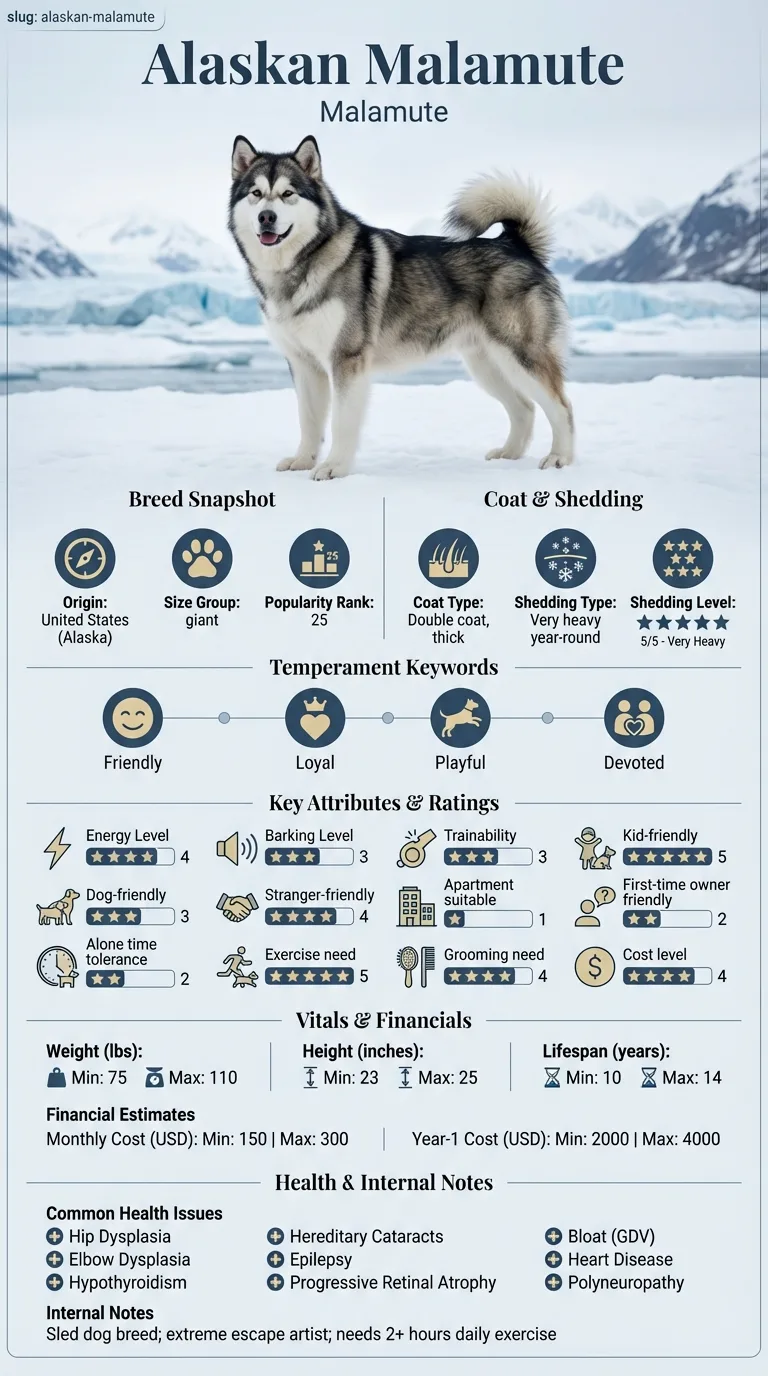
alaskan malamute infographic
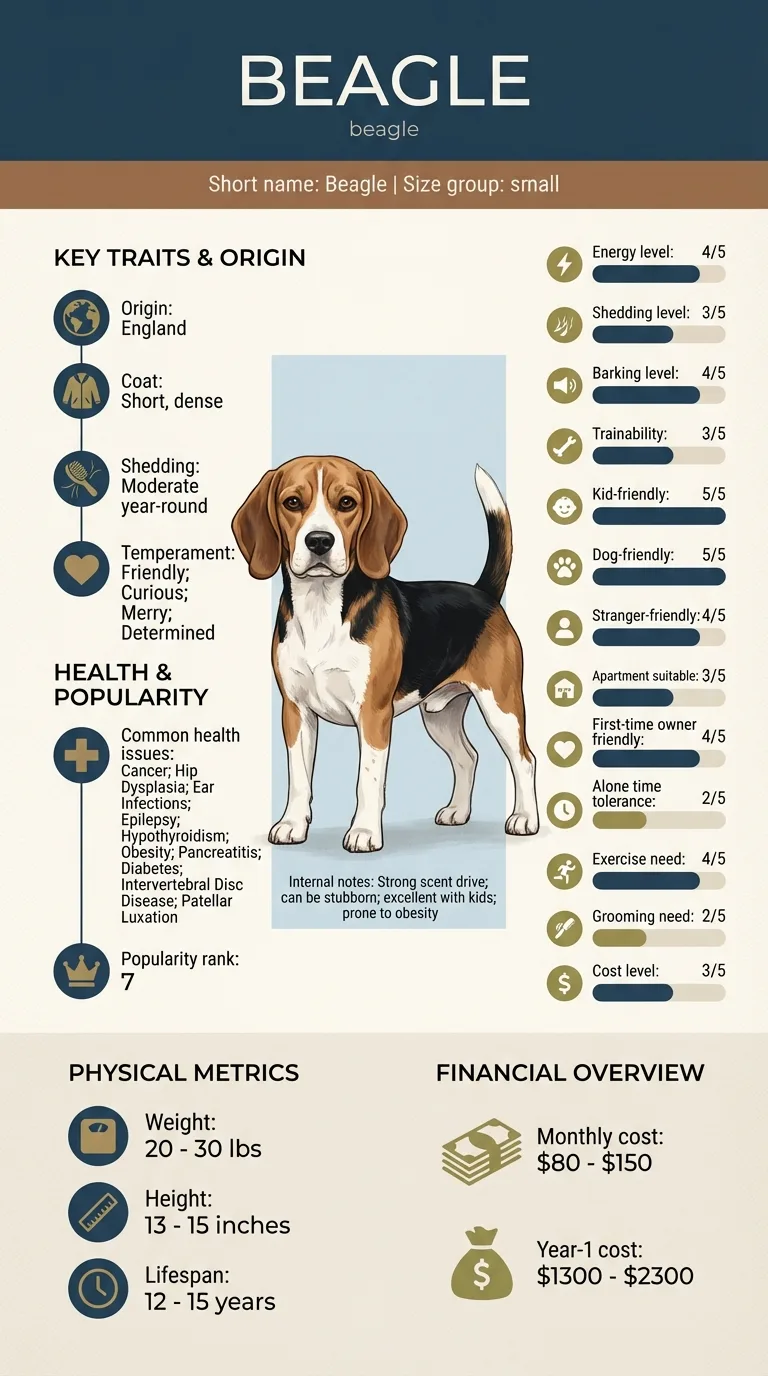
beagle infographic

This page is for someone weighing a small sociable hound against a large sociable sled dog. It covers noise, roaming and recall, weight control in a breed that cannot self-regulate, the cost gap, and what each needs from a week.

Quick verdict

The Beagle is cheaper, smaller and more suited to ordinary housing; the Malamute needs four times the space and twice the money, and both need company.

Choose alaskan malamute if...

Choose the Alaskan Malamute if you are athletic, have a properly secured garden and want a large northern breed. It barks at 3/5 against the Beagle's 4/5. You are accepting $150–$300 a month against $80–$150, 5/5 shedding against 3/5, 5/5 exercise against 4/5, and a 1/5 apartment rating against 3/5.

Choose beagle if...

Choose the Beagle if you want a sociable, manageable dog that fits an ordinary home. It rates 5/5 with children and other dogs, 4/5 with strangers and for first-time owners, grooms at 2/5 and lives 12 to 15 years at $80–$150 a month. You are accepting 4/5 barking, relentless food motivation and a nose that overrides recall.

Head-to-head comparison

Featurealaskan malamutebeagleWinner
Weight75–110 lbs20–30 lbsEqual
Height23–25 in13–15 inEqual
Lifespan10–14 years12–15 yearsbeagle
CoatThick double coatShort and denseEqual
Grooming needHigh (4/5)Low (2/5)beagle
SheddingVery high (5/5)Moderate (3/5)beagle
Energy levelHigh (4/5)High (4/5)Equal
Exercise needVery high (5/5)High (4/5)beagle
TrainabilityModerate (3/5)Moderate (3/5)Equal
BarkingModerate (3/5)High (4/5)alaskan malamute
Good with kidsVery high (5/5)Very high (5/5)Equal
Good with other dogsModerate (3/5)Very high (5/5)beagle
Friendly to strangersHigh (4/5)High (4/5)Equal
Apartment suitabilityVery low (1/5)Moderate (3/5)beagle
Good for first-time ownersLow (2/5)High (4/5)beagle
Tolerates being aloneLow (2/5)Low (2/5)Equal
Typical monthly cost$150–$300$80–$150beagle
Typical first-year cost$2,000–$4,000$1,300–$2,300beagle

Deep dive

The voice and the nose

The Beagle's 4/5 barking is functional in origin. A pack hound had to be audible to a handler on foot at a distance, and the breed produces a bay and a howl as well as an ordinary bark — a sound that carries much further than a 25-pound dog suggests.

It rises sharply when the dog is bored or alone, which is where most complaints come from. Occupation, scent games and a properly tired dog reduce it substantially; nothing makes a Beagle quiet.

Roaming is the other inherited trait, and both breeds have it for different reasons. A Beagle on a scent is genuinely deaf to you and will follow it under a fence and across roads without ever making a decision to leave. A Malamute simply travels — its own breed notes call it an extreme escape artist, and it digs, climbs and works at latches.

The practical rules are the same for both: a long line rather than off-lead in open ground, a fence dug in at the base, secured gates, and a microchip with current details.

Neither dog's recall should be treated as a safety measure.

A breed that will not stop eating

Obesity, pancreatitis and diabetes all appear on the Beagle's condition list, and they are one problem in three stages.

Beagles are among the most food-motivated dogs alive. A Beagle will counter-surf, open bins, work out cupboard doors, and eat until it is unwell if given the chance, and it does not develop a sense of having had enough.

That makes weight control an owner responsibility rather than a training outcome. Weigh the food rather than scooping it. Use part of the daily ration for training instead of adding treats on top. Secure bins and food cupboards physically rather than relying on the dog's judgement. Keep the dog visibly lean — a Beagle should have a waist and a tucked-up flank.

The stakes are real: intervertebral disc disease is also on the list, and excess weight loads a hound's back, while pancreatitis can be triggered by a single rich meal or a raided bin.

The food motivation has one genuine advantage. It makes a Beagle easy to train with food despite its 3/5 rating, provided you use the ration rather than adding to it.

The Malamute is not notably greedy, though it shares a bloat risk.

What each needs from an hour

The Malamute needs around two hours a day at 5/5, and it wants to pull — carting, scootering, canicross or long hikes rather than a walk. Heat is the limit, so summer sessions move to the cool ends of the day.

The Beagle needs around ninety minutes at 4/5, and it wants to follow a nose. Scent trails, hidden food searches and long sniffing routes tire it far more effectively than distance does, and that is convenient — forty minutes of proper scent work does more than an hour of pavement.

Both become destructive when under-worked, at proportionate scales. An under-exercised Beagle bays, digs and raids; an under-exercised Malamute excavates a garden and leaves.

Both are also poor at being left, at 2/5 each. For a full-time household that means absence training from week one and a walker or day care, whichever dog you choose.

The Beagle's ears need drying after wet walks — ear infections are on its list, as in every drop-eared hound.

Health lists and running costs

The Beagle's list carries cancer at the top, along with hip dysplasia, ear infections, epilepsy, hypothyroidism, obesity, pancreatitis, diabetes, intervertebral disc disease and patellar luxation.

The Malamute's runs to hip and elbow dysplasia, hypothyroidism, hereditary cataracts, progressive retinal atrophy, epilepsy, heart disease, bloat, inherited polyneuropathy and zinc-responsive skin disease. Two of those are worth asking a breeder about by name: polyneuropathy, which has a DNA test and shows in young dogs as exercise intolerance and a wobbly gait, and eye certification for hereditary cataracts.

On money the Beagle runs $80–$150 a month against $150–$300, and $1,300–$2,300 against $2,000–$4,000 in the first year. Food and weight-priced products account for most of the difference, and grooming for the rest — 2/5 against 4/5.

The Beagle also lives longer, 12 to 15 years against 10 to 14.

On balance the Beagle is the substantially cheaper and more housing-flexible dog, and the noisier one.

Alaskan Malamute vs Beagle: what a pack breed inherits

Five rows tie: energy at 4/5, trainability at 3/5, children at 5/5, strangers at 4/5 and time alone at 2/5.

That cluster is not a coincidence. Both breeds were selected to work alongside other dogs and around people all day, and both inherited the same package — sociable, tolerant, poor at being alone, and only moderately interested in taking instruction, because neither job required much of it.

What separates them is scale. The Beagle at 20 to 30 pounds rates 3/5 for apartments against the Malamute's 1/5, grooms at 2/5 against 4/5, sheds at 3/5 against 5/5, and costs roughly half as much.

The Beagle is also better with other dogs at 5/5 against 3/5, which reflects the difference between a pack hound and a sled dog — Malamute same-sex intolerance is common and usually appears at social maturity.

And the Beagle is louder: 4/5 against 3/5, in a voice designed to be heard across a valley.

Frequently asked questions

Do Beagles bark a lot?

Yes — 4/5, against the Malamute's 3/5, and the voice carries much further than a 25-pound dog suggests, because a pack hound had to be audible to a handler at a distance. It rises sharply when the dog is bored or alone. Occupation and scent work reduce it substantially; nothing makes a Beagle quiet.

Can either breed be let off the lead?

Neither reliably. A Beagle on a scent is genuinely deaf and will follow it under a fence and across a road without ever deciding to leave. A Malamute simply travels — its own breed notes call it an extreme escape artist. Long lines in open ground and a fence dug in at the base are the answer for both.

Why is weight such a problem in Beagles?

Because the breed does not develop a sense of having had enough. Obesity, pancreatitis and diabetes are all on its condition list, and excess weight also loads a hound's back where disc disease appears. Weigh the food, use the ration for training rather than adding treats, and secure bins physically.

Which copes better with being left alone?

Neither — both rate 2/5, and it is the clearest thing the two breeds share. Both were bred to work in a group all day, and neither inherited a tolerance for solitude. A full-time household needs absence training from week one and a walker or day care, whichever dog it chooses.

Which is better with other dogs?

The Beagle at 5/5 against the Malamute's 3/5. A pack hound was selected to work shoulder to shoulder with dozens of other dogs. Malamute same-sex intolerance is common and usually appears at social maturity around two years old, in a dog that was fine as a puppy.

How much exercise does each need?

The Malamute needs around two hours at 5/5 and wants to pull — carting, scootering or long hikes. The Beagle needs around ninety minutes at 4/5 and wants to follow a nose; forty minutes of proper scent work does more for it than an hour of pavement.

Which is cheaper to keep?

The Beagle, at $80–$150 a month against the Malamute's $150–$300, and $1,300–$2,300 against $2,000–$4,000 in the first year. It also grooms at 2/5 against 4/5, sheds at 3/5 against 5/5, and lives two to three years longer.

Quick answers

View more answers
Living

Malamute vs Beagle: which should I choose?

The Beagle if you want a sociable, manageable dog in ordinary housing and can live with a loud voice. The Malamute if you are athletic, have space and a properly secured garden, and want a large northern breed.

Costs

How much does each cost per month?

The Malamute runs $150–$300 a month and the Beagle $80–$150, with first-year totals of $2,000–$4,000 and $1,300–$2,300. Grooming widens the gap further at 4/5 against 2/5.

Behavior

Are either of these guard dogs?

No — both rate 4/5 with strangers and will greet anybody. The Beagle may announce an arrival loudly, but announcing is not guarding. Neither breed should be chosen for deterrence.

Health

What is the single most useful Beagle habit?

Weighing the food and securing the bins. The breed does not self-regulate around food, so weight control is an owner responsibility rather than something training solves.

Related DogBreedCompass guides

  • Alaskan Malamute breed guideThe Malamute profile covers exercise, containment and the breed's coat.
  • Beagle breed guideThe Beagle profile covers scent drive, weight management and ear care.
  • Malamute vs Basset HoundThe Basset Hound is the heavier scent hound most often weighed against the Beagle.
  • Akita vs Alaskan MalamuteThe Akita comparison sets out how the Malamute differs from a Japanese guardian breed.
  • Beagle obesityObesity is the risk that drives several other conditions on the Beagle's list.
  • Malamute bloat and GDVBloat is a genuine emergency in the Malamute and every owner should know the signs.

Related guides

Important reminder

Health information here is general and is not veterinary advice. If your dog shows pain, sudden behaviour change, or worsening symptoms, consult a licensed veterinarian.

Some links on this site are affiliate links. We may earn a commission at no extra cost to you, and we only suggest products we believe are helpful for dog owners.

Find Your Perfect Breed

Match your lifestyle to the right dog.

Take quiz

Find your match

Not sure which breed is right for you? Take our 2-minute quiz to find out.

Take the quiz